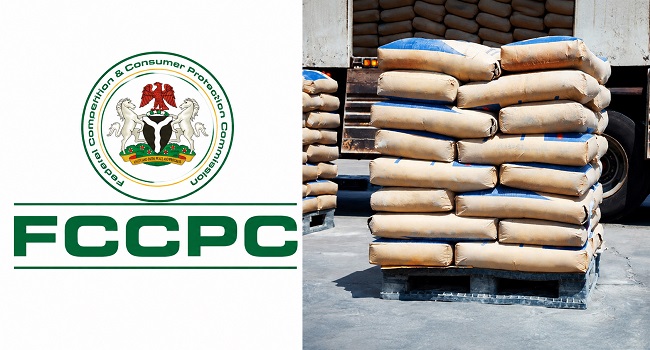
The Federal Competition and Consumer Protection Commission has said its preliminary investigation into Nigeria’s cement industry suggests possible manipulation of cement prices, following widespread complaints over the soaring cost of the commodity despite the country’s large production capacity and abundant limestone deposits.
It has also opened an investigation into possible price manipulation in Nigeria’s cement industry after a three-month inquiry raised concerns that prevailing market conditions may not fully explain the cost of the building material.
The preliminary findings followed a cross-border study conducted by the commission’s Anticompetitive Practices Department in response to widespread complaints over the rising cost of cement.
In a statement issued on Tuesday by the FCCPC Director of Corporate Affairs, Ondaje Ijagwu, the commission said its investigation compared Nigeria’s cement market with those of Kenya, Tanzania, South Africa, Egypt, Morocco, Algeria and Togo.
An analysis of findings in the FCCPC report showed that the cost of cement in Nigeria is higher than the prices of the same quantity of the commodity in neighbouring African countries.
This, however, came as building sector leaders and economists explained that the factors behind the high cement prices in Nigeria are compounded.
The study examined the availability of limestone, population, production capacity, consumption and retail prices. The statement read, “Findings from an industry-wide investigation conducted by the Federal Competition and Consumer Protection Commission suggest possible manipulation of prices of cement in the Nigerian market.
“This is the preliminary summation of the 40-page field reports collated following a three-month cross-border study by the Anticompetitive Practices Department of the Commission, undertaken in response to widespread public complaints over the high cost of cement, a common staple in the country’s construction industry.”
The commission noted that Nigeria has substantial limestone deposits and installed cement production capacity estimated at between 60 million and 65 million metric tonnes annually, against domestic consumption of about 25 million to 30 million metric tonnes.
Despite the reported excess capacity and Nigeria’s position as a net exporter to neighbouring countries, the commission said domestic prices had continued to rise.
Market intelligence reviewed by the FCCPC showed that a 50kg bag of cement, which sold for between N9,300 and N9,700 in January, rose to between N10,500 and N13,000 by mid-year. By July, prices of between N13,000 and N15,000 were reported in some parts of the country.
The commission also found that cement sold at lower prices in some African markets. In Kenya, where the population is about 58.6 million and cement demand was estimated at 9.3 million metric tonnes in 2025, a bag sold for about $5.40, or N7,344.
In Tanzania, with a population of about 66.3 million and similar cement demand, a bag sold for about $4.80, or N6,528. In Togo, which the commission said has no limestone deposits, cement retailed at about $6.75, or N9,180 per bag.
The FCCPC said the price disparity had raised questions about why Nigeria’s significant production capacity and raw material endowment had not translated into greater downward pressure on prices.
It said industry players had attributed the high prices to energy costs, naira depreciation, imported machinery and spare parts, as well as transportation and logistics expenses.
However, the commission said it was testing those explanations against verified information on production costs, pricing, capacity utilisation and other market conditions.
“Of particular concern to the commission is that this level of production capacity has not resulted in the downward pressure on domestic prices that might ordinarily be expected in a competitive market with substantial excess capacity.
“Information provided by industry participants has identified energy costs, depreciation of the Naira and its effect on imported machinery and spare parts, as well as transportation and logistics costs, among the factors contributing to cement prices.
“The commission is testing these explanations against verified information on costs, production, pricing and market conditions. However, the weight of preliminary findings provides sufficient grounds for the investigation to continue,” the statement said.
The FCCPC said the preliminary findings provided sufficient grounds to continue the investigation and determine whether cement prices were driven by legitimate costs or by anti-competitive practices.
The probe will examine possible coordinated conduct, abuse of market power, restriction of domestic supply and anti-competitive distribution practices.
Accordingly, the commission has issued Notices of Commencement of Investigation and Summons to Produce to key players in the sector, demanding records on pricing methodologies, production, capacity utilisation, exports and commercial relationships.
“Next is to determine whether prevailing cement prices can be explained by legitimate costs and market conditions, or whether there is evidence of coordinated conduct, abuse of market power, restriction of domestic supply, anti-competitive distribution practices or other conduct contrary to the provisions of the FCCPA,” it added.
Commenting, the Executive Vice Chairman and Chief Executive Officer of the FCCPC, Tunji Bello, said the investigation was necessary because of cement’s strategic importance to the economy.
“Cement occupies a strategic place in the Nigerian economy. Its price affects the cost of building a home, developing commercial property, delivering public infrastructure and, ultimately, the cost of doing business. When concerns persist about how such an important market is functioning, the Commission has a duty to look beyond assumptions and establish the facts,” Bello said.
He stressed that the investigation was not aimed at dictating how companies should conduct their businesses or limiting legitimate profits.
“Businesses are entitled to make legitimate commercial decisions and earn returns on their investments. Competition law does not prevent that. Its purpose is to protect the competitive process, so that prices, output and other market outcomes are determined by genuine competition rather than conduct that unlawfully restricts it,” Bello said.
The investigation comes amid growing pressure on the construction sector, where rising cement prices have increased the cost of housing and infrastructure projects across the country.
OPS, economists react
Building sector leaders and economists explained that the factors behind the high cement prices in Nigeria are compounded; on the one hand, it is largely structural, including transportation of limestone on impassable roads, and on the other hand, it could be influenced by monetary policy, including taxes.
They noted that there is only so much that the FCCPC could do, especially because any government intervention risks could impact free trade.
In separate phone interviews with The PUNCH, business leaders including the Chairman of the Lagos Chamber of Commerce and Industry Construction Group, Soji Adeniji, explained that his experience in a recent project confirmed the FCCPC report
He said, “I was in Canada recently, and a friend of mine who is having a project in Canada was contemplating buying cement from abroad. He was of the opinion that, why can’t we buy cement from Nigeria, as in he wants to import cement from Nigeria and stuff like that.
“By the time he did his calculations, he found out that cement is not as cheap in Nigeria, and that we could arrange for the importation. Eventually, as the report stated, he found out that Turkey is more price-friendly. He was able to establish a relationship with Turkey. Of course, the Tanzania, Kenya market too was a bit preferable, which boils down to the fact that the price of cement in Nigeria is high. But then the question would be, what is the location of that kind of high cost?”
Adeniji also acknowledged that the cement market in Nigeria is experiencing a moment of scarcity, but noted that the given reasons may not be as satisfying.
“Why are we having scarcity? Some people are saying because it was raining and therefore limestone deposits, well, that is not, I mean, for me, for the past two weeks now, since the beginning of August, there has not been much rainfall to affect any production. But what is happening to the limestone would be another thing,” the LCCI construction group leader stated.
He noted that other business factors could play a role, adding, “If you check the production line and look at that production chain line, you look at it from limestone to the facility that is an infrastructure facility for production.
“You look at the economy, which is stable, so we cannot be saying that things are changing. The economy is stable, and has been consistent for too long a time. Then other challenges, maybe with the manufacturer.
“You’d notice that Lafarge has just changed. A company called HBM has just bought over Lafarge, meaning that maybe the management issue or something like that. So, when you look at that production, up to the level of distribution, you’ll ask again, why are we experiencing this? They will be telling you logistics, transportation for delivery, and that kind of thing.
He noted that taxation could be another factor. “Some people from the manufacturer’s side too might be talking about the issue of double taxation, and things like that. If the tax regime is not favorable, there’s nothing definite.”
These experts urged the government to invest in improving supply to meet increasing demand, which may have caused exorbitant prices. They recommended working with researchers and the private sector to develop alternatives to cement for concrete making.
On his part, Professor of Economics and Public Policy, University of Uyo, Prof Akpan Ekpo, said the housing sector, the housing sector, is a very crucial part of investment where the cement issue could be a supply problem. He said, “This could be more demand than supply. So what the government should do is that you look at that sector properly and see whether you can help that sector.
Ekpo called on the government to help people who need access to finance in order to be in the cement business. “Otherwise,” he said, “you’d keep having this problem of high cost of cement.”
A member of the Nigerian Institute of Building and Yaba College of Technology researcher, Samuel Shonibare, said, “I urged the government to look for alternatives to the use of cement in construction. There has been a lot of research that studied other materials that can be used to replace cement partially in concrete production.
“I’m trying to look at the probability of using rice shells as partial replacements for cement in concrete production. It’s one research project I’m currently working on. Not that I’m even trying, I’m on it.
He explained that if the country reduces the use of cement in construction, of course, there will be a drastic reduction in the price of cement that is being used in construction. “So the recommendations I would make for now is telling the stakeholders in the construction industry to focus on research that will yield an alternative material to cement. If the producers of cement have discovered that there’s a shift in the usage, I think that will lead to a reduction in the price,” Shonibare noted.
Meanwhile, the Chief Executive Officer of the Centre for Promotion of Private Enterprise, Dr Muda Yusuf, urged the government to carry out more rigorous research to ensure a detailed solution.
He said, “In order for a balanced view, it is important to hear from the FCCPC what the producers and distributors of cement have to say. Secondly, we need to know the cost structure of the cement producers and suppliers in the foreign countries. It will help us gain clear insight.”
Yusuf noted that understanding what factors impact the pricing of cement in the other countries will enrich the FCCPC inquiry.
He added, “The report needs to be more rigorous and show us the cost structure in the other countries. We need to know their cost of production, taxes, logistics and energy. Having the factors that underlie the prices will help (the probe), since it is presented as a comparative report.”
Source: punchng.com
FOLLOW US ON: