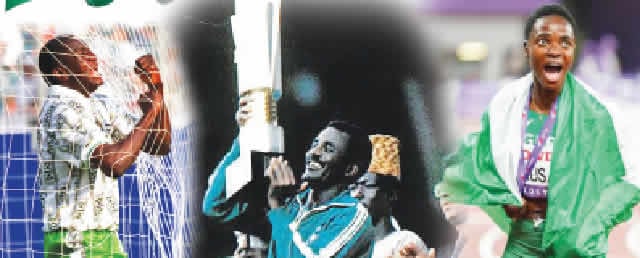
Nigeria’s sporting journey has been defined by unforgettable triumphs, historic breakthroughs and moments that continue to inspire generations. As the country marks its 65th Independence Day, OLAMIDE ABE highlights 65 golden moments of enduring impact on global sport
- 1962 – ‘Dick Tiger’ won boxing world title
Richard ‘Dick Tiger’ Ihetu was Nigeria’s first world boxing champion when he won the world middleweight title in 1962 by beating Gene Fullmer, and then in 1966, he won the world light heavyweight title by decisioning Jose Torres of Puerto Rico. Tiger died of liver cancer in 1971, at 42, and was inducted into the International Boxing Hall of Fame in 1991.
- 1964 – Maiyegun won Nigeria’s first Olympic medal
Nojeem Maiyegun represented Nigeria at the 1964 Summer Olympic Games in Tokyo, Japan, then he won the bronze medal in the men’s Light Middleweight category and enter the history books as Nigeria’s first Olympic medalist.
- 1972 – Ikhouria won Olympic bronze medal
Isaac Ikhouria won bronze competing in the light heavyweight class at the Olympic Games in 1972. He defeated Gilberto Carrillo, Cuba, on all the judge’s scorecards to win the Olympic bronze medal.
- 1973 – Nigeria’s national football team won gold at the 2nd All-Africa Games
In what was the first of many, the Green Eagles sounded a note of warning to other African football nations that they were ready to compete against and beat the best on the continent. This the Green Eagles confirmed by beating Guinea 2-0 in the final, at the AAG hosted by the country
- 1979 – Andeh claims world amateur boxing title
In 1979, Davidson Andeh became the first and only Nigerian to win the World Amateur Lightweight boxing championship fight against a Russian opponent, in Belgrade, Yugoslavia.
- 1980 – Eagles became Africa’s best at AFCON
The Green Eagles won their first Africa Cup of Nations Cup title in 1980. The event hosted by Nigeria was a showcase for the attacking talents of Segun Odegbami and the rock-solid defending by the captain of the team, Christian Chukwu
- 1980 – Fan attendance at the AFCON final reached 100,000
Nigeria’s Super Eagles entered the 1980 Nations Cup final as host and top bet to claim their first title and on hand to witness the memorable occasion was over 100,000 spectators, that included the President, Shehu Shagari, at the National Stadium, Lagos. The number of fans is still the record for a sporting event in Nigeria.
- 1983 – Odizor progressed to the Wimbledon fourth round
Nduka Odizor progressed to the fourth round of the 1983 Wimbledon tennis tournament – the farthest a Nigerian has achieved in lawn tennis. He also got to the highest ranking of 52 in the world in 1984. He is also the first Nigerian to play at an Olympic Games tennis event, representing Nigeria at the 1988 Seoul Olympic Games
- 1983 – Five Nigerians won gold at World Universities Games
The 1983 World University Games in Edmonton, Canada, gave birth to world-beaters. There was Sunday Uti, in the 400m, Yusuf Ali, in the long jump, Ajayi Agbebaku in the triple jump, Egbunike in the 200m, and Chidi Imoh in the 100m. All five won gold to kick-start fulfilling athletic careers for both countries and American universities
- 1984 – Nigeria’s 4×400 relay quartet made history with Olympic bronze
Nigeria won its first-ever Athletics Olympic medal at the 1984 Los Angeles Olympic Games in the 400m relay event. The quartet of Innocent Egbunike, Sunday Uti, Moses Ugbisie, and Rotimi Peters won the bronze in an Africa record time of 2:59.32.
- 1985 – Nigeria won maiden FIFA U-17 Championship in China
The national cadet team, the Golden Eaglets, were the inaugural winners of the U-17 World Championship, as it was known in 1985, that held in China. The team coached by Sebastien Brodericks and Christian Chukwu beat Germany in the final 2-0, with goals from Babatunde Joseph and Jonathan Akpoborie.
- 1987 – Egbunike became the first medal winner at World Athletics Championship
Innocent Egbunike became the first Nigerian athlete to win any medal at a World Athletics Championship in 1987 in Rome. Also, his Nigerian record of 44.17s in the 400m still stands till today.
- 1988 – Nigeria achieved Group 1 status in Davis Cup
The Nigeria Davis Cup team was two matches away from qualifying for the World group in 1988 as they reached the Group I semifinals in 1988 and 1989. The country now competes in Africa Zone Group III.
- 1989 – The ‘Damman Miracle’ at FIFA U-20 World Cup
At the 1989 FIFA World Youth Championship in Saudi Arabia, Nigeria’s U-20 team produced one of the greatest comebacks in football history, overturning a 4-0 deficit against Russia in the quarter-final at the Prince Mohammed Bin Abdul Aziz Stadium to level 4-4 within the final 30 minutes, before triumphing 5-3 on penalties. The Flying Eagles advanced to the final, where they lost 2-0 to Portugal, with their squad featuring talents such as Nduka Ugbade, Christopher Ohenhen and Samuel Elijah.
- 1989 – Okwaraji slumps and dies at the National Stadium
This was a tragedy, but it is an iconic moment in the history of sports in Nigeria. Samuel Okwaraji, a midfielder for the national team, collapsed and died before they could resuscitate him. He slumped in the centre of the pitch in the 77th minute of a FIFA World Cup qualification encounter against Angola on August 12, 1989. An autopsy conducted revealed the 25-year-old had an enlarged heart and high blood pressure.
- 1992 – Nigeria Paralympic athletes debut at the Paralympic Games
The Nigerian Paralympic team made its debut at Paralympic games at the 1992 summer Paralympics in Barcelona. At the games, the team claimed three gold medals, two in Athletics, and one in powerlifting. Since 1992, Nigeria has won 40 gold medals, 19 silver medals, and 21 bronze medals, for 80 medals.
- 1993 – Yekini named Africa’s best player
The diadem of Africa’s best football player had eluded Nigerian players until the late Rashidi Yekini, in 1993, showed that he was a cut above the rest. He went ahead to become the first Nigerian player to score at the FIFA World Cup, and was the lynchpin of the Super Eagles team that won the 1994 Africa Cup of Nations Cup tournament.
- 1993 – Super Eagles qualified for the 1994 World Cup in the USA
After six unsuccessful attempts to join the elite of world football, a team led by the late Stephen Keshi and coached by Clemens Westerhof eked out a 1-1 draw away to Algeria on October 8, 1993, at the Stade du 5 Juillet 1962, Algiers. Finidi George scored Nigeria’s goal in the 19th minute, and the Algerians equalised through Sidi Ahmed Zerrouki with 19 minutes left on the clock. The Eagles held on to book their place in the 1994 World Cup that held in the United States of America.
19 1994 – Eagles attain top 5 FIFA ranking
In what is fondly remembered as the golden generation of Nigerian football, coach Clemence Westerhof and his group of players made Africa proud, and took the world by storm with their professionalism and style of play. The team was ranked fifth in the April 1994 FIFA rankings, the highest FIFA ranking ever achieved by an African team. Till date, Nigeria is the only African country to have risen as high as 5th in FIFA’s monthly rankings.
- 1996 – Ajunwa’s Nigeria’s first individual Olympic gold
Arguably the biggest sporting accolade has been the individual Olympic gold medal won by Chioma Ajunwa at the 1996 Olympic Games in Atlanta, USA. Ajunwa became the first athlete in Nigeria to win an Olympic gold medal and is also the first black African woman to win an Olympic gold medal in a field event. She remains Nigeria’s only individual Olympic gold medalist till date.
- 1996 – First African football Olympic gold
Nigeria became the first African country to win the Olympic gold in the football event at the 1996 Olympics. The team, captained by Nwankwo Kanu, went the circuitous route; coming from 3-1 down to Brazil in the semi-final to win 4-3 with a sudden-death goal from Kanu and then repeating the feat against Argentina in the final.
- 1998 – Falcons win inaugural Women’s AFCON
Nigeria won the inaugural African Women Championship, now WAFCON, in 1998. The team beat Ghana 2-0 in the final match played at Abeokuta, Ogun state.
- 1998 – Okocha became Africa’s most expensive footballer
In 1998, just after the FIFA World Cup in France, Austin ‘Jay-Jay’ Okocha was transferred from Fenerbahce of Turkey to PSG of France in a then Africa world record fee of $18m. The midfield maestro played 84 times and score 14 goals in a four-year stint.
- 1999 – Falcons reached a World Cup quarter-final
They are the first African women’s team to have reached the quarterfinals of the FIFA Women’s World Cup in 1999. Having not won a match in their previous two visits, the Falcons beat North Korea 2-1 to kick off their campaign, before dispatching Denmark and progress to the quarter-final where they faced Brazil. The Brazilians went 3-0 up in 35 minutes, but the Falcons fought back to level the score. They eventually succumbed to a 104th-minute golden goal. The team has not gone as far ever since.
- 1999 – Nigeria hosted the U-20 FIFA World Cup
Nigeria hosted the 2009 FIFA U-17 World Cup in four venues–Lagos, Ibadan, Port Harcourt, and Enugu. The tournament was where Julius Aghahowa was unearthed but the Nigerian team, coached by Fanny Amu, ‘wobbled and fumbled’ their way out of the tournament in the quarterfinal, beaten 3-1 by Mali. Most of the Spain squad that won the tournament came to the world attention and went on to win the 2010 FIFA World Cup.
- 2000 – Offoin becomes first Nigerian swimmer at the Olympics
Gentle Offoin qualified for the 2000 Olympic games and competed in the 100m freestyle event where he crashed out in the first round. He was not the first swimmer to qualify; John Ebito holds that record, having qualified for the 1976 Montreal Olympic Games, which Nigeria boycotted.
- 2000 – Quarter-milers hit gold despite silver finish at Olympics
The quarter-mile relay quartet at the 2000 Sydney Olympic games – Sunday Bada, Jude Monye, Clement Chukwu and Enefiok Udo Obong did not win their final race but 12 years after one of the American runners was disqualified following a failed dope test.
- 2003 – Enyimba won the elusive CAF Champions League title
Enyimba FC of Aba won Nigeria’s first Champions League crown – the CAF Champions league. This trophy eluded Nigeria for 38 years, with three traditional teams Rangers FC, in 1975, Shooting Stars Sports Club, in 1984 and 1996, Iwuanyanwu Nationale (now Heartland FC) in 1988 having come very close to ending the drought but all three teams were beaten in the competition’s final. Enyimba, coached by Kadiri Ikhana, beat Ismail of Egypt 2–1 on aggregate to end the curse. They also retained the title in 2004.
- 2004 – Onyali attended 5 consecutive Olympic Games
Mary Onyali, for many years Nigeria’s sprint queen, attended the Olympic Games on five consecutive occasions. Onyali became the first Nigerian and African to achieve the feat in 2004, her fifth consecutive appearance since 1988, where she competed in the 100m, 200m, and the 4X100m relay race.
- 2006 – Fasuba set 100m African record
Olusoji Fasuba set the record of 9.85s from the Doha Grand Prix in May 2006, thus breaking Frankie Fredericks’ record of 9.86 set in 1996. That record remains Africa’s fastest time till date. He was part of Nigerian quartet that won bronze in the 4x100m relay at the 2004 Olympics.
- 2007 & 2009 – Two-time champions in Beach Soccer
Nigeria have won the Africa Beach Soccer Championship twice. The Sand Eagles won the tournament in 2007 and 2009. They were runners-up in 2006 and 2011. The team were bronze winners in 2015 and came fourth in 2013.
- 2008 – Peter won a World Heavyweight boxing title
Samuel Peter won the WBC Heavyweight title in 2008 when he defeated Oleg Maskaev by TKO in Mexico. Though Peter’s reign lasted only seven months, as a returning Vitali Klitschko eventually defeated him.
- 2008 – Chukwumerije won Taekwondo bronze at the Olympics
Chika Yagazie Chukwumerije qualified for the 2008 Olympic Games and defeated Akmal Irgashev of Uzbekistan to win Nigeria’s first bronze medal in taekwondo at an Olympic Games tournament.
- 2009 – Nigeria’s national cricket team qualified for ICC World League event
Nigeria qualified for the 2009 ICC World Cricket League Division Seven, held in May 2009 in Guernsey. The tournament was the first stage of the qualification structure for the 2015 World Cup.
- 2009 – Nigeria hosted the U-17 FIFA World Cup
Nigeria hosted the 2009 FIFA U-17 World Cup in four venues–Lagos, Ibadan, Port Harcourt, and Enugu. The tournament was where Julius Aghahowa was unearthed but the Nigerian team, coached by Fanny Amu, ‘wobbled and fumbled’ their way out of the tournament in the quarterfinal, beaten 3-1 by Mali. Most of the Spain squad that won the tournament came to the world’s attention and went on to win the 2010 FIFA World Cup.
- 2012 – D’Tigers qualify for the Olympics
Nigeria’s male national basketball team – D’Tigers were the first African nation to ever qualify for the summer Olympics through the FIBA World Olympic Qualifying tournament, and this feat was achieved in 2012.
- 2013 – Oduamadi scores hat trick against Tahiti after AFCON win
Nnamdi Oduamadi represented Nigeria at the 2013 FIFA Confederations Cup in Brazil and achieved the feat of becoming the only Nigerian to have scored a hat trick in a FIFA senior tournament. Nigeria represented Africa in the tournament having won the AFCON title in South Africa and the former AC Milan prodigy scored in the 10th, 26th, and 76th minutes to help Nigeria to a 6-1 victory over the Islanders.
- 2013 – Okagbare ended a 14-year World Athletics Championship drought
Nigeria’s participation at the IAAF World championship had become a fallow ground from 1999 when Gloria Alozie won silver in the women’s 100m hurdles, and Francis Obikwelu got a bronze in the men’s 200m in Spain until 2013 when Blessing Okagbare won silver and bronze medals in the long jump and 200m events, respectively.
- 2014 – Nigeria finished 8th at the Commonwealth Games
Nigeria finished with 11 gold, 11 silver and 14 bronze medals at the 2014 Commonwealth Games in Glasgow, finishing in eighth position, their second-highest since they started attending the Games.
- 2014 – Quadri named ITTF’s world best player
Aruna Quadri was named the International Table Tennis Federation star player in 2014. He was also voted the best male player ahead of the then world number one, China’s Xu Xin.
- 2014 – Oshoala named best player at FIFA U-20 Women’s World Cup
Asisat Oshoala was named best player and was the highest goal scorer at the 2014 FIFA U-20 Women’s World Cup, where she scored seven goals – the highlight being a four-goal haul in the 6-2 semi-final win over North Korea. Nigeria lost 1-0 to Germany in the final, but the future Barcelona star had already made her mark.
- 2014 – CHAN Eagles’ comeback against Morocco
The Stephen Keshi-coached home-based Super Eagles performed a minor miracle in African Nations Championship tournament held in South Africa in 2014, when the team came from a 3-0 deficit to beat Morocco 4-3 after extra time. Aliyu Ibrahim, a substitute, completed the turnaround when he scored his team’s fourth goal in the 11th minute of extra time.
- 2015 – Jighere won the Scrabble world title
Nigeria’s Wellington Jighere won the Scrabble world title triumph in 2015 and in the process became the first African player to be crowned World Scrabble Champion. He defeated Lewis MacKay in four straight rounds to win the inaugural WESPA Championship. Jighere is a two-time African Scrabble Champion and12-time National Champion.
- 2015 – D’Tigers won the FIBA Afrobasket title
The national male basketball team, D’Tigers won their first-ever FIBA Africa title in Tunisia in 2015 by defeating their perennial nemesis, Angola 74-65 in the final, led by Emeka Ugochi, who scored 19 points.
- 2015 – Osimhen sets record at a FIFA U-17 tournament
Victor Osimhen was part of the Nigerian U-17 team to the 2015 FIFA U-17 World Cup in Chile. The lanky forward set a record of scoring 10 goals to win the Golden Boot. He also won the Silver Ball award. He has since become an established forward for the Super Eagles and recently moved to Serie A to join Napoli for a multi-million-dollar transfer.
- 2021 – Okagbare receives Guinness World Record for Diamond League feat
Blessing Okagbare recorded her name in the Guinness Book of Records for appearing in the Diamond League for the most time – 67, competing in the 100m, 200m, and long jump events between July 3 2010 and August 2018
- 2016 – Kehinde breaks records at the Paralympics as Nigeria wins eight gold
Paul Kehinde, a Nigerian Powerlifter, twice, broke the men’s 65kg World Record at the 2016 Rio Games, to win the gold medal. The Powerlifter then lifted a whopping 220 kg to break the world record he held. He was decorated with the Member of the Order of the Niger award by the Nigerian government in 2016 as the team finished with eight gold medals, the highest ever for the country.
- 2017 – Adekuoroye claims first-ever African Silver Medal at World Wrestling
Odunayo Adekuoroye, a wrestler from Ondo state in Nigeria, became the first-ever African female wrestler to win a medal at the World Wrestling Championship event in Paris in 2017, in France. The 26-year-old had in 2014 won gold at the Commonwealth Games. She has become the No.1 ranked women’s freestyle 55 kg wrestler by United World Wrestling.
- 2018 – Eagles World Cup jersey is a hit
The Super Eagles debuted a Nike jersey just before the 2018 World Cup in Russia that won various accolades. It was reported that the Eagles’ uniquely designed jersey had pre-orders of over three million around the world. Nike released it to the public on May 29, 2018.
- 2018 – National cricket team qualified for World T-20s
The Nigeria national cricket team made their T-20 debut on September 14, 2018 in Boland Park, South Africa. As a result of Zimbabwe’s suspension, the ICC confirmed that Nigeria to replace them in the 2019 ICC T20 World Cup Qualifier tournament.
- 2018 – Nigeria presents bobsled team at Winter Olympics
Nigeria qualified for the 2018 Winter Olympics and became Africa’s first-ever bobsled team. Three US-based athletes, Seun Adigun, Akuoma Omeoga, and Ngozi Onwumere competed in the tournament that was held in Pyeongchang, South Korea.
- 2018 – D’Tigress reaches World Cup quarter-final
The women’s basketball team, D’Tigress, made it to the World Cup in Spain and bowing out in the quarterfinals after losing 71-40 to USA., and eventually finished in the 8th place in the classification matches.
- 2019 – Usman becomes first ever African-born UFC champion
Kamaru Usman won his first UFC world title on March 2, 2019 at UFC 235 in Las Vegas, where he defeated Tyron Woodley by unanimous decision after five dominant rounds to become the undisputed UFC welterweight champion and the first African-born fighter to capture a UFC belt.
- 2019 – Adesanya becomes UFC middleweight champion
Israel Adesanya won his first UFC world title on October 6, 2019 at UFC 243 in Melbourne, where he knocked out Robert Whittaker in the second round to unify the middleweight belts, having earlier claimed the interim title by defeating Kelvin Gastelum.
- 2021 – Oshoala wins first UEFA Women’s Champions League
Asisat Oshoala made history as the first African woman to win the UEFA Champions League after Barcelona thrashed Chelsea 4–0 in the final in May 2021. She went on to cement her place in European football by becoming the first African woman to claim La Liga’s Pichichi Trophy in the following season, and in August 2022 she became the first African woman nominated for the Ballon d’Or Féminin. Her achievements continued to grow, and by 2024 she became the first African player to win the UEFA Champions League three times.
- 2022 – Tobi Amusan sets 100m hurdles world record
Tobi Amusan stunned the world at the 2022 World Athletics Championships in Eugene, USA, where she broke the women’s 100m hurdles world record in the semi-final with a time of 12.12s, before running an even faster but wind-assisted 12.06s in the final. She crowned the night with victory to win Nigeria’s first-ever World Championships gold in athletics.
- 2023 –Wakama leads D’Tigress to AfroBasket title
Rena Wakama broke barriers when she became the first female head coach of Nigeria’s D’Tigress and the first Nigerian female coach to win the FIBA Women’s AfroBasket since the competition began in 1966.
- 2023 – Ebi becomes first African to play six World Cups
Veteran defender Onome Ebi wrote her name in history at the 2023 FIFA Women’s World Cup by coming on as a substitute in Nigeria’s 3–2 victory over Australia at the age of 40 years and 50 days. The appearance made her the first African player, male or female, to play in six World Cup tournaments, having featured in 2003, 2007, 2011, 2015, and 2019, for an African record of 15 matches played on the biggest stage.
- 2024 – Lookman nets Europa League final hat-trick
Ademola Lookman wrote his name into European football history in May 2024 when he scored his first career hat-trick in the Europa League final, leading Atalanta to a famous victory over Bayer Leverkusen and ending their record unbeaten streak. His treble made him the first player to net a hat-trick in a one-legged men’s European final since 1969. The feat earned him the African Footballer of the Year award and made him the first Atalanta player ever nominated for the Ballon d’Or.
- 2024 – D’Tigress set African Olympic record
At the Paris 2024 Summer Olympics, Nigeria’s women’s basketball team finally broke through by defeating Australia 75-62 to claim their first Olympic win in 20 years. They followed it up with another historic moment by beating Canada 79-70 to advance to the quarter-finals for the first time, making them the first African basketball team, male or female, to reach that stage at the Olympics. Their coach, Rena Wakama, was later named Best Coach of the Tournament by FIBA, capping a milestone outing for D’Tigress.
- 2024 – Bolaji wins first African badminton medal at the Olympics/Paralympics
Eniola Bolaji won the bronze medal in the women’s singles SL3 category at the 2024 Summer Paralympics, becoming the first African athlete to win a medal in badminton at either the Olympics or Paralympics.
- 2025 – Super Falcons claim 10th Women’s AFCON crown
The Super Falcons reaffirmed their dominance of African football in 2025 when they fought back from a goal down to beat Morocco 3–2 in the WAFCON final. The victory gave Nigeria a record 10th continental title and also came with multiple individual honours, as coach Justine Madugu was named Best Coach, Rasheedat Ajibade won Most Valuable Player, and goalkeeper Chiamaka Nnadozie claimed the Best Goalkeeper award.
- 2025 – D’Tigress win fifth straight AfroBasket title
Nigeria’s women’s basketball team continued their golden era by clinching their fifth straight AfroBasket title in 2025, extending their dominance of the African game.
- 2025 – Chukwuebuka Enekwechi sets African shot put record
Chukwuebuka Enekwechi broke the African men’s shot put record in July 2025 with a throw of 22.10 metres at the Diamond League Prefontaine Classic in Eugene, becoming the first African to surpass 22.00 m in the event. Prior to that, Enekwechi’s best official mark was 21.91 m, set in May 2024, which had itself been a national record at that time.
- 2025 – Nathaniel breaks long-standing records at World Championships
Ezekiel Nathaniel became the first Nigerian man since 1987 to reach a World Championship 400m hurdles final in 2025, where he finished fourth in 47.11s to set a new national record, narrowly missing bronze by 0.05s. His standout season also saw him crowned NCAA champion unbeaten, reached Diamond League podium in Prefontaine, Silesia and Zurich, earn a Bowerman Finalist spot, and rise to fifth in the world rankings and top five in African history.
punch.ng
FOLLOW US ON:
FACEBOOK
TWITTER
PINTEREST
TIKTOK
YOUTUBE
LINKEDIN
TUMBLR
INSTAGRAM