Connect with us

Education

Read how students can win FG’s ₦365m national laureate prize

Published

on

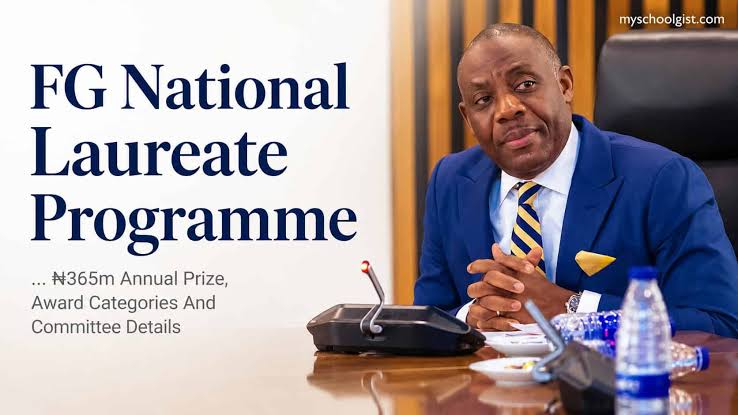
The Federal Government has opened the Tertiary Institutions National Laureate Prize, an annual ₦365 million scheme designed to reward and elevate outstanding research from Nigeria’s universities, polytechnics, monotechnics, and colleges of education.

Minister of Education, Dr Maruf Tunji Alausa, announced the opening of the prize on Thursday, following a press briefing with the Nigeria Education Repository and Databank National Laureate team.

He said the initiative aligns with President Bola Tinubu’s Renewed Hope Agenda by repositioning tertiary institutions as centres of research, innovation, enterprise and problem-solving rather than mere certificate-producing centres.

Prize structure

The annual prize fund of ₦365 million is structured as follows:

  • Undergraduate Star Prize: ₦35 million
  • Master’s Star Prize: ₦50 million
  • Doctoral Star Prize: ₦100 million
  • 15 Thematic Excellence Prizes: ₦12 million each, totalling ₦180 million

Across six thematic areas, one national thematic laureate is selected at each of the three academic levels — undergraduate, master’s and doctoral — producing 18 laureates in total.

Three of these receive the Star Prizes, while the remaining 15 receive the thematic awards.

The six thematic areas are Science, Engineering and Technology; Medicine and Health Sciences; Arts and Social Sciences; Agriculture; Law; and Teaching Innovation.

A special Dr Stella Adadevoh Prize, or Excellence Award, for Medicine and Medical Innovation honours the late physician whose actions helped contain Nigeria’s 2014 Ebola outbreak.

It is conferred on the laureate whose work and conduct best embody integrity, national service and protection of the public good.

Who is eligible?

The prize is open to students and researchers in every accredited tertiary institution in Nigeria — federal, state or private.

See also  AFRICA WAS TAUGHT TO MEMORIZE, NOT TO THINK!

Undergraduate dissertations or recognised equivalents, master’s theses and doctoral theses, or equivalents from polytechnics, monotechnics, colleges of education and similar institutions, are eligible if they demonstrate strong commercial potential, industrial application or clear developmental impact.

Works must meet research integrity and originality standards.

Every nominated work must first be deposited in the NERD system and issued a valid National Document Number.

An NDN confirms deposit but does not automatically enter a work into the competition.

How students can position themselves to win

Students cannot submit entries directly. Only institutions, through their formally constituted Institution Laureate Selection Committees, can nominate and enter works.

Each institution may submit up to 18 entries: up to six undergraduate, six master’s and six doctoral entries, or their equivalents, drawn from the six thematic areas, generally one per theme at each level.

To maximise their chances, students should:

  • Produce exceptional work with demonstrable commercial, industrial or developmental value that addresses national challenges.
  • Ensure the dissertation, project or thesis is fully submitted to NERD and assigned a valid NDN before the institutional selection window closes.
  • Actively engage their supervisor, co-supervisor, head of department and other academic leaders. Ask them to present their work to the Institution Laureate Selection Committee for independent review.

Institutional selection is the first gateway. High-quality research and proper NERD compliance can improve the prospects of nomination.

How institutions submit entries

Once an institution’s Laureate Selection Committee has chosen its strongest works, authorised members follow the submission process on the National Laureate portal.

Step 1: Log in to the National Laureate Committee portal. This assumes the institution has constituted its Laureate Selection Committee and directed its NERD Focal Officer to enrol and formally designate the appointed members on NERD. Committee members require this designation to access the Laureate portal using their existing NERD credentials.

See also  NSCDC uncovers fake university in Lagos, rescues 106 students

Step 2: On the Laureate Dashboard, click Manage Institution Entries from the top-right menu.

Step 3: The next page will display the dissertations, projects and theses submitted within the institution, grouped under the relevant academic levels: undergraduate, master’s and doctoral, or their recognised equivalents.

Step 4: Use the filters at the top of the page to search for a specific dissertation, project or thesis.

Step 5: Once the work the committee intends to enter is located, click View to review the submission details carefully and confirm that all information is correct.

Step 6: On the View page, click View Submission Evidence to confirm that all required departmental and institutional attestations have been supplied.

Step 7: Click Open Authoritative Student File to view the exact PDF of the dissertation, project or thesis as originally submitted.

Step 8: If everything is in order, click Back to Previous Page or Back to Dashboard to return to the relevant work.

Step 9: Tick the oath checkbox and read the declaration carefully before proceeding. By ticking the box, the committee is making the prescribed institutional declaration in respect of the entry.

Step 10: Click Submit Entry. This completes the submission process for that entry. The committee may then proceed to review and submit other eligible works.

Deadline for submission

The deadline for institutional entries is August 31, 2026.

What happens after institutional submission?

Entries progress through a three-tier process: Institution Committee, Regional (zonal) Committee, and National Committee.

The National Laureate Committee, chaired by Emeritus Professor Abubakar Sambo, oversees the final evaluation.

See also  PICTURES: Zulum approves N12.9bn aeronautics scholarship for 54 Borno students

The process is designed to be transparent, competitive and merit-driven, with emphasis on academic excellence and impact.

Winners are expected to be honoured at a National Laureate Gala later in the year, previously indicated for November.

Source: punchng.com

FOLLOW US ON:

FACEBOOK

TWITTER

PINTEREST

TIKTOK

YOUTUBE

LINKEDIN

INSTAGRAM

Continue Reading
Click to comment

Leave a Reply

Your email address will not be published. Required fields are marked *

Education

Australia scraps digital writing tests for Year 5 pupils

Published

on

Australia will return to pen-and-paper writing tests for Year 5 pupils from 2028 following growing concerns over the impact of excessive screen time and digital technology on children’s learning outcomes.

The decision, agreed by the country’s education ministers, will see pupils take the National Assessment Programme – Literacy and Numeracy (NAPLAN) writing test on paper rather than computers.

According to an updated ABC News report late Tuesday, South Wales Deputy Premier and Education Minister, Prue Car, said there was growing evidence that excessive screen exposure was affecting students and their academic performance.

“There is a lot of evidence to suggest that excessive screen time has been harmful for students and their outcomes.

“Ministers across the country have agreed that we work towards year 5 NAPLAN being writing with pen and paper, that will be in addition to year 3 already being pen and paper,” Car said.

Car is also pushing for the writing assessments for Years 7 and 9 to return to paper, with the Australian Curriculum, Assessment and Reporting Authority, which administers NAPLAN, expected to provide advice to ministers on the proposal.

Explaining the decision, she said students performed better when writing by hand than typing on screens.

“It’s about the evidence of how children learn and they actually do better when they’re writing pen to paper as opposed to typing on screen.

“So making sure that the assessment is actually pen to paper will then necessitate more classroom time being pen and paper as opposed to a computer,” she said.

See also  PHOTOS: In Nigeria's Federal Capital Territory, Abaji Pupils Carry Stones To Sit As School Lacks Desks, Chairs, Water, Toilet

The decision comes amid concerns about declining academic performance among Australian pupils, with recent international assessments highlighting challenges in literacy, numeracy and students’ use of digital devices.

Australian students recorded their worst-ever results in the recent Programme for International Student Assessment, which compares educational performance across countries.

The assessment found that Australian students spent an average of 2.6 hours daily using digital devices, compared with the Organisation for Economic Co-operation and Development average of 1.7 hours.

NAPLAN results have also consistently shown that about one-third of Australian students are not meeting what education authorities describe as challenging but reasonable expectations in foundational literacy and numeracy.

The Heads Up Alliance, a grassroots movement of parents campaigning against screen time, welcomed the proposed changes but called for more comprehensive reforms.

Its founder, Dany Elachi, said the decision was a step in the right direction but argued that more needed to be done to reverse the decline in educational standards.

“New South Wales’ recently announced screen time parameters and proposed NAPLAN reforms are welcome steps in the right direction.

“However, more will be needed to reverse the decline in Australian educational standards. It turns out that Australia’s Digital Education Revolution of 2008 was, in effect, a vast experiment on our children. Today, the results of that experiment have become impossible to ignore,” Elachi said.

La Trobe University Distinguished Professor Pamela Snow also backed calls for a broader reassessment of technology use in schools, arguing that its adoption had moved faster than the available evidence supporting its benefits.

See also  AFRICA WAS TAUGHT TO MEMORIZE, NOT TO THINK!

“I think as a general principle, the application of technology and education has got way ahead of the evidence.

“We can’t just keep going with these stopgap measures of tinkering around the edges downstream,” Snow said.

Snow said technology was introduced into classrooms too quickly.

“It’s now just become normalised, and, of course, it’s difficult now to wind it back and calibrate its use, but I’m not aware of any actual evidence that says technology has enhanced students learning,” she added.

Car said education ministers had also agreed to begin work on a broader digital detox initiative for Australian classrooms.

“State and territory ministers and the Commonwealth have agreed to start work on a digital detox for Australian classrooms.

“In New South Wales mandatorily from 2028, we’re going forward with screen time limits in classrooms, phased in from preschool to year 12 in the HSC year,” she said.

The education ministers are expected to release a communique later in the week outlining further reforms, including a proposed federal super commission partly aimed at addressing concerns over Year 12 dropout rates.

The ministers are also considering reforms to the primary school mathematics curriculum and additions to the national curriculum to address anti-Semitism.

Source: punchng.com

FOLLOW US ON:
FACEBOOK

WHATSAPP CHANNEL

TWITTER

PINTEREST

TIKTOK

YOUTUBE

LINKEDIN

INSTAGRAM

Continue Reading

Education

UniAbuja land dispute: ASUU threatens industrial action

Published

on

The Academic Staff Union of Universities (ASUU), University of Abuja (UniAbuja) branch, has demanded the immediate reversal of the alleged unlawful allocation of the university’s land by FCT Minister, Nyesom Wike.

The union also appealed to President Bola Tinubu to call Wike to order over the disputed land, saying this would allow peace and harmony to prevail on the university campus.

The Chairperson of ASUU, UniAbuja branch, Prof. Sylvanus Ugoh, made the demands at a news conference on Tuesday in Abuja.

The News Agency of Nigeria (NAN) reports that the conference was tagged: “Ministerial Encroachment into University of Abuja Land: Some Points to Ponder.”

Ugoh said the union would no longer guarantee industrial harmony if the minister failed to reverse the alleged allocation of the university’s land to his friends and cronies.

“The act of the FCT Minister is an outright breach and total disregard for the rule of law.

“On Aug. 18, Justice F.E. Mesiri of Maitama High Court granted interlocutory injunctions, including an order restraining the FCT Minister from entering or encroaching on University land.

“In spite of the court order, the FCT Minister went ahead on Sept. 26, to allocate the university land to companies and individuals,” he said.

Ugoh said the minister announced on June 30, 2025, during the inauguration of an access road to the Economic and Financial Crimes Commission (EFCC) Institute in Giri, the retrieval of 7,000 hectares from the 11,000 hectares allocated to the university.

He said the minister had accused the university of land grabbing and fencing several hectares of land without proper approval or documentation.

See also  Nigerian students win gold at Spelling Bee World Cup in China

“There is overwhelming documentary evidence showing that this parcel of land was allocated to the University of Abuja,” he said.

He explained that the University of Abuja was established on January 1, 1988, with an initial land allocation of 11,824 hectares to accommodate its long-term academic and infrastructural development.

According to him, the university authority could not have on its own decided where to situate the institution.

He said the university and the land were the property of the Federal Government and not the FCT.

Ugoh said the large landmass was deliberately allocated to provide room for future expansion, research activities, academic facilities and other institutional needs.

He noted that the university, as a dual-mode institution offering conventional and distance learning programmes, required sufficient land to fulfil its mandate.

Ugoh said the land was also needed for the establishment of research institutes, innovation centres and other facilities that would contribute to national development.

He added that portions of the land served as green areas for ecological balance, environmental conservation and climate change mitigation.

“The development of the University of Abuja may seem very slow, but it is still the Federal Government that is responsible for the development of its university.

“We appreciate the zeal of the FCT Minister to develop the FCT, but the argument that the land has been left undeveloped for too long does not stand.

“Universities gradually realise their full potential. It is pertinent to mention that the 11,824 hectares of University of Abuja land is not in any way beyond a dual-mode university in the country’s capital.

See also  AFRICA WAS TAUGHT TO MEMORIZE, NOT TO THINK!

“For instance, University of Ilorin occupies 15,000 hectares, Obafemi Awolowo University, Ile-Ife, occupies 13,000 hectares, Federal University of Technology, Minna, occupies 10,650 hectares and Federal University of Agriculture, Abeokuta, occupies 10,000 hectares,” he said.

He explained that out of the 11,824 hectares occupied by the University of Abuja, about two hectares were hilly and would require huge resources to develop.

He said the union would, within the ambit of the law, resist in totality any attempt by the minister to unlawfully take away UniAbuja land.

NAN reports that the news conference followed an emergency congress of the union held at the university on November 3 to deliberate on the land dispute.

In June 2025, Wike accused the varsity of land grabbing and noted that the institution has claimed 11,000 hectares of land, of which he had retrieved 7,000.

(NAN)

Source: punchng.com

FOLLOW US ON:

FACEBOOK

WHATSAPP CHANNEL

TWITTER

PINTEREST

TIKTOK

YOUTUBE

LINKEDIN

INSTAGRAM

Continue Reading

Education

MURIC kicks against hijab ban in Nigerian law schools

Published

on

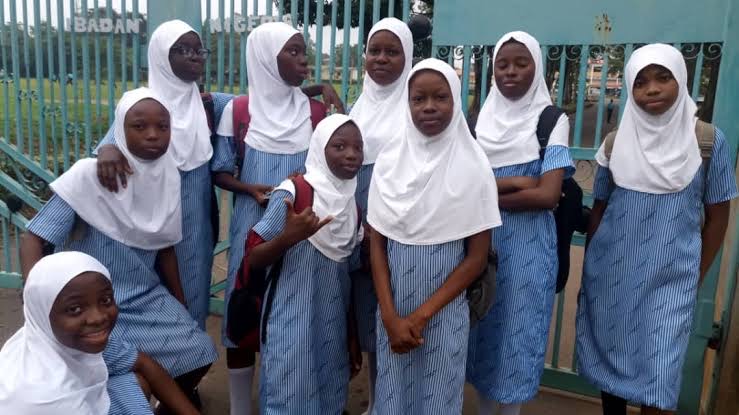
Muslim Rights Concern, MURIC, has expressed displeasure over the ban on female Muslim students from wearing hijab at Nigerian law schools.

The organisation described the development as sad and unfortunate.

MURIC, in a statement signed by its Executive Director, Professor Isiaq Akintola, on Sunday, alleged that female Muslim students in law schools across the country were, on Saturday, barred from wearing hijab.

He added that the students were intimidated and harassed, condemning the action of the Nigerian law schools’ authorities.

Akintola called for the suspension of all examinations at law schools across the country, pending investigation into the matter.

He said, “There was harassment and intimidation of hijab-wearing female Muslim students in some Law School examination halls across the country yesterday, Saturday, 31st October, 2026.

‎”Hijabites who came hoping to sit for their call to bar final examinations were disallowed from entering the examination halls. In some places, they were forced to remain standing outside for about one hour until they removed their hijabs before they were allowed to enter and start the examination.

‎”While this was going on, our office was inundated with telephone calls, text messages and chats. We heard the cries of traumatised candidates, the lamentations of distressed parents, hundreds of kilometres away from the examination centres and the agitation of concerned Muslims around the country.

“MURIC strongly condemns the wanton disruption of the lawful educational pursuit of innocent Muslim ladies. It is crude, irrational and sadistic.”

FOLLOW US ON:

FACEBOOK

WHATSAPP CHANNEL

TWITTER

PINTEREST

TIKTOK

YOUTUBE

LINKEDIN

INSTAGRAM

See also  NSCDC uncovers fake university in Lagos, rescues 106 students
Continue Reading

Trending