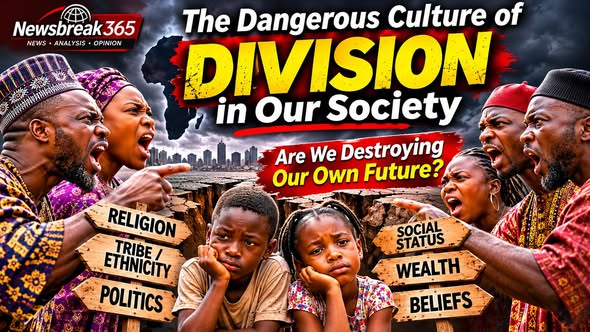
A society that allows religion, ethnicity, politics, wealth and social differences to turn its people against one another is slowly destroying itself. But who really benefits from our division?**
There is something deeply disturbing about the direction in which our society is heading. People who should be working together for a better future are increasingly becoming enemies because of differences they should have learned to respect.
Religion has become a battlefield. Ethnicity has become a weapon. Politics has become an excuse for hatred. Wealth has become a measure of human worth. Social status has become a reason to look down on others.
We are gradually creating a society where people are judged not by their character, honesty, intelligence or contribution to humanity, but by where they come from, what they believe, who they support and how much money they possess.
The question we must ask ourselves is this: **When did our differences become more important than our shared humanity?**
## THE DIVISION THAT IS TEARING OUR SOCIETY APART
Division does not always begin with violence. Sometimes, it begins with words, prejudice, stereotypes, manipulation and the refusal to accept that other people have the right to think differently.
It grows when people are taught to hate those who belong to different communities. It becomes dangerous when disagreements turn into hostility and when loyalty to a particular group becomes more important than justice and truth.
Consider some of the most damaging forms of division in our society.
### 1. Religious Division: When Faith Becomes a Weapon
Religion should encourage compassion, humility, kindness and peaceful coexistence. Yet, in many communities, religious differences have become reasons for discrimination, hostility and even violence.
Some people have become so attached to defending their religious identity that they forget the basic principles of humanity.
They condemn people who worship differently, insult those who question their beliefs and sometimes celebrate the suffering of people outside their religious communities.
But what is the value of religious devotion if it cannot teach people to respect one another?
Must someone follow your religion before you recognise their humanity?
### 2. Ethnic and Tribal Division: The Enemy Within
One of the most destructive attitudes in society is the belief that people from one ethnic group are naturally superior to others.
People are stereotyped, marginalised and discriminated against because of their ancestry, language, culture or geographical origin.
In Africa, where cultural diversity should be a source of strength, ethnic suspicion and tribal loyalty have repeatedly undermined social cooperation and national development.
We celebrate our ethnic identities, which is perfectly reasonable. But celebrating your culture should never require insulting another person’s culture.
**Your tribe is part of your identity, not proof that you are better than another human being.**
### 3. Political Division: Fighting for Politicians Who Do Not Fight for Us
Perhaps one of the most embarrassing spectacles in modern society is watching ordinary citizens fight bitterly over politicians.
People destroy friendships, insult family members and spread hatred because they support different political parties.
Meanwhile, the politicians they defend may be enjoying privileges, travelling comfortably and pursuing their personal interests.
When election campaigns end, political opponents can sometimes sit together, negotiate and share political interests. Yet ordinary supporters remain enemies long after the elections.
Why should citizens fight one another over political personalities who may not even remember their sacrifices?
Political loyalty should never be stronger than loyalty to truth, accountability and the welfare of society.
### 4. Wealth and Social Status: When Money Determines Human Worth
Another dangerous form of division is the growing obsession with wealth and social status.
People are increasingly judged by the cars they drive, the houses they own, their professional positions, their clothing and their financial influence.
The wealthy are celebrated regardless of how they acquired their money, while the poor are sometimes treated as though they have failed as human beings.
This culture encourages arrogance, envy, exploitation and unhealthy competition.
But when did money become the measurement of human dignity?
A person’s financial situation does not determine their intelligence, character or value to society.
### 5. Division Through Personal Beliefs and Ideologies
A healthy society should allow people to express different opinions without fear of intimidation or persecution.
Unfortunately, disagreement is increasingly interpreted as betrayal.
Question someone’s argument, and you become an enemy. Challenge a popular opinion, and you are labelled. Refuse to follow the crowd, and suddenly you become a problem.
A society that punishes independent thinking cannot expect to make meaningful progress.
We must learn that disagreement is not hatred, criticism is not necessarily disrespect, and asking questions is not a crime.
## WHO REALLY BENEFITS FROM OUR DIVISION?
This is perhaps the most important question of all.
Who benefits when neighbours become enemies?
Who benefits when citizens are too busy fighting over religion and ethnicity to demand good leadership?
Who benefits when poor people attack one another while powerful individuals continue exploiting their differences?
Who benefits when communities refuse to cooperate because of historical grievances and political manipulation?
Division creates opportunities for manipulation.
When people are emotionally consumed by hatred, they become less willing to question those who exploit their loyalty.
They defend individuals and institutions even when their actions contradict the values they claim to represent.
They spend more energy attacking one another than confronting the problems affecting their communities.
**A divided society is easier to manipulate, easier to exploit and much harder to develop.**
This does not mean every disagreement is deliberately manufactured. Genuine differences exist, and some divisions have deep historical, political and economic roots. However, those who exploit these differences for personal advantage must be held accountable.
## THE NEXT GENERATION WILL INHERIT THE CONSEQUENCES
Perhaps the most painful part of this culture of division is the future we are creating for our children.
Children observe how adults behave. They listen to the insults, witness the hostility and absorb the prejudices around them.
When parents teach children to hate people from other ethnic groups, they are passing hatred from one generation to another.
When communities teach young people that members of another religion are enemies, they are creating barriers that may take decades to dismantle.
When political differences become family conflicts, children grow up believing that disagreement must end in hostility.
What kind of future are we preparing for them?
Do we want a generation that values intelligence, innovation, education, cooperation and human dignity, or one that inherits the bitterness and prejudices of previous generations?
Our children deserve better than a society where their opportunities are determined by their surname, religion, ethnicity or political connections.
## UNITY DOES NOT MEAN WE MUST THINK ALIKE
It is important to understand that unity does not require everyone to share the same religion, ethnicity, political ideology, culture or personal beliefs.
Real unity means recognising that people can be different and still coexist peacefully.
You can disagree with someone’s religious beliefs without insulting them.
You can belong to a different ethnic group without becoming an enemy.
You can support a different political party without destroying a friendship.
You can be wealthy without looking down on the poor.
You can be successful without celebrating another person’s failure.
A mature society does not demand uniformity. It demands mutual respect, fairness, accountability and equal human dignity.
## IT IS TIME TO BREAK THE CYCLE OF DIVISION
We cannot continue planting the seeds of hatred and expect to harvest peace.
We cannot continue encouraging tribalism and expect national unity.
We cannot continue defending corruption because of political loyalty and expect good governance.
We cannot continue treating people as inferior because of their religion, background or financial circumstances and expect a fair society.
Every individual has a responsibility to challenge prejudice, reject manipulation, encourage critical thinking and treat others with dignity.
Our leaders must also recognise that governing a diverse society requires fairness, inclusion and accountability, not the exploitation of differences for political advantage.
The future of society depends not on how successfully we defeat one another, but on how effectively we learn to live and work together.
## THE BIG QUESTION: ARE WE BUILDING A SOCIETY OR DESTROYING ONE?
Imagine a society where people are judged by their character rather than their ethnicity.
Imagine communities where religious differences do not produce hatred.
Imagine political debates where people challenge ideas without threatening one another.
Imagine a society where wealth does not give someone the right to humiliate the poor.
Is that kind of society impossible, or have we simply become too comfortable with division?
We must ask ourselves whether we are genuinely interested in progress or whether we have become addicted to fighting over differences while ignoring the problems that unite us.
The uncomfortable truth is that nobody wins when hatred becomes the foundation of society.
**A divided people may win arguments, defend their tribes, protect their political heroes and celebrate their differences, but they risk losing something far more valuable: their collective future.**
The time to rethink our priorities is now.
—
## LET’S DEBATE: YOUR OPINION MATTERS!
1. Who benefits most from the growing division in our society: ordinary citizens or the powerful?
2. Has religion become a source of division in some communities rather than a force for compassion?
3. Why do people fight and destroy relationships over politicians who may not even care about their personal struggles?
4. Is tribalism one of the biggest obstacles to African unity and development?
5. Are parents and society unconsciously raising a generation that will inherit hatred and prejudice?
6. Can genuine development happen when people cannot respect one another’s differences?
**DROP YOUR HONEST OPINION IN THE COMMENT SECTION. DON’T JUST READ AND SCROLL PAST. LET US HAVE THIS IMPORTANT CONVERSATION!**
*Newsbreak365 — Challenging Perspectives, Questioning Narratives and Encouraging Conversations That Matter.*
#Newsbreak365 #Society #Division #Unity #AfricanSociety #Tribalism #ReligiousTolerance #PoliticalDivision #Humanity #SocialAwareness
FOLLOW US ON:
FACEBOOK
WHATSAPP CHANNEL
TWITTER
PINTEREST
TIKTOK
YOUTUBE
LINKEDIN
INSTAGRAM







 Education20 hours ago