The Federal Government on Wednesday blamed the renewed terror attacks, including the abduction of schoolgirls in Kebbi and the assault on worshippers in Eruku, Kwara State, on recent remarks by United States as public anger over the incidents spread nationwide.
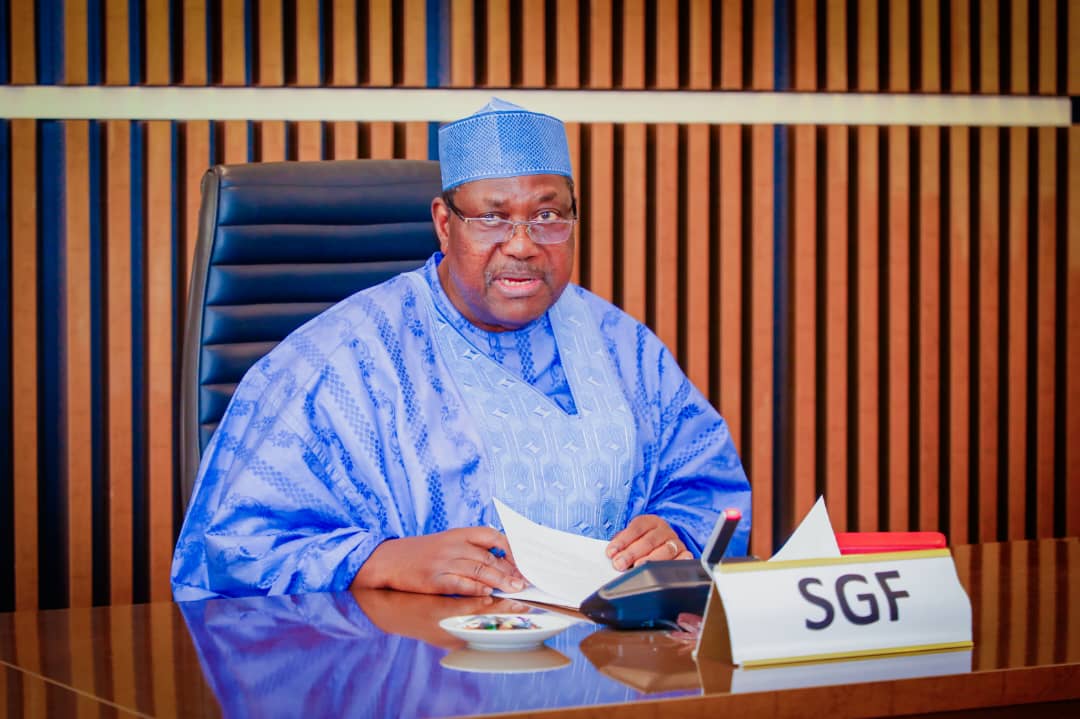
Secretary to the Government of the Federation, George Akume, said Trump’s posts alleging “Christian genocide” in Nigeria and threatening to deploy US troops had “inadvertently emboldened opportunistic violent groups” now seeking to justify attacks on soft targets.
“Recent pronouncements from the United States have inadvertently emboldened opportunistic violent groups seeking to exploit international narratives and make bold statements by attacking soft targets,” Akume said on Wednesday.
Addressing the evolution of violent extremism, banditry and ongoing security challenges in the country, the SGF added, “Before these statements, insurgency structures had been significantly degraded and reduced to isolated banditry.
“This resurgence underscores the vital need for collaboration, not public labelling, between Nigeria and the United States.”
Trump had, in a series of posts on X between October 30 and November 1, 2025, designated Nigeria as a “Country of Particular Concern” over allegations of a Christian genocide.
The US President warned that he might deploy American forces to Nigeria if the alleged killings of Christians did not stop.
He said he had directed what he called the “Department of War” to prepare for “possible action” should the violence persist.
Trump also threatened to suspend all U.S. assistance to Nigeria if President Bola Tinubu’s administration failed to address the alleged persecution.
In his statement on Wednesday, the SGF said insurgency networks had previously been significantly weakened and reduced to isolated banditry before the statements.
Some groups were now attempting to leverage those remarks to gain visibility,” he noted.
Highlighting the impact of Trump’s pronouncements, the SGF said, “Recent pronouncements from the United States have inadvertently emboldened opportunistic violent groups seeking to exploit international narratives and make bold statements by attacking soft targets.”
Akume reaffirmed the government’s position that Nigeria does not require foreign troops, noting that the Nigerian Armed Forces have reclaimed territories and degraded Boko Haram and ISWAP structures.
He said the country instead needs targeted support from partners, especially in intelligence, technology and equipment.
“The Nigerian Armed Forces are highly capable, experienced and professional. They have reclaimed vast territories, degraded Boko Haram/ISWAP leadership structures, and conducted successful multi-theatre operations.
“Nigeria does not require foreign troops. What is needed is targeted support from partners, especially the United States, in the areas of intelligence cooperation, technology and military equipment support for advanced engagement against the insurgents, “ Akume said.
Akume also said the government reject claims describing the conflict as a “Christian genocide,” stating that verified evidence shows insurgents and criminal groups have attacked both churches and mosques, killing Muslims and Christians.
The former Benue governor stressed that Nigeria remains a secular state and that government appointments reflect the country’s diversity.
He argued, “Nigeria is a secular state as guaranteed by various provisions of the constitution of the Federal Republic of Nigeria 1999 as amended.
“No state religion is adopted as a national religion and no citizen of Nigeria is above the Nigerian constitution.
“The appointment made by the present administration reflects the diversities of our nation and both Christians and Muslims and members of the Federal Executive Council holding key positions in equal proportion, including the Nigerian security council, the body that deals with all security challenges in Nigeria.”
He insisted that Nigeria rejects any characterisation of the conflict as a genocide against Christians or any group.
“Verified evidence shows that insurgents and criminal networks attack both churches and mosques, killing Muslims and Christians alike.
“The government remains committed to protecting all citizens and strengthening cooperation with international partners, especially the United States, to dismantle extremist and criminal networks,” he noted.
The Kebbi and Kwara attacks have drawn global attention in recent days.
The Zuru Emirate in Kebbi State was thrown into panic in the early hours of Monday after bandits attacked Government Girls Comprehensive Senior Secondary School, Maga in Danko/Wasagu Local Government Area, killed the Vice Principal, Hassan Makuku and abducted at least 25 students.
Makuku, who reportedly attempted to shield students from the attackers, was killed in the attack, the Kebbi State Police Command confirmed.
The police also confirmed that at least 24 students were abducted from the school.
However, the Kebbi State Government revealed that two of the schoolgirls escaped during the invasion.
The Commissioner for Basic and Secondary Education, Prof Halima Bande, disclosed this to newsmen on Tuesday.
Bande explained that a total of 26 students were abducted in the early-morning attack, but two girls managed to escape, leaving 24 schoolgirls still in captivity.
She identified the escapees as Salma and Hauwa’u Liman, noting that both girls are now safe and have been reunited with their families.
“Only two have escaped so far,” she emphasised.
In Kwara, gunmen stormed the Christ Apostolic Church, Oke Isegun, in Eruku, Ekiti Local Government Area, on Tuesday evening, opening fire during a live-streamed service.
At least two people were killed, while about 35 worshippers were abducted, according to police and multiple eyewitness accounts.
The assault, captured on video, sent congregants scrambling for cover as the attackers shot into the hall before fleeing into nearby bushes.
Eruku, a boundary town near Kogi State, has seen heightened security activity since the attack as the Kwara police launched a manhunt with support from local vigilantes.
The attack on Eruku is the latest in a series of violent incidents in Kwara’s border communities.
Meanwhile, President Bola Tinubu postponed his planned foreign trips to the G20 Leaders’ Summit in South Africa and the AU–EU Summit in Angola as nationwide anger grew over the abduction of schoolgirls in Kebbi and the attack on worshippers in Eruku.
Rather, he stayed back for field briefings from Vice President Kashim Shettima, whom he had dispatched to Kebbi State on an assessment visit, as well as security reports from the Police and the Department of State Services regarding the Kwara incident.
He also ordered the deployment of more security personnel “to Eruku and the entire Ekiti Local Government Area of the state, and directed the police to go after the bandits who attacked worshippers,” a statement by his Special Adviser on Information and Strategy, Bayo Onanuga, revealed on Wednesday.
The directive was “in response to the request by the governor of Kwara State,” Onanuga explained.
Officials close to the President had told our correspondent that Tinubu intends to receive first-hand reports on the situation in Kebbi, including the outcome of meetings with local leaders, before embarking on his trip.
Tinubu was scheduled to leave Abuja today to attend the 20th G20 Summit of leaders in South Africa and thereafter proceed to Luanda to attend the 7th AU-EU Summit.
“Disturbed by the security breaches in Kebbi State and Monday’s attack by bandits against worshippers at Christ Apostolic Church, Eruku, President Tinubu decided to suspend his departure.
“He now awaits reports from Vice President Kashim Shettima, who paid a sympathy visit to Kebbi on his behalf, as well as reports from the police and the Department of State Services regarding the attack in Kwara,” Onanuga explained.
The President reiterated his directive to the security agencies to “do everything possible to rescue the 24 schoolgirls, abducted by the bandits and bring the girls back home, safe.”
On Tuesday night, Tinubu had directed Vice President Shettima to visit Kebbi State on Wednesday over the abduction of 25 students of Government Girls Comprehensive Secondary School, Maga, Kebbi State, and the killing of the school’s Vice-Principal.
The President, who had been briefed by the military authorities, “expressed sadness over the abduction of the schoolgirls, despite intelligence warnings of a possible strike by the bandits,” Onanuga revealed.
While assuring the guardians of the kidnapped schoolgirls that the government will ensure their quick release, Tinubu also commiserated with the military over the death of the gallant soldiers and Brig. Gen. Musa Uba, who paid the ultimate price while on active duty fighting insurgents in Borno state.
Kwara State Governor, Abdulrahman Abdulrazaq, on Wednesday announced plans to seek the establishment of a Forward Operating Base of the Nigerian Army and a Mobile Police Squadron in Eruku, Ekiti Local Government Area, following Tuesday night’s deadly bandit attack on a church in the community, which left two worshippers dead and over 35 abducted.
The governor, who visited Eruku for an on-the-spot assessment, disclosed that he had spoken with the General Officer Commanding (GOC), 2 Division, and the Inspector-General of Police, Kayode Egbetokun, regarding the urgent security upgrade needed in the crisis-hit area.
“We will speak with the GOC to see that we have a Forward Operating Base in Eruku to enhance security here and also talk to the Inspector General of Police about establishing a mobile squadron here,” Abdulrazaq said.
“It is indeed unfortunate what happened yesterday despite all the effort we have been making. Our main purpose here is to commiserate with the people of the community. All the security agencies are on this. The President had to cancel his trip to the G-20 because of this incident and that of Kebbi State. So the President is aware and we are on top of the situation,” he added.
He accused security agents, especially the police, of worsening the situation instead of assisting the community.
“We have soldiers around this place. We also have a police station, but nothing was done throughout the attack.
“When we were pursuing the bandits, the police started shooting from their gate. We thought it was the bandits again. When we got to the station, they tear-gassed us and allowed the attackers to escape,” he alleged.
A youth leader, Shola Peters, also accused the police of failing the community despite benefitting from local support.
“These are the same police officers the town supported. We built houses for the DPO and the men. When we needed them most, they failed us.
“Instead of joining us to pursue the bandits, they stopped us. The Inspector-General needs to probe the Eruku division. All they do here is harass young boys and tag them as Yahoo boys or cultists.
“We need the Commissioner of Police and the Inspector-General to come and probe the police. We don’t want them again. Let the government give us guns; we can protect ourselves.”
He added that despite having only “a Dane gun and one pump-action,” the youths confronted the armed attackers. “Their firepower was too much. They came with AK-49 rifles and machine guns.”
Speaking earlier with PUNCH, the resident pastor of the attacked church, Lawrence Bamidele, said the congregation was holding a thanksgiving service for 18 kidnapped residents freed last week when the bandits struck.
“We were doing thanksgiving service for the 18 people who were kidnapped three weeks ago, and all of them were rescued. We were thanking God for their safe return, not knowing that danger was lurking around.
“The incident happened unexpectedly and so fast. They came in and surrounded the church, shooting sporadically. Some who ran outside were shot from a tree, which one of the bandits climbed.
“In the pandemonium, three people died on the spot and about 35 church members were kidnapped. We need government assistance. This attack is the first of its kind in Kwara State in a church.”
The Ekiti LGA Christian Association of Nigeria Coordinator, Pastor Kenneth Adigoke, expressed deep concern, warning that the attack could be interpreted as an assault on the Christian community.
“This attack is just like a direct assault on the Christian community and the body of Christ.
“Look at the situation that happened yesterday, they entered the church and killed three people on the spot and kidnapped about 35. If they said there is genocide against the church or the Christian community, it can be justified.
“People are not happy. We want the government to handle this insecurity issue dispassionately, and we believe that with prayers, the issue will be tackled.”
Earlier in the day, hundreds of angry youths barricaded the Ilorin–Kabba expressway to protest what they described as “total abandonment” by security agencies during the attack.
When PUNCH visited around 1:30 pm, bonfires, stones, and logs blocked the highway, leaving dozens of trailers and commercial vehicles stranded.
Residents insisted the attack lasted almost an hour without any intervention from security operatives reportedly stationed nearby.
A vigilante member who pleaded anonymity suggested foul play, citing similarities with previous incidents in Kwara.
“It was on Sunday that they took the forest guards and some of our men for training, and two days later the bandits attacked. This is similar to what happened in Oke Ode when rifles were collected from vigilantes before an attack. The government must probe this. It doesn’t look like a coincidence.”
The Jama’atu Nasril Islam, led by its President-General and Sultan of Sokoto, Alhaji Sa’ad Abubakar III, condemned the abduction of the students of Government Girls Comprehensive Secondary School, describing it as “one tragedy too many to bear.”
In a statement issued on Wednesday by the JNI Secretary-General, Prof. Khalid Abubakar-Aliyu, the organisation said it received news of the abduction “with absolute shock,” noting that the attack followed a familiar pattern seen in previous mass abductions of schoolgirls in the North.
“The tragic and heartless but avoidable recurring abduction of school girls remains utterly condemnable in its entirety. This is coming after several similar incidents of Chibok, Dapchi, then Kankara, Kagara and now Maga. This is too much to bear on the parents,” JNI said.
The Islamic body expressed concern that despite years of repeated school abductions, adequate surveillance and security presence were still missing around boarding schools, especially those known to be vulnerable.
“Ordinarily and ethically, the school abduction should have been thwarted. Expectedly, security surveillance ought to have been adequately provided within the radius of the school. The trend in boarding-school abductions should have compelled proactive measures,” the statement added.
The JNI also faulted what it described as poor coordination among security agencies in Kebbi State, recalling the recent abduction of the Deputy Speaker of the state House of Assembly, who was later released after a ransom was allegedly paid.
The Islamic body said, “A reasonable analysis will conclude that there is apparent lack of synergy between security operatives in Kebbi State. Criminals brazenly act unchallenged, and we are genuinely worried. What could be the factors? Why is there no information from government quarters relating to efforts made in the rescue process to assuage the anxieties of parents and guardians?”
The organisation likened the Maga attack to the Chibok and Dapchi abductions, which occurred in similar “commando-style raids.”
“With nostalgia, discerning minds could recall that the Chibok abduction happened in a similar manner, just as it happened in Dapchi. Yet we are visited with another tragic schoolgirl abduction. Have we not learnt anything?” JNI said.
It further questioned how the attackers gained easy access to the school, saying the circumstances raised troubling concerns about intelligence gathering.
“Does it mean that when they were coming, no security or informants provided any hint?” the body asked, adding, “Indeed, there is much more than meets the eye in the way the fight against banditry, insurgency and insurrections is being handled in Nigeria.”
The JNI warned that persistent attacks on schools were undermining years of advocacy for girl-child education in the North.
“No parent will now be comfortable, especially in our local environments, to allow their daughters to go to such callously unprotected schools,” it said. “And the North is the loser. This is a wake-up call to quiescent northern governors.”
The body expressed condolences to the family of the vice principal, who was reportedly killed during the attack, as well as the parents of the abducted students.
“We commiserate with the families of the killed Vice-Principal, parents of the Maga girls’ victims and wish them safe reunion,” it added. “We pray for Allah’s guidance, strength and stamina for all those on the battlefields against criminalities in Nigeria.”
Consequently, the JNI called on the Federal Government to deploy all available measures to ensure the immediate rescue of the Maga schoolgirls as well as those still in captivity from the Dapchi and Chibok abductions.
“It is time for decisive action, no more rhetoric. Enough should be enough,” the group declared.
Also, the African Democratic Congres has warned that the “Christian genocide” narrative—once dismissed—was becoming a self-fulfilling prophecy under the Tinubu administration.
In a statement signed by its National Publicity Secretary, Mallam Bolaji Abdullahi, the party accused the Federal Government of reacting defensively to worsening insecurity rather than confronting it head-on.
“The African Democratic Congress, ADC, condemns, in the strongest possible terms, the attack on Christ Apostolic Church in Eruku, Kwara State, where innocent worshippers were murdered during a church service, and others, including the pastor, abducted.
“This tragedy is another painful reminder of the pervasive insecurity that has taken roots across the country,” the party said.
The party noted that the “Christian genocide” claim, often made by foreign groups and dismissed by the government, was being reinforced by Abuja’s refusal to honestly examine the problem.
Abdullahi said, “The ADC is particularly concerned that the Christian genocide narrative, which we dismissed when it was first proposed, is gradually becoming a self-fulfilling prophecy due to the failure of the government to conduct an honest appraisal of the problem.”
He faulted recent remarks by the Minister of Foreign Affairs, Yusuf Tuggar, who said in an interview that only 177 Christians had been killed in Nigeria in the last five years.
With Nigeria’s security woes spiralling out of control, former presidential hopeful Senator Rabi’u Musa Kwankwaso unleashed a fiery critique, slamming the Federal Government for failing its core duty as kidnappings and killings grip the nation from Kebbi to Borno.
Kwankwaso, the 2023 NNPP presidential candidate and ex-Kano governor, laid out his concerns in a pointed statement posted across his social media handles, including X and his official Facebook page, on Wednesday.
Kwankwaso’s statement read, “The surge in insecurity has hit alarming heights, demanding swift action from all levels of authority, especially the FG.”
He continues and warns that “First up, the kidnapping of 25 schoolgirls in Kebbi State has him deeply troubled, mirroring a grim pattern of school abductions haunting Nigeria’s recent history.”
However, the former presidential candidate spotlighted another horror: the abduction and brutal killing of Brigadier Gen. M. Uba by terrorists in Borno State, a low point in the anti-terror war.
He decried it as a massive intelligence flop, demanding: “This shocking intelligence and operational failure demands an immediate and thorough investigation.”
He also pressed for urgency, stating: “I urge the swift rescue of the victims,” adding, “Closer to home, bandit attacks have exploded in Kano’s Shanono and Ghari Local Government Areas, pulling no punches on the need for action.”
A former Governor of Rivers State, Rotimi Amaechi, urged President Tinubu to take decisive action against the escalating insecurity in Nigeria.
Amaechi criticised the Federal Government for what he described as a lack of political will to curb killings, terrorist attacks, and mass kidnappings across the country.
In a statement posted on his X handle on Wednesday, the former minister of transportation between 2015 and 2022 said the failure to protect citizens has emboldened terrorists and eroded public trust.
“The government has failed to provide adequate protection for its citizens, as evidenced by the surge in terrorist attacks and mass kidnappings in some parts of the country, challenging our national security. This failure to act decisively has sadly emboldened terrorists and eroded public trust,” he said.
He listed a series of violent incidents within a single week, including attacks on citizens in Plateau State.
Amaechi called on the government to strengthen military intelligence, sharpen tactical operations, and ensure the security of lives and property.
“To Mr President, your primary assignment is the security of lives and property. Enough of looking the other way or issuing watery statements of condemnation. Prioritising a summit or jetting out for whatever reason when Nigerians are dying can never be the trait of a good leader. It is time to probe wrong decisions, strategise, and make tough calls,” he said.
The Nigeria Labour Congress similarly expressed sadness over the abduction of 25 school girls in Kebbi state.
In a statement by its president, Joe Ajaero, the NLC also commiserated with the state governor, Nasir Idris, who happens to be the immediate-past president of the National Union of Teachers.
“Our hearts are with the students, their parents, people and government of Kebbi State. Kebbi State has been among the few states in the federation where salaries, pensions and other social interventions are regularly done. It is equally a state where remarkable infrastructural development has been recorded almost effortlessly.
“The state is reputed to have taken proactive security measures in light of its expansive land mass. These recorded strides were intended to better the lives of the citizens, reduce social tension, minimise economic pressure as well as reduce to the barest minimum incidences like this.
“That bandits struck with relative ease in spite of these measures points to something more worrying, something sinister, something we cannot readily put our finger on. We, as a nation and as a people, need to be concerned as well as think out of the box.
“We had promised that after Chibok, it would not happen again, yet here we are, to where we started. The Governor needs all the support he can get at this point in time.
“While we share in the pains and trauma of the victims, parents and governor of the state, we call on the federal government to do more in securing the land mass of the nation and its citizens.”
Also, human rights activist Omoyele Sowore, prominent artistes and some lawyers on Wednesday criticised President Bola Tinubu over the rising insecurity across the country.
Sowore, alongside singer Folarin Falana, popularly known as Falz, and lawyer Inibehe Effiong, called for the President’s resignation following killings that recently took place in different parts of the country.
Around five persons were killed and several others abducted after suspected bandits launched two separate attacks in Eruku, a boundary town with Kogi State in the Ekiti Local Government Area of Kwara State, on Tuesday.
In a Facebook post, Sowore, a former presidential candidate, claimed “Tinubu appears not to even know what’s going on in Nigeria, except where there is land to grab, loans to obtain and steal, and using Nyesom Wike to cause confusion in preparation for his failed and dead 2027 ambition. At this point, #TinubuMustGo!”
Falz, in a post on X via @falzthebahdguy, reshared a post made by Tinubu in 2014, where the latter asked the then President Goodluck Jonathan to resign over insecurity.
“Tinubu: Why should any part of this country be under occupation? In any civilised country, Jonathan should resign,” Tinubu’s post read.
Falz, who reshared the post, asked President Tinubu to also resign over the spate of bandit attacks witnessed in the country this week.
The singer wrote, “You have consistently shown your unwillingness to protect the lives and property of our people despite pretending to care in the past. Resign Now!”
In a similar post, human rights lawyer Inibehe Effiong said Tinubu should tender his resignation and apologise to the country.
“As Commander-in-Chief, he is weak, clueless and grossly incompetent.
The killings and bloodbath can’t continue. Resign now, Tinubu,” he wrote on X via @InibeheEffiong.
Abuja-based lawyer Deji Adeyanju, in a Facebook post, also called for the President’s resignation.
“The daily killings of Nigerians are beyond depressing. Most recently, gunmen attacked Christ Apostolic Church in Eruku, Kwara State, killing at least two people, injuring many, and abducting others. An attack on a place of worship is an indication of the terrifying reality that no one is safe in this country.
“The fact that this particular attack occurred very close to a police station shows government inaction and unwillingness to protect its citizens. President Tinubu must take decisive action on insecurity or resign,” Adeyanju wrote.
Celebrities, including comedian Debo Macaroni and Nollywood actor Femi Adebayo, have also condemned the killings.
Macaroni said the killings should concern every Nigerian irrespective of their region, describing the attacks as “madness.”
“These terrorist attacks concern all of us! Please don’t think it doesn’t affect you. Whether it happens in the North, South, East, or West, it affects all of us!
We cannot keep quiet while Nigerians are being slaughtered in different parts of the country! This is madness!” he wrote on X.
He had on Tuesday shared a post made by Tinubu in 2023 where the latter had “vow to end the scourge of insecurity” if elected President.
“You made a vow to end the scourge of insecurity once and for all if elected President of Nigeria. What changed? What are you doing about the kidnapping of innocent school children in Kebbi?” Macaroni asked the President.
Actor Adebayo, in a Facebook post, referred to the viral video that captured the moment worshippers were being attacked inside a church in Kwara.
“That elderly woman struggling to find safety… it tells you everything about where we are right now as a nation,” he wrote.
“These are human lives. Families, futures, dreams, real people,” he added. “We need to step up our security measures and strategies. This can’t continue anywhere within our country. Nigeria must be better than this. #EndTerroristsKillingInNigeria.”
Singer Simisola Kosoko, popularly known as Simi, also condemned the killings in posts made on X.
Simi lamented that the country “is in such disarray that they turn us into seemingly performative complainants.”
“She wrote, “People losing their lives in the name of religion. Children being stolen from their families like their lives are worth nothing.
“Sorry’ is not enough. Never has been. Never will be. No value for life. Not from the powers that be. Not from the powerless.
“If the government doesn’t get up and do something like they would if these were their children, then we know exactly where they stand. We know exactly what we mean to them. Our epistles and tears haven’t done much, if anything. They just wait us out. ‘They’ll get tired and move on to something else.’ And what do you know, they succeed.”
She demanded that something be done to check the insecurity.