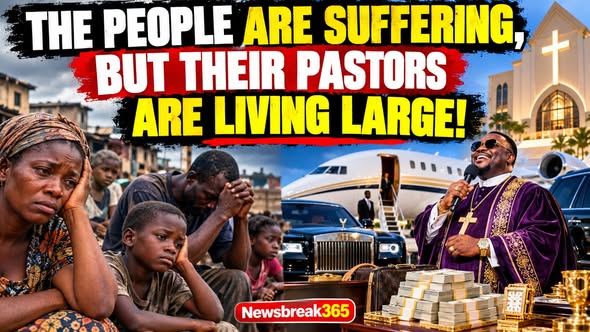
As many Africans struggle with poverty and rising living costs, the luxurious lifestyles of some religious leaders are raising questions about faith, financial transparency and accountability.
When the People Struggle to Survive, Who Is Looking After Them?
Across Africa, millions of families face the daily challenge of making ends meet. The cost of food, housing, education and healthcare puts pressure on household budgets, leaving many people wondering how they will provide for their families.
For many, religious institutions remain a source of hope, spiritual comfort and community support. People attend services seeking encouragement, healing, direction and the strength to overcome life’s difficulties.
However, a difficult question continues to arise in public discussions about religion: **Why are some religious leaders associated with extravagant lifestyles while members of their congregations struggle to meet their basic needs?**
From luxury vehicles and expensive mansions to private jets and lavish public appearances, the wealth displayed by some prominent religious leaders has prompted debate about the relationship between religious ministry, personal prosperity and social responsibility.
The issue is not whether a pastor should be wealthy. The deeper question is whether religious institutions are fulfilling their responsibilities to the people who trust them.
The Financial Sacrifices of Ordinary Worshippers
Many worshippers make financial contributions to their religious communities through offerings, tithes, donations and special fundraising campaigns.
Some contribute willingly because they believe in the mission of their church and want to support its activities. Others give because they hope to receive spiritual encouragement or because they feel a strong sense of responsibility towards their faith community.
For low-income families, however, financial contributions can represent a significant sacrifice.
Consider a parent struggling to pay school fees, a worker who can barely afford rent or a family trying to pay medical bills. When such people contribute to a religious institution, they should reasonably expect responsible stewardship of those funds.
This raises important questions.
Are donations being used to support genuine religious and community activities? Are the institution’s finances managed transparently? Do members have access to appropriate financial reports? And how much assistance reaches vulnerable people within the congregation?
These questions deserve serious consideration, without assuming that every church or pastor misuses donations.
Should Religious Leaders Live in Luxury?
There is no universal rule that a religious leader must live in poverty. Pastors, like other professionals, may receive legitimate compensation for their work, own property and enjoy the rewards of their careers.
Some religious institutions also operate large organisations with substantial expenses, including staff salaries, buildings, media operations and charitable programmes.
Nevertheless, wealth can become a matter of legitimate public concern when an institution relies heavily on donations from financially vulnerable people and provides little information about how those funds are used.
The central issue is not wealth itself, but transparency, responsibility and the treatment of people who provide financial support.**
If a religious leader lives comfortably while the institution also provides meaningful support to vulnerable families, that situation deserves to be assessed on its actual merits.
But when extravagant displays of wealth appear alongside persistent appeals for money, members have every reason to ask reasonable questions about priorities and accountability.
Faith Should Not Be Used to Exploit Vulnerability
People experiencing poverty, illness, unemployment or family difficulties may be especially vulnerable to promises of a dramatic change in their circumstances.
Religious teachings can provide genuine comfort and hope. However, problems arise when spiritual authority is used to pressure people into giving money they cannot afford, or when financial contributions are presented as a guaranteed route to wealth, healing or divine favour.
No person should have to choose between feeding their children and feeling accepted by their religious community.
Religious leaders have an important responsibility to communicate honestly, avoid exploiting people’s desperation and recognise the financial realities facing their congregations.
Faith should encourage compassion and dignity, not shame people who cannot afford to give.
What About the Pastors Who Help the Poor?
A balanced discussion must recognise that many religious leaders and faith-based organisations provide valuable services.
Some support orphanages, distribute food, assist struggling families, fund scholarships, operate schools and clinics, and help people facing emergencies. Many religious workers serve their communities without enjoying extraordinary wealth or public recognition.
These contributions matter and should not be dismissed.
The concern is directed at practices that lack transparency, encourage financially harmful behaviour or place personal enrichment above the welfare of the congregation.
Criticism should focus on documented conduct and institutional practices rather than treating all pastors as if they were the same.
What Should Change?
Religious institutions can strengthen public trust by adopting practical measures, including:
– **Financial transparency:** Provide appropriate reports explaining how donations and other income are spent.
– **Independent oversight:** Use suitable financial controls and independent audits where appropriate.
– **Responsible fundraising:** Avoid pressuring financially vulnerable members to give beyond their means.
– **Community support:** Consider food assistance, education, healthcare support and other programmes that address local needs.
– **Accountable leadership:** Establish clear processes through which members can raise concerns and seek answers.
These measures can help ensure that religious institutions remain places of trust, service and genuine community support.
The Bigger Question: Who Benefits From Religion?
Religion is deeply important to many people, offering meaning, identity, moral guidance and a sense of belonging. It should be possible to respect people’s beliefs while also questioning how religious institutions exercise financial and spiritual authority.
As economic hardship continues to affect many households, conversations about charitable giving, religious wealth and accountability are worth having openly and respectfully.
The question is not whether people should stop praying, attending church or supporting their faith communities.
The question is whether religious institutions can demonstrate that they take the welfare of their members seriously.
**When ordinary people make sacrifices to support a ministry, should that ministry’s success be measured only by the size of its buildings and the wealth of its leader, or also by the lives it improves?**
That is a conversation worth having.
—
### Join the Conversation
Do you believe religious leaders should publicly account for how church donations are spent?
Should churches do more to support members who are struggling with poverty, school fees, rent and medical bills?
Share your views respectfully in the comments.
**Newsbreak365 — Bringing important conversations to the public.**
*Editorial note: This article discusses a general social concern. It does not accuse any specific religious leader or institution of wrongdoing.*
**Suggested SEO keywords:** pastors and wealth in Africa, church financial transparency, religious accountability, poverty in Africa, church donations, faith and social responsibility.
FOLLOW US ON:
FACEBOOK
TWITTER
PINTEREST
TIKTOK
YOUTUBE
LINKEDIN
INSTAGRAM