
Connect with us

Business

Marketers fault Dangote’s 500,000-litre fuel delivery threshold

Published

on

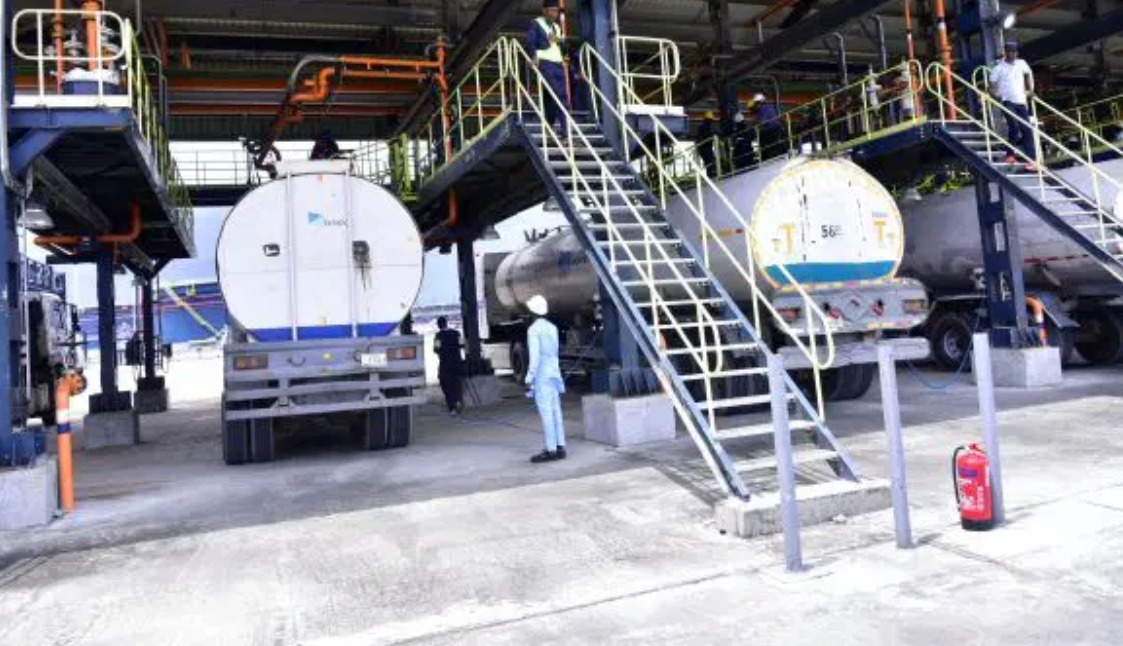
The Dangote Petroleum Refinery has introduced a minimum purchase requirement of 500,000 litres of petrol for oil marketers wishing to benefit from its free delivery scheme, sparking debates across Nigeria’s downstream petroleum sector.

The refinery confirmed the new condition this week, stating that only marketers who buy half a million litres or more qualify for no-cost transportation of products. At the refinery’s gantry price of N820 per litre, this translates to a minimum outlay of about N410 million, equivalent to at least 11 trucks of 45,000 litres each.

A senior refinery official, who asked not to be named, explained, “Yes, the Minimum Order Quantity for the free delivery is 500,000 litres.”

The requirement has raised concerns among independent petroleum marketers, who argue that the benchmark is too high for most operators to meet. The National Publicity Secretary of the Independent Petroleum Marketers Association of Nigeria, Chinedu Ukadike, confirmed that members were struggling with the threshold.

“Yes, it is true. We have to buy a minimum of 500,000 litres. That requirement has not been easy to follow,” he said. Ukadike explained that the association was compiling a list of members who could pool resources to meet the refinery’s benchmark.

According to him, without such collaboration, the free delivery scheme could be hijacked by middlemen, leading to profiteering and bureaucracy in the fuel supply chain.

“The current situation would bring back middlemen. We usually just buy one truck before, but now we have to buy 11 trucks. That is why we are encouraging members to group themselves to access products directly from Dangote,” Ukadike stressed.

See also  President Trump orders firing of Labor statistics chef over unemployment in US

Energy analyst Olatide Jeremiah, Chief Executive Officer of Petroleumprice.ng, criticised the requirement, describing it as unrealistic for the majority of retail station owners. “At ₦820 per litre, marketers must raise over ₦400m to qualify. How many operators can afford that? Many will have no choice but to rely on wholesalers,” Jeremiah said.

He argued that the policy could inadvertently strengthen middlemen, undermining the refinery’s goal of reducing costs and providing direct delivery to retailers. “The only way to eliminate middlemen is to allow marketers to load and pay per truck. Requiring 11 trucks per order risks keeping depot operators and wholesalers in business, which is exactly what Dangote wants to avoid,” he warned.

Earlier this month, the Dangote Refinery unveiled a free delivery initiative, backed by 1,000 compressed natural gas-powered trucks, aimed at cutting supply chain costs and ensuring cheaper pump prices for Nigerians.

The refinery, which boasts a capacity of 650,000 barrels per day, is Africa’s largest and began commercial operations last year. Its entry into the market has been hailed as a potential game-changer for Nigeria’s energy landscape, with expectations of improved domestic fuel supply and reduced dependence on imports.

Several major marketers, including Conoil Plc, Eterna Plc, Golden Super, Nepal Energies, Kifayat Global Energy, and Riquest & Gas, have already partnered with the refinery to benefit from the free logistics scheme.

However, the scheme has triggered strong opposition from tanker owners and fuel distributors. The President of the National Association of Road Transport Owners, Yusuf Othman, criticised the initiative, arguing that it undermines existing agreements between his members and fuel buyers.

See also  Meta sues Brazil, China advertisers over celebrity deepfake scams

“NARTO members own over 30,000 trucks, and we cannot do fuel distribution free of charge. Many of our members took bank facilities to buy trucks based on signed contracts. If Dangote delivers fuel directly for free, those agreements collapse,” Othman lamented.

He also cited provisions of the Petroleum Industry Act (PIA), arguing that the refinery’s direct free delivery violates regulatory guidelines.

Stakeholders now fear that instead of reducing costs, the new threshold could distort the market, leaving small operators sidelined while wholesalers reassert control.

Analysts warn that depot operators and middlemen, who typically thrive on bulk purchases, may continue to dominate distribution. Smaller filling station owners, lacking the resources to buy 11 trucks at once, may find themselves dependent on intermediaries once again.

Jeremiah reinforced this concern, noting that middlemen could easily resell products with additional margins, undermining the refinery’s effort to lower pump prices.

“If nothing changes, the refinery is only encouraging middleman activities, and depot operations will remain viable. That would defeat the original purpose of the free delivery programme,” he said.

While the Dangote Refinery’s initiative was designed to cut costs and reduce pump prices, the implementation has exposed structural weaknesses in Nigeria’s downstream sector.

IPMAN is pushing for collective purchasing to help smaller operators participate, while experts recommend revising the policy to allow per-truck loading. Industry watchers argue that without adjustments, the refinery risks alienating the very marketers it needs to ensure broad distribution nationwide.

For now, the free delivery programme remains under scrutiny, with stakeholders awaiting possible revisions. The debate highlights the delicate balance between economies of scale for the refinery and inclusivity for independent marketers in Nigeria’s evolving fuel supply chain.

See also  FG announces end of PENGASSAN, Dangote rift

punch.ng

FOLLOW US ON:

FACEBOOK

TWITTER

PINTEREST

TIKTOK

YOUTUBE

LINKEDIN

TUMBLR

INSTAGRAM

Continue Reading
Click to comment

Leave a Reply

Your email address will not be published. Required fields are marked *

Business

Agricultural quarantine service postpones release of recruitment shortlist

Published

on

The Nigeria Agricultural Quarantine Service has postponed the publication of shortlisted candidates for its ongoing recruitment exercise, which was initially scheduled for Thursday, August 13.

NAQS said the decision was made to ensure a thorough, transparent and accurate recruitment process.

The agency announced the postponement in a public notice signed by the Director of Human Resources, ACG Issaka Ahmed, and posted on its X handle on Friday.

“In order to ensure a thorough, transparent and accurate process, we are unable to release the list of shortlisted candidates as scheduled,” the notice stated.

The agency apologised for the delay and urged applicants and members of the public to remain patient while awaiting a new date.

“We sincerely regret any inconvenience or uncertainty this delay may have caused and appreciate the patience, understanding and continued interest of all applicants.

“All applicants and the general public are hereby notified that a new date will be communicated in due course through our official communication channels,” it said.

The agency advised applicants to rely only on information released through its official channels.

The recruitment exercise, which opened on July 28 and closed on August 10, attracted 606,928 attempted applications, while 407,659 were successfully submitted, according to statistics released by NAQS on Wednesday.

The agency said 199,269 applications were incomplete at the close of the application period.

The Assistant Superintendent of Quarantine II cadre, requiring HND or bachelor’s degree, recorded the highest number of applications with 290,076, followed by Quarantine Assistant II with 117,177 applications.

Other cadres included the NCE category with 79,685 applications, OND with 70,170, and the Superintendent cadre requiring a master’s degree with 13,183 applications.

See also  Electricity Power subsidy hits N418bn, losses exceed N300bn

PUNCH Online reports that NAQS said it will conduct a computer-based test and interviews on August 15, after shortlisted candidates are released on August 13.

However, candidates will now await new dates.

The recruitment exercise covers the Superintendent, Inspectorate and Assistant cadres.

Source: punchng.com

FOLLOW US ON:

FACEBOOK

TWITTER

PINTEREST

TIKTOK

YOUTUBE

LINKEDIN

INSTAGRAM

Continue Reading

Business

Customs dismiss smuggling, revenue leakage allegations

Published

on

The Nigeria Customs Service has dismissed allegations of increased smuggling, revenue leakage, recruitment impropriety and manipulation of succession within the service, describing them as a misrepresentation of its operations and administrative processes.

The service’s National Public Relations Officer, Deputy Comptroller Abdullahi Maiwada, stated this in a response released on Thursday to an investigative report published by a media outlet (not PUNCH) on August 7, 2026.

The report had alleged intensified smuggling along the Seme, Idiroko, Ilaro, Ipokia and Igbeti-Kishi corridors, as well as manipulation of the 846 valuation code at the Apapa, Tin Can Island and PTML Area Commands.

Maiwada said the claim of a surge in smuggling was inconsistent with the service’s enforcement activities, pointing to regular seizures recorded along the affected corridors.

“Our responsibility is to reduce smuggling to the barest minimum, not to claim that it can be completely eradicated,” he said.

On the 846 valuation code, the NCS explained that it was a digital tool designed for vehicles with non-standard or non-compliant Vehicle Identification Numbers, including specialised heavy equipment, classic vehicles and customised models.

“The 846 code is an established digital valuation code within the Customs portal, specifically designated for vehicles with non-standard or non-compliant Vehicle Identification Numbers,” Maiwada said.

He added that standard vehicles were assessed automatically through manufacturer-linked databases, while 846 applications were subjected to secondary approval by valuation officers and Area Controllers.

Maiwada said discrepancies discovered through post-clearance audits could lead to Demand Notices for the recovery of short-collected duties and sanctions against offending operators, adding that revenue collections at major ports had reached historic levels under the digital framework.

On the recruitment of Assistant Superintendents of Customs II, the Service said the exercise was conducted under the authorisation of the Nigeria Customs Service Board and in line with the NCS Act 2023 and Federal Character Commission guidelines.

See also  President Trump orders firing of Labor statistics chef over unemployment in US

It said successful candidates were issued provisional offers subject to medical verification, background checks and formal acceptance.

The Service also rejected allegations of succession manipulation and favouritism among officers, saying promotions were determined by seniority, merit, promotion examinations and available vacancies in accordance with established regulations.

“Succession and promotion within the Service are governed by established rules and career progression structures, not personal preference,” the Service said.

Maiwada said leadership training for Deputy Comptrollers was part of the Service’s human capital development strategy, aimed at strengthening trade operations, intelligence management and executive leadership.

He explained that approved training programmes and international exposures were funded through budgetary allocations or formal technical assistance arrangements with partner institutions.

Responding to calls for independent investigations, the NCS said it remained subject to oversight by the Federal Ministry of Finance, National Assembly, Office of the Auditor-General for the Federation and anti-corruption agencies.

“The management maintains a firm, intolerant posture toward corruption, revenue leakage or administrative misconduct,” the Service stated.

It added that any officer or stakeholder found culpable would face disciplinary action and prosecution in accordance with the law, while assuring Nigerians that the Service would cooperate with any legitimate investigation by statutory authorities.

Source: punchng.com

FOLLOW US ON:

FACEBOOK

TWITTER

PINTEREST

TIKTOK

YOUTUBE

LINKEDIN

INSTAGRAM

Continue Reading

Business

Patience Jonathan revealed she mentored Azikel refinery boss Eruani from ‘small boy’ to big businessman

Published

on

Ex-President Goodluck Jonathan’s wife, Patience, has described the Group President of Azikel Group, Dr Azibapu Eruani, as a “small boy” she raised and mentored into the league of Nigeria’s biggest businessmen.

She said her guidance was behind his bold entry into big business at a relatively young age.

The former First Lady spoke on Tuesday in a video which went viral on Thursday during an inspection tour of the Azikel Refinery in Obunagha, Bayelsa State, alongside other dignitaries.

She said she personally introduced Eruani to billionaire businessmen, Aliko Dangote and Aminu Dantata, and pushed him to aspire to their level despite being the youngest among them.

“He’s a boy that I brought up. We are always together. Although he’s the little one among us when we are friends — Dangote, Seyi, Dantata, Eruani — among us, he’s the smallest. But I made sure he followed the Dangotes, he followed Dantata.

“Because I’m a woman in their midst, I made sure I told this small boy, ‘Go and follow them, and stop the grammar.’ But when he told me that one day he would be like Dangote, I said, ‘You’re thinking too high.’ I prayed to God to grant him his heart’s desire,” she said.

Group President of Azikel Group, Dr Azibapu Eruani

The former First Lady also recalled how the immediate past APC administration under Muhammadu Buhari initially failed to grant Eruani a refinery licence before eventually approving three.

“During the Buhari administration, he and others came to me and told me they were going to apply for a refinery. I told him, ‘Eruani, your brother, the President, did not give you a refinery.

See also  NNPC eyes $60bn investment, targets 600tcf in new master plan

“Is it the APC government that will give you one?’ I prayed it would happen. But later, they came back and told me they had been given three refineries,” she said.

The inspection coincided with the arrival of the refinery’s Crude Distillation Unit, a major milestone in the development of the $1bn facility.

The 25,000 barrels-per-day plant is a private hydro-skimming refinery designed to process condensate into petrol, diesel, aviation fuel, kerosene and other products.

It is set to become Nigeria’s second-largest full-slate refinery and the first major privately owned refinery in the Niger Delta.

The Managing Director/Chief Executive Officer of the Niger Delta Development Commission, Samuel Ogbuku, who joined the inspection tour, commended Eruani for his perseverance, noting that he had attended the project’s groundbreaking ceremony eight years ago.

Ogbuku described the refinery as an inspiration and a potential catalyst for investment, job creation and economic growth in Bayelsa State, and urged residents, particularly youths, to key into the opportunities it would create.


He also praised the Bayelsa State Government for improving road infrastructure leading to the refinery site and called for continued support for the project.

Governor Douye Diri, who was represented at the inspection by his deputy, Peter Akpe, has consistently backed the project, which is expected to employ hundreds of workers and drive industrialisation in the state.

Other dignitaries at the event included the Chairman of the Bayelsa State Council of Traditional Rulers, King Bubaraye Dakolo; Vice President of Azikel Group, Presley Asemota; and Isaac Yalah, among others.

See also  Electricity Power subsidy hits N418bn, losses exceed N300bn

Source: punchng.com

FOLLOW US ON:

FACEBOOK

TWITTER

PINTEREST

TIKTOK

YOUTUBE

LINKEDIN

INSTAGRAM

Continue Reading

Trending