Connect with us

News

Armed Forces Day: Tinubu, govs celebrate soldiers, fallen heroes

Published

on

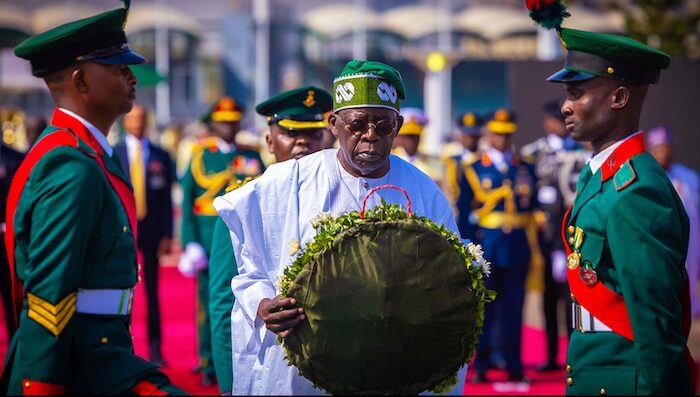
President Bola Tinubu, the leadership of the National Assembly, governors, and other top government officials, on Thursday, honoured fallen and living soldiers at the Armed Forces Celebration and Remembrance Ceremony in Abuja and across the states.

Armed Forces Remembrance Day in Nigeria is observed annually to honour the men and women of the Nigerian military who have sacrificed their lives in service to the nation. Specifically, January 15 commemorates the end of the Nigerian Civil War, which officially concluded on January 15, 1970.

In Abuja, the event began with the submission of the parade state by the parade commander, after which Vice President Kashim Shettima, who represented the President, inspected the guard of honour, accompanied by the Commander, Guards Brigade, Brig Gen Adebisi Onasanya.

A firing party then led dignitaries to the cenotaph for the laying of wreaths.

The Last Post was sounded in honour of fallen heroes as all present stood in respect.

Special prayers were later offered by an imam and a chaplain for the repose of the souls of the departed and the protection of serving personnel.

This was followed by a minute of silence in honour of the fallen soldiers.

At about 10:35 am, wreaths were laid at the cenotaph, beginning with the Vice President, followed by the Senate President, Godswill Akpabio, the Deputy Speaker of the House of Representatives, Ben Kalu, the Chief Justice of Nigeria, Justice Kudirat Kekere-Ekun; the Minister of Defence, Gen Christopher Musa (retd), Dean of the Diplomatic Corps and High Commissioner of Cameroon, Salaheddine Ibrahima, Chief of Defence Staff, Gen Olufemi Oluyede, Chief of Army Staff, Lt Gen Waidi Shaibu, Chief of Air Staff, Air Marshal Sunday Aneke, the Chief of Naval Staff, Vice Admiral Idi Abbas and the Inspector General of Police, Kayode Egbetokun.

Three volleys were later fired by the firing party after the wreath-laying.

The President, represented by Vice President Shettima, thereafter signed the anniversary register and released pigeons to mark the occasion.

Other dignitaries at the event were the Secretary to the Government of the Federation, George Akume; the National Security Adviser, Nuhu Ribadu, among others.

Speaking to journalists after the event, Gen Musa (retd) reaffirmed the importance of honouring Nigeria’s fallen soldiers, wounded personnel, serving officers and their families, noting that the nation owed them continued appreciation and support.

He said, “It is always important to appreciate those who have made sacrifices — those who lost their lives, their family members, those who were injured, and those who are still serving.

“It is a comprehensive effort we undertake together to appreciate and encourage them by reminding them that Nigerians love them, Nigerians are praying for them, and that we need to support them.

“If you recall, even the name has been changed. It is no longer only the Armed Forces Remembrance Day. It is now the Armed Forces Celebration, where we celebrate those who are alive and remember those who have passed on. I think that is very comprehensive.”

The celebration was also observed across the states, with governors and heads of security agencies honouring both fallen and serving heroes.

In Ondo State, Governor Lucky Aiyedatiwa pledged to support the widows of military men who had lost their lives in active service to the country.

See also  Charly Boy bus stop renamed Olamide (Baddo) Bus stop

Speaking at the final parade, laying of wreaths and empowerment of widows of the fallen heroes at the Government Cenotaph, Akure, the state capital, he said, “To the widows of our fallen heroes, we recognise the challenges you face and the sacrifices you continue to make.

“We are committed to supporting you and ensuring that you have the resources, opportunities and recognition you deserve.”

The Commissioner for Women Affairs and Social Development, Dr Seun Osamaye, commended the governor for his financial support to widows, noting that the initiative would enhance their livelihoods.

In Cross River State, Governor Bassey Otu also reaffirmed his administration’s commitment to the welfare of military veterans, widows and families of fallen heroes.

At the celebration held at the Eleven Eleven Millennium Park, remembrance arcade on Thursday in Calabar, the governor described the event as a solemn reminder of the supreme sacrifices made by members of the Armed Forces to keep Nigeria united and peaceful.

Otu, represented by the Deputy Governor, Dr Peter Odey, said, “The lesson from this ceremony is that we remember our fallen heroes, those who paid the supreme sacrifice for this country to remain one.

“Many people do not fully understand the sacrifices these people made, most of them with their lives. The fact that we can sleep peacefully in this state is because of the hard work and commitment of our military officers.”

The State Chairman of the Nigerian Legion, Daniel Ojugbo, described the ceremony as a mark of honour for fallen heroes and a moment of reflection on the challenges faced by veterans and their families.

Katsina State Governor, Mallam Dikko Radda, speaking at the Peoples Square, Katsina, reaffirmed his administration’s commitment to sustain support for the security forces and the welfare of veterans.

Describing the occasion as a solemn moment of reflection, Radda paid glowing tribute to both fallen heroes and living veterans, as well as active-duty personnel, whose commitment, he said, continued to shield the country from internal and external threats.

“In Katsina State, we hold this day with profound reverence. Our soil has known the footsteps of many gallant soldiers, some who returned as heroes, others whose names now grace memorials, and countless more whose sacrifices remain unspoken but never forgotten,” the governor said.

He extended condolences to families of fallen heroes, describing their loss as a collective sorrow and their resilience as a source of inspiration.

Ogun State Governor, Dapo Abiodun, reiterated his administration’s commitment to improving the welfare of families of deceased soldiers who paid the supreme price in the service of the nation.

Speaking at the special parade and wreath-laying ceremony at the Arcade Ground, Governor’s Office, Oke-Mosan, Abeokuta, the governor also pledged the continued support of his administration for veterans of the Nigerian Army in recognition of their selfless service to the country.

Represented by the Deputy Governor, Noimot Salako-Oyedele, the governor said “fallen heroes and war veterans deserved to be honoured because the peace and unity currently enjoyed in the country were products of their patriotism and sacrifice.”

He commended the gallant officers and men of the Nigerian Army, adding that “Your professionalism, discipline and commitment to duty continue to underpin the peace and stability we enjoy in Ogun State and across the country. We do not take your sacrifices for granted.”

Abia State Governor, Alex Otti, urged residents to take actions that would promote peace, unity and protect the sovereignty of the Nigerian State.

See also  Don’t sell your NIN or personal data for N2000 — NIMC warns Nigerians

At the Armed Forces Remembrance and Celebration Day held in Umuahia, the state capital, the governor insisted that violence should have no place in the state and country at large.

He asked citizens to learn from history, particularly the 1966 coup and the civil war.

Otti commended the leadership of the various security He commended agencies in the state for their unyielding resolve to ensure the safety of lives and property in both urban and rural areas, noting that their exceptional courage had improved the social and economic conditions of Abia residents and facilitated the reactivation of previously dormant resources, particularly agricultural lands.

He disclosed that the state remained committed to supporting the welfare of the spouses and children of deceased personnel, providing sustenance for the adults and scholarships for the children to pursue education up to the tertiary level.

The governor also paid respect to five Ghanaian security personnel who died in active service in the state in 2025 and pledged to provide for the welfare of their spouses and children.

In Delta State, Governor Sheriff Oborevwori led other officials in laying of wreaths at the ceremonial tomb of the Unknown Soldier at the Cenotaph in Asaba.

Others in attendance were the Deputy Governor, Monday Onyeme; Speaker, state House of Assembly, Emomotimi Guwor; Chief Judge, Justice Tessy Diai, service commanders of the Armed Forces and the state Commissioner of Police.

Also in attendance were the Secretary to the State Government, Dr Kingsley Emu; Chairman, Delta State Council of Traditional Rulers and the Orodje of Okpe, Maj Gen Felix Mujakperuo (retd.) and members of the Nigerian legion, among others.

Kebbi State Governor, Dr Nasir Idris, on Thursday restated his administration’s commitment to the welfare of serving military personnel, veterans and families of fallen heroes.

Speaking at the commemoration held at the Haliru Abdu Stadium, Birnin Kebbi, Idris expressed sympathy to the families of fallen heroes, assuring them that their loved ones “did not die in vain” and that Kebbi State would continue to support them through targeted welfare programmes.

“As a government, we remain fully committed to the welfare of our armed forces, veterans and their families,” he said.

In a show of support, the Secretary to the State Government, Alhaji Yakubu Tafida, announced a N30m donation on behalf of the state government to the Officers’ Wives Association, Widows Association of Soldiers and Servicemen, with N10m allocated to each group.

The event followed another round of donations a day earlier, in which the Kebbi State Government contributed N50m to the Nigerian Legion, while the governor donated N10m.

Speaking on the celebration, the African Democratic Congress urged leaders to demonstrate responsible, people-centred governance by prioritising the safety and well-being of Nigerians over image management, foreign travels, or political convenience.

In a statement issued on Thursday by its National Publicity Secretary, Bolaji Abdullahi, the ADC expressed concern over President Bola Tinubu’s absence on such a solemn occasion, noting that the physical and moral presence of the Commander-in-Chief would be an important symbol of solidarity with the armed forces and their families, especially amid growing insecurity.

See also  Nationwide blackout looms as electricity workers down tools

“It is therefore deeply troubling that the President of the Federal Republic is absent and unavailable on a day meant to symbolise solidarity with our armed forces and the families who continue to bear the cost of Nigeria’s security failures.

“At a time when Nigerian soldiers are overstretched across multiple fronts, battling insurgency, banditry, and violent crime, leadership cannot be outsourced, postponed, or treated as ceremonial.

“The physical and moral presence of the Commander-in-Chief on this day is not optional; it is a statement of respect, responsibility, and shared sacrifice,” the statement read.

The party said it honoured the fallen heroes, stood with serving personnel and recognised the resilience of military families who continued to pay the ultimate price for the country.

“Remembrance must go beyond wreaths and words. It must be reflected in leadership that shows up, takes responsibility, and places the lives of Nigerians above image management, foreign trips, or political convenience,” the party stated.

The Peoples Democratic Party National Working Committee, led by Tanimu Turaki (SAN), also called on the Federal Government to prioritise improved welfare packages for officers and men of the Armed Forces.

Turaki, in a statement commemorating the 2026 Armed Forces Remembrance Day on Thursday, emphasised that providing sufficient support was essential for sustaining morale and enhancing national security.

He called for the provision of sufficient funding for security agencies to enable them to effectively combat insecurity and ensure the restoration of peace and stability across the nation.

“As our country marks the 2026 Armed Forces Remembrance Day, we convey our deepest condolences to the families of members of the Armed Forces who died in active service while executing their mandate of protecting the territorial integrity and sovereignty of our country.

“We use this opportunity to demand improved welfare packages for members of the Armed Forces and all members of the security and intelligence community, to help them better discharge their assigned roles.

“We also urge the Federal Government to adequately fund the security agencies to effectively neutralise agents of insecurity and restore peace and security to our country,” the statement read.

The Kogi State PDP chairman, Muhammed Gambo, in a statement on Thursday, saluted the sacrifices made by the fallen heroes and heroines of the Nigerian Armed Forces.

He called on the government at all levels to show up for the families of the fallen heroes.

“As we honour these brave men and women, let us collectively shun tendencies that inflame passions in our polity.

“Let us celebrate our diversity and see the differences as reflected in the rainbow of our colours as sources for strength rather than weakness to be exploited for narrow individual or group’s political, social or economic advantage…

“Today, as we gather all over the nation, let us not forget the families of those who paid the ultimate price, let us give them a reason to feel proud that their husbands, sons and daughters truly died for causes greater than their individual desires,” he stated.

punch.ng

FOLLOW US ON:

FACEBOOK

TWITTER

PINTEREST

TIKTOK

YOUTUBE

LINKEDIN

TUMBLR

INSTAGRAM

Continue Reading
Click to comment

Leave a Reply

Your email address will not be published. Required fields are marked *

News

Pentagon restores name of US Pacific Command

Published

on

The Pentagon is set to restore the name of the US Indo-Pacific Command to the US Pacific Command, it said on Tuesday, reversing a 2018 decision.

The renaming will not change the command’s area of responsibility, which stretches from the western part of India to America’s Pacific coastline, the Department of War said in a statement.

Its “fundamental mission and its unwavering commitment to maintaining a free and open theatre alongside regional allies and partners” also remain unchanged, it added.

The name change “honours the command’s deep historical roots, fostering a sense of pride and collective spirit among all who serve in the Pacific,” the department said, without giving additional details.

The US Pacific Command was established by former President Harry Truman after World War II.

It operated under that name for over 70 years before being renamed as the US Indo-Pacific Command in 2018, in a nod to the growing importance of the Indian Ocean in US strategic thinking.

The 2018 name change also came as part of broader efforts by Washington to counter China’s growing influence across the Asia-Pacific domain.

AFP

See also  FG declares holidays for Christmas, New Year celebrations
Continue Reading

News

Labour to engage FG on minimum wage review

Published

on

The Nigeria Labour Congress and the Trade Union Congress said they will restart negotiations with the Federal Government over a new national minimum wage, warning that workers can no longer cope with rising living costs as inflation continues to erode real incomes.

The unions are pushing for what they described as a “genuine living wage” to replace the current framework, which they said no longer reflects Nigeria’s economic realities, particularly sharp increases in food, transport, housing, and healthcare costs.

The position was contained in a joint address delivered at the 114th International Labour Conference in Geneva on Monday, where the unions also rejected any proposal to tax the minimum wage or impose additional fiscal burdens on low-income earners.

Nigeria’s current minimum wage of N70,000 was signed into law on 18 July 2024, in an agreement between organised labour and the federal government. President Bola Tinubu formally announced the wage on 19 July 2024, and it took effect on 29 July 2024.

The agreement originally set a three-year review cycle, shifting from the previous five-year arrangement. However, in January 2025, the Federal Government adjusted the framework, announcing that the minimum wage would now be reviewed every two years, effectively setting 2026 as the next review point.

In light of this, labour leaders said they intend to formally open discussions with the federal government ahead of the July 2026 wage renegotiation deadline, in a bid to prevent the delays that have often hindered previous minimum wage reviews.

“The current Act expires early next year, and we have announced that renegotiation will commence by July 2026 to avoid the painful delays of the past. As soon as we leave here, we shall write again to the government demanding the commencement of the process for renegotiating the national minimum wage,” the unions said.

See also  Anglican Primate Hails Tinubu’s Economic Plans, Predicts Nigeria’s Rise

The labour leaders said workers are already under severe pressure from inflation, currency depreciation, and rising costs across essential services, arguing that official economic indicators do not reflect the daily realities of most households.

They warned that taxing the minimum wage would worsen poverty and deepen economic hardship at a time when many citizens are struggling to meet basic needs.

“We demand nothing less than a genuine living wage that reflects today’s harsh economic realities. We also demand immediate relief measures by governments at all levels until a new minimum wage is signed into law. We reject outright any attempt to tax the minimum wage or impose further burdens on the poor,” the unions said in their communiqué.

The unions stressed that the upcoming negotiations must go beyond nominal wage adjustments and instead focus on protecting real incomes, which they said have been steadily eroded by inflation.

They also urged federal and state governments to introduce short-term relief measures pending the conclusion of negotiations, warning that delays could heighten industrial tensions across the country.

Beyond wage concerns, the labour movement used the Geneva platform to highlight broader economic and social challenges, including insecurity, unemployment, and rising poverty levels.

They said insecurity in several parts of the country has made commuting increasingly dangerous for workers, with killings, abductions, and displacement affecting productivity and livelihoods.

According to the unions, nearly 2,000 people were killed in the first quarter of the year, while millions have been displaced, with entire communities and economic activities disrupted by violence.

See also  FG blames technical hitch for February salaries delay

They warned that worsening insecurity could force workers to remain at home as a survival response, escalating tensions beyond traditional labour action if not urgently addressed.

The labour leaders also said about 65 per cent of Nigerians, estimated at roughly 150 million people, are currently living in multidimensional poverty, driven by inflation, job losses, and declining purchasing power.

They argued that while macroeconomic reforms are aimed at stabilisation, they have yet to translate into improved living standards for ordinary citizens.

As the 2027 general elections approach, the unions said they are developing a charter of demands to shape their engagement with political actors and inform their support for candidates, noting that  only political actors who commit to improved security, functional public services, wage reforms, and protection of labour rights would receive their backing.

The labour movement also raised concerns over alleged interference in union affairs in some states, accusing certain governments of undermining democratically elected labour leadership structures.

They emphasised that organised labour would resist any attempt to weaken union independence or impose external control on labour organisations.

As the current wage regime approaches its 2026 review window, the unions said their priority remains securing a wage structure that reflects economic realities and protects workers from further erosion of income.

They maintained that the outcome of the upcoming negotiations would determine whether Nigerian workers receive what they termed a “living wage” or continue to endure worsening economic hardship.

punch.ng

FOLLOW US ON:
FACEBOOK

TWITTER

PINTEREST

TIKTOK

YOUTUBE

LINKEDIN

INSTAGRAM

Continue Reading

News

Ribadu, Akpabio advocate tech-driven border control over Insecurity

Published

on

The National Security Adviser, Nuhu Ribadu, and President of the Senate, Godswill Akpabio, on Tuesday called for the deployment of modern technology and stronger regional cooperation to strengthen Nigeria’s border security architecture and address growing security threats across the country.

FILE: Akpabio

They made the call at the opening of the 15th National Security Seminar organised by the Alumni Association of the National Defence College in Abuja.

Represented by the Director of Policy and Strategy at the Office of the National Security Adviser, Yazid Gbemudu, the NSA said Nigeria’s territorial integrity and national stability were closely tied to the effectiveness of its border security framework.

He noted that while Nigeria’s extensive land and maritime borders facilitated trade, regional integration and socio-economic development, they also exposed the country to threats including terrorism, arms trafficking, smuggling, human trafficking, irregular migration and other forms of transnational organised crime.

According to him, weak border governance creates vulnerabilities that can be exploited by criminal and terrorist networks, thereby undermining national security and development efforts.

“A major pillar of Nigeria’s contemporary border security framework is the National Border Management Strategy, which promotes an integrated border management approach.

“The strategy seeks to enhance intelligence collaboration, strengthen border infrastructure, improve surveillance capabilities and modernise border management processes,” he said.

Ribadu said the deployment of Border Management Information Systems and other technological solutions at key entry and exit points had improved data collection, traveller screening and migration monitoring.

“These initiatives demonstrate Nigeria’s commitment to aligning its border management practices with international standards,” he added.

See also  PHOTOS: Yoruba Nation Agitator Sunday Igboho Apologises To Ooni Of Ife, Pleads For Support To Clear Watchlist Status

The NSA stressed the need for the full implementation of an integrated border management system to improve coordination among security, intelligence and law enforcement agencies.

“Effective intelligence sharing, joint operations and harmonised border procedures are essential for addressing contemporary security threats,” he said.

He also advocated increased investment in technology-driven border security solutions.

“Expanding surveillance systems across land, maritime and coastal borders will significantly improve monitoring capabilities and reduce illegal cross-border activities.

“Modern challenges require modern solutions, including biometric identification systems, advanced border monitoring technologies and data-driven security frameworks,” Ribadu stated.

The NSA further emphasised the importance of regional and bilateral cooperation, noting that many of the security challenges confronting Nigeria’s borders were transnational in nature and required coordinated responses among neighbouring countries.

He also called for greater investment in border communities through sustainable development, improved infrastructure and economic opportunities to reduce their vulnerability to criminal exploitation.

“Strengthening Nigeria’s border security architecture is fundamental to ensuring national stability, protecting territorial integrity and promoting socio-economic development,” he said.

Ribadu, however, acknowledged challenges such as porous borders, inadequate infrastructure, limited technological capabilities and gaps in inter-agency coordination, saying they required urgent attention.

“Border security is a shared responsibility that requires the collective efforts of security agencies, government institutions, border communities and international partners,” he added.

Speaking at the event, Akpabio, who was represented by the Chairman of the Senate Committee on Defence, Ahmad Lawan, said Nigeria’s extensive land and maritime boundaries posed significant security challenges.

“As a country with extensive land and maritime boundaries, Nigeria faces significant challenges relating to border control, illegal migration, arms trafficking, smuggling and the infiltration of criminal and extremist elements.

See also  Don’t sell your NIN or personal data for N2000 — NIMC warns Nigerians

“It is, therefore, imperative that Nigeria prioritises the strengthening of its border security architecture through improved surveillance, enhanced infrastructure, better inter-agency coordination, technological innovation and stronger regional cooperation,” he said.

Akpabio noted that many of the security threats confronting Nigeria had transnational dimensions, making coordinated responses essential.

He stressed that peace and security remained prerequisites for meaningful national development.

“There can be no meaningful development without peace and security. Porous and poorly managed borders can become vulnerabilities that undermine national security efforts and national stability,” he said.

The Senate President also advocated a whole-of-government and whole-of-society approach to addressing insecurity.

According to him, government institutions, security agencies, civil society organisations, the private sector, traditional institutions, the media and academia all have critical roles to play in safeguarding the country.

Earlier, the Acting President of AANDEC, Commodore Amatare Kpou (retd.), described the seminar as a key platform for promoting informed discourse on national security challenges and opportunities.

Kpou said the theme of the seminar, “Strengthening Nigeria’s Border Security Architecture for National Stability,” was timely, given the growing threats of irregular migration, smuggling, trafficking and other cross-border crimes.

He expressed confidence that the deliberations would generate useful recommendations for policymakers and contribute to efforts aimed at building a safer and more secure Nigeria.

Nigeria shares over 4,000 kilometres of land borders with neighbouring countries and an extensive coastline, making border security a critical component of national security.

Authorities have repeatedly identified porous borders as channels for terrorism, arms smuggling, human trafficking and other transnational crimes.

The Federal Government has in recent years intensified efforts to strengthen border management through technology, intelligence sharing and regional cooperation.

See also  FG screens 170 foreigners seeking Nigerian citizenship

punch.ng

FOLLOW US ON:

FACEBOOK

TWITTER

PINTEREST

TIKTOK

YOUTUBE

LINKEDIN

INSTAGRAM

Continue Reading

Trending