Connect with us

Lifestyle

Murtala Muhammed’s simplicity led to his assassination – Daughter

Published

on

Aisha Muhammed, daughter of former Head of State, General Murtala Ramat Muhammed, has said her father’s simple lifestyle and leadership approach contributed to the ease with which he was assassinated.

Muhammed, who is also the Chief Executive Officer of the Murtala Muhammed Foundation, said this while speaking on ARISE News’ Morning Show on Monday.

Reflecting on her father’s leadership style on the 50th anniversary of his assassination, she said the late military leader embodied the values he preached, particularly accountability, responsibility and discipline.

She said her father believed corruption was a “cankerworm” capable of destroying society and did not merely speak against it but lived out his anti-corruption stance through his personal conduct and leadership style.

“I think his (late Muhammed’s) leadership style was clear. He led with clarity. He believed in accountability.

“He believed in responsibility, you know, and then, you know, we’re all very familiar with his anti-corruption stance, you know, and corruption was not something you sort of just talked about.

“He actually literally felt that it was a cankerworm that was going to destroy our society, and 50 years later, look at what has happened.

“But I also think that he felt that you had to embody the leadership, you know, in the way you yourself presented yourself,” Muhammed said.

According to her, Murtala Muhammed deliberately avoided the trappings of power, including heavy security details, motorcades and sirens, insisting on living like the ordinary Nigerian.

This lifestyle, she said, directly contributed to his assassination on February 13, 1976.

See also  The Majekodunmi Family of Abeokuta: A Legacy of Heritage and Leadership

Aisha Muhammed noted that he was travelling in traffic like every other road user when the attack occurred.

“If you know, my father didn’t go around with motorcades and sirens and a lot of security. Now, there are people who say to me, 50 years later, it must have been quite painful because of the loss, but that was what he embodied.

“So, and that was why it was actually easy to assassinate him, because he didn’t have a whole slew of security with him.

“He was in traffic just like everybody else. In fact, the traffic wardens stopped them, and they stopped, just like everybody else, and that was when the coup plotters came out from behind the sectarian barricade, and then he was shot,” she said.

General Muhammed seized power in a bloodless coup in July 1975, ousting General Yakubu Gowon.


FILE: General Murtala Ramat Muhammed

He was, however, assassinated during an abortive coup on February 13, 1976, barely six months after assuming office as Nigeria’s Head of State.

During his brief 200-day tenure, Muhammed implemented sweeping reforms, including the dismissal of over 10,000 public officials accused of corruption, the creation of seven new states, and plans for a transition to civilian rule.

His administration also initiated the process that led to the relocation of Nigeria’s capital from Lagos to Abuja.

FOLLOW US ON:

FACEBOOK

TWITTER

PINTEREST

TIKTOK

YOUTUBE

LINKEDIN

TUMBLR

INSTAGRAM

Continue Reading
Click to comment

Leave a Reply

Your email address will not be published. Required fields are marked *

Lifestyle

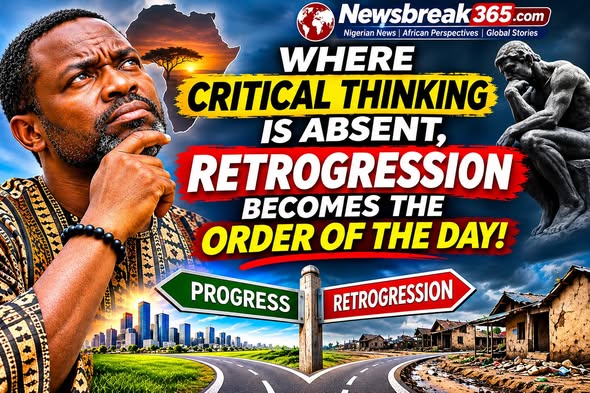
WHERE CRITICAL THINKING IS ABSENT, RETROGRESSION BECOMES THE ORDER OF THE DAY

Published

on

A society that discourages questions, celebrates ignorance, and blindly defends outdated beliefs cannot expect to make meaningful progress.**

One of the biggest obstacles to human development is not necessarily a lack of natural resources, money, or opportunities. Sometimes, the greatest obstacle is the absence of critical thinking.

A society cannot move forward when its people are discouraged from questioning authority, examining evidence, challenging established beliefs, and demanding accountability.

Unfortunately, across many African societies, independent thinking is sometimes mistaken for disrespect, questioning religious authorities is labelled rebellion, and challenging political leaders is treated as an act of disloyalty.

This mentality creates an environment where people defend ideas without examining whether those ideas are beneficial to society.

## WHEN QUESTIONING BECOMES A PROBLEM

How can a society develop when asking questions is considered offensive?

How can corruption be defeated when citizens defend politicians based on political loyalty rather than performance?

How can education transform society when people are encouraged to memorise information instead of understanding, analysing, and applying knowledge?

How can Africa compete globally when scientific evidence, innovation, research, and rational thinking are sometimes pushed aside in favour of superstition and unquestionable traditions?

These are uncomfortable questions, but uncomfortable questions are sometimes exactly what a society needs.

## BLIND LOYALTY IS THE ENEMY OF PROGRESS

A responsible citizen should be able to question political leaders without being branded an enemy.

A person should be able to examine religious teachings without being insulted or threatened.

Cultural traditions should be respected, but traditions should not be immune to criticism, particularly when they conflict with human dignity, justice, equality, and social development.

See also  Veteran actor Olu Jacobs dies at 84

No political leader, religious institution, cultural authority, or traditional belief should be above reasonable questioning.

Respect should never mean surrendering your ability to think.

## AFRICA NEEDS THINKERS, NOT JUST FOLLOWERS

Look at the societies making remarkable progress in science, technology, medicine, engineering, education, and industrial development.

Their progress is supported by investment in knowledge, research, innovation, institutions, accountability, and the freedom to challenge existing ideas.

Africa cannot solve modern problems with an unwillingness to question old assumptions.

We cannot continue blaming every national failure on spiritual forces while ignoring corruption, poor leadership, weak institutions, inadequate education, unemployment, and economic mismanagement.

Prayer may offer personal comfort to believers, but responsible governance, sound policies, education, scientific research, and accountability are essential to national development.

The future belongs to societies willing to learn, question, adapt, and improve.

## THE REAL QUESTION

Africa does not lack intelligent people. What it urgently needs is an environment where intelligence, curiosity, independent thought, and constructive criticism are encouraged rather than suppressed.

A society that fears questions will struggle to discover answers.

A society that rejects evidence will struggle to solve problems.

And a society that blindly protects outdated thinking will struggle to move forward.

**Critical thinking is not the enemy of religion, culture, or tradition. It is a necessary tool for examining ideas and making better decisions.**

The question is no longer whether Africa needs progress. The question is whether its people are willing to challenge the attitudes and systems that stand in the way.

**NEWSBREAK365 — Informing, Challenging Perspectives, and Encouraging Critical Conversations.**

See also  The Majekodunmi Family of Abeokuta: A Legacy of Heritage and Leadership

—

**JOIN THE CONVERSATION:**

What is holding Africa back the most?

1. Lack of critical thinking and independent reasoning.
2. Bad leadership and corruption.
3. Blind religious and cultural loyalty.
4. Poor educational systems.

Share your opinion. Let’s have an honest conversation.

#Newsbreak365 #CriticalThinking #AfricanDevelopment #Education #IndependentThinking #GoodGovernance #AfricaMustProgress

FOLLOW US ON:

FACEBOOK

WHATSAPP CHANNEL

TWITTER

PINTEREST

TIKTOK

YOUTUBE

LINKEDIN

INSTAGRAM

Continue Reading

Lifestyle

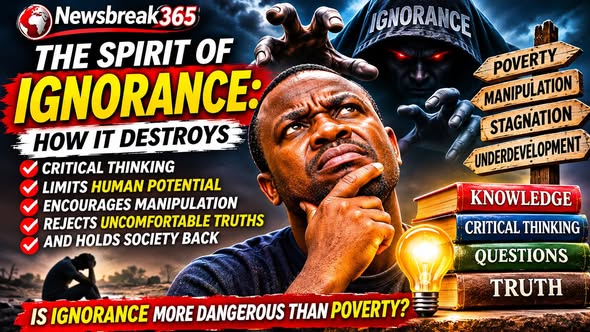
THE SPIRIT OF IGNORANCE: HOW IT DESTROYS CRITICAL THINKING, LIMITS HUMAN POTENTIAL AND HOLDS SOCIETY BACK

Published

on

Ignorance is not simply the absence of knowledge. Sometimes, it is the refusal to acquire knowledge, question established beliefs, or accept facts that challenge what we have been taught.**

One of the greatest obstacles to human development is a mindset that treats questioning as disrespect, independent thinking as rebellion, and new knowledge as a threat.

A person trapped in ignorance may defend what they do not understand, reject evidence that challenges their beliefs, and attack anyone who dares to ask difficult questions.

This is how ignorance becomes a powerful instrument of manipulation.

## How does the spirit of ignorance affect an individual?

**1. It destroys critical thinking.**

Instead of examining facts, people accept information without questioning its accuracy. They become followers rather than independent thinkers.

**2. It encourages blind obedience.**

People begin to obey authority, tradition, religious leaders, political figures, or popular opinions without considering whether their instructions are reasonable or beneficial.

**3. It limits personal development.**

When someone believes they already know everything, they close the door to learning, improvement, innovation, and personal growth.

**4. It makes people vulnerable to manipulation.**

Ignorance creates opportunities for dishonest politicians, religious manipulators, fraudsters, and other individuals who exploit people’s inability or unwillingness to question information.

**5. It encourages the rejection of uncomfortable truths.**

Some people would rather defend a familiar falsehood than accept an unfamiliar truth.

## How does ignorance affect society?

A society that discourages critical thinking creates an environment where misinformation spreads easily, accountability becomes difficult, and poor leadership can survive without sufficient scrutiny.

See also  Maryam Abacha From Royal Roots to National Influence

When citizens stop asking questions about education, healthcare, infrastructure, employment, security, and economic development, those responsible for delivering results face less pressure to perform.

No nation can achieve sustainable development simply by wishing for it. Progress requires knowledge, scientific thinking, practical solutions, innovation, responsible leadership, and citizens who are willing to question the status quo.

## The uncomfortable truth

Ignorance is not limited to people without formal education. An educated person can also be ignorant when they refuse to examine evidence, challenge their assumptions, or consider alternative perspectives.

Equally, questioning something does not automatically make someone intelligent. True critical thinking requires evidence, reason, intellectual humility, and a willingness to correct one’s mistakes.

**The greatest sign of intelligence is not knowing everything; it is having the courage to recognise what you do not know and the willingness to learn.**

Africa does not need more people who simply memorise information and repeat what they have been told. It needs people who can analyse, question, investigate, innovate, and demand accountability.

Because where critical thinking is absent, ignorance flourishes, manipulation becomes easier, and progress becomes difficult.

**A society that refuses to think will continue struggling with problems it has the intellectual capacity to solve.**

—

**NEWSBREAK365 EDITORIAL QUESTION**

Is ignorance more dangerous than poverty, or is ignorance one of the major reasons poverty, manipulation, and underdevelopment continue to thrive in many African societies?

Share your thoughts. Let’s have an honest conversation.

FOLLOW US ON:

FACEBOOK

WHATSAPP CHANNEL

TWITTER

PINTEREST

TIKTOK

YOUTUBE

LINKEDIN

INSTAGRAM

Continue Reading

Lifestyle

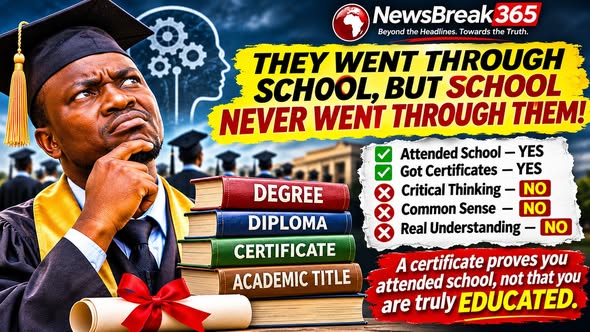
THEY WENT THROUGH SCHOOL, BUT SCHOOL NEVER WENT THROUGH THEM: THE TRAGEDY OF CERTIFICATES WITHOUT UNDERSTANDING

Published

on

Education without critical thinking is one of the greatest contradictions of modern society.**

There is a painful reality in our society that deserves serious discussion: some people have spent years in classrooms, earned impressive academic qualifications, collected university degrees and proudly displayed certificates, yet still struggle with basic reasoning, independent thinking and common sense.

They went through primary school, secondary school and university. They passed examinations, graduated and acquired academic titles. But the bigger question remains: **Did education truly transform their minds?**

A certificate may prove that someone attended an educational institution and met certain academic requirements. However, it does not automatically prove wisdom, intelligence, emotional maturity, critical thinking or good judgement.

## The difference between schooling and education

Schooling and education are related, but they are not necessarily the same thing.

Schooling often involves attending classes, studying prescribed materials, writing examinations and obtaining qualifications.

True education should go much further. It should teach people how to question information, analyse situations, recognise manipulation, challenge outdated beliefs and make informed decisions.

An educated person should not simply accept everything because an influential individual said it. They should have the ability to examine evidence, consider different perspectives and reach reasonable conclusions.

Unfortunately, some people mistake memorisation for understanding and academic qualifications for intellectual superiority.

## When certificates become more important than knowledge

In many societies, academic titles are treated as symbols of superiority. People introduce themselves with their degrees, qualifications and professional achievements, sometimes expecting unquestionable respect simply because they have attended prestigious institutions.

See also  Maryam Abacha From Royal Roots to National Influence

But what happens when someone possesses several qualifications yet refuses to listen to opposing opinions?

What happens when academic achievements are accompanied by arrogance, prejudice, intolerance and an inability to think independently?

What happens when people use their education to intimidate others rather than enlighten them?

That is when we must question whether education is serving its true purpose.

## Critical thinking is the real test

A society cannot progress simply by producing graduates. It needs people who can identify problems, challenge injustice, demand accountability, question harmful traditions and develop practical solutions.

A person who cannot distinguish facts from propaganda is vulnerable to manipulation, regardless of how many certificates they possess.

A person who refuses to question misinformation is not demonstrating intellectual strength.

And someone who believes that having a degree automatically makes their opinions superior to everyone else’s has misunderstood the purpose of education.

## Africa needs educated minds, not just certificate collectors

Africa does not suffer from a shortage of people with academic qualifications alone. The continent also needs stronger institutions, responsible leadership, scientific thinking, innovation, accountability and citizens who are willing to question things that do not make sense.

Education should liberate the mind, not imprison it in blind conformity.

We need graduates who can think independently, challenge bad leadership, reject ignorance and contribute meaningfully to society.

We need people who understand that respect should not be demanded through academic titles but earned through character, knowledge, wisdom and responsible conduct.

## THE BIG QUESTION

You can graduate from a university without graduating from ignorance.

See also  Oyo gears up for historic Olubadan coronation event

You can possess multiple degrees without possessing wisdom.

You can be academically qualified and still lack the ability to think critically.

**THEY WENT THROUGH SCHOOL, BUT SCHOOL NEVER WENT THROUGH THEM!**

Perhaps it is time we stopped measuring education only by the number of certificates hanging on people’s walls and started measuring it by the quality of their reasoning, decisions, behaviour and contributions to society.

**What is your opinion? Are we producing truly educated people, or are we producing people who are simply good at collecting certificates?**

Join the conversation.

#Education #CriticalThinking #AfricanEducation #Wisdom #CommonSense #IntellectualDevelopment #Newsbreak365

FOLLOW US ON:

FACEBOOK

WHATSAPP CHANNEL

TWITTER

PINTEREST

TIKTOK

YOUTUBE

LINKEDIN

INSTAGRAM

Continue Reading

Trending