Connect with us

Business

No plan to borrow from IMF’s $50bn fund – FG

Published

on

The Federal Government on Thursday declared that it has no plan to approach the International Monetary Fund to borrow from the estimated $50bn, which the IMF had earlier announced on Wednesday that it plans to use and support struggling economies in Africa.

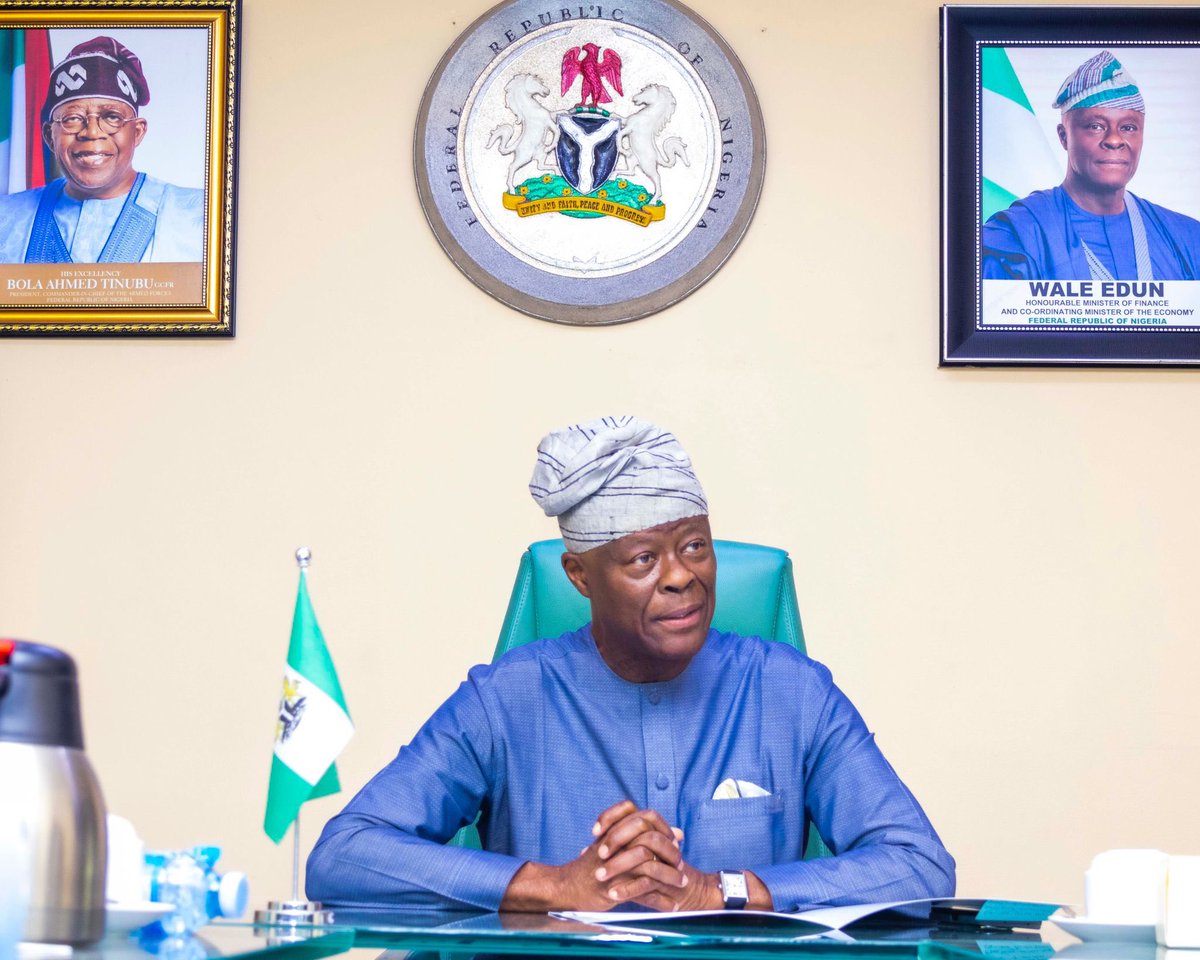
The Minister of Finance and Coordinating Minister for the Economy, Wale Edun, disclosed this at a press briefing during the ongoing Spring Meetings of the World Bank/IMF in Washington DC, United States.

The PUNCH earlier reported that the Managing Director, IMF, Kristalina Georgieva, had advised countries facing economic pressures to act swiftly in seeking financial support when necessary, warning that delays could worsen economic conditions.

“My advice is that when you need help financially, don’t hesitate to move fast, because the sooner we act, the more we protect the economy,” she said.

Georgieva also revealed that the institution was committed to financially supporting member countries through the current challenges, adding that about $20bn to $50bn was being planned by the IMF for this exercise.

“We anticipate financial demand for IMF support to range between $20bn and $50bn, which represents augmentation of some existing problems and prospective demands from new problems from at least a dozen countries, a number of them in Sub-Saharan Africa,” she said.

But while responding to a question on Thursday, whether the Federal Government would approach the IMF to borrow from the fund, Nigeria’s finance minister, Edun, responded negatively.

“Nigeria has no plan at the moment to approach the IMF for any other such burden,” Edun declared.

See also  Marketers fault Dangote’s 500,000-litre fuel delivery threshold

The minister also told the meeting on Thursday that African nations need “extra help” at this moment.

He noted that the Middle East crisis is one that affects African countries and economies disproportionately, stressing that while nations in this region “are not creators in any way of this situation, they stand to command greater pressure than perhaps any other region.”

The minister added, “This is in terms of the threat to macroeconomic stability, growth trajectories, and their ability to create jobs and reduce poverty in their countries.

And I think that is a clear statement, particularly to those identified as the most vulnerable oil-importing countries. They need and deserve extra help at this time.”

Recall that Georgieva earlier observed that many of the countries most affected by the Middle East crisis are located in Sub-Saharan Africa, adding that the IMF was working to identify those in urgent need of assistance. “We are very determined to use this week to identify which of the countries must get our support,” she stated.

She emphasised the importance of strong fiscal and economic policies, urging governments to build buffers during periods of economic stability to better withstand future shocks. According to her, prudent economic management in good times remains critical for resilience during downturns.

The IMF chief also disclosed that during a meeting with central bank governors and finance ministers from Africa held the previous day, officials did not request immediate financial assistance but instead sought policy guidance.

“But, of course, there could be a need for financial support. And my advice is that when you need help financially, don’t hesitate to move fast, because the sooner we act, the more we protect the economy,” she said.

See also  Bank recapitalisation: Local investors provide 72% of N4.6tn

Georgieva highlighted the broader global implications of the Middle East conflict, noting that it has already inflicted significant economic damage. “We have been watching developments in the Middle East. A war that causes significant pain to people and economies in the region and around the world. The impact on the global economy is already large,” she said.

She explained that supply chain disruptions and damage to infrastructure are driving up prices and slowing global economic growth. According to her, global growth is projected to decline from 3.4 per cent last year to 2.1 per cent in 2026. She warned that if the conflict persists and oil prices remain elevated for a prolonged period, global economic conditions could deteriorate further.

“But if the conflict persists, and oil prices stay high for an extended period, we must brace for tough times ahead,” she added.

On the IMF’s global outlook, Georgieva cautioned that in a worst-case scenario, global growth could fall to two per cent, stressing that the impact would be widespread. She noted that countries that depend on energy imports are particularly vulnerable, many of which are low-income or fragile economies.

“In the most adverse case, growth could fall to two per cent, and the shock is global,” she said, adding that the highest negative impact is being felt by energy-importing nations.

punch.ng

FOLLOW US ON:

FACEBOOK

TWITTER

PINTEREST

TIKTOK

YOUTUBE

LINKEDIN

Continue Reading
Click to comment

Leave a Reply

Your email address will not be published. Required fields are marked *

Business

Shell, banks launch $3bn financing for oil contractors

Published

on

Shell Nigeria Exploration and Production Company Limited has partnered with nine Nigerian banks to launch a $3bn contract finance facility aimed at improving access to credit for indigenous oil and gas contractors executing projects for the company.

According to a statement, the financing scheme, unveiled on Thursday, is designed to provide credit support to local contractors handling projects for SNEPCo and will be available in both naira and United States dollars.

The participating banks are First Bank, Guaranty Trust Bank, Zenith Bank, Access Bank, United Bank for Africa, Stanbic IBTC, Standard Chartered Bank, First City Monument Bank, and Fidelity Bank.

Speaking at the signing of the Memorandum of Understanding in Lagos, the Managing Director of SNEPCo, Ronald Adams, said the initiative aligns with the objectives of the Nigerian Oil and Gas Industry Content Development Act by promoting greater in-country value retention.

“The initiative reflects the spirit of the Nigerian Oil and Gas Industry Content Development Act, which is aimed at in-country value retention. Our partner banks offer capital and discipline.

“SNEPCo brings contracts and domiciliation of payments that de-risk lending.

On their part, the contractors provide performance. Each is accountable to the others, and the mutual accountability gives the arrangement its strength,” he said.

The Vice President, Finance, Shell Nigeria, CJ Akwaeze, said the financing scheme demonstrates Shell’s commitment to supporting the growth of oil and gas operations in Nigeria.

The Chairman of the Petroleum Technology Association of Nigeria, Wole Ogunsanya, who was represented by Dr Joan Faluyi, described the facility as a major boost for indigenous contractors.

See also  Aviation tax removal requires govt consensus, says Keyamo

Ogunsanya lauded the initiative as a “gateway to unlocking contractor financing issues, which will also drive efficiency in contract execution.”

Representatives of the participating banks also commended SNEPCo for introducing the financing arrangement, saying the partnership would strengthen local contractors, and pledged their continued support for the initiative.

SNEPCo said Nigerian companies have continued to play significant roles in its operations and project delivery. It noted that earlier this year, 43 wholly Nigerian companies participated in the turnaround maintenance exercise at the Bonga Floating Production Storage and Offloading vessel out of the 53 companies involved in the exercise.

According to the company, the Contract Finance Facility is expected to further strengthen the capacity of Nigerian companies and enhance value delivery in the operations of Nigeria’s premier deepwater producer.

punch.ng

FOLLOW US ON:

FACEBOOK

TWITTER

PINTEREST

TIKTOK

YOUTUBE

LINKEDIN

Continue Reading

Business

Nigeria faces lubricant squeeze as imports tighten globally

Published

on

Nigeria may face a lubricant supply squeeze in the coming months as tightening global base oil supplies and rising prices limit imports into West Africa, according to a report by global energy and commodity intelligence firm Argus.

The report, based on insights from Argus’ Head of Base Oil Pricing, Gabriella Twinning, said lower availability of base oils and rising global prices linked to disruptions caused by the US-Iran conflict are reducing offers into the West African market despite the announcement of a peace deal.

It noted that West Africa remains heavily dependent on imported base oils, with average annual imports standing at about 135,752 tonnes over the past five years. According to the report, the Dangote refinery expansion includes a base oil production unit, but the facility has yet to commence operations, leaving the region dependent on imports.

“Lower availability of base oils and rising global prices due to the continued disruption associated with the US-Iran war are curbing offers into the West African market despite a peace deal announcement,” Twinning stated.

On the region’s dependence on imports, Twinning said West Africa is a net importer of base oils, with average imports of around 135,752 tonnes annually over the past five years.

The report disclosed that the last major shipments arrived in March, warning that replacement cargoes are unlikely to be available from exporting countries throughout the summer. “The last large shipments arrived in March, and replenishment cargoes look unavailable from exporting nations over the summer,” she stated.

Explaining the supply constraints, Twinning said, “Bulk European Group I volumes, usually used for engine, marine and industrial oil lubricants and greases, are unavailable following PK Orlen’s five-week maintenance shutdown and restart at the end of May.

See also  Reps to mediate in PENGASSAN, Dangote refinery dispute

“Bulk volumes out of the US are also limited as refiners service domestic demand and stockpile volumes for hurricane season. Crude changeovers at some Group I US refineries are also hampering output.”

The report noted that Nigerian buyers could switch to alternative grades where product formulations permit. “Nigerian buyers could purchase Group II heavy grades as alternatives to Group I where formulations allow. These are more readily available outside Asia. However, Asian sellers are prioritising higher prices from blenders in South America,” Twinning said.

She further stated that volumes from Russia had also declined as several refineries undergo repair works. According to her, higher spot prices are also discouraging purchases into the region.

“Rising spot prices to record highs in June since the start of the conflict will also make any cargo unattractive to West African buyers given the complicated payment process,” Twinning said.

Warning of the implications for the local market, she added that West African blenders would need to increase ex-tank prices and bid levels to compete with buyers in other regions.

“Demand is rising despite the rainy season, when transport and logistics typically slow. This is because no replenishment cargoes have arrived since March and tanks are running dry,” she noted.

punch.ng

FOLLOW US ON:

FACEBOOK

TWITTER

PINTEREST

TIKTOK

YOUTUBE

LINKEDIN

Continue Reading

Business

African startups raise $3.9bn as funding rebounds – Report revealed

Published

on

African startups raised $3.9bn across 506 deals in 2025, signalling a recovery in fundraising activity after earlier market challenges, according to a new report by Bloomwit Africa.

The report stated that technology funding exceeded $4bn through a combination of equity and debt financing, representing an estimated 25 per cent year-on-year increase, with venture debt emerging as a significant source of capital.

Bloomwit Africa, a foremost PR and communications firm, stated in its report that the positive trend extended into 2026, with startup funding reaching $705m in the first quarter, up 26.5 per cent year-on-year, as investment activity spread across key markets, including Egypt, South Africa, Kenya and Nigeria.

According to the report, “the improvement in funding reflects growing investor interest in Africa’s technology ecosystem despite global funding pressures that have affected venture capital markets in recent years.”

The report noted that increasing use of venture debt alongside equity financing is providing startups with additional funding options, while investment activity continues to broaden beyond a few traditional markets.

It added that the wider geographical spread of funding across leading African economies suggests a more diversified investment landscape as investors seek opportunities across the continent.

The report stated that sustained capital inflows into technology startups could support innovation, business expansion, and job creation, while strengthening Africa’s position as an emerging destination for venture investment.

punch.ng

FOLLOW US ON:

FACEBOOK

TWITTER

PINTEREST

TIKTOK

YOUTUBE

LINKEDIN

See also  CBN reduces interest rate to 27%
Continue Reading

Trending