Connect with us

Education

Ansar-Ud-Deen appoints AGF as Summit varsity pro-chancellor

Published

on

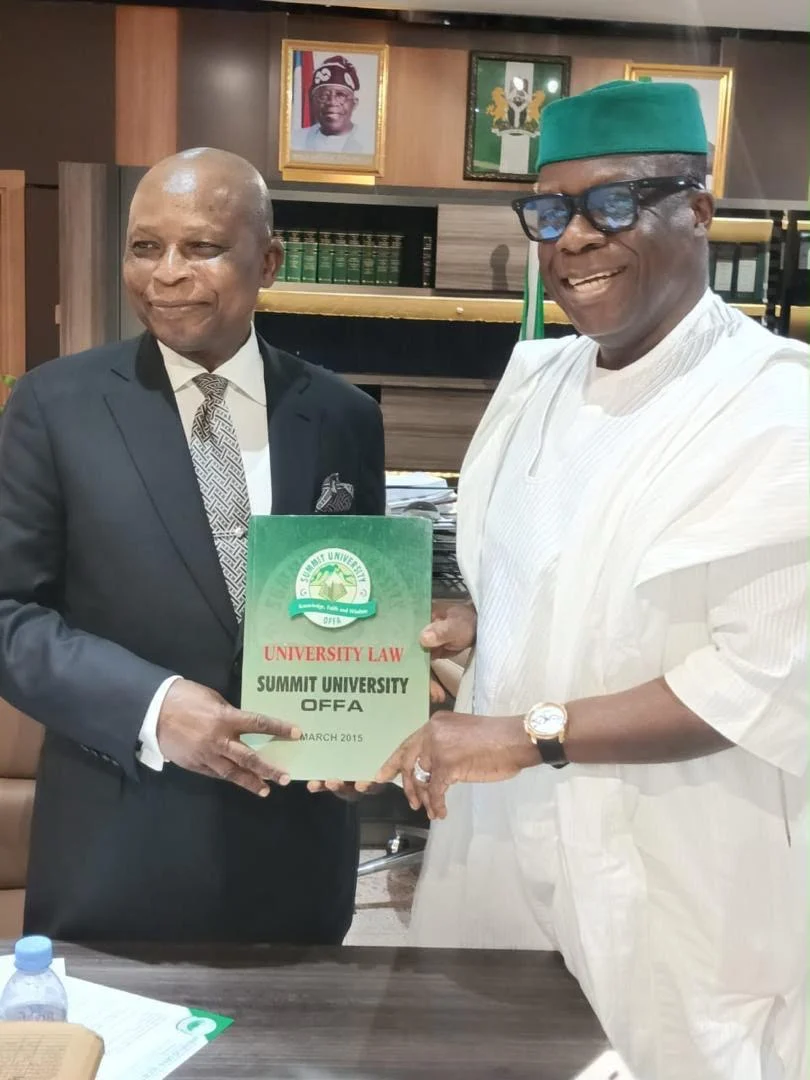
The Ansar-Ud-Deen Society of Nigeria has appointed the Attorney General of the Federation and Minister of Justice, Lateef Fagbemi, SAN, as the Pro-Chancellor and Chairman of the Governing Council of Summit University, Offa.

The Letter of Appointment was presented to the AGF during a ceremony held on Thursday at the Office of the Attorney General of the Federation in Abuja, according to a statement made available to PUNCH Online by the Society’s National Publicity Secretary, Dr. Muhammad Hassan.

The Ansar-Ud-Deen’s National President and Visitor to Summit University, Prince Adeniji Kazeem, SAN, led a delegation of the Society’s National Executive Committee to present the letter.

Members of the delegation included the Deputy National President, Dr. Ibrahim Adebayo Yusuf; Vice President (Northern States Council), Alhaji Najeem Yasin; First National Assistant Secretary, Dr. Sheu Luqman Sambo; Vice-Chancellor of Summit University, Prof Musa Aibinu; Missioner of the Society’s Abuja Branch, Prof Musa Olaofe; and Chairman of the Abuja Branch, Alhaji Kabiru Olaiyiwola.

Speaking during the ceremony, the Society’s national president described the appointment as the outcome of a transparent and merit-based selection process.

He said, “The National Executive Council unanimously approved Fagbemi’s appointment in recognition of his distinguished legal career, exemplary public service, integrity, and unwavering commitment to the ideals and educational vision of the Ansar-Ud-Deen Society of Nigeria.

“The Society is confident that Prince Fagbemi’s wealth of experience and exceptional leadership qualities will provide strategic direction for the University’s Governing Council and further strengthen Summit University’s commitment to academic excellence, sound governance, research, innovation, and character development.”

See also  UNILAG alumni to honour corporate leaders

He also commended the AGF for his longstanding support for the programmes and institutions of the Society, particularly his contributions to the growth of the Ansar-Ud-Deen in Kwara State and his commitment to educational development across Nigeria.

Receiving the appointment letter, Fagbemi expressed profound appreciation to the leadership of the Society for the confidence reposed in him.

He pledged to discharge the responsibilities of his office with diligence, integrity, and dedication.

The AGF assured members of the Society that he would work closely with the Governing Council, University Management, and other stakeholders to advance the strategic vision of Summit university.

Established by the Ansar-Ud-Deen Society, Summit University, Offa, has continued to expand its profile as one of Nigeria’s leading faith-based universities, promoting academic excellence, moral discipline, innovation, and service to humanity.

punch.ng

FOLLOW US ON:

FACEBOOK

TWITTER

PINTEREST

TIKTOK

YOUTUBE

LINKEDIN

Continue Reading
Click to comment

Leave a Reply

Your email address will not be published. Required fields are marked *

Education

Sex-for-marks: 60 randy lecturers axed in five years

Published

on

No fewer than 60 lecturers across Nigerian universities and polytechnics have been suspended, dismissed, had their appointments terminated or been prosecuted over allegations of sexual harassment and other forms of sexual misconduct in the last five years.

An analysis of disciplinary actions publicly announced by tertiary institutions between 2021 and July 2026 shows that while universities and polytechnics have maintained zero-tolerance policies against sexual misconduct, reports of lecturers demanding sex from students have continued to emerge across the country.

The latest incidents occurred on July 27, 2026, when Paul University, Awka, Anambra State, announced the suspension of a practical biology technologist in its Faculty of Natural and Applied Sciences, Cornelius Eze, over allegations of serious sexual misconduct after a complaint was lodged with the institution on July 14.

A week earlier, on July 18, Kogi State Polytechnic terminated the appointment of a lecturer, Mukhtar Muhammed, over allegations that he sexually molested a student.

The institution said the decision was part of efforts to maintain discipline and protect students from abuse.

The latest action was not the first by the institution.

In December 2025, the polytechnic also terminated the appointment of a lecturer, Abutu Thompson, after he was allegedly found guilty of sexually harassing and victimising a female student in the Department of Computer Science.

Similarly, in May 2024, a lecturer in the Department of English and Literary Studies at the Federal University, Lokoja, Kogi State, was investigated after he was allegedly caught attempting to sexually harass a female student through repeated inappropriate messages.

The crackdown intensified in 2024 and 2025.

In April 2024, the University of Nigeria, Nsukka, suspended a lecturer, Mfonobong Udoudom, indefinitely after a viral video allegedly showed him sexually harassing a female student.

Also, in April 2025, the Governing Council of the Lagos State University of Science and Technology dismissed three lecturers over allegations of sexual harassment following disciplinary proceedings.

Barely 10 days later, the Governing Council of Abubakar Tafawa Balewa University, Bauchi, dismissed a senior lecturer, Dr. Usman Aliyu, after finding him guilty of sexually harassing a married postgraduate student who had accused him of demanding sexual favours and threatening her academic progress.

See also  FG and ASUU clash over 2021 agreement

The list grew further in July 2025 when the Lagos State University dismissed two lecturers after its Governing Council reportedly found them guilty of offences, including sexual harassment, inhumane treatment of students and financial misconduct.

The latest sanctions are only a fraction of the disciplinary measures taken by tertiary institutions over the past five years.

In February 2021, the University of Nigeria, Nsukka, suspended a lecturer in the Department of Archaeology and Tourism, Dr Chigozie Odum, over allegations of sexual misconduct.

Four months later, the Federal University, Oye-Ekiti, suspended a lecturer in its Department of Media and Theatre Arts over similar allegations, while the University of Lagos dismissed two lecturers in June 2021 for sexual misconduct.

The University of Port Harcourt also dismissed a lecturer in the Department of Foreign Languages and Literature in August 2021 over sexual misconduct.

Similarly, in June 2021, the Vice-Chancellor of Akwa Ibom State University, Prof. Nse Essien, disclosed that the institution had sacked about 14 lecturers for engaging in the sexual molestation and abuse of female students.

In October 2021, the Federal Polytechnic, Bauchi, dismissed two lecturers from its Departments of Nutrition/Dietetics and General Studies over sexual misconduct.

Also in 2021, Ignatius Ajuru University of Education dismissed a lecturer in its Department of Sociology for impregnating a female student, while Kwara State University, Malete, sacked a lecturer in December for sexually harassing a student in the Department of Pure and Applied Sciences.

The sanctions continued in 2022.

In January of that year, Elechi Amadi Polytechnic in Rivers State dismissed a lecturer over allegations of sexually harassing a female student.

Three months later, Obafemi Awolowo University, Ile-Ife, Osun State, launched an investigation into allegations of sexual harassment involving a professor in its Department of Linguistics and African Studies, bringing to two the number of professors at the institution who had faced similar allegations within a few years.

In June 2022, the then Vice-Chancellor of the University of Abuja, Prof. Abdul-Raheed Na’allah, announced the dismissal of two professors over sexual misconduct, describing the decision as part of efforts to uphold the university’s ethical standards.

The year 2023 recorded another wave of disciplinary actions.

See also  FG begins disbursement of tertiary institution staff support fund

The Independent Corrupt Practices and Other Related Offences Commission arraigned a lecturer at Tai Solarin University of Education, Dr Balogun Olaniran, over allegations that he demanded sexual gratification from a female student to alter her examination results.

In May of the same year, Ambrose Alli University dismissed a lecturer over allegations of sexual harassment after its Staff Disciplinary Committee found him guilty of misconduct.

According to the institution’s Vice-Chancellor, Prof. Asomwan Adagbonyin, the lecturer admitted making advances to the student and even visited her church to seek forgiveness.

In July 2023, Na’allah disclosed that the University of Abuja had dismissed two additional lecturers over allegations of sexual harassment.

Saturday PUNCH also learnt that in August 2023, the University of Calabar suspended its then Dean of the Faculty of Law, Prof. Cyril Ndifon, over allegations of sexual harassment.

The case later became one of the country’s most prominent campus sexual harassment cases after criminal proceedings were initiated against him.

Barely a month later, the University of Lagos suspended a lecturer, Kadri Babalola, over allegations that he raped a 21-year-old student.

Similarly, the Federal College of Forestry in Plateau State suspended four lecturers in October 2023 over allegations of sexually harassing female students.

The recurring cases have reinforced concerns that sexual harassment remains entrenched within Nigeria’s tertiary education system despite repeated disciplinary actions by institutions.

A 2018 survey by the World Bank Group found that about 70 per cent of female graduates from tertiary institutions in Nigeria experienced one form of sexual harassment during their academic journey.

The report identified lecturers and fellow students as the major perpetrators, while many victims said they failed to report incidents because of fear of victimisation, intimidation, academic repercussions and lack of confidence in existing reporting systems.

The issue has again come under public scrutiny following recent developments involving students who accused lecturers of misconduct.

A student of the University of Lagos recently approached the court after accusing a lecturer of sexual harassment, a development that has reignited conversations about access to justice for survivors and the responsibility of institutions to protect complainants from retaliation.

See also  FULL LIST: Covenant University beats UI, UNILAG, UNN, OAU, others to emerge best in Nigeria

The renewed public attention comes amid fresh legislative efforts to strengthen the country’s legal response to sexual harassment in tertiary institutions.

In 2025, lawmakers in the House of Representatives introduced a bill seeking stiffer punishment for lecturers found guilty of sexually harassing students.

The proposed legislation seeks to strengthen existing legal provisions by prescribing tougher penalties for offenders while compelling tertiary institutions to establish transparent reporting and investigative procedures.

The move followed years of advocacy after the Sexual Harassment in Tertiary Educational Institutions Prohibition Bill, which had generated widespread public support, failed to become law despite receiving legislative approval in previous assemblies.

Education rights advocates have maintained that while universities have become more willing to dismiss offending lecturers, criminal prosecution remains uncommon, allowing many perpetrators to escape with only administrative sanctions.

Speaking on the issue, the Director of Programmes at Reform Education Nigeria, Ayodamola Oluwatoyin, urged President Bola Tinubu to assent to the proposed legislation.

“The President signing the bill will be a game-changer. We need to make schools safe for our students. The most unfortunate part of the issue is that some of these students, even when harassed, are scared to come out in the open for fear of victimisation and other issues,” Oluwatoyin said.

Similarly, the former Programme Manager, Gender Justice at the Shehu Musa Yar’Adua Foundation, Nafisa Atiku-Adejuwon, called on tertiary institutions to adopt survivor-centred reporting systems that encourage victims to speak out without fear.

“The response system has to be survivor-centred and holistic; mental and physical health concerns must be taken seriously. The response system shouldn’t be created to make the university look good; it should be to take care of the survivors,” she said.

She added that universities must build trust with students by guaranteeing confidentiality, protecting complainants from retaliation and ensuring that allegations are investigated promptly and transparently.

punch.ng

FOLLOW US ON:
FACEBOOK

TWITTER

PINTEREST

TIKTOK

YOUTUBE

LINKEDIN

Continue Reading

Education

FG launches nationwide AI training for 11,700 unity schools’ teachers

Published

on

The Federal Government has launched a nationwide Artificial Intelligence (AI) capacity-building programme for teachers in Federal Unity Colleges, with about 11,700 educators expected to receive digital skills training aimed at transforming classroom teaching across Nigeria. NigerianBusiness News

The initiative advanced on Thursday with the signing of the Terms of Reference (ToR) between the Federal Ministry of Education and ICEDT Consult Limited, paving the way for the nationwide implementation of the AI Teacher Capacity Development Programme.

The programme, to be implemented through the Ministry’s Education Support Services Department, forms part of the Federal Government’s broader strategy to modernise Nigeria’s education sector, strengthen teacher professionalism, and prepare students for a technology-driven global economy in line with President Bola Tinubu’s Renewed Hope Agenda.

Speaking during the signing ceremony in Abuja, the Director of the Education Support Services Department, Gabriel Amudipe, described the programme as a strategic investment in Nigeria’s teaching workforce and the future of education.

He said the nationwide rollout followed the success of an earlier pilot phase and commended ICEDT Consult Limited for developing a structured implementation model that would ensure effective coordination and quality delivery across the country’s six geopolitical zones.

Amudipe stressed that the standards achieved during the pilot phase must be maintained throughout the national rollout. He also urged ministry officials assigned to monitor the programme to carry out their responsibilities professionally and ensure strict compliance with every provision of the agreement.

“The Ministry remains committed to supporting innovative initiatives that strengthen teacher professionalism, improve learning outcomes and promote the responsible integration of emerging technologies into education,” he said.

See also  A Glimpse into Early UNN: The 1960s Lecturer’s Residential Building

Earlier, Deputy Director of the Education Support Services Department, Oladele Fapohunda, described the programme as a strategic intervention designed to deepen digital innovation in Federal Unity Colleges. He emphasised that collaboration among all stakeholders would be critical to the successful implementation of the initiative nationwide.

Providing further insight into the programme, the Head of Strategic Partnerships and Learning Scientist at ICEDT Consult Limited, Dr Abdulrahman Orosanya, said the project was approved for national expansion after a successful pilot conducted in six Federal Unity Colleges, representing the country’s six geopolitical zones.

According to him, the pilot demonstrated how Artificial Intelligence could significantly improve lesson planning, classroom instruction, assessment methods and teachers’ overall productivity.

He noted that the nationwide rollout would strengthen teachers’ digital competencies, enhance instructional delivery and support the Federal Government’s vision of building a technology-driven education system capable of producing globally competitive learners equipped with 21st-century skills.

The ceremony concluded with the formal signing of the Terms of Reference by officials of the Federal Ministry of Education and ICEDT Consult Limited, signalling the commencement of preparations for the full implementation of the programme across all Federal Unity Colleges.

Beyond the direct training of approximately 11,700 teachers, the initiative is expected to benefit thousands of students through improved classroom practice, increased digital innovation and the responsible application of Artificial Intelligence in teaching and learning.

The Federal Ministry of Education reaffirmed its commitment to partnering with key stakeholders to modernise Nigeria’s education system, improve teacher quality and deliver inclusive, equitable and future-ready education nationwide.

See also  FULL LIST: Covenant University beats UI, UNILAG, UNN, OAU, others to emerge best in Nigeria

FOLLOW US ON:

FACEBOOK

TWITTER

PINTEREST

TIKTOK

YOUTUBE

LINKEDIN

INSTAGRAM

Continue Reading

Education

FG extends 2026 textbooks ranking deadline to August 7

Published

on

The Nigerian Educational Research and Development Council on Friday announced a final extension of the deadline for the submission of textbooks and other instructional materials for the “2026 Phase I assessment, reassessment and ranking exercise”, giving publishers, authors and other stakeholders until August 7, 2026, to complete their submissions.

The council said the extension, approved under the Federal Ministry of Education, follows the earlier deadline of July 3, 2026, and is intended to encourage wider participation in the national textbook evaluation exercise while providing eligible stakeholders additional time to finalise and submit their materials.

In a statement issued by the Executive Secretary of NERDC, Prof. Salisu Shehu, the council said the extension was granted to ensure that more publishers, authors and other participants in the book industry have the opportunity to take part in the 2026 Phase I textbook assessment process.

The statement read, “This final extension is being granted to ensure broader participation and provide publishers, authors, and other eligible stakeholders with an additional opportunity to complete and submit their materials for participation in the 2026 Phase I textbook assessment, reassessment, and ranking exercise.”

NERDC urged all intending participants to take advantage of the final window, stressing that every submission must comply with the approved procedures outlined in the Textbook Quality Indicators and Submission Guidelines.

The council noted that the guidelines remain unchanged and are available on its official website for prospective participants.

It further warned that the August 7 deadline is final and that no additional extension would be granted.

See also  SSANU rejects FG’s 30% pay rise offer

“No further extension will be granted, and late submissions received after the final deadline will not be accepted under any circumstances,” the council stated.

NERDC also thanked publishers, authors and other stakeholders for their continued cooperation and urged them to ensure prompt compliance with the submission requirements to facilitate a smooth assessment and ranking process.

The National Textbook Ranking System is one of the key reforms being implemented by the Federal Ministry of Education under the Renewed Hope Agenda to improve the quality of basic and secondary education.

punch.ng

FOLLOW US ON:

FACEBOOK

TWITTER

PINTEREST

TIKTOK

YOUTUBE

LINKEDIN

Continue Reading

Trending