Connect with us

Education

NECO question papers were sold for N3,000 before exams — Minister

Published

on

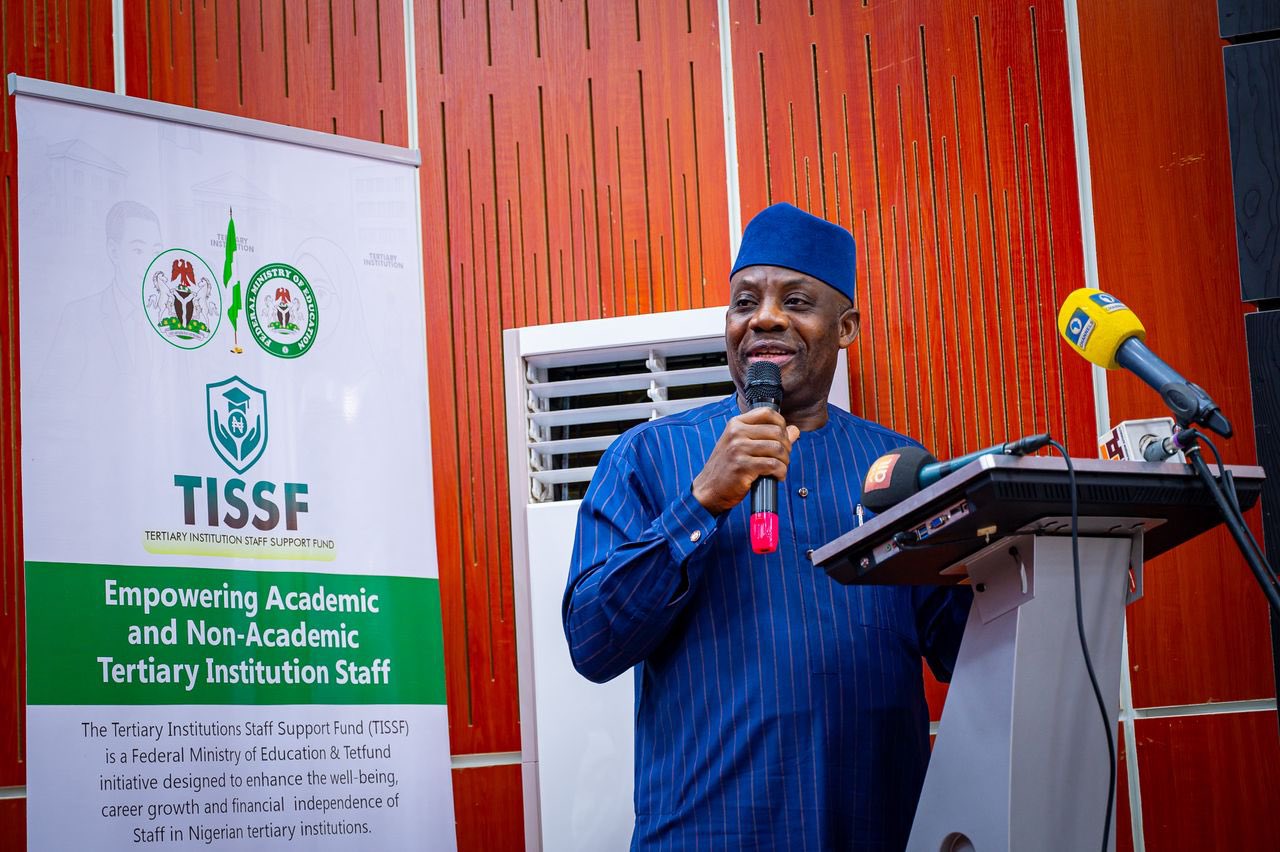
The Minister of Education, Dr Tunji Alausa, has revealed how examination questions were allegedly obtained for N3,000 before the conduct of the National Examinations Council examinations, describing the level of examination malpractice in the country as “mind-boggling.”

Alausa made the revelation on Thursday at a meeting with the National Association of Proprietors of Private Schools and other stakeholders in the education sector, where he warned parents, teachers, proprietors, principals, invigilators and students against practices capable of undermining the integrity of public examinations.

The minister said examination malpractice had, for years, been tolerated in Nigeria, creating an unfair system in which students who prepared genuinely for examinations were disadvantaged by those who gained access to leaked questions.

According to him, the situation was particularly dangerous because it could push honest students into malpractice as they sought to compete with candidates who had access to examination materials before the tests.

Alausa said, “It’s sad. Before she (Minister of State for Education) and I came, the acceptance of examination malpractice, cheating and examination leakages in this country was mind-boggling, and the country accepted it. It was a nightmare,” adding that the “danger was that the good students would also become bad.”

The minister, while recounting his experience in the fight against examination malpractice, alleged that examination questions had previously been made available for sale before candidates sat for the examinations.

He said, “The Registrar of NECO at the time had a name. His name was (Ibrahim) Wushishi. You would go to Wushishi… I didn’t know that Wushishi meant going to the dark website.

See also  Law student Ayomiposi Ojajuni kills self over failure to write final exam

“They bought his question for N3,000. That was it. Before the examination. They called him Wushishi and bought the questions for N3,000 before the examination.”

Alausa also recalled his experience during the 2025 examination period, saying he was regularly sent examination questions allegedly obtained before candidates sat for the papers.

He said the development forced officials to verify the questions with examination authorities, sometimes confirming that the questions being circulated were actually the ones scheduled for the day.

He said, “During that examination period, during the hardest time of my life, I was always worried, waking up. I would wake up to her text. She would send questions to me… She would say, ‘I just got this question.’

“It could be English or Chemistry. I was always waking up with trepidation every morning, doing work. I would send it to the HNO and ask, ‘HNO, is this correct?’ And the answer I got was, ‘Unfortunately, that’s the question we’re doing today.’

“So, that was a more aggressive intervention because we were seeing the question and confirming from the other side.”

The minister said the revelations demonstrated that examination malpractice was not simply a student problem, insisting that the wider education ecosystem must take responsibility for curbing the practice.

He noted that parents, schools, teachers, invigilators and principals all had roles to play in preventing candidates from gaining unfair access to examination materials.

Alausa said, “You might be in that isolated school, but the school system is also involved. In fact, I don’t blame the students that much. Any child can be bad.

See also  JAMB axes affiliated degree courses in colleges of education; read details

“But when we have an ecosystem where parents, schools, teachers, invigilators and principals are in full connivance, the students are the smallest players. The people who should put the deterrents in place are the ones involved.”

He warned that the Federal Government would strengthen measures to protect the integrity of public examinations and ensure that academic qualifications reflected genuine learning and merit.

The minister said the reforms were part of President Bola Tinubu’s broader efforts to restore standards and reposition Nigeria’s education system.

He said, “This is a country with the rule of law. President Bola Ahmed Tinubu is transforming this country in a way that’s never been transformed before. This is Nigeria’s renaissance that we’re building to be sustainable into the future.”

He added that the country had for too long tolerated practices that undermined its education system, but said the Tinubu administration was determined to reverse the trend.

The Minister of State for Education, Prof Suwaiba Ahmad, also called on private school proprietors and other stakeholders to support the reforms, noting that stronger examination controls could initially expose weaknesses in students’ actual preparation.

Ahmad explained that some students who appeared to perform exceptionally well in internal examinations might have become accustomed to accessing leaked questions ahead of external examinations.

She said the introduction of serialised examination questions would make it more difficult for candidates to rely on leaked materials, while encouraging genuine preparation.

The minister urged schools to complete their curricula on schedule and promote consistent study among students, assuring private education stakeholders that the Federal Ministry of Education would continue to engage them during the implementation of the reforms.

See also  Nigerian professors should earn N2.5m monthly, says ex-NAL president

The latest warning comes amid longstanding concerns over examination malpractice in Nigeria, including question-paper leakages, impersonation, collusion and unauthorised assistance to candidates.

The Federal Government’s renewed emphasis on examination integrity is aimed at ensuring that results from public examinations provide a credible assessment of students’ knowledge and abilities, while protecting candidates who prepare and compete fairly.

Source: punchng.com

FOLLOW US ON:

FACEBOOK

TWITTER

PINTEREST

TIKTOK

YOUTUBE

LINKEDIN

INSTAGRAM

Continue Reading
Click to comment

Leave a Reply

Your email address will not be published. Required fields are marked *

Education

Appeal Court affirms 2-year jail term on UNICAL Professor convicted of s£xual harassment

Published

on

The Court of Appeal has affirmed two-year-jail sentence on Prof. Cyril Osim Ndifon, former Dean of the Faculty of Law, University of Calabar, for soliciting p0rnographic, indecent and obscene photographs from a female student.

J. Okor Odey, Head, Media and Public Communications, Independent Corrupt Practices and Other Related Offences Commission, ICPC revealed this in a statement on Friday, September 25.

According to the statement, the Abuja Division of Court of Appeal, in its judgment delivered in Appeal No. CA/ABJ/CR/1798/2025, upheld the judgment of the Federal High Court, Abuja, which convicted Prof Ndifon on one count charge and sentenced him to two years’ imprisonment without an option of fine.

The conviction arose from evidence put before the trial court that Professor Ndifon, while serving as Dean of the Faculty of Law, University of Calabar, solicited p0rnographic, indecent and obscene photographs from a female student through electronic communication.

The offence in Count One was prosecuted under Section 24 of the Cybercrime (Prohibition, Prevention, etc.) Act, 2015.

Following a protracted trial, the Federal High Court, presided over by Justice James Omotosho, found the prosecution’s evidence sufficient to establish the offence against the former Dean beyond reasonable doubt.

The trial court subsequently convicted Professor Ndifon on November 17, 2025, and sentenced him to two years’ imprisonment on Count One and five years on Count Two, without the option of a fine.

The sentences were ordered to run concurrently.

Professor Ndifon, dissatisfied with the judgment, appealed to the Court of Appeal, challenging his conviction and sentence.

See also  JAMB axes affiliated degree courses in colleges of education; read details

The appellate court, having considered the grounds of appeal, affirmed the conviction and sentence in respect of Count One.

ICPC, in the statement noted that the affirmation by the Court of Appeal means that the conviction of Professor Ndifon on the cybercrime-related offence contained in Count One has now been sustained by the appellate court.

The case originated from allegations concerning the conduct of Prof. Ndifon towards female students while he was Dean of the Faculty of Law, University of Calabar.

During the trial, the ICPC presented evidence relating to communications between the appellant and a female student, including electronic communications which formed part of the evidence relied upon by the prosecution.

The prosecution’s case was that Professor Ndifon, by virtue of his position as Dean and the authority attached to that office, was in a position to exercise significant influence over students of the Faculty.

The allegation in count one specifically concerned the solicitation of p0rnographic, indecent and obscene photographs from a student.

In its consideration of the evidence, the Federal High Court examined the testimony of prosecution witnesses as well as the electronic evidence tendered before it. The court ultimately held that the ingredients of the offence charged under the Cybercrime Act had been established beyond reasonable doubt.

The Court of Appeal has now affirmed that finding in respect of Count One, thereby sustaining the conviction and the two-year custodial sentence imposed on Professor Ndifon for the offence

With respect to Count Two, which concerned the allegation of conferment of an undue advantage contrary to Section 19 of the Corrupt Practices and Other Related Offences Act, 2000, the Court of Appeal took a different position on jurisdiction.

See also  Leave before visa expires, UK warns foreign students

The appellate court held that the Federal High Court lacked jurisdiction to entertain the offence under the ICPC Act and consequently ordered the Respondent to commence prosecution of Professor Ndifon on the count before the High Court of Cross River State.

But Odey said the ICPC is currently taking steps to challenge this aspect of the judgment before the appropriate superior court.

According to him, the Commission considers the jurisdictional question arising from Count Two to be a matter requiring further judicial determination.

“The Commission wishes to emphasise that the appellate court’s decision on Count Two does not affect its affirmation of the conviction on Count One. The conviction for soliciting pornographic, indecent and obscene photographs from a student remains affirmed by the Court of Appeal.

“The Commission reiterates its commitment to the prosecution of corruption, abuse of office and other related offences, particularly where public or institutional authority is allegedly used to exploit persons under the authority or influence of an accused person.

“The ICPC also reaffirms its commitment to conducting its investigations and prosecutions strictly within the provisions of the law and in accordance with due process.

“The Commission respects the decisions of the courts and will continue to utilise the available legal avenues where it considers further judicial clarification necessary.

“The Commission will provide further updates on the matter as the legal process progresses,” Odey said.

FOLLOW US ON:

FACEBOOK

TWITTER

PINTEREST

TIKTOK

YOUTUBE

LINKEDIN

INSTAGRAM

Continue Reading

Education

NECO records 58.67% pass rate in English, Maths

Published

on

A total of 804,948 candidates, representing 58.67 per cent of those who sat for the 2026 Senior School Certificate Examination conducted by the National Examinations Council, obtained five credits and above, including English Language and Mathematics.

The Registrar of NECO, Prof Dantani Wushishi, disclosed this on Thursday during the release of the 2026 internal examination results.

Wushishi said 1,378,048 candidates registered for the examination, comprising 682,352 male and 695,696 female candidates.

He said 1,371,992 candidates sat for the examination, comprising 678,903 males and 693,089 females.

According to him, 1,162,118 candidates, representing 84.70 per cent, obtained five credits and above irrespective of English Language and Mathematics.

Wushishi said 1,334 candidates with special needs also sat for the examination.

He disclosed that 1,406 candidates were involved in examination malpractice in 2026, compared with 3,878 in 2025, representing a 64.74 per cent decrease.

The registrar said the 2026 examination represented an improvement over the 2025 exercise.

Wushishi, while responding to questions from journalists, also distanced NECO from so-called miracle centres, saying the examination body had no dealings with such centres.

“NECO is not aware of miracle centres because we don’t have any business with them,” he said.

He added that NECO had only one school and could not be associated with miracle centres.

“We register centres and have criteria for which we register these centres. We don’t know miracle centres because we have only one school and we cannot be associated with miracle centres.

“If there are miracle centres, it is the state governments that established these miracle centres or they are privately owned, but NECO does not believe in miracle centres,” he said.

See also  School not scam, foundation warns pupils

Meanwhile, at an event preceding the release of the 2026 examination results, Wushishi honoured staff of the examination body at the 2025 Annual Staff Productivity Awards.

He said the awards were designed to reward workers and pupils for their hard work, dedication and performance.

The registrar stressed that banditry, kidnapping and sit-at-home orders could not stop NECO examinations.

Highlighting the council’s achievements, he cited the successful and transparent conduct of its internal examinations, prompt release of results, rancour-free promotion exercises and development of ICT software.

Wushishi said the annual awards recognised workers in zones, states and headquarters, as well as pupils who excelled in its examinations during the year.

He disclosed that 55 former workers received certificates of service for their retirement in 2025.

He noted that the awards were grouped into categories, including certificates for retirees, recognition for hardworking and dedicated staff, and prizes for the best state coordinator, best driver and top-performing pupils.

The Director-General of Student Affairs, Niger State Government, Bello Sheriff, who spoke on behalf of the state government, congratulated the recipients and charged the council to sustain its tempo of success.

Among the awardees were Akai Kuyet, who emerged best female in the SSCE category, and Felix Emenike, who emerged best male.

Others were Ezeudu Akachukwu, who emerged best male, and Ubochi Nancy, who emerged best female in the National Gifted Examination category.

Source: punchng.com

FOLLOW US ON:

FACEBOOK

TWITTER

PINTEREST

TIKTOK

YOUTUBE

LINKEDIN

INSTAGRAM

Continue Reading

Education

Ignore fake conference advertisement, Army College tells Nigerians

Published

on

The Nigerian Army College of Logistics and Management (NACOLM), Ojo, Lagos, has warned Nigerians to disregard an online advertisement promoting a purported “Highstone Global University USA International Research Conference” allegedly scheduled to hold at the college.

The college, in a statement dated September 22, 2026, said the advertisement was false and fraudulent, stressing that it had no connection with the purported programme.

NACOLM’s Public Relations Officer, Major Innocent Audu, said, “The College has no affiliation, partnership, endorsement or involvement whatsoever with the said programme, and no such conference has been authorised to take place at the College.”

The college urged members of the public not to make payments or disclose personal information in connection with the purported conference.

“Members of the public are therefore advised to disregard the advertisement and refrain from making any payments or providing personal information in connection with the purported programme,” Audu said.

According to the statement, NACOLM remains committed to protecting the integrity of its name, facilities and official engagements.

It added that any authorised programme or event involving the college would be communicated through its recognised official channels and those of the Nigerian Army.

The college also urged the public to exercise caution and report any suspicious solicitation linked to the purported event to the appropriate authorities.

Source: punchng.com

FOLLOW US ON:

FACEBOOK

TWITTER

PINTEREST

TIKTOK

YOUTUBE

LINKEDIN

INSTAGRAM

See also  Leave before visa expires, UK warns foreign students
Continue Reading

Trending