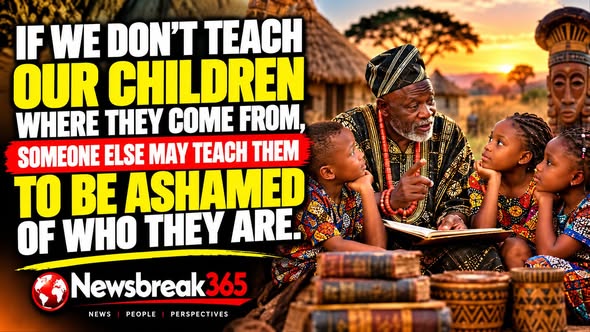
Imagine your child growing up ashamed of their African name, unable to speak their mother tongue, knowing more about foreign celebrities than their own ancestors, and believing that everything foreign is superior to their own culture.
**What would hurt more than discovering that your child knows so much about the world but so little about their own roots?**
Parents, our responsibility goes beyond feeding our children, sending them to school, buying them expensive clothes, and securing their future. We must also teach them who they are, where they come from, and the history of the people whose blood runs through their veins.
Our children deserve to know the meaning of their names, the beauty of their native languages, the wisdom of their traditions, and the struggles and achievements of previous generations.
If we never tell them our stories, who will? If we never teach them our languages, who will preserve them? If we treat our own heritage as unimportant, what message are we sending to the next generation?
7 PRACTICAL WAYS PARENTS CAN PRESERVE THEIR CHILDREN’S CULTURAL IDENTITY
**1. Speak your native language at home.**
Make time every day to speak Yoruba, Igbo, Hausa, or your own African language with your children. Teach them greetings, common expressions, proverbs, and the meanings of words. If they struggle, be patient and encourage them rather than making them feel embarrassed.
**2. Tell them the stories of their ancestors.**
Explain where your family comes from, the meaning of your family name, and the experiences of previous generations. Let your children know the people and sacrifices that helped shape their family.
**3. Teach them African history.**
Do not allow their entire understanding of African history to come from social media or outsiders. Introduce them to African kingdoms, inventors, writers, leaders, artists, and historical achievements, while teaching them honestly about the difficult chapters of our history too.
**4. Celebrate cultural traditions at home.**
Let your children experience traditional foods, music, clothing, festivals, dances, and family customs. Explain the meaning behind these traditions so that they understand more than just the outward appearance.
**5. Encourage relationships with grandparents and elders.**
Our older generations carry stories, wisdom, and knowledge that may never appear in textbooks. Encourage your children to speak with their grandparents and other elders, record family stories with permission, and ask questions about the past.
**6. Introduce them to books, films, and role models from Africa.**
Help your children discover African authors, filmmakers, scientists, entrepreneurs, and historical figures. Let them see that African people have contributed—and continue to contribute—to knowledge, creativity, science, and society.
**7. Lead by example.**
Children learn from what parents practise. If you constantly mock your own language, dismiss your traditions, or describe your culture as backward, your children may adopt the same attitude. Show them how to appreciate their heritage while remaining open-minded and respectful of other cultures.
OUR CHILDREN CAN BE MODERN WITHOUT FORGETTING THEIR ROOTS.
They can speak English, French, Dutch, and other languages. They can embrace technology, receive excellent education, travel the world, and build successful careers without feeling inferior because they are African.
Cultural pride does not mean rejecting other cultures. It means understanding your own identity while respecting the identities of others.
Parents, do not wait until your children become adults before you begin teaching them their heritage. **Start today—even one native-language conversation, one family story, or one lesson about your history can make a difference.**
One day, when we are no longer here to tell our stories, our children will either carry our heritage forward or struggle to rediscover what we failed to teach them.
**Let us not be the generation that provides everything for our children except a connection to their roots.**
NEWSBREAK365 ASKS:
Which of these seven steps do you practise in your home? And for African parents raising children in Europe or America, how do you keep your children connected to their cultural identity?
Share your experience in the comments. Let’s learn from one another.
NEWSBREAK365 — NEWS | PEOPLE | PERSPECTIVES**
#Newsbreak365 #AfricanCulture #AfricanIdentity #AfricanParenting #CulturalHeritage #AfricanHistory #KnowYourRoots #ParentingMatters
FOLLOW US ON:
FACEBOOK
TWITTER
PINTEREST
TIKTOK
YOUTUBE
LINKEDIN
INSTAGRAM