Connect with us

Business

We’re ready for court cases on fuel imports – Dangote

Published

on

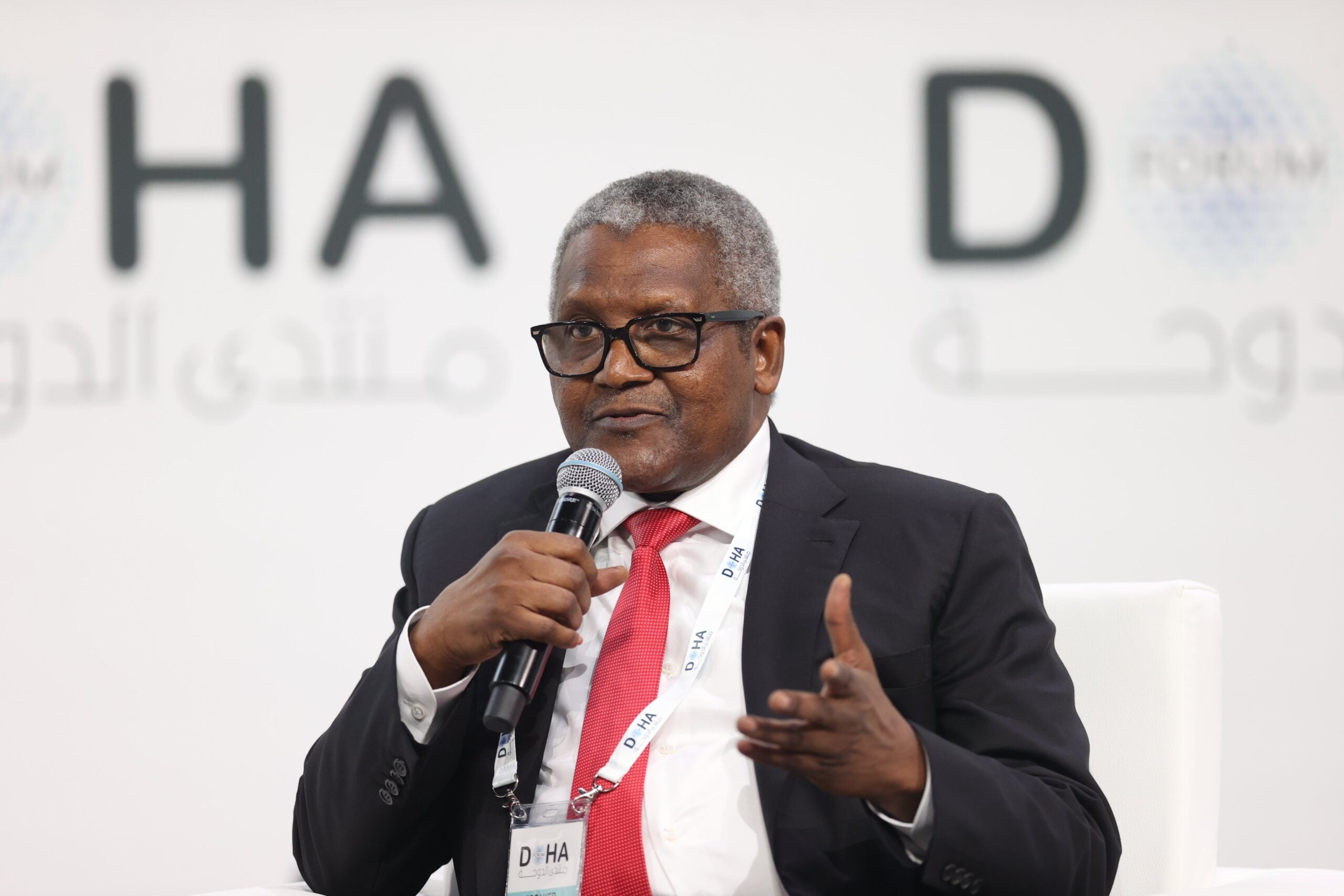
Africa’s richest man and President of Dangote Industries Limited, Aliko Dangote, has said he is prepared to confront legal challenges to his businesses, stressing that he is also willing to reduce his ownership of the Dangote Petroleum Refinery to 25 per cent as more Africans buy shares in the company.

The Dangote Group had earlier said a Kenyan court ruling over a land rights dispute would not stop the groundbreaking ceremony for its planned 700,000-barrel-per-day refinery in Lamu on Wednesday, although the order might affect some activities at the project site.

During a fireside chat at the Nairobi Securities Exchange in Kenya, Dangote spoke on the company’s planned investments in Africa, the Lamu refinery and its proposed public ownership structure in Kenya and other African countries.

The Malindi Environment and Land Court had ordered that the “status quo prevailing” on the land be maintained until a hearing on October 14. The order, dated September 25, was made public on Monday.

According to Reuters, the lawsuit was filed by 133 residents of Chandavai, an area in Lamu County, who claim that the land earmarked for the refinery is their ancestral heritage and that their families have lived and farmed there for generations.

The Dangote Group, in a statement, said, “The court has not halted the groundbreaking ceremony of the refinery at this stage. However, activities at the site may be affected by the ruling as both parties are required not to carry out activities until the case is heard on 14th October.”

Dangote, however, expressed confidence that the project would proceed despite the legal challenge. “I’m sure some of you must have seen that one court has given an order that we shouldn’t do any construction? I said no, no. This is normal for us in Africa. In fact, this is even small,” he told investors at the event.

See also  NNPC, NUPRC remit N322bn, $116.9m after Tinubu order

Dangote challenged his challengers as he said he knew the forces behind the court cases. “Anyone who wants to cause trouble, we are ready for them,” he declared.

He said his business group had encountered more difficult situations in other African countries, citing a case in Senegal where one of its factories was stopped for a year.

“In Senegal, it’s not even the court. They stopped our factory for one year. We went up to the Supreme Court to get a judgement. So anybody who wants to cause trouble, we are ready for them,” Dangote said.

The planned Lamu refinery is expected to have a capacity of 700,000 barrels per day and is intended to replicate the Dangote refinery in Nigeria. Dangote has said the Kenyan refinery will cost between $15bn and $16bn and is expected to be completed by 2030.

The businessman said Kenya has become an important part of his group’s expansion strategy, adding that the company considers African countries its home. “We’re taking Kenya as our home. It is home here, and that’s why we’re here to invest. Anywhere in Africa is home, because we understand the issues, we understand the problems,” he said.

Dangote said the Lamu refinery project had moved quickly from discussions to implementation, noting that the group had already deployed construction equipment to the site.

The refinery is expected to generate significant employment, with Dangote saying more than 60,000 people would be required during the project. “We will try as much as possible to train a lot of people here because part of the project will need over 60,000 people working there,” he said.

See also  World Bank dismisses Nigeria’s single-digit inflation target

He said the project would also create opportunities for small and medium-sized businesses around the refinery. Dangote said the refinery would not operate in isolation but would attract other businesses and industries to the area.

He also disclosed that the group planned to list the Lamu refinery on the Nairobi Securities Exchange, rather than the Nigerian Exchange, as part of efforts to deepen African capital markets.

“If there’s this kind of collaboration, it means that tomorrow, if we are going to have the refinery here in Lamu, it will be listed here in Lamu; we don’t have to list it in Nigeria. We shouldn’t list it in Nigeria. We should list it here,” he said.

The billionaire also said the planned ownership structure of his businesses would increasingly involve ordinary Africans, stressing that the group was willing to sell more shares where there was sufficient demand.

He said the company initially planned to raise $2.5bn through a private placement and an initial public offering. “The issue is that when we decided to do this expansion, we said, okay, fine, we’re going to sell about $2.5bn worth of shares,” Dangote said.

“And during that, we opened up a private placement; that’s just by invitation. The private placement was to get about a billion dollars, and then IPO, $1.5bn, so that’s a total of $2.5bn.”

According to him, the private placement attracted demand of $3.7bn. “But the private placement came out with a demand of $3.7bn. So we already took the $2.5bn after a lot of argument because we are two shareholders then, ourselves and the Nigerian National Petroleum Company, and we were able to convince them that, look, it’s better that we allow $2.5bn to go,” he said.

See also  Naira records mixed performance in FX markets

He added that the group subsequently created another $1.6bn offering to expand public ownership. “And then after that, we created another $1.6bn. The real purpose is for us to democratise wealth-making,” he said.

Dangote said the group was prepared to reduce its stake in the refinery significantly if more Africans wanted to buy shares.

“This $1.6bn that we have, I can tell you for nothing that we will sell more. We will go to the regulator and ask the regulator that, ‘Look, there is more demand; we want more Africans to own it ‘. As we go along, we don’t mind, even if Dangote will end up having twenty or twenty-five per cent, we have nothing to hide.”

This means that the group could ultimately sell up to 75 per cent of its stake in the refinery, depending on further share sales and demand from investors. Dangote maintained that shareholders would also have a role in determining the leadership of the company if they were dissatisfied with its performance.

“If we go to an AGM, if we are not doing the right thing, then change the leadership. You can vote us out, and put anything that you think can do better, which I doubt very much,” he noted.

He added that the group was committed to corporate governance and protecting minority shareholders as it brings more of its businesses to the capital market.

Source: punchng.com

FOLLOW US ON:

FACEBOOK

TWITTER

PINTEREST

TIKTOK

YOUTUBE

LINKEDIN

INSTAGRAM

Continue Reading
Click to comment

Leave a Reply

Your email address will not be published. Required fields are marked *

Business

How Moniepoint customers can check eligibility for FG’s ₦50,000 relief support

Published

on

Moniepoint Microfinance Bank says eligible customers can now check their status and access the Federal Government’s ₦50,000 emergency relief support through its Unstructured Supplementary Service Data (USSD) channel.

The bank said in a statement issued on Wednesday that “customers could dial *5573*27# from their registered phone numbers and select the option to check their eligibility for the National Emergency Relief and Stabilisation Intervention (NERSI).”

It said customers confirmed as beneficiaries would be guided through the steps to accept the support and receive the funds into their Moniepoint accounts at no additional cost.

The intervention, led by the Federal Ministry of Humanitarian Affairs and Poverty Reduction, is designed to provide direct financial assistance to vulnerable households to help them meet essential needs amid prevailing economic pressures.

On Tuesday, PUNCH Online reported that that FG had begun payment to eligible Nigerians.

Moniepoint said it was “among the payment providers selected by the Federal Government to facilitate the disbursement of the relief funds.”

It explained that beneficiary selection was based on the government’s eligibility criteria and verification processes, which relied on verified national identity records and the National Social Register.

The bank noted that the programme was being implemented in phases across the country, adding that not all customers would qualify or be selected at the same time.

What moniepoint customers should know?

Babatunde Olofin, Managing Director and Chief Executive Officer of Moniepoint Microfinance Bank, said the “bank was pleased to support eligible customers in receiving assistance under the government initiative.”

See also  NNPC, NUPRC remit N322bn, $116.9m after Tinubu order

Olofin said Moniepoint would deploy its technology and financial infrastructure to make the process accessible, seamless and secure.

He urged “customers to use only the bank’s official USSD channel when checking their eligibility or accessing the funds.”

He added that the process required “no additional payment, documentation or third-party intervention.”

The bank also advised customers with enquiries to contact its customer service team or the NERSI helpdesk.

Moniepoint said its nationwide network of financial services infrastructure, including Point-of-Sale terminals across the country’s 774 local government areas, would support efforts to extend access to the intervention.

Source: punchng.com

FOLLOW US ON:

FACEBOOK

WHATSAPP CHANNEL

TWITTER

PINTEREST

TIKTOK

YOUTUBE

LINKEDIN

INSTAGRAM

Continue Reading

Business

$196m NIN funds unspent, FG seeks extension

Published

on

The Federal Government has requested another 12-month extension of Nigeria’s $430 million digital identity project as approximately $196m of its financing remains undisbursed and National Identification Number (NIN) issuance trails the target by 59 million.

This is contained in a World Bank restructuring paper dated 22 October, 2026, obtained by The PUNCH from the bank’s website on Wednesday.

The proposed extension would move the Nigeria Digital Identification for Development Project’s closing date from 31 December, 2026, to 31 December, 2027.

“The proposed Level 2 restructuring seeks to extend the project closing date by 12 months, as requested by the Government on May 8, 2026,” the report stated.

“This would be the third closing date extension under this project since Board Approval in February 2020, for the cumulative period of 42 months (3.5 years).”

The project was originally scheduled to close in June 2024 before receiving a six-month extension and another two-year extension.

An analysis by The PUNCH showed that approximately $196m, representing 45.6 per cent of the financing, remained undisbursed after total disbursements reached about $234m.

“The overall project disbursement rate inclusive of co-financiers stands at approximately $234m or 54.4 per cent,” the bank stated.

The financing comprises $115m from the World Bank’s International Development Association, $100m equivalent from the French Development Agency and $215m equivalent from the European Investment Bank.

The undisbursed balance therefore covers all three financiers. The report’s financing summary separately puts IDA’s undisbursed balance at $18.83m.

Approved in February 2020 and effective from December 2021, the project seeks to expand access to identification and services through a secure, inclusive national identity system.

See also  CBN announces new withdrawal limit, removes deposit cap

However, about 121 million people had received NINs by September 30, 2026, against the 180 million target, leaving a shortfall of 59 million.

Although this represents an increase of approximately 84 million from the baseline, NIMC must substantially accelerate enrolment to meet the target.

“NIMC reconfirmed the commitment to reach the target of 180 million noting that this would require an increase in monthly enrollment rates from the current average of 1.5 million to 3.9 million,” the report stated.

This implies a 160 per cent increase in monthly enrolment.

The bank also distinguished enrolment records from successfully generated NINs, noting that more than 140 million enrolments had been recorded by September 14, but only 121 million had completed biometric and demographic validation and duplicate checks.

Women and children remained behind their respective targets. As of June, 40.4 million women and girls had NINs against a target of 79 million, while 26.3 million children under 16 had NINs against 60.83 million.

The report identified unpaid enrolment partners as another constraint, stating that the billing system must produce audited payment reports to enable payments to partners “which have not been paid since January 2026.”

Other priorities include deploying 7,000 procured mobile devices by January 2027, training agents, expanding ward-level enrolment nationwide and beginning school enrolment by December 2026.

The ward campaign had generated 10 million NINs since March, according to the report.

A major reason for the extension is the delayed replacement of NIMC’s existing technology with the National Identity Management System 2.0.

The contract was signed on September 15, 2026, following lengthy procurement. Implementation, normally requiring approximately 18 months, was compressed into 15 months, with full deployment and data migration scheduled for December 15, 2027.

See also  Finnish court jails Simon Ekpa six years for terrorism offences

The new platform would replace fragmented proprietary systems with an open-source system designed to improve capacity, interoperability and data protection.

Although NINAuth was launched in May 2025, the project’s digital authentication targets remained unmet pending integration into the new platform.

The bank warned that failure to extend its involvement would also halt implementation by the other financiers.

“If the project is not extended by WBG, all other co-financiers will also close,” it stated.

Source: punchng.com

FOLLOW US ON:
FACEBOOK

WHATSAPP CHANNEL

TWITTER

PINTEREST

TIKTOK

YOUTUBE

LINKEDIN

INSTAGRAM

Continue Reading

Business

Read how FG selects beneficiaries for N50,000 relief

Published

on

The Federal Government has explained how it selects beneficiaries for its N50,000 cash relief under the National Emergency Relief and Stabilisation Intervention.

The clarification comes as payments continue and many Nigerians seek to understand how the government identifies recipients and determines their eligibility.

According to information on the Federal Ministry of Humanitarian Affairs and Poverty Reduction’s NERSI website, sighted by PUNCH Online on Wednesday, beneficiaries are selected from verified national identity records and the National Social Register.

“Beneficiaries are selected from verified national identity records and the national social register, then screened to reach poor and vulnerable households,” the website states under its eligibility and selection section.

The National Identification Number (NIN) is issued by the National Identity Management Commission (NIMC) after enrolment.

It is used to verify an individual’s identity and is linked to the mobile wallet through which selected beneficiaries receive the relief.

The National Social Register (NSR), on the other hand, is a database of poor and vulnerable households in Nigeria, coordinated by the National Social Safety-Nets Coordinating Office.

According to NASSCO, the register contains data on more than 70 million individuals.

It said registering vulnerable persons is a multi-process activity that begins with states identifying their poorest local government areas and communities, after which trained teams work with residents and community leaders to identify vulnerable households.

The identified households are then registered digitally and assessed using poverty indicators.

Those ranked within the bottom six deciles may qualify for inclusion in the National Beneficiary Register, which is used for programmes such as cash transfers.

See also  Strike countdown begins as PenCom, Labour disagree on Pension funds

Enrollment in both NIMC and NSR is a prerequisite for being selected for N50,000 cash relief, according to NERSI.

However, the office does not provide further details on the specific screening criteria used to determine relief recipients.

It stresses that Nigerians cannot apply or pay to be included in the beneficiary list.

“You cannot apply or pay to be added,” the website says. “Not everyone is in the first group. Your data is used only for this programme.”

The Humanitarian Assistance Programme is described as the Federal Government’s shock-responsive cash transfer initiative for poor and vulnerable households. It provides financial support through mobile wallets.

“Under NERSI, selected beneficiaries receive support of ₦50,000 into a mobile wallet,” the website explains. “It is a grant from the Federal Government. You do not pay it back.”

According to the office, selection is based on need and covers all six geopolitical zones, regardless of religion, ethnicity or political affiliation. Payments are made in phases, meaning beneficiaries are not contacted at the same time.

PUNCH Online reported that the Minister of Humanitarian Affairs and Poverty Reduction, Dr Bernard Doro, announced the commencement of disbursement in a statement on October 30.

Nigerians can check if they are selected through the approved providers by dialling their USSD codes: ALAT by Wema (*945*23#), MoMo PSB (*671*0#), NairaGram (*726*00#), OPay (*955*20#) and Moniepoint (*5573*27#).

Source: punchng.com

FOLLOW US ON:

FACEBOOK

WHATSAPP CHANNEL

TWITTER

PINTEREST

TIKTOK

YOUTUBE

LINKEDIN

INSTAGRAM

Continue Reading

Trending