Connect with us

News

NGF unveils 10-year plan to establish leadership academy

Published

on

The Nigeria Governors’ Forum (NGF) has approved a 10-year plan, spanning 2026 to 2036, to establish a leadership academy as a flagship directorate within its secretariat, offering training, research and advisory services to improve governance and policy delivery across the 36 states.

NGF, in a statement on Monday, signed by its Director-General, Abdullateef Shittu, explained that the initiative was designed to provide executive capacity development, applied research, governance advisory services, digital innovation and peer-learning opportunities for state-level political and administrative leaders.

It stated, “The Nigeria Governors’ Forum (NGF) has approved the establishment of the NGF Academy & Leadership Centre as a flagship Directorate within its secretariat, delivering executive capacity development, applied research, governance advisory services, digital innovation and structured peer learning within a unified, non-partisan institutional framework tailored to the governance realities of all 36 states.

“According to the concept note prepared by the NGF Secretariat, the NGF Academy is designed to build competent, reform-minded and future-ready leaders able to address emerging governance and development challenges at the subnational level.

“It approaches leadership capability as the route to institutional performance, rather than as a stand-alone activity, and is positioned as the subnational capacity development centre of excellence of the forum, and as a think-tank and global interface for leadership and innovation.

“The NGF Academy serves three tiers of state leadership. Executive and Strategic Leadership covers governors and their deputies, who are addressed together across a single leadership pathway; cabinet leadership covers Secretaries to the State Government, chiefs of staff, commissioners, special advisers and senior special assistants, local government chairmen and holders of specialised offices; and institutional leadership covers heads of service, permanent secretaries, directors-general, heads of agencies and departments, board chairs and senior technical officers, including those serving in acting capacities.”

See also  PHOTOS: We’re repositioning Ogun as Nigeria’s leading destination for culture, tourism – Gov Abiodun

NGF said the academy would introduce specialised leadership programmes for serving, incoming and outgoing governors and their deputies, featuring executive training, policy retreats and structured induction to strengthen governance, ensure smooth transitions and promote sustainable institutional legacies.

It continued, “The cabinet leadership programme strengthens the state executive council as the engine of policy design and delivery.

“The institutional governance and sustainability programme supports heads of service, permanent secretaries and senior officials in sustaining institutional continuity, integrity and administrative excellence, and in strengthening the ability of ministries, departments and agencies to translate government policies into measurable development outcomes.

“The NGF Academy’s provision covers strategic leadership, public-sector ethics, negotiation strategy, adaptive management, change implementation and sector-specific governance challenges, delivered across twelve sector hubs that range from public finance, health and agriculture to infrastructure, trade and investment, security, digital and climate.

“Its faculty and resource persons are drawn from across Nigeria and around the world, bringing practical, lived and comparative governance experience into every programme.

“Each programme rests on a shared competency framework, with progress measured through a personal action plan reviewed under the Academy’s Monitoring, Evaluation, Accountability, Learning and Feedback (MEAL-F) framework.

“The NGF Academy establishes innovation and foresight labs to co-create practical governance solutions through applied research, data analysis, case studies, policy briefs and design thinking, positioning it as a subnational think-tank.”

NGF Director-General said the academy would support state governments in institutional reforms, fiscal sustainability, investment promotion and performance management, while providing platforms for sharing governance innovations.

He added that its programmes would combine online courses with physical training sessions, incorporating gender inclusion, digital innovation and sustainability.

See also  El-Rufai abused medical visit, doctor arrested – ICPC

The NGF stated, “The Secretariat deploys the eLMS to provide virtual classrooms, mobile and offline access, artificial-intelligence-enabled learning tools, data analytics, role-based programmes, performance-tracking dashboards and digital certification across the 36 states, and it integrates with the NGF Repository, the NGF e-Library and the NGF website.

“The NGF Academy operates under a two-tier governance arrangement comprising a Governing Council and the NGF Academy and Leadership Directorate.

“The governing council, drawn from NGF Secretariat leadership, development partners and sectoral experts, oversees programme quality, approves work plans and budgets, and provides institutional accountability. The directorate coordinates programme implementation, stakeholder engagement, and monitoring and evaluation.

“The implementation framework covers 2026 to 2036 across four phases. The first phase, from April 2026 to September 2026, establishes strategic planning, institutional arrangements, curriculum development, pilot programmes, and collaborations and partnerships.

“The second phase, from October 2026 to June 2027, strengthens operational structures, develops the digital learning platform, engages faculty and technical personnel, and formalises strategic partnerships.”

Shittu said the academy would expand its leadership training, research and governance advisory programmes between 2027 and 2030, before extending nationwide operations and establishing regional learning hubs and an endowment fund by 2036.

He added that the initiative would partner with national, continental and international institutions, including NIPSS, the Mo Ibrahim Foundation, the World Bank Institute, UNDP and UNICEF, to strengthen research, training and governance capacity.

The statement read in part, “Over the long term, the NGF Academy aspires to extend its reach beyond Nigeria, across West Africa, sub-Saharan Africa and the wider continent, with the ambition to serve as a flagship institution for subnational governance in Africa, open to any subnational government that shares this governance structure.

See also  Tinubu declares state of emergency on insecurity as NASS rejects bandit negotiations

“This aspiration is aligned with the vision of the Nigeria Governors’ Forum. In the immediate term, the NGF Academy operates through the Forum’s existing institutional structures, with a view to becoming a full-fledged subsidiary of the Forum over the long term.

“This initiative is expected to provide a common institutional platform for strengthening public-sector leadership, improving policy implementation and promoting more effective governance across Nigeria’s subnational governments.”

Source: punchng.com

FOLLOW US ON:

FACEBOOK

WHATSAPP CHANNEL

TWITTER

PINTEREST

TIKTOK

YOUTUBE

LINKEDIN

INSTAGRAM

Continue Reading
Click to comment

Leave a Reply

Your email address will not be published. Required fields are marked *

News

Southern, Middle Belt leaders seek voters’ register audit on AI photos

Published

on

The Southern and Middle Belt Leaders Forum has urged the Independent National Electoral Commission to conduct an urgent, independent forensic audit of the preliminary voters’ register ahead of the 2027 general elections, following allegations of AI-generated photographs, duplicate entries, and suspicious voter records.

The forum also condemned reported attacks on presidential candidates and political figures, including Nigeria Democratic Congress presidential candidate Peter Obi and African Action Congress presidential candidate Omoyele Sowore, warning that political violence could undermine the credibility of the forthcoming elections.

The SMBLF, in a statement issued on Monday in Kaduna and jointly signed by its leaders, expressed concern over what it described as an increasingly tense political atmosphere as the country approaches the January 16, 2027 presidential and National Assembly elections.

The statement was signed by the Chairman of the SMBLF and Afenifere leader, Oba Oladipo Olaitan; President of the Middle Belt Forum, Dr Bitrus Pogu; President-General of Ohanaeze Ndigbo Worldwide, John Azuta-Mbata; and National Chairman of the Pan Niger Delta Forum, Amb Godknows Igali.

The leaders said the alleged irregularities in the preliminary voters’ register had raised serious questions about the preparedness of INEC and the credibility of the electoral process.

“Our most urgent concern is the disturbing discovery of suspected Artificial Intelligence-generated photographs, duplicate entries and records reportedly belonging to unknown persons in the preliminary voters’ register published by the Independent National Electoral Commission,” the statement said.

The forum said the revelations had generated widespread anxiety among Nigerians, insisting that the credibility of the voters’ register was fundamental to conducting free, fair and transparent elections.

See also  Lagosians react after governorship candidate Gbadebo Rhodes-Vivour responds to Yoruba question in English

It, therefore, demanded an independent forensic examination of the register by electoral technology experts, civil society organisations and other qualified stakeholders.

Beyond the voters’ register, the SMBLF urged INEC to demonstrate its preparedness to deploy the Bimodal Voter Accreditation System effectively, protect election infrastructure, adequately train electoral personnel and ensure transparent collation and prompt publication of polling-unit results.

The statement added, “INEC must learn from previous controversies over its use of technology in result transmission and restore public trust.”

On political violence, the forum expressed alarm over reports and video footage of attacks on political figures, including Obi in Makurdi and Calabar, as well as Sowore in Ekiti State.

It insisted that no politician or supporter should be attacked or intimidated because of political affiliation or participation in democratic activities.

“Whatever their political affiliations, no candidate or supporter should face violence for participating in democratic activities,” the leaders declared.

They called on security agencies to investigate the reported attacks impartially, identify those responsible and prosecute perpetrators and their sponsors wherever sufficient evidence was established.

The forum also condemned the destruction of campaign billboards, posters and other political materials, describing such actions as unacceptable and capable of escalating political tensions.

According to the statement, “Such conduct violates the spirit of political competition and could escalate into avoidable violence.”

The SMBLF further urged the judiciary and other electoral institutions to discharge their responsibilities independently and without unnecessary delay, particularly on disputes involving party leadership and candidates’ eligibility.

It warned that prolonged uncertainty over such matters close to election day could deny voters meaningful choices and weaken public confidence in the democratic system.

See also  Renowned Evangelist Uma Ukpai Dies at 80

The leaders, however, clarified that the forum had not endorsed any presidential candidate or political party ahead of the 2027 elections.

“For the avoidance of doubt, the SMBLF has not adopted any presidential candidate or political party as the collective choice of the forum,” the statement said.

They reaffirmed their commitment to a peaceful, credible and inclusive electoral process, stressing that every eligible Nigerian must be allowed to exercise their voting rights freely without coercion, inducement or fear.

Source: punchng.com

FOLLOW US ON:

FACEBOOK

WHATSAPP CHANNEL

TWITTER

PINTEREST

TIKTOK

YOUTUBE

LINKEDIN

INSTAGRAM

Continue Reading

News

Outrage as 4,300 corps members cram into Ogun NYSC camp

Published

on

The National Youth Service Corps (NYSC) has come under fire following the emergence of a viral video showing prospective corps members sleeping in overcrowded conditions at its orientation camp in Sagamu, Ogun State, amid growing concerns over their welfare.

The footage, which surfaced online on Monday, showed graduates packed into a multipurpose hall, with mattresses placed closely together on the floor, leaving little room for movement.

The hall, ordinarily used for events, was reportedly converted into a sleeping area to accommodate the increasing number of prospective corps members.

The development sparked outrage on social media, with Nigerians condemning the living conditions and demanding improved welfare arrangements for corps members.

Nigerians also raised questions about the preparedness of the scheme to provide adequate accommodation for participants.

The NYSC came under further fire after the Ogun State Government blamed the overcrowding on the scheme’s decision to mobilise more than twice the facility’s normal capacity.

The government said the camp, popularly known as the Five-Star Camp, which typically accommodates slightly over 2,000 corps members per batch, received more than 4,300 prospective corps members in the current batch.

Reacting to the controversy, the Special Adviser on Media and Strategy to Governor Dapo Abiodun, Kayode Akinmade, said in a statement on Monday that the video captured a temporary arrangement during the registration exercise, which continued into the night.

He explained that the registration, screening, credential verification and hostel allocation of corps members were exclusively handled by NYSC officials and did not fall under the direct responsibility of the state government.

Akinmade said prospective corps members had to undergo credential verification and screening by NYSC officials before being allocated hostels, adding that those whose registration extended into the night were temporarily accommodated in the multipurpose hall, where mattresses were provided.

See also  PHOTOS: We’re repositioning Ogun as Nigeria’s leading destination for culture, tourism – Gov Abiodun

He said, “The state received more than 4,300 prospective corps members for the current batch, compared with slightly over 2,000 in previous batches, increasing the pressure on available camp facilities.”

The government said it had intervened to ease the situation by providing 500 mattresses during the current exercise, while the Akarigbo of Remo donated 100 mattresses, followed by an additional donation of 200.

Akinmade emphasised that although the NYSC was responsible for managing the registration process and camp accommodation, the state government consistently supported the agency through interventions aimed at improving the welfare of corps members.

He also recalled that Governor Abiodun had recently approved ₦50,000 each for the 3,050 corps members in the previous 2026 Batch C, Stream I, to assist with their transportation.

He added that Ogun State had been adjudged the best in the country in NYSC administration, describing the recognition as evidence of the state’s sustained commitment to supporting the scheme.

The governor’s aide urged members of the public to understand the distinction between the operational responsibilities of the NYSC and the supportive role of the state government, assuring them that the administration would continue to provide assistance to corps members.

The controversy also drew social media attention to conditions at other orientation camps in the South-West, with users alleging that similar situations existed in other states.

A video purportedly showing female corps members at the permanent orientation camp in Ikare-Akoko, Ondo State, sleeping in an incomplete building without toilets or bathrooms also circulated online.

The footage was said to have been recorded during the November 2026 Batch C, Stream II exercise.

See also  FG declares Thursday, Friday public holidays for Eid-el-Fitr

However, the NYSC has yet to provide a substantive public explanation of the reported conditions.

When contacted for comments, the NYSC Public Relations Officer in Ogun State, Tejumade Awoleye, declined to comment, saying only the state coordinator and the Director-General of the scheme could address the matter.

Similarly, the NYSC’s national spokesperson had yet to respond to calls or text messages requesting the scheme’s position on the outrage as of the time of filing this report.

While awaiting the NYSC’s explanation, Nigerians continued to condemn the reported conditions at the camp.

An X user, Ayohid01 (@ayohid01), who appeared to be among those affected, expressed frustration over the situation, writing, “Bro, I can’t believe I am experiencing this right now at Ogun State camp. Unna no try at all.”

Another user, Chude (@Chude_ND1), compared the conditions to those in displacement camps, writing, “Imagine NYSC Orientation Camp Shagamu, Ogun State in 2026. Even people in IDP camps in Gaza are not living like this. We have serious problems in this country.”

Similarly, CandyLove (@DazylingQueen) described the living conditions as unacceptable, saying it was heartbreaking that Nigerian graduates were subjected to such conditions.

A civic technology and accountability organisation, MonITNG (@monitng), also condemned the reported conditions, describing them as “a national disgrace that demands immediate intervention.”

In a lengthy post, the organisation alleged that some prospective corps members had been asked to return home because the camp lacked sufficient accommodation, while others struggled to find sleeping spaces.

It questioned the preparedness of the NYSC authorities, asking, “How can a national programme responsible for receiving thousands of graduates fail to make adequate preparations for their arrival? Was the number of prospective corps members not known beforehand? Why were sufficient accommodation, sanitation and other essential facilities not provided?”

See also  Tinubu declares state of emergency on insecurity as NASS rejects bandit negotiations

MonITNG called on the NYSC Director-General, the Federal Ministry of Youth Development and other relevant authorities to investigate the situation and improve accommodation, healthcare, sanitation, feeding and security at orientation camps across the country.

Economist Pat Utomi also condemned the situation, questioning why Nigerians continued to normalise deplorable conditions in public institutions.

In a post on his X handle, he wrote, “Why do we keep normalising abnormal conditions in Nigeria? This is the NYSC camp in Sagamu, Ogun State. You could show this video to a foreigner, and they would probably mistake the place for a prison hall. Our young corps members should never be subjected to such deplorable conditions. They deserve dignity, better facilities and a much better camping experience.”

Meanwhile, some social media users argued that the overcrowding should not be blamed on the Ogun State Government, noting that the NYSC is a Federal Government scheme responsible for posting corps members to states.

An X user, nba (@nba101i), alleged that some male corps members had been moved out of their hostel to accommodate female corps members.

The user wrote, “This is currently live at NYSC camp in Sagamu. The boys were sent out from their hostel for no reason, just to bring other females to the only boys’ hostel in this camp. This is unfair. You guys can do better; honestly, I’m currently pissed.”

Source: punchng.com

FOLLOW US ON:
FACEBOOK

WHATSAPP CHANNEL

TWITTER

PINTEREST

TIKTOK

YOUTUBE

LINKEDIN

INSTAGRAM

Continue Reading

News

LG autonomy: EFCC probes 774 chairmen’s spending, read details

Published

on

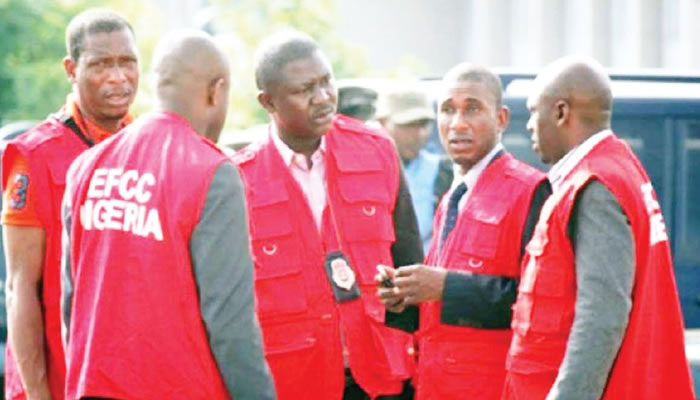
The Economic and Financial Crimes Commission (EFCC) is secretly investigating the 774 local government chairmen across the country over their management and spending of public funds since the councils gained financial autonomy, The PUNCH has learnt.

The investigation, which is being handled by the commission’s zonal directorates, is aimed at determining whether the councils have been accountable in the management of their allocations.

It was further gathered that the anti-graft agency is particularly interested in assessing how the chairmen have managed the funds allocated to their respective councils, their capacity to administer public resources and the extent to which the autonomy has improved service delivery.

An official of a state Ministry of Local Government had earlier confirmed the development to our correspondent, saying all the local government chairmen in the state were being investigated by the anti-graft agency.

“All the local government chairmen in the state are currently being probed by EFCC over their spending,” the official said.

However, sources within the EFCC confirmed that the investigation was ongoing across the 36 states and the Federal Capital Territory, stressing that the exercise was being conducted discreetly.

One of the sources said the commission wanted to establish whether the councils had demonstrated accountability and managerial competence since the Supreme Court judgment granting them financial autonomy.

The source said, “All the local governments across the country are being investigated. It’s discreetly being done. You know the Supreme Court ruling granted them financial autonomy. We want to know whether they are accountable.

See also  PHOTOS: Six missing, over 70 rescued as boat carrying mourners capsizes in Benue River

“We want to see their definite impact on the economy as a result of the financial autonomy that has been granted them. We want to see whether they have the necessary managerial skills, and whether their integrity quotient is high.

“We want to see comparatively what was existing before the autonomy and what is existing now and whether there has been development. It is not about the state you mentioned alone; it is across the country. All the EFCC zonal offices are handling the investigation secretly.”

The investigation comes more than two years after the Supreme Court affirmed the financial autonomy of the 774 local government areas in the country and barred state governors from controlling funds meant for the councils.

In May 2024, the Federal Government, through the Attorney-General of the Federation and Minister of Justice, Lateef Fagbemi, instituted a suit at the Supreme Court challenging the governors’ control of local government allocations.

The suit sought to stop governors from dissolving democratically elected local government councils and replacing them with caretaker committees, as well as preventing them from receiving and withholding funds allocated to the councils.

The Attorney-General argued that the 1999 Constitution provided for a democratically elected local government system and did not recognise caretaker committees as a substitute for elected councils.

On July 11, 2024, the Supreme Court, in a landmark judgment, ruled in favour of local government financial autonomy, declaring it unconstitutional for state governors to control or withhold allocations meant for the councils.

The seven-member panel, led by Justice Garba Lawal, also directed the Accountant-General of the Federation to pay allocations directly to the accounts of the local governments.

See also  Fintiri hikes corps members’ allowance to N30,000, promises new NYSC camp

The judgment was expected to strengthen governance at the grassroots by allowing elected council officials to independently manage their finances and implement development projects without interference from state governments.

However, concerns over accountability and the management of the funds prompted the EFCC to announce plans to monitor the spending of the councils.

In October 2024, the EFCC Chairman, Ola Olukoyede, said the commission would monitor the budget performance of all local governments to ensure that allocations were spent on projects and programmes for which they were approved.

Olukoyede, who spoke in an interview published in the commission’s magazine, said the agency was prepared to work with relevant stakeholders to track the councils’ expenditure and prosecute officials found to have violated the law.

He also identified the establishment of additional zonal directorates as part of efforts to strengthen the commission’s presence and improve its capacity to monitor public funds across the country.

He said, “We are fully prepared to ensure accountability in the use of local government funds. One of the reasons that informed the decision to establish additional zonal directorates by the commission is the need to improve the commission’s presence and coverage of the country.

“We’ll work closely with stakeholders in tracking the budget performance of the councils, to ensure that funds appropriated are used for specified purposes and those who violate the law will be brought to justice.”

Efforts to get the EFCC’s spokesman, Dele Oyewale, proved abortive at the time of filing this report on Monday night.

See also  Truck crash triggers Lagos-Ibadan Expressway gridlock

Source: punchng.com

FOLLOW US ON:

FACEBOOK

WHATSAPP CHANNEL

TWITTER

PINTEREST

TIKTOK

YOUTUBE

LINKEDIN

INSTAGRAM

Continue Reading

Trending