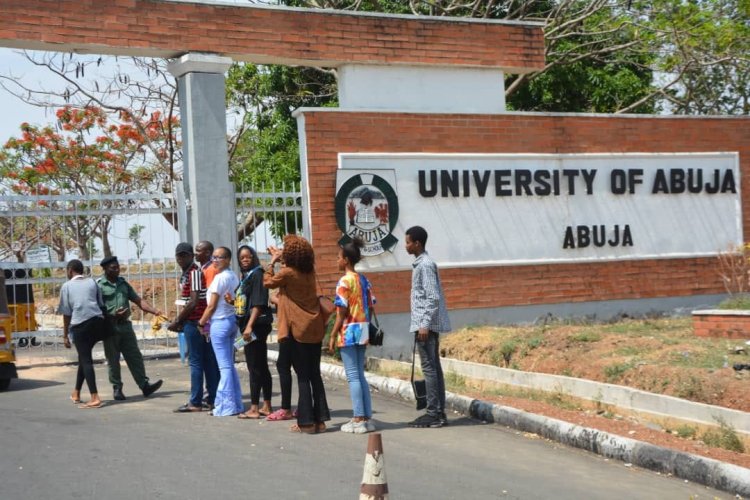
The University of Abuja (UNIABUJA) land dispute escalated on Monday as five university unions staged a protest against the alleged reallocation of portions of the institution’s land by the Minister of the Federal Capital Territory, Nyesom Wike, while the FCT Administration defended the decision, citing recommendations by a committee set up in 2016.
The protesters, comprising academic and non-academic staff, students and alumni, urged President Bola Tinubu to intervene and reverse the land reduction, accusing the FCTA of disregarding the rule of law.
However, the administration maintained that Wike merely implemented a decision approved by his predecessor, former FCT Minister Mohammed Bello, following a review of the university’s landholding.
Earlier on Monday, the university community staged a protest, with members of the Academic Staff Union of Universities, Senior Staff Association of Nigerian Universities, Non-Academic Staff Union of Educational and Associated Institutions, Students’ Union Government and the university’s alumni association demanding an immediate reversal of the alleged land reallocation.
The unions accused the FCT minister of disregarding the rule of law by allegedly transferring portions of land allocated to the university to private individuals.
Speaking during the protest in Abuja, ASUU chairman, University of Abuja branch, Sylvanus Ugoh, said the land was allocated to the institution when it was established in 1988, insisting that it should not be taken away for private interests.
Ugoh described the alleged action as an attack on public education and called on the President to intervene by directing Wike to reverse the decision.
He said, “University is a public good; university is public interest. There is nowhere in the world where you take public interest for individual interest.
“We say no to the issue of the honourable minister taking the land that belongs to the university.”
The ASUU chairman warned that the dispute could undermine the Federal Government’s assurances that universities would not experience industrial action under the current administration.
According to him, the university community would not remain passive while land reserved for the development of future generations was allegedly transferred to private individuals.
“We cannot allow what is for unborn generations to be given to individuals. University development is for everyone,” he said.
Also speaking, SSANU branch chairman, Nurudeen Yusuf, said the unions would resist any attempt to take over the institution’s land, stressing that adequate land was critical to the growth of universities and their academic programmes.
Yusuf cited the university’s Departments of Nuclear Engineering and Aeronautical Engineering as examples of programmes requiring substantial space for research, practical training and other specialised activities.
He explained that nuclear engineering research, in particular, required buffer zones, arguing that the land was deliberately provided to accommodate the institution’s specialised academic and research needs.
The unions’ protest followed an earlier warning by the UniAbuja ASUU branch that it could embark on industrial action if the minister failed to rescind the alleged decision.
The union had also threatened legal action to prevent the disputed land from being taken over and reallocated.
The protesters urged the Federal Government to resolve the matter before it degenerated into a broader crisis capable of disrupting academic activities at the institution.
The PUNCH reports that the dispute dates back to June 2025, when Wike announced plans to reclaim about 7,000 hectares of land originally allocated to the university, reducing its landholding from 11,824 hectares to approximately 4,000 hectares.
The minister had accused the institution of occupying and fencing off extensive portions of land without adequate documentation, directing the FCT Administration to reallocate the reclaimed portion for other developments in the Giri District.
Defending the decision, the FCTA said the action was based on recommendations made by a joint committee established in 2016 by the administration of former FCT Minister Bello.
It said the committee, comprising representatives of the administration and the university, had recommended that the institution’s landholding of over 11,000 hectares be reduced to 100 hectares in line with the National Universities Commission’s recommended size for universities.
In a statement issued on Monday by the minister’s Senior Special Assistant on Public Communications and Social Media, Lere Olayinka, the FCTA described the protest as misplaced, insisting that Wike merely implemented a decision taken by his predecessor.
According to the statement, the joint committee was inaugurated on November 10, 2016, to examine the university’s land size, encroachment by indigenous settlers, illegal developments around its Gwagwalada mini-campus and the issuance of title documents for the institution’s two campuses.
Olayinka disclosed that five of the committee’s 12 members were representatives of the university, namely Prof. Otaki Alanana, Prof. A. Mallam, Mohamed Kassim, A.E. Ripite and Sadiq O. Shuaibu.
He said the committee subsequently recommended that the university’s landholding of over 11,000 hectares was far beyond the size recommended by the NUC, adding that the 100-hectare recommendation was approved by Bello.
“It is on record that on November 10, 2016, the then FCT Minister inaugurated a Joint Committee of FCTA and UNIABUJA on Land and Sundry Issues.
“The committee was to look into the UNIABUJA land size vis-à-vis encroachment by indigenous settlers, encroachment on the Gwagwalada Mini Campus land by illegal developers and issuance of titles for the two campuses of the university with their actual land size.
“The committee recommended, amongst others, that the land area of over 11,000 hectares of the main campus was far beyond the recommended size by the National Universities Commission (NUC), and that the recommended size of 100 hectares by the NUC be given to the university.
“The report of the committee was approved by the immediate past FCT Minister, Mohammed Musa Bello, and going by the committee’s recommendation, only 100 hectares of land ought to be given to UNIABUJA,” the statement read.
Olayinka, however, said Wike approved 4,519.80 hectares for the university, rather than the 100 hectares recommended by the committee.
It added that the retained land could accommodate more than 80,000 buildings, using a plot size of 500 square metres.
The FCTA also accused the university of allocating portions of its land to individuals and corporate organisations without consulting the administration, citing the Economic and Financial Crimes Commission as one of the beneficiaries.
The statement questioned the rationale behind the university’s insistence on retaining more than 11,000 hectares, asking what significant expansion the institution had undertaken in its 38 years of existence to justify such a land requirement.
He asked: “Where in the civilised world is a university built on over 11,000 hectares of land, on which over 220,000 houses can be built at 500 square meters per plot?
“If the government that owns a university chooses to reduce the size of its land on which no structure has been built in the school’s 38 years of existence, what effect will that have on ASUU, SSANU and NASU? Will that affect the payment of their salaries? Will it affect the students in terms of their studies?”
The media aide urged the academic unions to be honest and clarify their interest in a land dispute between the administration and the management.
The controversy dates back to June 2025, when Wike announced that the administration had reclaimed about 7,000 hectares of land from the university, accusing the institution of laying claim to an extensive portion of government land without adequate documentation.
At the inauguration of access roads in Giri District, the minister directed relevant agencies to carve out about 4,000 hectares for the university, while the remaining portions would be made available for other developments.
Wike had argued that the university could not retain such an extensive landholding without developing it, particularly as the FCTA sought to open up the district for infrastructure and institutional development.
However, the university’s management and ASUU have maintained that the original land allocation was legitimate and necessary for the institution’s long-term development, including academic expansion, agricultural research and other infrastructure.
The university’s Pro-Chancellor, Olanrewaju Tejuoso, had also argued that much of the land left for the institution comprised rocky hills, raising questions about the actual amount of land available for development.
The dispute has also taken a legal dimension, with the university instituting Suit No. FCT/HC/CV/3500/2026 before the High Court of the Federal Capital Territory, Maitama.
In the suit, Justice F.E. Messiri, on August 18, 2026, reportedly ordered the parties to maintain the status quo ante bellum concerning Plot No. 1, Giri District, pending the determination of the substantive matter.
ASUU has subsequently accused the FCTA of violating the court order through alleged allocations of portions of the disputed land to private individuals and companies on September 26, 2026.
Source: punchng.com
FOLLOW US ON: