Connect with us

Politics

Ganduje, Badaru meet Tinubu amid defection surge

Published

on

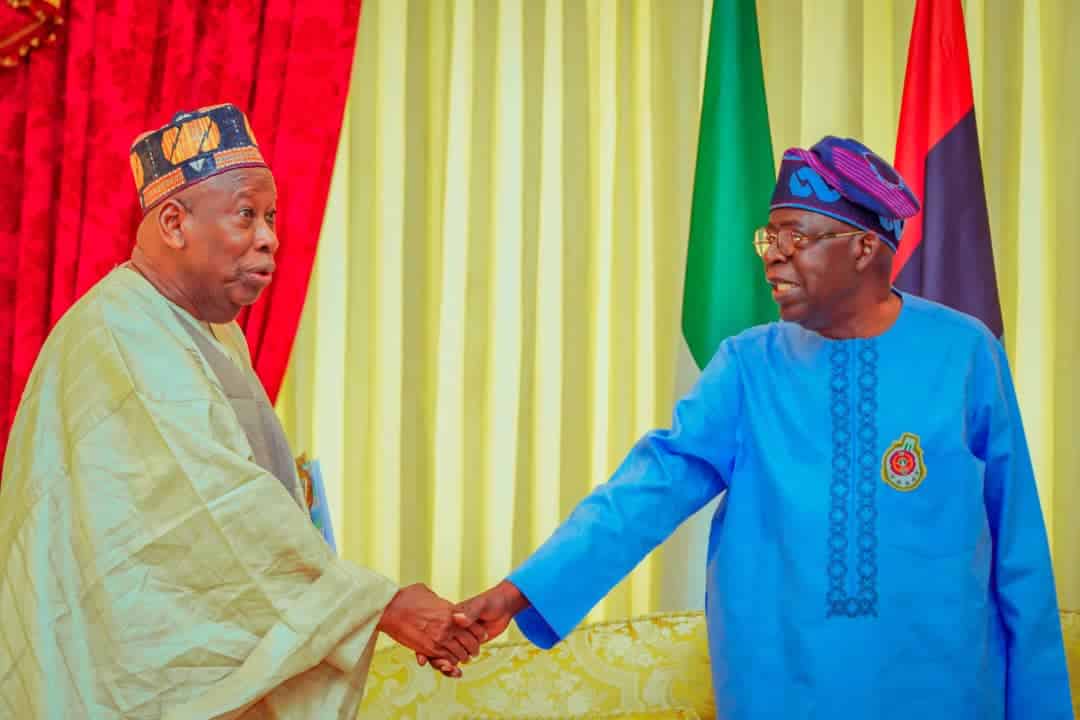
President Bola Tinubu on Tuesday received in audience former National Chairman of the All Progressives Congress, Dr Abdullahi Ganduje, and former Minister of Defence, Badaru Abubakar, in separate meetings at the Presidential Villa, Abuja.

The meeting came a day after the former governor of Kano State and New Nigeria People’s Party chieftain, Dr Rabiu Kwankwaso, defected to the African Democratic Congress.

Also defected alongside Kwankwaso were former deputy governor and 2023 governorship candidate of the APC in Kano, Nasiru Gawuna; former deputy governor of Kano State, Aminu Gwarzo, and a host of supporters.

There were reports that some lawmakers from the state were planning to join Kwankwaso in the ADC.

Our correspondent spotted Ganduje, dressed in a green ‘Babanriga’, leaving the State House at approximately 4:15 pm, while Badaru departed about 15 minutes later at 4:30 pm.

Both men declined to speak with journalists about the purpose of their visits.

Ganduje served as APC national chairman from August 2023 until July 2025, when he resigned from the position.

He was succeeded by Prof Nentawe Yilwatda, who was formally elected as substantive national chairman at the party’s 4th Elective National Convention held on March 27, 2026, at Eagle Square, Abuja.

Prior to his role as party chairman, Ganduje served as Kano State governor from 2015 to 2023.

Badaru, a former governor of Jigawa State (2015-2023), served as defence minister in Tinubu’s cabinet before his recent resignation from the position.

The separate timing of their exits suggested the meetings were individual consultations rather than a joint session with the President.

See also  Jonathan Will Contest 2027 election - Jerry Gana

The visits may be connected to ongoing party reorganisation following the recent APC national convention and defection surge in Kano and Jigawa states.

It was reported that some chieftains of the party loyal to Badaru may be heading to the ADC in Jigawa State, following the crisis with Governor Umar Namadi.

Earlier on Tuesday, Ganduje had accompanied Governor Abba Yusuf and Deputy Senate President, Barau Jibrin, to the House of Representatives to witness the defection of eight NNPP members of the House to the APC.

Speaking to newsmen after the event, Ganduje assured that Kano will deliver President Tinubu and Governor Yusuf in the 2027 elections.

He played down the defection of Kwankwaso to the ADC and assured that the party would be victorious in 2027.

punch.ng

FOLLOW US ON:

FACEBOOK

TWITTER

PINTEREST

TIKTOK

YOUTUBE

LINKEDIN

Continue Reading
Click to comment

Leave a Reply

Your email address will not be published. Required fields are marked *

Politics

Ekiti Decides: Police secure election materials across LGs, INEC ready

Published

on

The Independent National Electoral Commission on Thursday began the distribution of sensitive materials for the conduct of Saturday’s governorship election in Ekiti State.

Electoral officers from different local government areas were on hand to receive the materials for onward movement to their councils in readiness for onward distribution to the wards and units for the election.

INEC Resident Electoral Commissioner in Ekiti State, Dr Bunmi Omoseyindemi, who spoke at the Central Bank of Nigeria, Ado Ekiti branch, venue of the distribution, assured residents of the commission’s readiness to conduct a credible, free and fair poll.

The governorship election is scheduled to be held across the 16 local government areas of the state.

Omoseyindemi said, “As you can see, we have begun the distribution of sensitive materials for Saturday’s governorship election. The process is being carried out in a transparent manner in the presence of security agencies, political parties, election observers, media and other stakeholders.

“We started with local government areas that are far from the state capital to ensure that the materials get to their destinations on time and without any hitch.”

The REC, who said all necessary arrangements had been put in place for a successful election across the state, said that INEC remained committed to delivering a credible exercise that would reflect Ekiti people’s wishes.

He urged residents to come out peacefully and perform their civic responsibility on election day as he commended the security agencies for their collaboration and support, saying their presence would help guarantee the safe movement of election materials and the overall integrity of the electoral process.

Police deploy operatives

The Commissioner of Police for the Ekiti Governorship Election, Dr Abayomi Shogunle, speaking with newsmen on Thursday, commended the transparency in the distribution of the election materials, as he assured of adequate security on Saturday.

He said the police had put in place a multi-layered security framework to ensure hitch-free exercise.

He declared war against vote-trading, saying the Electoral Act had specific sanctions for the act, which the police would implement by ensuring anyone caught faced the prescribed music.

Shogunle, who assured general security for all, said, “Every unit, every centre, every INEC personnel, every voter, every journalist and every observer would be protected. What we want to achieve is increased voter turnout.”

The police commissioner said the security agencies were on the ground to escort the election materials and ensure security at the various destinations, including the wards and polling units.

He said, “Distribution of election materials to each of the 16 local government areas has commenced. INEC is starting with the faraway local governments.

“We have police officers who are going to escort these materials from here to all the local government headquarters, where the materials will be housed. The police officers will also be on guard to protect all these materials.

“Then, by tomorrow (Friday), we expect the movement of these materials from the various local governments to the Registration Area Centres (wards). Then, from the wards, INEC will get the materials to the polling units, where they will be used on Saturday.

“We have plans in place to ensure that the materials arrive safely at all designated polling units across the state by Saturday morning, very early, to enable the commencement of polling at the stipulated time at the various polling units.”

Shogunle said the police, which is the lead agency in the election security, had, in addition to their intelligence, “considered the risk assessments carried out by different stakeholders and put in place adequate measures to forestall any security issue or apprehension of any individual.”

He said that the police were operating under the operational order of the Inspector General, Tunji Disu, saying, “The operational order is based on a security framework, which is a multi-layered security framework.

See also  Soludo Hails INEC, Says Anambra Election Best In Recent Years

“We have identified different elements here, and we are putting in place different measures to take care of the issues that have been identified.”

He said that adequate measures had been put in place with the multi-layered security framework.

The police also said it will deploy a proactive and preventive security model for the election, while movement of persons will be restricted on election day to ensure a peaceful and credible poll.

The Force Public Relations Officer, DCP Anthony Placid, disclosed this in an interview on Thursday, assuring residents of the state’s readiness to provide adequate security before, during and after the election.

Placid said the IGP, Disu, had already deployed sufficient personnel to secure polling units, collation centres and other designated election facilities across the state.

He said, “As we approach the forthcoming elections in Ekiti under the leadership of our admirable Inspector General of Police, IGP Olatunji Disu, I would like to inform you that the Nigerian Police Force intends to utilise a proactive and preventive model in order to ensure a peaceful election.

“Currently, the Inspector-General of Police has deployed adequate personnel to cover polling units, collation centres, and all other designated election facilities. We will provide physical security, personal security, information security, as well as security for all election-related activities and events.”

The police spokesman said the Force would remain neutral throughout the electoral process, stressing that its allegiance was to the Constitution and not to any political interest.

“It’s an enormous task, but our neutrality mandate comes to mind at a time like this to ensure that our loyalty and allegiance are to the Constitution of the Federal Republic and not to any political faction,” Placid stated.

According to him, the police have activated the Inter-Agency Consultative Committee on Election Security to coordinate the activities of all security agencies participating in the election.

“The media have a role to play in collaboration with the police, but for the police and all other security agencies, we have set in motion the Inter-Agency Consultative Committee on Election Security to ensure a uniform command of all the security agencies that will participate in the forthcoming elections,” he said.

Placid further disclosed that security agencies had put in place a three-layer security arrangement and that movement restrictions would be enforced on election day.

“We have also made arrangements for the three concentric layer security zones, and on the election day, in order to have a successful election, there will be restrictions on the movement of persons,” he said.

He urged residents of the state to remain peaceful and participate in the electoral process.

“I urge all good people of Ekiti State to rest assured that the Nigerian Police Force will provide a level playing field for all to come out en masse and exercise their franchise,” Placid added. 

Yiaga-Africa warns vote-buyers

With a few hours to the governorship election, a non-governmental organisation, Yiaga Africa, has called on the political parties and their candidates to shun vote-buying and vote-selling during the forthcoming poll.

The group, which noted that the vote-trading remained one of the threats to the integrity of the election, said the political gladiators might capitalise on the economic hardship to exploit the voters.

The Chairman, 2026 Ekiti Election Observation Mission of the group, Dr Aisha Abdullahi, stated this while speaking with journalists in Ado Ekiti on Thursday.

Abdullahi also appealed to the INEC to sustain its commitment to transparency and professionalism, “particularly to the deployment of election materials, the RACs, the accreditation of voters using the Bimodal Voter Accreditation System and the management of election results, including the transmission of results.”

The group urged security agencies to sustain intelligence-led deployment, maintain strict neutrality and professionalism and guarantee the safety of voters, observers, journalists, electoral personnel, party agents, and election materials throughout the voting, counting, transmission and collation processes.

See also  APC consensus push faces resistance in states ahead of primary elections

Yiaga Africa urged INEC, in collaboration with security agencies and anti-corruption bodies, to proactively identify, arrest, and prosecute individuals engaged in vote trading on election day.

She said, “Political parties and candidates must publicly renounce vote buying, and voters are encouraged to reject inducements and protect the value of their vote.

“Sustained voter education on the dangers of vote trading remains essential in the days leading up to the election.”

The Yiaga Africa urged the stakeholders and INEC to intensify voter education and mobilisation, with deliberate outreach to women, youth, persons with disabilities, and rural communities.

 IPC tasks journalists

The International Press Centre and the Centre for Media and Society charged journalists and other media professionals who would be on duty during the election to adhere to professional standards and be safety conscious.

At a press parley, the Executive Director of IPC, Lanre Arogundade, said the admonition had become necessary in the light of the critical role that the media played during electioneering processes and elections, during which journalists’ safety may be threatened.

He said, “It is very important for journalists covering the Ekiti State election to be safety conscious in the discharge of their duties, and to avoid situations that will put them in harm’s way. Journalists are expected to be non-partisan.

“Being partisan is not only about being a member of a political party, but also includes the use of expressions and/or impressions with statements, tags, symbols and colours that portray or identify with a particular political party or personality,” Arogundade added.

He also admonished journalists covering the election to be well-equipped.

“Journalists who are to cover the elections should ensure that they are fully kitted and accredited to avoid situations wherein security agencies would have to question them or bar them from performing their duties.

“Journalists who are not on election duty should avoid straying into the identified polling units at will during the stipulated period of the election.

“At all times, journalists covering the elections must have their identification card and press/media tag clearly displayed to avoid undue harassment and unnecessary identity checks by the security agencies.

“Other stakeholders, including elections observers, should also proactively provide journalists covering the elections with information to ensure that all work together for the credibility of the electoral process,” Arogundade added.

The Executive Director of CEMESO, a partner organisation in the IPC/CEMESO-Safety of Journalists framework, Dr Akin Akingbulu, underscored the democratic imperative of journalist safety.

Akingbulu noted that the conditions under which journalists were permitted to work constituted a direct measure of a society’s commitment to its own civic values.

“Every election is, at its core, a test of those values and nowhere is that test more visibly administered than in the field,” he said.

On the broader relationship between security forces and the press during elections, Akingbulu called for functional collaboration grounded in mutual respect for institutional roles.

He said, “The relationship between security personnel and journalists during elections has historically been one of the most contested frontiers in Nigeria’s democratic experience, shaped by mutual suspicion on both sides.

“We expect the security forces to note that the media is a critical part of the electoral process and so the media should be accorded due rights and privileges to enable them to carry out their social obligations as partners in enshrining the credibility of the electoral process,” he added.

Among other activities, IPC/CEMESO will, during the election, be partnering with the Ekiti State police command in ensuring the safety of journalists deployed to the field.

As part of initiatives to keep tabs on the safety consciousness of journalists, IPC/CEMESO said that there were safety alert officers whom journalists under threat/attack could report to.

See also  Haiti targets August 2026 for first elections after 10 years

EU, CSOs launch observation hub

The European Union and a coalition of civil society organisations have launched a Joint Election Observation Hub to provide real-time monitoring of the election, in a move aimed at strengthening electoral transparency and boosting public confidence in the polls.

The initiative, under the European Union Support to Democratic Governance in Nigeria programme, will deploy accredited observers across all local government areas of Ekiti State to monitor the conduct of the election and provide verified, evidence-based reports throughout the electoral process, according to a statement by the EU delegation on Thursday.

The coalition comprises Yiaga Africa, IPC, CEMESO, TAF Africa, The Kukah Centre and the Nigerian Women Trust Fund.

Announcing the initiative in Ado-Ekiti, the organisations said the hub would serve as a central coordination platform for receiving, verifying and analysing reports from observers stationed at polling units across the state.

According to the coalition, the observers would monitor critical aspects of the election, including the opening of polls, voter accreditation, voting, vote counting, results collation, media coverage, electoral integrity and compliance with electoral guidelines.

The groups added that special attention would also be paid to the participation of women, young people and persons with disabilities to ensure that the election remained inclusive and reflective of democratic values.

“Verified information from the field will be analysed in real-time and shared through periodic public updates to promote transparency, counter misinformation, strengthen public confidence and encourage peaceful participation before, during and after the election,” the organisations stated.

Speaking on behalf of the EU-SDGN implementing partners, the coalition said the initiative reflected the strength of collaboration among Nigerian civil society organisations in safeguarding democracy.

“The Joint Election Observation Hub reflects the strength of Nigerian civil society working together in the public interest.

“By bringing together our expertise, nationwide networks and election observation efforts, we are able to provide timely, credible and evidence-based information that strengthens transparency, supports peaceful participation and reinforces public confidence in the electoral process,” the statement read.

The organisations stressed that credible elections required the active participation of citizens and the collective commitment of electoral institutions, security agencies, political actors, the media and civil society.

“Every stakeholder has a responsibility to protect the integrity of the electoral process. We encourage citizens to participate peacefully, reject violence and misinformation, and contribute to an election that reflects the will of the people,” they added.

Also speaking, Governance Adviser at the European Union Delegation to Nigeria and ECOWAS, Laolu Olawumi, said the EU remained committed to supporting Nigerian institutions and civil society organisations to deepen democratic governance through locally driven initiatives.

“The European Union is proud to support initiatives that place Nigerian organisations at the forefront of strengthening democracy.

“The Joint Election Observation Hub is significant because it is locally led, locally driven and built on the collective expertise of trusted Nigerian civil society organisations. It reflects our long-term commitment to supporting sustainable democratic institutions while ensuring that Nigerians themselves lead the efforts to protect and strengthen their democracy,” he said.

The Ekiti governorship election has emerged as one of Nigeria’s most closely watched off-cycle elections, with political observers viewing it as an early indicator of the mood of the electorate ahead of the 2027 general elections.

The election will determine whether incumbent Governor Biodun Oyebanji secures another four-year term or whether opposition parties can wrest control of the state.

The election is also expected to test reforms introduced by INEC, particularly the INEC Result Viewing Portal.

Beyond technology, stakeholders are paying close attention to issues of voter turnout, election security, misinformation and the inclusion of women, youths and persons with disabilities in the electoral process.

Continue Reading

Politics

APC knocks opposition, rejects Tinubu resignation call due to Insecurity

Published

on

The All Progressives Congress has condemned the African Democratic Congress, Peoples Democratic Party, Social Democratic Party, Nigeria Democratic Congress and others for endorsing the House of Representatives minority caucus’s “lead or leave” call on President Bola Tinubu over worsening insecurity in the country, describing the position as politically motivated and unfair.

On Wednesday, the minority caucus of the House of Representatives delivered a scathing assessment of the state of the nation, accusing the government of President Tinubu of failing to tackle worsening insecurity, deepening economic hardship and mounting threats to democratic institutions, while allegedly focusing on political calculations ahead of the 2027 general elections.

For over two decades, Nigeria, especially the northern region, has been severely affected by insecurity, with groups like Boko Haram, armed bandits, and other criminal networks responsible for thousands of deaths and the displacement of millions of people.

While the Federal Government and security agencies have succeeded in neutralising, arresting, and prosecuting some of the perpetrators, the menace has continued, with these groups persisting and even extending their operations into parts of southern Nigeria.

Addressing journalists at the National Assembly Complex in Abuja, Minority Leader of the House, Fred Agbedi, said the country was facing one of its most difficult periods since the return to democratic rule in 1999, citing persistent insecurity, rising poverty and growing public frustration.

Agbedi stated, “President Tinubu must suspend all 2027 political activities and declare a six-month National Security and Economic Recovery Plan.”

The Minority Leader, citing worsening economic hardship and insecurity as evidence that Nigeria is drifting toward a failed state, challenged the President to either provide effective leadership or step aside.

Speaking with The PUNCH in Abuja, the National Publicity Secretary of the ADC, Bolaji Abdullahi, said the minority caucus merely echoed the frustrations of many Nigerians.

He said, “ADC wholeheartedly support the position of the House of Representatives minority caucus because it reflects the view of the majority of Nigerians. It is obvious that President Tinubu has run out of ideas.

“Everything he is doing regarding insecurity now is mere showboating and for the media headlines.”

According to Abdullahi, recent security breaches exposed the weaknesses of the country’s security architecture.

He said, “The attack on the National Institute for Policy and Strategic Studies, Kuru, Jos, underscores this.

“If the highest policy institutions that ordinarily attract high-level presence of military officers could be so brazenly attacked and security personnel killed, what other daring could be more than that?

“The President was busy issuing threats to bandits on Democracy Day. But it is obvious now that he was only talking to himself and trying to sound tough.”

The PDP faction led by Tanimu Turaki (SAN), through its spokesperson, Ini Ememobong, also urged the President to step aside if he could not effectively address insecurity and economic challenges, saying greater focus on governance would have reduced the country’s problems.

He stated, “It is commonsensical that if you cannot solve a problem, you should give way for those who can. If you cannot solve the problem, you should step aside, because you will eventually become part of the problem.

“We said this over a year ago, that he should seek support. There are many people willing to offer assistance, but if he is unwilling to seek that support, it reflects a disposition that places politics above policies and programmes, and seeks public approval on issues.

“If he were to put even half the energy he invests in political strategy and weakening the opposition into tackling insecurity, it would have been a thing of the past.”

See also  Jonathan Will Contest 2027 election - Jerry Gana

He added that the government had not done enough in addressing insecurity and the economy, despite claims of progress.

The Social Democratic Party also backed the position of the House minority leadership, arguing that the Federal Government had failed to meet public expectations since taking office.

The party’s National Publicity Secretary, Rufus Aiyenigba, said Tinubu had not fulfilled the constitutional obligation of ensuring the security and welfare of Nigerians.

Speaking with our correspondent, Aiyenigba said, “The administration of President Tinubu has undeniably and inexplicably performed underwhelmingly and failed terribly in fulfilling the fundamental obligations of Chapter 2 of the Constitution of the Federal Republic of Nigeria (1999 as amended).

“His inability to secure the lives and welfare of Nigerians, which is his primary duty, after three years of being in power, speaks to the imperative of his having to step aside, or be rejected at the next polls, particularly considering that he had in the past been very critical of past governments when he was in opposition.”

Drawing comparisons with Tinubu’s role as an opposition figure before the APC came to power in 2015, Aiyenigba said the President was now facing the same scrutiny he once directed at previous administrations.

He continued, “It’s on record that Asiwaju Bola Tinubu, as opposition leader, strongly called out President Goodluck Jonathan. His party, Action Congress of Nigeria, as they were at the time, terribly lampooned President Jonathan and tagged him as being clueless!

“The ‘cluelessness’ of President Jonathan’s administration pales into insignificance, compared to the complete absence of governance under the APC administrations in the last 11 years, considering what Nigerians presently contend with in the areas of pervasive poverty, worsening insecurity, mounting national social tension and the dwindling public trust in government and our public institutions.”

The Democratic Leadership Alliance also endorsed the position of the opposition lawmakers.

Its Deputy National Publicity Secretary, Judith Aguenu, said the party had consistently maintained a similar position and had previously issued an ultimatum to the Federal Government over insecurity.

“This has always been the position of the DLA. Recall that we gave the President a 14-day ultimatum on this subject matter,” Aguenu said.

Also, the Nigeria Democratic Congress threw its weight behind the House of Representatives minority caucus’s demand for Tinubu to suspend political activities related to the 2027 general elections and concentrate on addressing Nigeria’s worsening security crisis.

Speaking on the proposal for a six-month national security and economic recovery plan, the NDC Deputy National Publicity Secretary, Abdulmumin Abdulsalam, described the recommendation as timely and long overdue, arguing that the scale of insecurity across the country required urgent and coordinated action.

“I think the Reps minority caucus position on the six-month national security and economic recovery plan is apt. It is coming at the right time. In fact, it is long overdue,” Abdulsalam said.

He stressed that insecurity had reached a level where the National Assembly must take a more active role in finding solutions, noting that security is a collective responsibility.

“Everybody knows the prevailing insecurity issue in the country has reached a level that the National Assembly, as an institution, ought to rise to the occasion. This is because security is the business of everybody.

“When the government fails to take a proactive step to stem the tide of insecurity, we should expect that it will continue to consume many of our citizens,” he added.

See also  Gov Fintiri: Millions of Nigerians defecting due to survival – Atiku

The opposition spokesman said the NDC fully aligned with the position of the minority lawmakers, lamenting what he described as the government’s reactive approach to security challenges.

“As a political party, we, therefore, align ourselves with the position of the minority caucus. On a personal level, I don’t think it is when a general or a high-profile person is killed that the Federal Government will vow to take action.

“Ordinary citizens have been dying for quite some time now. People, especially schoolchildren, have been abducted, and women have been raped with reckless abandon. Yet, the government appears not to care that much.”

Abdulsalam also dismissed concerns that a six-month emergency security plan could disrupt preparations for the 2027 general elections.

According to him, Nigeria had successfully combined intensive security operations with election preparations during the administration of former President Goodluck Jonathan.

“Personally, I don’t think so. If you recall, former President Goodluck Jonathan in 2015 declared an emergency on security. He ordered the military to take over the barracks, and all the other security agencies went to work to see how they could tame the Boko Haram insurgents.

“As of that time, a lot of success was recorded even though it was an election year. The election was very near, and a massive campaign was going on. But the military launched an onslaught on the terrorists.

“I don’t think declaring an emergency on security will in any way affect the planning, preparation or campaign for the elections. If it works for us in 2014/15, it can still work for us ahead of 2027.”

Meanwhile, the President of the Nigerian Bar Association, Afam Osigwe (SAN), said that rising insecurity, including cases of kidnapping, should not automatically lead to the suspension of elections or political campaigns in Nigeria.

Osigwe stated that while insecurity remains a serious national concern, the democratic process must not be disrupted, arguing that elections and campaigns provide a platform for accountability.

“That people are being kidnapped does not mean we should not hold an election,” he said.

The NBA President stressed that campaign periods are essential to democracy as they allow citizens to assess political leaders and hold them accountable for performance, particularly on security and welfare.

“Campaign season should not stop. It should offer an opportunity for us to actually hold accountable those who seek votes, those who seek to be re-elected,” Osigwe said.

He argued that suspending campaigns due to insecurity could unintentionally shield political office holders from scrutiny and weaken democratic accountability.

“It would also be an opportunity for them to show the people that they have a strong credential on security,” he said.

Osigwe further noted that elections serve as a “referendum” on leadership performance, especially on issues of insecurity.

“Voting them out, if the people feel they have failed to tackle mounting insecurity, is part of the democratic process,” he said.

He warned that removing electoral pressure could reduce urgency in addressing security challenges.

“What if the insecurity does not stop? What if leaders become laid back and do not take strong action?” he asked.

Osigwe maintained that political campaigns are central to democratic engagement, where key national issues are debated, and leaders are assessed by the electorate.

“Usually during election season, politicians tackle strong issues so they can score high with the electorate,” he said.

He, however, acknowledged concerns over insecurity but insisted that halting campaigns or elections is not a straightforward solution.

The All Progressives Grand Alliance, however, distanced itself from the call on the President to “lead or leave,” insisting it did not support the demand.

See also  Haiti targets August 2026 for first elections after 10 years

Asked whether APGA backed the position of the House minority leadership, the party’s National Publicity Secretary, Ejimofor Opara, replied: “Never, we don’t.”

Reacting, APC Director of Publicity, Bala Ibrahim, rejected calls for Tinubu’s resignation, describing the call and claims that Nigeria was tilting towards a failed state as reckless and misleading.

Ibrahim said the President remained focused on tackling insecurity and reviving the economy.

He argued that security and economic challenges were not unique to Nigeria, noting that countries such as the United States and the United Kingdom were facing similar difficulties.

He maintained that the Federal Government was taking steps to address the challenges and urged Nigerians to support efforts aimed at finding solutions.

The APC official stated, “The Minority Leader is reading the situation upside down. President Bola Tinubu is providing the necessary leadership in tackling insecurity and revamping Nigeria’s economy. He is focused on governance, not 2027 politics.

“It is reckless for the minority caucus to demand his resignation based on the false alarm that Nigeria is tilting towards a failed state. But that is not a surprise.

“That is why he is in the minority, minority in the membership of the National Assembly and, I think, minority in his thinking about situations around the world, not just in Nigeria.

“Every country is facing security challenges, including advanced democracies like America. As I speak to you, America is undertaking serious investigations regarding security threats to the White House. Nobody has said America is tilting towards a failed state. America is also facing economic challenges as a result of inflation and the Iran-Israel conflict. Yet, nobody is saying America is tilting towards a failed state.

“Britain, the United Kingdom, is facing mass resignations in Parliament and the cabinet. The Prime Minister is facing challenges, but nobody is saying Britain is facing a failed-state situation.

“So, Nigeria cannot be an exception. If you look at what the President and the party are doing to address these problems, you will know that nobody is sleeping with their eyes closed.

The party is strategising to ensure that the situation is brought under control. The government is also taking steps to ensure that the situation is brought under control.”

Speaking on the call for Tinubu’s resignation, Ibrahim said it was uncalled for.

“To call for the resignation of the President is uncalled for. I think it is a statement coming from people who do not fully understand the nature of the challenges confronting the country.

“The call is reckless. It is reckless in the sense that, in a democratic system where people can openly discuss issues through parliamentary processes, contributions should be made constructively with a view to finding solutions.”

Ibrahim stressed that everyone must unite to tackle the challenge, rather than introduce sentiments that could worsen divisions.

He stated, “All hands must be on deck to confront the challenge, not to inject sentiments that will deepen divisions rather than bridge them.

“People are entitled to their opinions, but we believe the President is doing everything possible. After all, no leader would want to govern in a situation characterised by insecurity.

It is the ambition of every leader to ensure that he leads a united, secure, and prosperous country, especially a country like Nigeria, which is a developing economy in Africa.”

Continue Reading

Politics

Ekiti election will be transparent, credible and inclusive — State REC

Published

on

The Resident Electoral Commissioner in Ekiti State, Dr Bunmi Omoseyindemi, says the Independent National Electoral Commission is fully prepared for the June 20 governorship election, with BVAS machines ready and personnel adequately trained. In this interview with ABIODUN NEJO, he speaks on the commission’s preparations, voter apathy, the threat of fake news, election security and assurances of a credible, transparent and peaceful poll

The Ekiti election is two days away. How far has INEC gone with preparations for the exercise?

We have done most of the things we need to do. The only things we are waiting for are the sensitive materials and the conduct of the election. Every other thing is set.

What arrangements have you made for people with disabilities?

We have done a lot of sensitisation for them. They have even been part of the people going around as Civil Society Organisations to mobilise their members. We have the braille ready, as well as all other facilities that will assist people with disabilities.

What is the total number of registered voters for the poll, and are there concerns about voter apathy?

There are 1,059,063 registered voters. When you talk about voter apathy, it is the responsibility of people, as citizens, to come out and vote. As much as possible, we want people to come and vote, but you cannot force them unless there is a law that makes voting mandatory. To vote or not to vote is a matter of choice. In some other countries, however, if you do not participate in the electoral process, there are certain benefits you will not get. So, voter apathy is an issue for citizens, while INEC has the duty to conduct elections. However, there are a lot of uncollected PVCs at INEC offices. That is why when people talk about low voter turnout or voter apathy, most times it is based on the total number of registered voters instead of the number of PVCs collected. The number of PVCs collected is different from the number of registered voters. It is the number of people who collected their voter cards that will determine the percentage of people who voted. For instance, if we have one million registered voters, how many of them collected their voter cards? The uncollected cards are there; either some of the owners have passed on or some people have changed location.

See also  Kwankwaso, Makinde hold closed-door meeting ahead of 2027

Do you think the country needs to toe the line of making participation in the electoral process mandatory?

It has to be discussed with the citizens, and people must decide whether that is what they want or not. It is a democratic setting; people have to decide what they want and what they do not want.

Many people criticise governments for poor performance but fail to vote during elections. Why do you think many citizens choose not to vote?

Psychologists, political scientists and sociologists are to provide answers to this. They need to conduct studies on why people are not voting. Their findings will form recommendations on the needs of the people. Is it out of ignorance? Is it out of fear? Is it out of intimidation? These are issues that need to be studied. Sociologists, political scientists and psychologists should find solutions to why people are not coming out to vote on election days. My responsibility here as a REC is to conduct a credible, inclusive, transparent and peaceful election.

Are there intelligence reports or developments that worry INEC as far as the Ekiti election is concerned?

Any intelligence report will be divulged to the appropriate quarters — the security agencies — to do the needful.

But are there worries?

I do not have worries. I am very positive. I have confidence in the people that they will do the right thing.

What is the biggest challenge for INEC going into the Ekiti election?

We are well prepared for the election. The biggest challenge is people spreading fake news. We have had meetings with media personalities, those in charge of online publications and others. People should not announce results that have not been announced by INEC, and they should not spread fake news about insecurity. For this election, the biggest challenge is fake news.

How does fake news affect INEC?

Fake news affects INEC and everybody as well. It can cause disorderliness, insecurity and anxiety among the people. It can intimidate people and discourage them from participating in the electoral process. For us, we know the people spreading fake news; we are not the ones. We know which reports are false because we are the custodians of information as far as the electoral process is concerned. So, when certain things are circulated, we know whether they are true or false. We have been able to train some people and organisations. Also, organisations such as the International Press Centre and the Centre for Media and Society have visited Ekiti State to train journalists on fact-checking. I think media practitioners should utilise the training and fact-check their stories. Some people like sensationalism. They want to break news and end up spreading false information, thereby losing their credibility. Journalists must wake up so they do not lose their credibility. Anything you want to know, ask INEC and we will provide the information.

See also  I felt unsafe for the first time, Emeka Ike cries out over INEC data leak

How ready are the Bimodal Voter Accreditation System machines for the election?

They are fully charged and ready. We conducted a mock accreditation exercise in some local governments last Friday to test the machines. Definitely, everything is set. INEC will deploy the machines to all the polling units. We have 2,445 polling units. That means 2,445 BVAS machines.

How confident is INEC that the result transmission process will be seamless and transparent?

We rely on technology. It will be seamless and transparent because we have confidence in our officers. I have to be confident in what I am doing. I am highly confident in the process and in what we are doing at INEC.

What is your message to political actors regarding adherence to the rules of engagement?

Political actors should follow the rules and regulations — the Electoral Act and INEC guidelines. They should caution their supporters and encourage and mobilise their people to vote. When you talk about mobilisation, INEC has a responsibility, but the main responsibility lies with the politicians. They are the ones who want people to vote for them, so they should go and talk to them one by one. You can see elections in other parts of the world where politicians engage citizens and talk to them. It should not be a case of making noise everywhere and then complaining that people are not coming out to vote. It is the responsibility of political parties to mobilise voters. For instance, if you are a banker looking for deposits, will the money come to you on its own? You go out and talk to your customers. It is the parties that want to sell their candidates to the people that should mobilise and convince them.

See also  Tinubu doesn’t fully trust me because I supported Peter Obi — Cubana Chief Priest

What are your expectations from the Ekiti electorate?

We expect the electorate to be orderly, come out en masse and vote for the candidates of their choice. It is the responsibility of eligible citizens to vote. If people believe it is their civic responsibility, they should come out and vote on Election Day. People should wake up to their civic responsibilities. Nigerians always talk about rights, but they do not talk about responsibilities. Their responsibility is to participate in the electoral process so that they can put the people they want in power. Without participatory democracy, you cannot have sustainable development. Sustainable development is premised on a participatory process. People must participate. You cannot just sit in your house complaining or be an online tiger without being on the ground. People should wake up, talk to one another and realise that this country belongs to all of us. We can make it better by living up to our responsibilities at every level and at all times.

What assurances can you give Ekiti people about the credibility of this election?

The credibility of the election depends on us at INEC and on the people on the field. We have trained our personnel thoroughly and our machines are ready. It is not going to be like in the past when people were brought in to thumbprint without being captured by BVAS. BVAS has removed all those kinds of practices. The people should rest assured that the election will be transparent, credible, peaceful and inclusive. That is the assurance I am giving the people of Ekiti.

What difference will this election make that the 2027 general elections can take a cue from?

We are well prepared and we are going to start the election on time, with adequate security in place. There will be lessons to learn from the processes we have put in place and from our ability to commence the election on schedule. One thing, however, is that this is a stand-alone election, which is different from the general elections. In the general elections, you are saddled with many other responsibilities.

punch.ng

FOLLOW US ON:

FACEBOOK

TWITTER

PINTEREST

TIKTOK

YOUTUBE

LINKEDIN

INSTAGRAM

Continue Reading

Trending