Connect with us

Sports

Ex-Jersey FA chief backs Nigeria grassroots development

Published

on

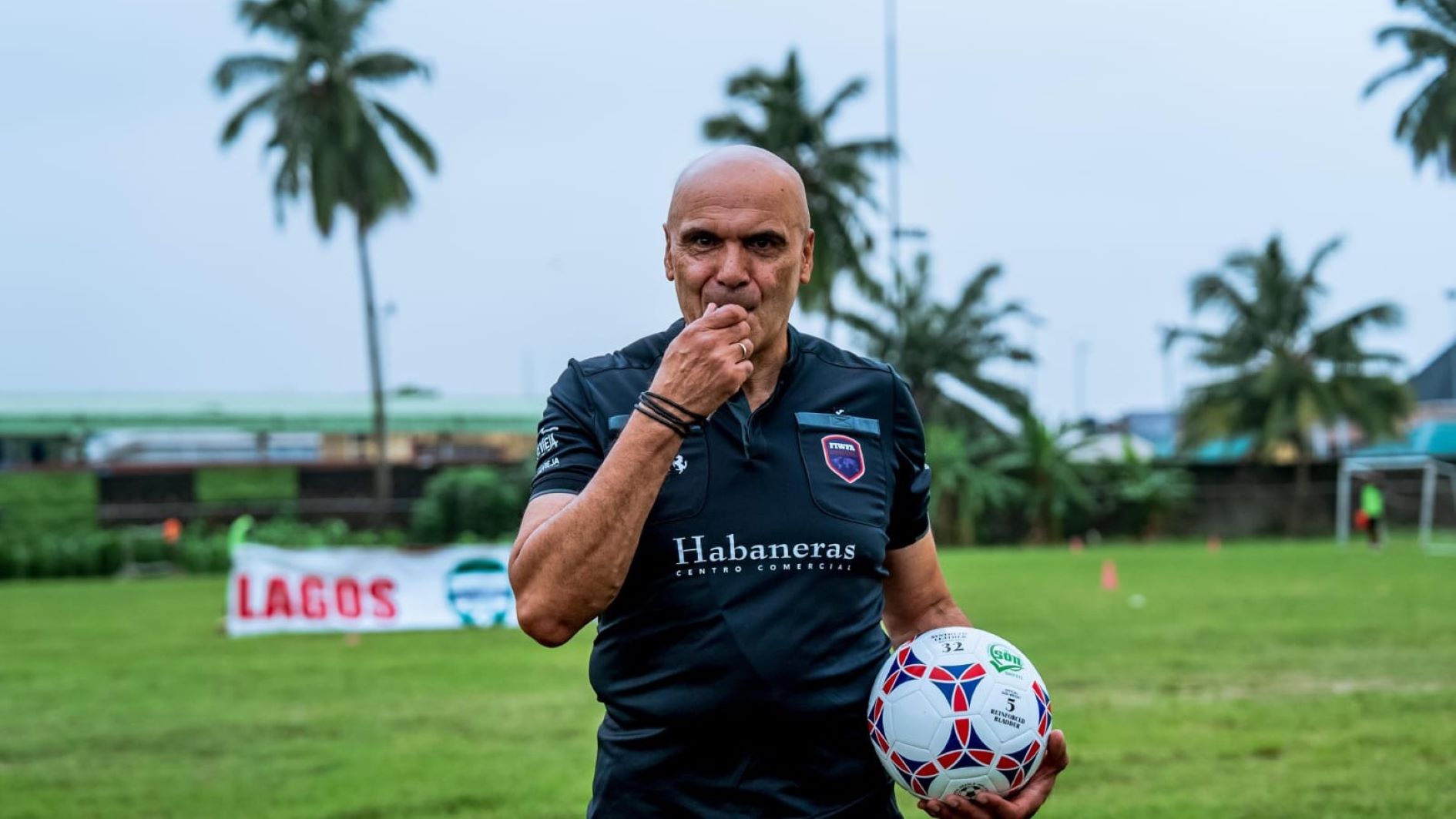
Former Jersey Football Association president Ricky Weir has set his sights on deepening grassroots football development in Nigeria, returning to the country this month on a visit that combined the promotion of his award-winning memoir with continued support for Walking Football and youth league programmes, The PUNCH reports.

Weir, who now holds a Nigerian passport, told reporters in Lagos that his latest trip was driven by three personal missions namely promoting his book, “Illegitimately Blessed”, supporting grassroots football, and strengthening the growth of Walking Football, a discipline he helped introduce to Nigeria in 2020.

“The biggest thing is that I can come back whenever I want. I don’t have to think about visas or costs anymore. It allows me to embrace the country more, spend time with family, and potentially shift more of my football development work to Nigeria,” Weir said.

The Founder of the Jersey 2 Africa 4 Football Foundation continued his grassroots engagement by attending the 5Stars Premier League opening in Abuja, where he delivered a new Premier League ball to each of the sixteen participating teams, before officiating at the Walking Football opening league programme at the Eagle Club Pitch in Surulere, Lagos.

“It was gratifying to see how far it has come. There are now league programmes and women’s teams, which is fantastic,” Weir said of the progress made in Walking Football since he helped establish the slow-paced, non-contact discipline in the country six years ago.

Weir, a prolific striker in his playing days who scored more than 600 goals in over 1,000 matches before moving into football administration, served as president of the Jersey Football Association for six years and has since built charitable initiatives using football as a tool for social development across Africa.

See also  EPL: Fixture pile-up no excuse for Man City in title race - Guardiola

During his visit, he was honoured in Lagos by the Africa Illustrious Awards, organised by My Media Africa, receiving the Award of Excellence and Special Recognition as African Football Ambassador.

Alongside his football work, Weir used the trip to promote his memoir, which chronicles his journey reconnecting with his Nigerian heritage after being born in Glasgow to a Scottish mother and a Nigerian father he never met. His father died before he was born, and Weir was placed for adoption and raised in Scotland.

He explained that he had deliberately delayed searching for his biological roots out of respect for the family who raised him.

“I never wanted my adopted parents to feel they were somehow not enough. My real parents were the people who raised me,” Weir said.

The search eventually led him to uncover his father’s Nigerian heritage and establish connections with relatives linked to his family history, a journey at the centre of “Illegitimately Blessed,” which Weir self-published in September 2024 before it was picked up by European publisher Europe Book and went on to win a literary award in Italy.

“When I finished the book, my goal was simply to complete it, leave something meaningful for my three sons and hopefully inspire one person. Everything after that has been a bonus,” Weir said.

While football features prominently in the memoir, Weir insisted the book carries a broader message beyond the sport.

“It covers identity, family, discrimination, resilience and overcoming challenges. It’s not just a football book,” he said.

Having spent fourteen years focused largely on philanthropic work in Kenya, Weir believes the next chapter of his African journey may increasingly be written in Nigeria, the homeland of the father he never had the chance to meet.

See also  EPL: Tottenham sign Liverpool’s Robertson on free transfer

punch.ng

FOLLOW US ON:

FACEBOOK

TWITTER

PINTEREST

TIKTOK

YOUTUBE

LINKEDIN

INSTAGRAM

Continue Reading
Click to comment

Leave a Reply

Your email address will not be published. Required fields are marked *

Sports

WAFCON: Morocco, Senegal renew rivalry in crucial Group A clash

Published

on

Hosts Morocco will look to complete a perfect Group A campaign when they face Senegal in their final group-stage match of the 2026 Women’s Africa Cup of Nations (WAFCON) at the Moulay El Hassan Stadium in Rabat on Monday evening, while the Lionesses of Teranga need a positive result to keep their quarter-final hopes alive.

Kick-off is scheduled for 21:00 local time (20:00 GMT).

The fixture also rekindles one of African football’s growing rivalries, with Morocco and Senegal having met in the controversial final of the 2025 Africa Cup of Nations.

Moroccan Team | CAF

Senegal initially won the match 1-0 after extra time in Rabat, but CAF’s Appeals Board later overturned the result and awarded Morocco a 3-0 victory after ruling that Senegal had forfeited the final following a temporary walk-off in protest over a penalty decision.

The case remains the subject of an appeal before the Court of Arbitration for Sport (CAS), ensuring there is no shortage of history and emotion whenever the two nations meet.

Meanwhile, PUNCH Online reports that the encounter, which comes after Morocco secured six points from their opening two matches, is being billed as one of the standout fixtures of the group phase.

“Some group stage matches feel like knockout games. The clash between Morocco and Senegal on Monday evening at the Moulay El Hassan Stadium in Rabat falls into this category,” CAF said in its match preview on Monday.

The Atlas Lionesses opened their campaign with a 4-0 victory over Kenya before edging Algeria 1-0 to book their place in the knockout rounds. Senegal, meanwhile, recovered from a 2-0 defeat to Algeria by beating Kenya 1-0 and remain in contention for qualification.

See also  Ex-Premier League referee Coote charged with making indecent child image

According to the official preview, “Hosts Morocco, who have already secured their place in the knockout stage, face Senegal in their final Group A match at the Moulay El Hassan Stadium in Rabat on Monday, 3 August, with kick-off at 21h00 local time (20h00 GMT).”

Senegal team | CAF

The preview also notes that this will be “the third WAFCON meeting between Senegal and Morocco,” with “the teams meeting at a third successive edition of the finals.”

Morocco have won both previous meetings by identical 1-0 scorelines, with Ghizlane Chebbak scoring from the penalty spot in 2022 and Yasmin M’Rabet converting another penalty in first-half stoppage time at the last edition.

CAF further noted that “when the teams were paired together in 2022, and at the last edition, both progressed beyond the group stage.”

This time, however, Senegal’s qualification scenario is more complicated.

“For both teams to advance this time, Senegal need to win and Algeria must fail to beat Kenya,” the preview stated.

Morocco coach Jorge Vilda dismissed suggestions that history could determine Monday’s outcome despite last year’s narrow victory over Senegal.

Vilda said, “These are two completely different situations. Senegal is a great team on the African and even global stage. We will have to show the best version of Morocco.”

Although already through to the knockout phase, Morocco insist there is still plenty at stake.

“It’s neither a dead rubber match nor an easy one.

“It’s a mini-final. In this WAFCON, all the teams have improved. We must stay focused on our game,” Morocco international Sakina Ouzraoui said.

See also  PHOTOS: BREAKING: Nigerian-British Boxing Star Anthony Joshua Involved In Road Accident In Ogun, Two Killed

The hosts are also counting on home support to inspire another victory.

“Our supporters are our twelfth player. We want to repay their pride by winning,” Ouzraoui said.

Vilda expects another capacity crowd in Rabat.

The coach added, “All the tickets are sold out. If the stadium were bigger, it would be just as full. We want to offer a victory to those in the stands as well as those watching on television.”

Senegal coach Mame Moussa Cissé said his side had recovered strongly from their opening defeat and remained confident ahead of the decisive encounter.

“We approach every match with confidence, humility and the desire to achieve a positive result. After our first defeat, we found the mental, physical and tactical resources to react. Today, our qualification depends on us,” Cissé said.

Cissé also brushed aside comparisons with previous meetings between the two countries.

He added, “Football evolves. Circumstances change. The two teams are now very evenly matched in terms of level. It’s up to each of them to write their own story. The Moroccan crowd is a hurdle.”

He acknowledged the challenge posed by playing the host nation, saying, “playing against the hosts is always difficult.”

However, he believes such occasions bring out the best in players.

“But these are the matches every player dreams of playing. We’ll have to ignore the atmosphere and stay focused on our own game,” he noted.

Looking beyond the result, the Senegal coach said the match would also be a showcase for women’s football on the continent.

See also  EPL: Fixture pile-up no excuse for Man City in title race - Guardiola

The coach stated, “Beyond Morocco and Senegal, it’s African women’s football that will be under scrutiny. This will be one of the most-watched matches of the competition. Everyone will have to rise to the occasion.”

The statistics underline Morocco’s recent dominance. The hosts are unbeaten in their last eight WAFCON group-stage matches, with seven wins and one draw, and have never conceded in this tournament after victories over Kenya and Algeria.

Victory would see Morocco win all three group matches for the second time after achieving the feat in 2022.

For Senegal, a win would secure successive WAFCON victories for only the second time and could send them into the knockout stage for a third successive appearance, provided Algeria fail to beat Kenya.

Senegal are also seeking to end an unwanted record, having never won, scored or avoided defeat in a third WAFCON group-stage match.

punch.ng

FOLLOW US ON:
FACEBOOK

TWITTER

PINTEREST

TIKTOK

YOUTUBE

LINKEDIN

Continue Reading

Sports

30 years on: Remembering Nigeria’s 1996 Olympic heroes

Published

on

30Thirty years after Nigeria’s historic run at the 1996 Olympic Games in Atlanta, the heroes who delivered the country’s most celebrated athletics and football as well as other landmark medals have taken different paths. ABIODUN ADEWALE looks at where Nigeria’s 1996 Olympic heroes are today and how their lives have unfolded since that historic Games

GOLD MEDALISTS

CHIOMA AJUNWA — LONG JUMP

Before athletics, Ajunwa had a football career and was part of the Super Falcons team to the 1991 FIFA Women’s World Cup. She was unused in that tournament. A year later, she was banned for four years over doping despite maintaining her innocence.

In 1996, she returned to the Games in Atlanta and, to date, remains Nigeria’s only individual Olympic gold medallist. She was also in the Nigeria Police Force and retired as a Deputy Commissioner of Police in 2023. She is now a retired police officer.

She now runs a foundation dedicated to lifting young Nigerians through sports and education.

FOOTBALL

EMMANUEL BABAYARO

Babayaro was the first-choice goalkeeper but lost his place to Dosu Joseph in Atlanta. The 1993 U-17 World Cup winner’s international career ended at that level. He turned to the entertainment industry on retirement.

He released his debut album, Best of Both Worlds, courtesy of Rectitude Records in 2010. In 2015, he was named General Manager of National League outfit Kaduna United while he ran his own team, Pioneers Academy. Recently, he delved into digital media by hosting the Special Delivery Podcast on YouTube.

 CELESTINE BABAYARO

Celestine, Emmanuel’s younger sibling, struck in the 28th minute to cancel out Claudio Lopez’s opener as Nigeria went on to beat Argentina 3-2 in the final at Sanford Stadium, Athens, and claim a first-ever football gold medal, the first by an African team. That was his second goal at the tournament, having also scored during the quarter-final win over Mexico.

Cele, as he is fondly called, went on to play for Chelsea, where he won the UEFA Cup Winners’ Cup (1998), UEFA Super Cup (1998) and the English FA Cup (2000), as well as Newcastle and LA Galaxy. He was at the 1998 and 2002 World Cups and captained the U-23 team at the 2000 Olympics in Sydney, where they crashed out in the quarter-finals.

The left-back announced his retirement from football on July 8, 2010, and was declared bankrupt just seven months later. He has led a quiet life since then, rebuilding his life after football.

 TARIBO WEST

The hard-as-nails ex-defender had a glorious club career, where he played for crosstown rivals AC Milan and Inter, Kaiserslautern, Derby County and Partizan Belgrade. He quit the national team in 2005 after playing at the ’98 and 2002 World Cups and reaching the 2000 AFCON final.

He turned pastor on retirement and operates a church, Shelter in The Storm Miracle Ministries of All Nations, in Lagos.

 NWANKWO KANU

Kanu was the golden boy of the ’96 Games, grabbing three crucial goals — in the opening 1-0 win over Hungary as well as the equaliser and winner against Brazil in the semi-final.

He remains one of Africa’s most decorated footballers after winning the U-17 World Cup, UEFA Champions League, UEFA Cup, UEFA Super Cup, three FA Cups, EPL (two) and two African Player of the Year awards, amongst others.

Papilo is involved in private business, which spreads across the hospitality industry and other sectors. He also owns a football club, Papilo FC, as well as kit-making outfit King Kanu.

He was appointed chairman of nine-time Nigerian champions and two-time CAF Champions League winners Enyimba in 2023.

Aside from his numerous trophies at club level and a few with Nigeria, Kanu is a two-time African Footballer of the Year, winning the award in 1996 and 1999.

UCHE OKECHUKWU

The publicity-shy Okechukwu has largely withdrawn from the limelight, preferring to live a quiet lifestyle since he called it quits in the mid-2000s.

See also  WAFCON 2024: Super Falcons to face Morocco in final

When asked recently about what he was doing on retirement from the game, Gentle Giant said, “I’m doing very well and I’m very fine but I don’t play football anymore.”

Recently, he was said to have been appointed Sporting Director of Enyimba, but that was disputed due to the lingering leadership crisis at the team.

EMMANUEL AMUNEKE

Amuneke seemed to be a specialist in showing up when it mattered most between 1994 and 1996. The ex-Barcelona man grabbed the winner to enter the record books as the man who handed Africa its first Olympic gold, before injury cut short his promising career.

Amuneke has since gone into coaching, assisting Manu Garba in 2013 as the Golden Eaglets won a fourth world title, before leading the team to a record fifth title in Chile in 2015.

His coaching career became more famous for giving Super Eagles star striker Victor Osimhen a 15-minute chance to prove himself during trials for the 2015 U-17 team in Abuja. He was promoted as Flying Eagles coach, but his side crashed out of the qualifiers for the 2017 U-20 AFCON.

After guiding Tanzania to their first AFCON appearance in over 40 years in 2019, Amuneke left the job. He was an assistant coach with the Super Eagles in 2022 and was among the candidates for the Super Eagles coaching role in 2024.

Amuneke won the African Player of the Year Award in 1994 and currently works with Heartland Football Club of Owerri.

 TIJANI BABANGIDA

Babangida played all the matches in Atlanta and scored one goal — the 82nd-minute opener in the 2-0 win over Japan in the group stage.

Having played most of his career in Holland, he called it quits in 2004 after a season at Changchun Yatai.

He worked as an agent but has experience in coaching, having led FC Taraba to a first-ever appearance in the elite domestic league. He was special assistant and liaison to ex-Eagles coach Sunday Oliseh.

In 2024, Babangida was involved in a fatal accident along Kaduna–Zaria Road, where he lost his then one-year-old son and his brother, Ibrahim Babangida, who was a 1993 U-17 World Cup winner.

Since the incident, Babangida has spent most of his time in The Netherlands, where his former clubs have risen to help him recover from the mental stress of the losses.

He also published his autobiography, ‘Between Sun and the Shadow’, which chronicles his life and contributions to Nigerian football.

WILSON ORUMA

At the Olympics in 1996, Oruma didn’t feature for Nigeria until the semi-final against Brazil and the final against Argentina. He came on as a second-half substitute in both games.

Since he retired from football in 2010, former Marseille midfielder Oruma has been reportedly ill and largely out of the scene. In 2018, he opened up about how he was defrauded of almost N2bn in an investment.

TESLIM FATUSI

Fatusi wore the No. 9 jersey in Atlanta and featured in three games during the tournament. He came in as a second-half substitute in the 1-0 defeat against Brazil during the group stage, the 2-0 win over Mexico in the quarter-final and the 4-3 extra-time win over Brazil in the semi-final.

Although he didn’t become as famous as many of his teammates after the tournament, he had a decent career at club level and featured for Nigeria. He scored on his debut, from a late penalty in a friendly against the Czech Republic in 1996.

Fatusi has had a nomadic career, playing for at least 18 clubs in 12 countries. He last played in the Vietnamese second division league. He relocated to the US and was at Miami Dade FC till 2016.

AUSTIN OKOCHA

Arguably the most gifted footballer to have ever come out of Nigeria, Okocha’s career has transcended his flashy skills since scoring two goals at the Atlanta 1996 Olympic Football event, as he continues to build a prosperous career outside football.

See also  Mikel snubs Fabregas for Chelsea job, backs Luis

Okocha was a Frankfurt player in 1996 but joined Fenerbahçe, PSG, Bolton, Qatar SC and Hull City afterwards before retiring in 2012, six years after he left the national team, having been captain since 2002.

Okocha’s post-playing career has seen him dabble in administration, becoming the chairman of the Delta State Football Association in 2015, but that journey infamously ended over allegations of maladministration.

Since then, he has been focused on building his brand’s engagement while also serving as a pundit on TV during major continental and international competitions.

In June 2025, he rallied 2,000 fans across Nigeria to join him in setting the Guinness World Record for the most number of people juggling the ball at the same time in one venue.

 VICTOR IKPEBA

Ikpeba scored one of Nigeria’s 12 goals en route to triumph in Atlanta. The then Monaco striker was on target in the dramatic 4-3 semi-final win over Brazil, scoring in the 78th minute to reduce the deficit to 3-2 and hand the Dream Team a lifeline in the game.

Since retiring from football in 2005, Ikpeba has been active as a member of the Nigeria Football Federation’s technical committee, a pundit on SuperSport’s Monday Night Football and also features occasionally for CAF.

Nicknamed The Prince of Monaco during his days, Ikpeba won the African Player of the Year Award in 1997.

He also runs a grassroots football tournament to uplift upcoming stars.

ABIODUN OBAFEMI

Obafemi was involved in all the qualifiers for Atlanta ’96 but played just one game, the team’s final group game against Brazil, at the competition proper.

Obafemi, who began his career at Stationery Stores, played mostly in Germany, featuring for Köln, Düsseldorf, Reutlingen and Augsburg, where he retired in 2001.

He has been involved in grassroots football development ever since and is the Technical Director/Head Coach of Youth Sports Management, a Lagos-based academy reputed to have produced players for the U-17 team and the local league.

GARBA LAWAL

After the Olympic Games in 1996, Lawal moved to Dutch side Roda JC from Esperance in Tunisia. At Roda, Lawal had his most successful time, making 155 appearances.

In 2007, he returned home to end his career in the NPFL with Lobi Stars after playing for Julius Berger.

Lawal, now 52, was successful at the national team level as well, playing at the AFCON four times between 2000 and 2006 and winning bronze on three occasions. He has since transitioned to a coach and now an administrator.

 DANIEL AMOKACHI

Aged just 23 in 1996, Amokachi’s international career only lasted till 1999 and he also called it quits at club level in 2000 after a fulfilling club career at Club Brugge, Everton and Besiktas.

Since then, he has mostly worked as a coach, especially in Nigeria with Nasarawa United, Enyimba, FC Ifeanyi Ubah and Lobi Stars. In between that, he was also an assistant coach with the Super Eagles during the 2013 AFCON triumph under late Stephen Keshi.

In 2020, Amokachi was appointed by late President Muhammadu Buhari as a Special Assistant on Sports. He has also worked with CAF as a member of their technical study group and as a commentator during the Africa Cup of Nations.

 SUNDAY OLISEH

Oliseh, like a few of his teammates in Atlanta, was already a mainstay in the Super Eagles before 1996.

After the tournament, he went on to captain the Super Eagles and had a successful club career at Ajax, Juventus and Borussia Dortmund before ending it at Genk.

He has also landed coaching jobs, including leading the Super Eagles between 2015 and 2016. His last coaching job was at SV 19 Straelen in Germany.

Since he stepped aside from coaching, he has been an active voice in football punditry through his Global Football Insights podcast and also working with bodies like the Confederation of African Football.

See also  EPL: Fixture pile-up no excuse for Man City in title race - Guardiola

KINGSLEY OBIEKWU

Obiekwu didn’t get any minutes during the 1996 Olympic football gold triumph but played a major role in qualifying. His ferocious long-range stunner against the Egyptian U-23 team in Lagos helped knock out the North Africans in the final game to Atlanta.

In a hard and least expected twist of fate, he became a commercial bus driver many years after retiring from football. In 2022, he received a donation of N2m from former Super Eagles captain Ahmed Musa, as well as other donations from Nigerians who were moved by his predicament.

He was playing his trade with Go Ahead Eagles in the Netherlands when he was invited for the tournament. He ended his career at Rangers International in 2006 before serving as a coach at the club between 2009 and 2013.

After his ordeal on the dusty motor parks, he is now back into coaching and mentoring young players.

MOBI OPARAKU

Oparaku played at the 1996 Olympic Games as an Anderlecht player. After the tournament, he played at two other clubs in Belgium, moved to the US and Jamaica before returning home to feature for Gateway FC and Enyimba International before ending his career.

In 2025, he was the Technical Director of newly promoted Nigeria Premier Football League side Kun Khalifat FC. The club would also retain their NPFL status and are set to play their second season in the top flight.

DOSU JOSEPH

Despite being involved in a ghastly accident that cut short his career, Dosu has made the most of his career as an administrator, establishing one of the most successful football academies in Nigeria, Dosu Joseph Football Academy.


SILVER MEDALISTS

WOMEN’S 4x400M RELAY

FALILAT OGUNKOYA

Ogunkoya ran the last leg of the relay final as Nigeria clinched a historic 4x400m silver medal. She also won a bronze medal in the women’s 400m, behind France’s Marie-José Pérec and Cathy Freeman of Australia, in a personal best and former African record of 49.10s.

Ogunkoya, who is the first and only Nigerian athlete to win two medals in one Olympics, was a board member of the Athletics Federation of Nigeria and is still active within the athletics scene in Nigeria as a veteran.

 FATIMA YUSUF-OLUKOJU

She ran the second leg of the final, coming from behind to emerge in first place before handing over the baton.

Fatima, married to another retired Nigerian athlete, Adewale Olukoju, resides with her family in California. She’s a health and wellness professional and mother of two kids.

In 2025, she was elected as a board member of the AFN as representative of the National Association of Women in Sports.

BISI AFOLABI

Not much has been heard of Afolabi since she quit athletics. However, it was learnt that she resides in the US.

CHARITY OPARA

After Atlanta, Opara won silver and bronze respectively in the Grand Prix Final in Moscow and Doha in 1998 and 2000. On retirement, she relocated to Owerri.


BRONZE MEDALISTS

MARY ONYALI — WOMEN’S 200M

After winning bronze in the 4x100m relay at the 1992 Games, Queen of the Tracks then won the 200m bronze at Atlanta. In 2004, she became the first Nigerian to compete at five Olympics.

Onyali has been engaged with the nurturing of new athletics talents for Nigeria through the Making of Champions/MTN partnership.

DUNCAN DOKIWARI — BOXING

Dokiwari won bronze in Atlanta but never truly lived up to his potential in the professional ranks despite his impressive form as an amateur.

In December 2006, he won the WBC USNBC heavyweight title with an impressive fourth-round knockout of Willie Palms in Laughlin, Nevada. He is resident in the United States.

punch.ng

FOLLOW US ON:

FACEBOOK

TWITTER

PINTEREST

TIKTOK

YOUTUBE

LINKEDIN

Continue Reading

Sports

UEFA declares loss of confidence in Gianni Infantino’s FIFA presidency

Published

on

UEFA says it has lost confidence in FIFA President Gianni Infantino and that “no option should be off the table” as it will pursue a full review of his now-abandoned plan to sell stakes of the World Cup to private equity investors.

Infantino was forced to scrap the plan early Saturday after his senior adviser, who sat on a White House panel, resigned and Asia’s soccer body joined Europe and North America in opposing it.

Infantino had proposed creating a $20 billion company to run the World Cup with private investors, but drew backlash that grew every day since Tuesday’s announcement.

“We must identify those responsible and hold them to account,” UEFA said on Saturday. “No option should be off the table. The current FIFA leadership has not only lost UEFA’s confidence but also that of many other members of the football family.”

The governing body of European soccer, headed by Aleksander Čeferin, issued its blistering statement hours after FIFA announced it was withdrawing its private equity plan.

“We cannot keep going on like this with secret schemes on fast-track timescales, cooked up by faceless individuals and of dubious benefit to the game,” UEFA said.

“It is right that, in the coming days and weeks, UEFA will work with its associations and in close cooperation with other confederations to reflect on how this happened and devise a plan to make sure that it cannot occur again.”

UEFA’s 55-member nations agreed to boycott the World Cup and all other FIFA competitions over Infantino’s plan on Thursday. North America’s CONCACAF and the Asian Football Confederation also said they opposed the plan.

See also  Osimhen pens heartfelt message as daughter turns three

Infantino’s senior adviser, Carlos Cordeiro, a former Goldman Sachs banker who represented the soccer body on the White House Task Force for the World Cup, resigned on Friday and urged other senior FIFA staff to speak out.

“I cannot stand by while FIFA considers selling a stake in the World Cup,” Cordeiro said in a statement, just hours after FIFA insisted: “Nobody is selling football.”

Hours later, FIFA chief operating officer Kevin Lamour issued a statement to The Associated Press, saying FIFA staff were deceived by Infantino’s lack of openness in planning the sale over recent months and that the project must not continue.

FOLLOW US ON:
FACEBOOK

TWITTER

PINTEREST

TIKTOK

YOUTUBE

LINKEDIN

INSTAGRAM

Continue Reading

Trending