Connect with us

Education

Nigerian students win gold at Spelling Bee World Cup in China

Published

on

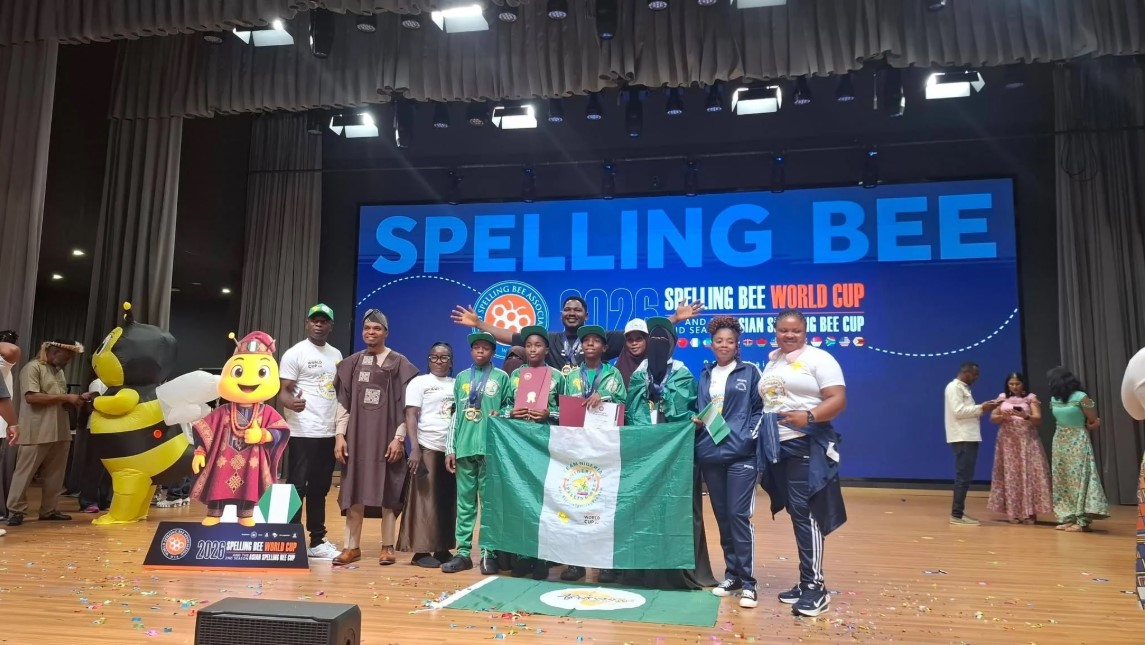
Team Nigeria has won the Gold Award in the Middle School Group Category at the 2026 Spelling Bee World Cup in Shanghai, China.

The achievement was announced by the Nigeria Spelling Bee on its official Facebook page on Sunday.

The organisation wrote, “Team Nigeria has won the Gold Award in the Middle School Group Category at the Spelling Bee World Cup in Shanghai, China.”

Also confirming the feat on Sunday, Ar-Raheem International College, Ilorin, announced that two of its students, Maryam Yusuf and Abdurrahman Yusuf, won medals at the global competition.

Maryam Yusuf won medals at Spelling Bee World Cup final in Shanghai, China 2026…Photo Credit: Ar-Raheem International College

The school wrote on its Facebook page, “Ar-Raheem International College students Maryam YUSUF and Abdurrahman YUSUF won medals at Spelling Bee World Cup final in Shanghai, China 2026.”

PUNCH Online had earlier reported that Team Nigeria was making its first-ever appearance at the Spelling Bee World Cup after qualifying through the Nigeria Spelling Bee and the African Spelling Bee Championship.

Abdurrahman Yusuf won medals at Spelling Bee World Cup final in Shanghai, China 2026…Photo Credit: Ar-Raheem International College

The four-member team comprised 2026 African Spelling Bee Junior champion, Oluwadamilola Adeolu of St. Lawrence Metropolitan College, Ado-Ekiti; Abdurrahman Yusuf of Ar-Raheem International College, Ilorin; Chinedu Okediachi of Madonna International Schools, Asaba; and Maryam Yusuf of Ar-Raheem International College, Ilorin.

Maryam Yusuf and Abdurrahman Yusuf won medals at Spelling Bee World Cup final in Shanghai, China 2026…Photo Credit: Ar-Raheem International College

Announcing Nigeria’s historic participation before the tournament, the Nigeria Spelling Bee had said, “For the first time ever, Nigeria will be represented at the Spelling Bee World Cup, as four outstanding young spellers prepare to compete in Shanghai, China, from 10th–20th July 2026.

“Their journey has been one of excellence and determination—beginning with the Nigeria Spelling Bee, progressing to the African Spelling Bee Championship in Harare, Zimbabwe, and now advancing to the world stage.”

See also  FG seeks to transform polytechnics for job creation, innovation
Team Nigeria wins Gold at the World Cup Spelling Bee in China…Photo Credit: Nigeria Spelling Bee

The organisers also noted that the students were representing not only Nigeria but the African continent.

“As they compete against the world’s finest young spellers, they carry with them the hopes of a nation and the pride of an entire continent. Join us in wishing Team Nigeria a successful outing as they make history at the Spelling Bee World Cup 2026. Go Team Nigeria!” the statement added.

Team Nigeria wins Gold at the World Cup Spelling Bee in China…Photo Credit: Nigeria Spelling Bee

Ahead of the competition, Adeolu had expressed excitement about competing on the global stage.

“I am proud to be part of the Nigerian Spelling Bee and African Spelling Bee delegation travelling to the Spelling Bee World Cup in Shanghai, China, to represent Nigeria,” she had said.

Team Nigeria wins Gold at the World Cup Spelling Bee in China…Photo Credit: Nigeria Spelling Bee

She added, “I am looking forward to the competition itself, meeting new spellers across the world, boosting my vocabulary and confidence on the global stage and also raising the trophy and bringing it back home.”

PUNCH Online also reported that Adeolu qualified for the World Cup after emerging champion of the Junior category at the African Spelling Bee Championship in Harare, Zimbabwe, where she outperformed contestants from more than 30 African countries.

At the continental competition, Abdurrahman Yusuf finished third, while Nigeria emerged the second-best overall team, further strengthening the country’s growing reputation in international spelling competitions.

punch.ng

FOLLOW US ON:

FACEBOOK

TWITTER

PINTEREST

TIKTOK

YOUTUBE

LINKEDIN

Continue Reading
Click to comment

Leave a Reply

Your email address will not be published. Required fields are marked *

Education

Technical education, Nigeria’s fastest job creation route – NABTEB

Published

on

The Chief Executive Officer of the National Business and Technical Examinations Board (NABTEB), Dr Muhammed Aminu Muhammed, has declared that technical education remains Nigeria’s strongest pathway to employment, entrepreneurship and national economic growth.

Speaking during an inspection of the 2026 May/June NABTEB examinations at the Federal Technical College, Awka, Anambra State capital, Muhammed said the future of Nigeria depends on equipping young people with practical skills that will enable them to create jobs.

His visit to the Awka centre is part of a nationwide monitoring exercise covering examination centres across Nigeria.

He said, “Technical education remains the Nigeria’s strongest pathway to employment, entrepreneurship and national economic growth.

“The future of Nigeria depends on equipping young people with practical skills that will enable them to create jobs rather than wait endlessly for white-collar jobs.

“Effective leadership within a school naturally reflects in students’ performance and the quality of teaching and learning.”

Muhammed disclosed that more than 167,000 candidates are sitting for this year’s examinations nationwide, while 226 candidates are taking their papers at the Federal Technical College, Awka.

During the exercise, the NABTEB Registrar inspected the Physics practical examination, monitored the organisation of candidates, interacted with officials supervising the exercise and assessed the overall conduct of the examination.

He expressed satisfaction with what he witnessed at the Awka centre, describing it as one of the most organised technical colleges visited during his nationwide assessment tour.

He commended the way the practical examination was organised, noting that candidates were carefully grouped to ensure the exercise ran smoothly despite the large number of students involved.

See also  WAEC under fire as results portal goes down

Reflecting on the nationwide exercise, Muhammed said this year’s examinations have shown remarkable improvement over those conducted in 2025.

He attributed the progress to stronger supervision by school principals, better coordination by NABTEB officials and increased support from security agencies working to safeguard the examination process.

“In every area, this year’s examination is better than last year’s,” he added.

The Registrar stressed that the practical component of NABTEB examinations remains central to the Board’s mission of producing graduates with employable skills that can transform their lives and contribute meaningfully to the nation’s economy.

He maintained that expanding technical education is essential if Nigeria hopes to reduce unemployment, empower young people and build a more productive economy.

punch.ng

FOLLOW US ON:

FACEBOOK

TWITTER

PINTEREST

TIKTOK

YOUTUBE

LINKEDIN

Continue Reading

Education

US exchange programmes boosting Nigeria-US economic ties — US Mission

Published

on

The United States Mission in Nigeria has reaffirmed its commitment to strengthening bilateral relations through educational and professional exchange programmes, saying investments in people continue to deliver lasting benefits for both Nigeria and the United States.

The mission said Nigerian beneficiaries of US-sponsored exchange programmes had returned home with new skills, wider professional networks and a renewed commitment to promoting good governance, entrepreneurship and innovation.

The position was contained in a statement issued by the US Mission in Nigeria on Tuesday following a #Freedom250 event held to celebrate Nigerian alumni of various US exchange programmes.

According to the mission, the event formed part of activities marking the 250th anniversary of the United States’ independence, while reaffirming America’s commitment to partnerships built on mutual benefit.

The mission also explained that the exchange programmes were designed not only to expose participants to educational and professional opportunities in the United States but also to equip them with knowledge and networks that contribute to Nigeria’s development.

The mission’s statement partly read, “What an outstanding #Freedom250 event with our U.S. exchange alumni here in Nigeria! Fulbright scholars, YALI Fellows, IVLP participants, and other exchange programs gathered to demonstrate something the United States has always known: investment in people delivers lasting returns – for Nigeria, and for America.

“These alumni didn’t just visit the United States. They returned home with new skills, expanded networks, and a commitment to the kind of transparent governance, entrepreneurship, and innovation that drives real economic growth, benefiting both countries.

See also  Tinubu appoints NECO, NBTE chairmen, names poly rector, renews library DG tenure

“As the United States marks 250 years of independence, events like this one make clear that U.S. engagement in Africa is about building capable, sovereign partners who choose to work with us because it works for them.”

The mission further noted that the US Country Public Affairs Counsellor, Lee McManis, highlighted the role of Nigerian exchange alumni in deepening bilateral relations during his welcome remarks. The mission also praised the leadership demonstrated by the alumni, saying it reflected the enduring value of educational and professional exchanges.

It stated, “In Country Public Affairs Counsellor Lee McManis’s welcome remarks, he underscored how the values imbued in America’s 250th celebratory year are reflected in our thousands of Nigerian exchange alumni, always working to make the U.S.-Nigeria relationship stronger. To our exchange alumni: your leadership is proof that diplomacy delivers results.”

The statement added that the Chargé d’Affaires of the US Mission in Nigeria, Keith Heffern, encouraged participants to continue serving as ambassadors of stronger US-Nigeria cooperation.

In Charge d’Affaires Keith Heffern’s address to the participants, he emphasised, “Your success is the argument for why more Nigerians should choose to partner with the United States in business, tech, agriculture, and the creative economy. So keep building. Keep leading.”

The United States has maintained a long-standing partnership with Nigeria through a range of educational, leadership and professional exchange programmes, including the Fulbright Programme, the Young African Leaders Initiative and the International Visitor Leadership Program.

Thousands of Nigerians have participated in these initiatives over the years, with many going on to occupy leadership positions in government, business, academia, civil society and the creative industry.

See also  2025 WASSCE: Stakeholders blast WAEC, demand investigations, sanctions

The programmes form part of broader U.S. efforts to promote people-to-people diplomacy, economic cooperation and democratic governance between the two countries.

punch.ng

FOLLOW US ON:

FACEBOOK

TWITTER

PINTEREST

TIKTOK

YOUTUBE

LINKEDIN

Continue Reading

Education

Atiku condemns increase in WAEC, NECO fees

Published

on

Former Vice President Atiku Abubakar has described the recent increase in fees for Federal Unity Colleges and the reported approval of a uniform ₦50,000 examination fee for WAEC and NECO candidates from 2027 as cruel, economically insensitive, and fundamentally incompatible with the government’s constitutional responsibility to make education accessible to every Nigerian child.

Reacting to the development on Sunday through his Senior Special Assistant on Public Communication, Phrank Shaibu, Atiku condemned the Federal Government’s continued escalation of the cost of public education.

The presidential candidate of the African Democratic Congress (ADC) said it is unconscionable that at a time when Nigerian families are battling record inflation, soaring food prices, rising transportation costs, crippling electricity tariffs, stagnant incomes and widespread unemployment, the Tinubu administration has chosen to make education even more expensive.

He noted that education remains the greatest instrument of social mobility and the surest pathway out of poverty for millions of children from humble backgrounds.

According to him, every additional financial burden imposed on parents translates into another child being denied the opportunity to learn, dream, and contribute meaningfully to society.

Atiku therefore called on President Bola Ahmed Tinubu to immediately reverse the increase in Unity School fees and the proposed ₦50,000 WAEC and NECO examination fee and convene an urgent stakeholders’ dialogue on sustainable financing for public education.

He urged the Federal Government to invest more in public schools, strengthen educational infrastructure, recruit more qualified teachers, expand the carrying capacity of tertiary institutions, and ensure that no Nigerian child is denied education because of poverty.

“By the grace of Almighty God, I remain confident that Nigerians will reject policies that punish their children and make education the exclusive preserve of those who can afford it. The African Democratic Congress is committed to restoring education as a public good, not a privilege. An ADC-led government will not permit the implementation of this unjust and punitive increase in examination fees. Instead, we shall reverse policies that place education beyond the reach of ordinary families, expand access to quality education at every level, increase the carrying capacity of our tertiary institutions, and ensure that every Nigerian child, regardless of background, has a fair opportunity to learn, excel and fulfil his or her God-given potential.”

See also  Tinubu appoints NECO, NBTE chairmen, names poly rector, renews library DG tenure

Atiku argued that education should never become another avenue through which citizens are made to bear the cost of government policy failures.

“No nation has ever taxed its way into educational excellence. Countries that aspire to economic greatness invest more—not less—in education during difficult times because they understand that human capital is the engine of sustainable development. Nigeria cannot build a globally competitive economy while systematically pricing millions of its children out of classrooms.”

He said the administration’s economic choices reveal a troubling pattern in which the burden of governance is repeatedly transferred to ordinary Nigerians.

“When families are being asked to pay more for food, more for transportation, more for electricity, more for healthcare and now significantly more for education, government cannot honestly claim to be protecting the vulnerable. Reform without compassion becomes punishment.”

“A government that genuinely believes in the future of its people does not erect financial barriers between children and education. It removes them. Education is not a privilege reserved for the wealthy; it is the birthright of every Nigerian child and the foundation upon which prosperous nations are built.”

Atiku described the latest decisions as particularly alarming because they come against the backdrop of Nigeria’s worsening education crisis.

“Nigeria already bears the painful distinction of having one of the largest populations of out-of-school children in the world. Depending on the methodology and age group measured, between 10.5 million and about 15 million Nigerian children and young people are already outside the classroom. Any government confronted with such a national emergency should be investing aggressively to bring these children back into school. Instead, this administration is choosing policies that will inevitably swell those numbers.”

See also  Cross River gov mourns UNICROSS students, staffer killed in crash

He warned that increasing fees in Federal Unity Colleges while imposing a significantly higher cost on WAEC and NECO examinations would disproportionately affect children from poor and middle-income families whose parents are already making impossible choices between food, healthcare, transportation, and education.

“The consequences of these policies extend far beyond school gates. Every child priced out of education today becomes tomorrow’s victim of unemployment, poverty, child labour, criminal exploitation, drug abuse or insecurity. Nations do not become prosperous by making education more expensive; they prosper by making education more accessible.”

The former Vice President said the recent increase in WAEC and NECO examination fees represents far more than another financial burden on parents.

“It is a systemic filter that will inevitably restrict access to tertiary education for thousands of indigent but academically qualified Nigerian students. For many children from low-income families, the journey to university does not end at the admission gate—it is terminated long before then by the inability to afford the qualifying examinations that determine their future.”

He said the contradiction becomes even more glaring when viewed against the reality of Nigeria’s tertiary education system.

“Instead of investing massively in expanding lecture theatres, laboratories, hostels, libraries, and other critical infrastructure to boost the carrying capacity of our public universities, this administration is making access to education even more difficult. Today, Nigerian universities can admit only about 500,000 to 700,000 students annually, even though more than two million young Nigerians seek admission every year. The inevitable consequence is that well over one million qualified candidates are denied university admission annually—not because they lack the merit or the desire to learn—but because available spaces fall far below national demand. Rather than addressing this structural deficit by expanding infrastructure and increasing admission capacity, the government is effectively constricting access even further through higher Unity School fees and the proposed ₦50,000 WAEC and NECO examination fees.

See also  2025 WASSCE: Stakeholders blast WAEC, demand investigations, sanctions

“The result is a cruel double punishment: first, millions of qualified young Nigerians cannot secure admission because there are insufficient spaces; second, many will now be priced out of even competing for those limited spaces. That is not educational reform; it is the systematic rationing of opportunity and the gradual exclusion of the children of the poor from the promise of higher education.”

Atiku said the irony in the administration’s education policy is impossible to ignore.

“The same administration whose policies are progressively narrowing access to public tertiary education continues to project the Nigerian Education Loan Fund (NELFUND) as one of its flagship achievements. Yet, a university loan offers little comfort to a child who has already been priced out of secondary education or cannot afford the qualifying examination required to secure admission. A government cannot credibly claim to be expanding access to higher education while simultaneously erecting financial barriers that prevent millions of young Nigerians from ever reaching the university gates.”

He added that, in the view of many Nigerians, NELFUND has yet to address the structural barriers confronting access to education.

“Genuine educational reform begins by making education affordable from the primary and secondary levels, expanding the carrying capacity of our tertiary institutions, and ensuring that poverty never becomes the reason a child is denied the opportunity to learn. A government that truly believes in education invests in classrooms before it invests in loans.”

tribuneonlineng.com

FOLLOW US ON:

FACEBOOK

TWITTER

PINTEREST

TIKTOK

YOUTUBE

LINKEDIN

Continue Reading

Trending