
Connect with us

Education

University of Maiduguri alumni and students reject renaming institution after Buhari

Published

on

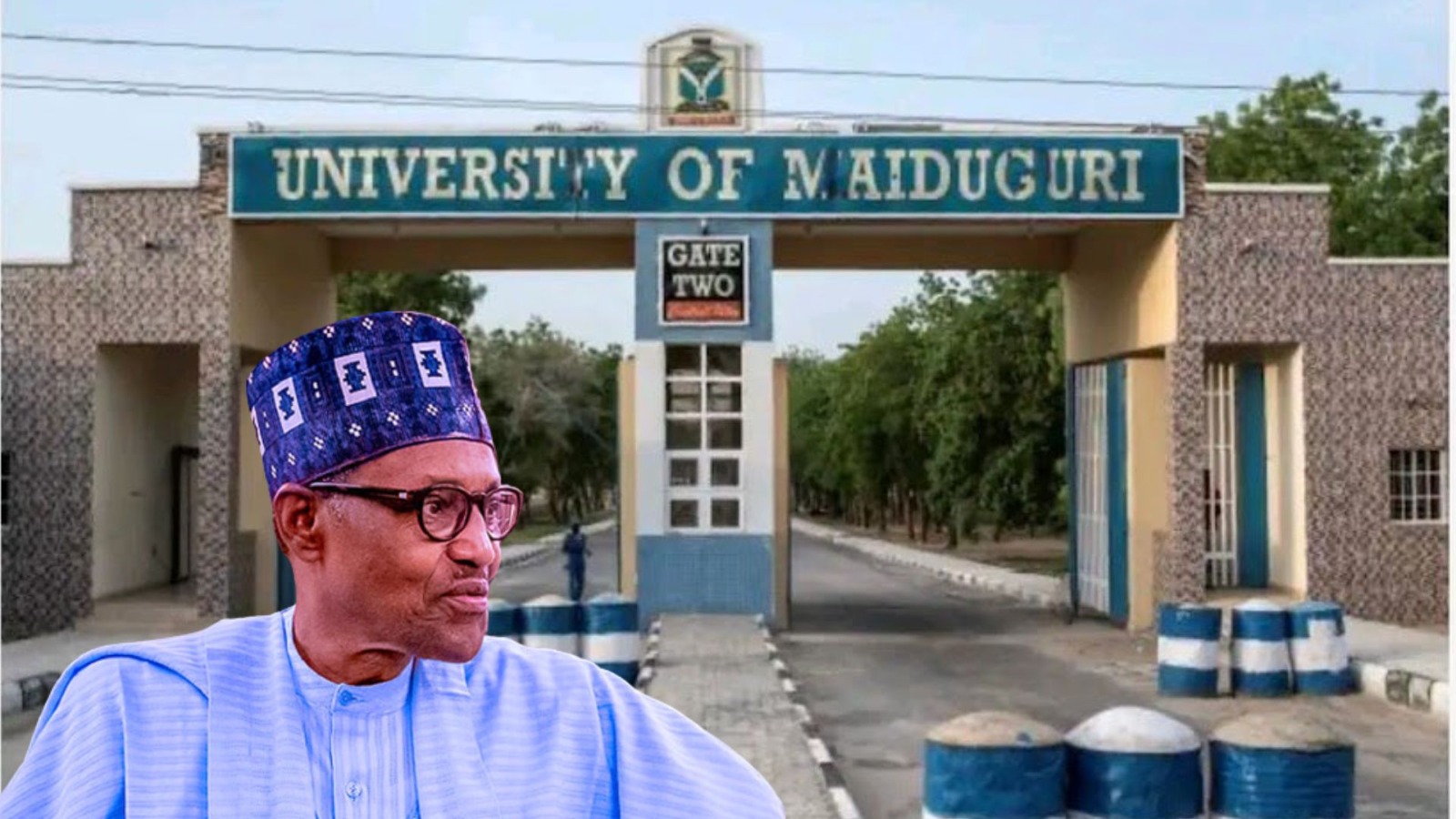
Alumni and students of the University of Maiduguri, alongside concerned citizens of Borno State, have strongly opposed President Bola Ahmed Tinubu’s decision to rename the institution after former President Muhammadu Buhari.

The announcement was made on Thursday, July 17, 2025, during an expanded Federal Executive Council (FEC) meeting at the Presidential Villa in Abuja, where President Tinubu declared that the university would now bear the name Muhammadu Buhari University, in a move to honour his predecessor.

Reacting swiftly, the affected groups condemned the decision, insisting that the University of Maiduguri represents far more than a name. “The University of Maiduguri is more than just a name. It is a powerful symbol of resilience, academic excellence, and cultural heritage — especially in the face of insecurity that once threatened the North-East region,” they stated.

The protest was formalised through a public petition that began circulating online shortly after the announcement. So far, approximately 9,000 individuals have signed in support of the appeal, which has gained significant traction within the past 48 hours.

In their appeal to President Tinubu, the petitioners wrote: “We, the alumni, students, and concerned citizens, write this heartfelt appeal to Your Excellency regarding the recent decision to rename the University of Maiduguri to Muhammadu Buhari University. With the deepest respect to the memory and legacy of the late President Muhammadu Buhari — a man whose contributions to Nigeria remain indelible; we believe that renaming the University of Maiduguri does not align with the sentiments of its core stakeholders and the enduring identity the institution has built over the decades.”

See also  How Nigerians Can Apply for ECOWAS Fully Funded Graduate Programme

The petitioners proposed alternative options for immortalising Buhari, urging the government to consider renaming institutions more closely linked to his personal history and legacy. “In this regard, we respectfully propose that the Federal University of Transportation, Daura — a relatively new and highly symbolic institution located in former President Buhari’s hometown — could be considered for renaming… Also, considering his background as a retired military general, the Nigerian Army University Biu stands out as another fitting institution that could be renamed in honour of the Late Former President Muhammadu Buhari.”

Their message concluded with a plea: “Preserving this name is not a political position; it is a plea for continuity, emotional attachment, and the integrity of a brand that has stood the test of time and conflict. Let us honor both the legacy of former President Buhari and the soul of UNIMAID — without erasing the identity of either.”

FOLLOW US ON:

FACEBOOK

TWITTER

PINTEREST

TIKTOK

YOUTUBE

LINKEDIN

TUMBLR

INSTAGRAM

Continue Reading
Click to comment

Leave a Reply

Your email address will not be published. Required fields are marked *

Education

Canada updates Visa processing times for Nigerians as study permit wait rises

Published

on

Nigerians applying to study or travel to Canada are facing longer estimated processing times following the latest temporary residence update released by Immigration, Refugees and Citizenship Canada (IRCC).

The immigration department updated its processing-time estimates on August 5, 2026, with the latest figures showing increases across several temporary residence categories. For Nigerian applicants, the estimated processing time for study permits increased from six weeks to seven weeks between July 28 and August 5.

The wait for Canadian visitor visas also increased, rising from 64 days to 68 days. However, the estimated processing time for Nigerians applying for a work permit remained unchanged at seven weeks. There was also a slight increase in the estimated processing time for super visa applications from Nigeria, which rose from 41 days to 43 days.

With these latest figures, Nigerian applicants should now expect an estimated wait of seven weeks for a work permit, seven weeks for a study permit, 68 days for a visitor visa, and 43 days for a super visa.

The changes in Canada’s latest update were not limited to Nigerian applicants. Work permit processing for applicants from Pakistan recorded one of the biggest increases, jumping from 11 weeks to 25 weeks, a rise of 14 weeks.

Study permit processing for applicants from the Philippines also increased by one week, while super visa processing for applicants from the Philippines rose from 73 days to 100 days. Some applicants, however, saw their estimated waiting periods fall.

The biggest reduction among the featured categories was recorded for super visa applications from Pakistan, which dropped from 196 days to 185 days.

See also  OAU has fulfilled founding fathers’ vision, says TETFund boss

IRCC’s processing times are estimates and do not represent a guaranteed date for when an application will be completed. The actual time required to process an application can vary depending on factors such as the complexity of the case, the volume of applications awaiting processing, available resources, and whether immigration officials require additional information or documents.

The Canadian immigration department updates temporary residence processing times weekly, meaning the estimates for Nigerian applicants could change again in the next update, which is expected around August 12, 2026.

FOLLOW US ON:

FACEBOOK

TWITTER

PINTEREST

TIKTOK

YOUTUBE

LINKEDIN

INSTAGRAM

Continue Reading

Education

WAEC results reveal 38.5% failed five key subjects

Published

on

The West African Examinations Council (WAEC) says 61.54 per cent of candidates who sat the 2026 West African Senior School Certificate Examination for school candidates secured five credits and above, including English Language and Mathematics, leaving 38.46 per cent unable to meet the benchmark.

The examination body, however, withheld the results of candidates sponsored by indebted state governments pending the settlement of outstanding payments owed to the council.

The Head of the Nigeria National Office of WAEC, Dr Amos Dangut, announced this on Wednesday during a press briefing at the Council’s headquarters in Yaba, Lagos, where he released the results of the 2026 Computer-Based WASSCE for school candidates.

The WAEC boss disclosed that 1,959,668 candidates from 24,207 schools registered for the examination, while 1,950,726 candidates eventually sat for the test conducted between April 24 and June 19, 2026.

According to him, 1,834,695 candidates, representing 94.05 per cent of those who sat the examination, had their results fully processed and released, while the results of 116,031 candidates, representing 5.95 per cent, were still being processed due to unresolved issues.

He assured that efforts were ongoing to conclude the processing and release the outstanding results within a few days.

Dangut said the affected candidates would not be able to access their results until the defaulting state governments paid their debts to the Council.

He said, “The results of candidates who are sponsored by states indebted to the Council will not be released now until payment is made. We appeal to the concerned to do so to enable the affected schools and candidates to access their results.”

Dangut added that candidates whose results had been released and whose financial obligations had been met could access their results on WAEC’s results portal within 12 hours of the announcement and apply for their digital certificates, which would be available within 48 hours.

See also  JAMB registrar Oloyede bows out, Aina takes over Friday

He further said 1,200,514 candidates, representing 61.54 per cent of those who sat the examination, obtained credits in at least five subjects, including English Language and Mathematics, noting that the performance represented a 1.42 per cent decline compared to the 2025 examination.

Giving a breakdown of the candidates by gender, Dangut added, “Of this number, 558,883, i.e. 28.65 per cent were male candidates, while 641,631, i.e. 32.89 per cent were female candidates.”

On examination malpractice, he revealed that the results of 167,486 candidates, representing 8.59 per cent of the total candidature, had been withheld over alleged involvement in various forms of examination malpractice.

He explained that the cases were being investigated and would be considered by the Nigeria Examinations Committee before final decisions were taken.

“Nonetheless, the council, through its collaborative efforts with security operatives, was able to apprehend some of these individuals, and they are already having a taste of their pudding.

“A few supervisors and invigilators who were caught aiding and abetting examination malpractice were also brought to book.

“The council, on its part, through the NEC, will mete out appropriate sanctions to affected supervisors, through the various state Ministries of Education,” he added.

punch.ng

FOLLOW US ON:

FACEBOOK

TWITTER

PINTEREST

TIKTOK

YOUTUBE

LINKEDIN

Continue Reading

Education

UK opens applications for 2026 Chevening Scholarships

Published

on

The United Kingdom Government has announced that applications for the 2026 Chevening Scholarship will open on August 4, 2026, offering Nigerians and other eligible candidates the opportunity to pursue a fully funded one-year master’s degree at universities across the UK.

According to the UK Foreign, Commonwealth and Development Office, applications will run until October 6, 2026, with the programme aimed at professionals who have demonstrated leadership potential and a commitment to creating positive change in their communities.

Funded by the UK Government and partner organisations, the Chevening Scholarship covers tuition fees, living expenses, travel costs and access to a global network of professionals.

What is the Chevening Scholarship?

The Chevening Scholarship is the UK Government’s flagship international scholarship programme. Established in 1983, it supports outstanding professionals from more than 140 countries and territories to undertake a one-year taught master’s degree at eligible UK universities.

More than 60,000 people have benefited from the programme, with many alumni going on to hold leadership positions in government, business, academia and civil society.

Scholarship benefits

Successful applicants will receive:

• Full tuition fees for an eligible master’s programme
• Monthly living allowance
• Return economy airfare to the UK
• Arrival and departure allowances
• Travel grants for approved Chevening events
• Access to exclusive networking and leadership opportunities
• Membership of the global Chevening alumni network

Who can apply?

The programme is open to professionals who:

• Demonstrate strong leadership and influencing skills
• Show potential to contribute to sustainable development
• Possess excellent networking and relationship-building abilities
• Are committed to creating positive change in their communities and countries
• Meet the academic and general eligibility requirements

See also  Nigerian students win gold at Spelling Bee World Cup in China

The UK Government also encourages applications from under-represented groups as part of its diversity and inclusion commitment.

How Nigerians can apply

Interested applicants should:

• Visit the official Chevening application portal from August 4 –
• Register on the online application system through the Nigeria country page
• Complete the eligibility checker
• Save their unique application access code
• Fill in personal information, education history and work experience
• Select three eligible UK master’s degree courses
• Provide details of two referees
• Complete the required essay questions covering leadership, networking, study plans and career goals
• Submit the application before the October 6, 2026 deadline

Applicants are advised to draft their essays in a separate document before completing the online form and save their progress regularly, as inactive sessions automatically time out.

Selection timeline

According to the UK Government:

• Applications open: August 4, 2026
• Applications close: October 6, 2026
• Application sift: October 2026 onwards
• Interviews: March–April 2027
• Successful candidates notified: Mid-June 2027
• Studies begin: September/October 2027

What Chevening is looking for

Candidates will be assessed based on:

• Leadership potential
• Academic excellence
• Professional experience
• Ability to build strong professional networks
• Commitment to creating lasting impact locally and globally

The programme seeks individuals who can use the knowledge, skills and international connections gained in the UK to contribute to development and address global challenges.

Applicants are encouraged to begin preparations early and carefully review the eligibility requirements before submitting their applications.

See also  OAU has fulfilled founding fathers’ vision, says TETFund boss

APPLY HERE: https://www.chevening.org/

punch.ng

FOLLOW US ON:

FACEBOOK

TWITTER

PINTEREST

TIKTOK

YOUTUBE

LINKEDIN

Continue Reading

Trending