Connect with us

Lifestyle

Flight fury: Inside story of KWAM 1, Emmason’s pardon

Published

on

Fresh details have emerged on why the Federal Government backtracked on its earlier decision to punish popular Fuji musician, Wasiu Ayinde, aka KWAM 1, and a passenger on the Akwa Ibom-owned airline, Ms. Comfort Emmason, for misconduct.

Findings showed that KWAM 1 was compelled to apologise as part of conditions for intervention from the ‘powers that be’, just as the government withdrew charges against Emmason after reviewing the roles of the airline in the saga and the threats of multiple suits.

Hasty trial

On August 10, Emmason was removed from a flight from Lagos to Uyo after allegedly refusing to turn off her phone as instructed by crew members.

The situation escalated when she became physically aggressive, struck a flight attendant, and had to be restrained and escorted off the aircraft at the Murtala Mohammed International Airport.

Following that, Ibom Air imposed a lifetime ban on her from both local and international flights, citing its zero-tolerance policy toward violent or disruptive behaviour.

She was also arraigned and remanded in the Kirikiri Correctional Centre.

Ayinde, on August 5, caused a disruption at the Nnamdi Azikiwe International Airport, Abuja, when he attempted to board a ValueJet flight carrying a flask containing liquid beyond the permissible size.

When staff asked him to surrender it, he allegedly refused, poured its contents on the crew and security personnel, and then moved onto the tarmac to obstruct the aircraft from taxiing and delaying the flight’s safe operation.

The Nigeria Civil Aviation Authority petitioned the Inspector-General of Police, Kayode Egbetokun, to investigate the matter.

Ayinde was also placed on a six-month flight ban.

But Emmason’s prosecution for a criminal offence sparked outrage as a section of the public accused the government of bias, saying it failed to prosecute Ayinde, who allegedly committed a more grievous offence.

However, the Minister of Aviation and Aerospace Development, Festus Keyamo, SAN, announced on Wednesday that the government had directed the withdrawal of criminal complaints against Emmason and Ayinde.

Keyamo also said the government had told the NCAA to name Ayinde as an ambassador for airport security protocols.

The minister’s announcement was also greeted with mixed reactions, as some members of the public believe that the Federal Government pardoned Emmason in a bid to protect Ayinde, a well-known loyalist of President Bola Tinubu, from prosecution.

Saving airlines from suit

Insiders knowledgeable about the case told Saturday PUNCH that the government and the airline authorities needed to reach a compromise, de-escalate the matters, and save many of the individuals involved from prosecution and potential court cases.

According to a source, who is a top security officer at the Nnamdi Azikiwe International Airport, the airlines involved in the two cases were also not interested in pursuing their individual cases against Ayinde and Emmason having realised that the two passengers had “strong cases” against them if allowed to go to court.

He said, “The truth of the matter is that the aviation security, airline security, and the pilot, and all parties involved in Wasiu Ayinde’s case were at fault. The same thing with the Ibom Air case involving the lady who was stripped half-naked.

“I am aware that lawyers and stakeholders in the airlines and the aviation authorities reviewed the cases and opted for alternative conflict resolution to avoid lawsuits and counter-lawsuits. The Minister of Aviation was sincere in his statement when he said the decision was on compassionate grounds.”

Ayinde’s apology

Other insiders at the Ministry of Aviation told Saturday PUNCH that the reason for the reversal of what they called “hasty and harsh” decisions by both the government and the airlines was because preliminary investigations available to the government had shown that the airline was also culpable for the chaos at the airport in Emmason’s case.

“The soft landing or compromise is actually in favour of the airline in the case of Emmason. Everything was about protecting them from potential huge loss that would arise from any suit filed by the passenger,” said an insider, who spoke on condition of anonymity as she was not empowered to speak on the matter.

See also  Birds of a Feather: Does Your Circle Reflect Who You Really Are?

Another source, a top official at the ministry, told one of our correspondents that there were interventions from the ‘powers that be’ in Ayinde’s case, though the minister insisted on doing the right thing.

The source said, “The powers that be compelled KWAM 1 to apologise as a condition for intervening in the matter. They felt embarrassed about his attitude.

“After his apology, the industry was already speaking about Emmason, while still planning what to do about KWAM 1. The lady’s case became the talk of the town, especially after she was hastily remanded without hearing from her.

“The blowback from that action forced the hands of the government to find a general amicable solution to the matter.

“The resolution we all heard was a face-saving measure for both the government’s hasty and harsh decision on Emmason and also to find a soft landing for the musician, who is a friend to powerful people in government.”

Who filmed Emmason half-naked?

Many Nigerians were enraged after video clips of Emmason being dragged from the airplane half-naked went viral.

Ibom Air denied that any of its staff recorded or released the dehumanising clip to the public as Keyamo slammed the release of the clip.

Independent review of the clips making the rounds on social media showed that only an airport official could have made the recording and released the graphic clips to the public.

For instance, a 28-second clip showed calls to “drag her out” as three men, joined by the Ibom Air hostess, identified as Juliana Edward, pulled an unwilling Emmason out.

The person behind the recording, a female, could be heard responding on a walkie-talkie that “there is a situation here, standby”.

Emmason’s clothes also appeared to have been pulled up by an official, before her bosom was exposed.

Her lawyer,  Adefunke Maria, alleged that the air hostess “wilfully ripped-off” her blouse while security men manhandled her.

Also, a five minute, 20 seconds clip revealed that only officials of Ibom Air, Federal Airport Authority of Nigeria and security agents were around the scene of the incident.

Most of them wore reflective jackets.

For a second time, the person behind the video could be seen with her walkie-talkie, which was clearly visible in the first few seconds of the clip.

A member of the team could also be heard confirming that an official was already making a recording of the violent acts of the passenger, while urging the colleagues to be mindful of their action on camera.

Co-passenger shares experience 

An eyewitness on the flight, Ogebe David, stated that the female passenger was unjustly humiliated.

The lawyer, who presented his flight ticket to prove that he witnessed the incidents in-flight, stated that the flight attendant provoked the situation through what he described as unprofessional conduct.

“It is important to state that prior to meeting Miss Emmason on the aircraft by pure happenstance, I had never met her before. She is a complete stranger to me.  In the same vein, I have never met any of the Ibom Air hostesses before Friday, to the best of my knowledge,” David told Channels TV.

He described what he characterised as a pattern of unjust treatment toward the female passenger.

His account contradicted early suggestions that the altercation was solely due to the unruly behaviour of the passenger.

“I am only speaking out now out of a moral duty and civic responsibility to speak the truth, so that everyone, whether highly placed or not, highly connected or not, can be treated fairly and justly in all circumstances,” he added.

Despite defending Emmason’s right to be treated respectfully, David condemned her outbursts in the videos circulating on social media.

I’ve forgiven everyone, says Emmason

Emmason on Friday took to her Facebook page to share in detail how she was allegedly harassed and intimidated on the flight.

See also  Zamfara Governor - I can end banditry in two months

She said she had no intention of being unruly, adding that she was insulted by the air hostess.

She lamented that she was dragged like a criminal after the incident degenerated.

The Facebook post, made around 6pm, read, “I boarded the flight peacefully like every other passenger, with no intention of disturbing anyone. I took my seat and waited for take-off.

“While we were still on the ground, the cabin crew started the normal safety checks, and that was when I was asked to switch off my phone.

“I politely explained that my phone had a faulty power button, and because of that I normally let the battery run down or use airplane mode instead. I also told the air hostess that if she could assist me, I would gladly hand over the phone for her to switch it off herself.”

Emmason said the first hostess who spoke to her was polite and understanding, adding that the second flight attendant spoke in a disrespectful tone.

The female passenger said, “She said, ‘I don’t have time for your excuses. Just switch it off.’ I calmly tried to explain again, but she cut me short and said, ‘If you don’t want trouble, you had better obey.’

“At that point, some passengers sitting close to me even intervened, and one of them helped me switch the phone off completely.

“Even after the phone was switched off, the same air hostess continued looking at me in a very aggressive way, almost as if she wanted a fight. I kept quiet because I didn’t want any trouble.”

Emmason noted that throughout the flight, she remained on her seat and did not disturb anyone.

She said, “I didn’t raise my voice, and I didn’t abuse or threaten any staff. Even the hostess who treated me harshly never came to apologise — she just kept watching me from afar.

“When we landed, everybody began to disembark. I waited for others to go first. As I was stepping out, that same hostess confronted me again and started saying things like: ‘You think you can threaten people here and go free. Wait, we will show you.’

“At that moment, I felt intimidated and embarrassed in front of other passengers. I asked her, ‘Madam, what exactly did I do to you?’ Instead of answering, she raised her hand as if she wanted to touch me again. I instinctively defended myself and told her not to harass me.

“Before I knew what was happening, they had already called security and labelled me as an ‘unruly passenger.’

“I begged them to at least watch the videos on the passengers’ phones so they would know the truth — but nobody listened. I was dragged off the aircraft like a criminal, still begging them to hear me out.

“At the airport police station, one of the managers from Ibom Air arrived and presented a completely different story, claiming that I assaulted their staff and threatened the safety of the flight. I immediately denied this and asked again for them to watch the videos, but my voice was ignored.

“Instead, I was moved straight to detention and eventually taken to Kirikiri, even though I kept insisting I was innocent.

“Everything I went through started from a faulty phone power button and a hostess who chose to abuse her authority instead of simply helping a passenger.

“I have forgiven everyone involved — but I felt it was important to finally share the truth of what happened, because a lot of people still don’t know my side.

“To everyone who stood up for me when I couldn’t speak, to everyone who prayed and fought for my freedom — thank you. God bless you all.”

‘No romance behind 500,000 job’

Meanwhile, the Special Adviser to the Delta State Governor on Media, Success Ossai, explained why he offered a N500,000 monthly salary job to Emmason.

In an Instagram post on Wednesday, Ossai announced that a monthly salary of N500,000 had been secured for the female passenger in the state.

See also  Brigadier General Enitan Ransome-Kuti: The Nigerian Officer Who Faced Court-Martial and Redemption

The package, according to Ossai, also includes flight tickets, accommodation in a five-star hotel, a guided tour, and a ticket to the Delta Social Media Summit scheduled for August 28 in Asaba.

Ossai said the summit would enable her to interact with others, share her experience, and inspire people to avoid negative conduct.

Speaking in an interview with Saturday PUNCH, the governor’s aide clarified that the gesture was not from the state government but a personal decision to help Emmason reintegrate into society.

While dismissing speculations of having a romantic interest in her, he said,  “I’m a married man and a faithful man. I can never get myself involved with such a thing. I am just offering harmless assistance to her.

“The gesture shown to the passenger wasn’t from the state government. It’s my personal gesture. She has shown remorse for what she did. Whatever has happened has happened. She went to Kirikiri prison and came back. It is time to support her as well.”

Reacting to criticisms that his offer could encourage unruly behaviour among air passengers, Ossai disagreed, citing global examples of rehabilitating offenders into advocates of good conduct.

Asked why he extended the offer despite Emmason not being from Delta State, Ossai said, “In Delta State, we don’t discriminate. We offer help to people, whether you are from Delta State or not. We are first Nigerians before anything else.”

He noted that his expectation was for Emmason to become disciplined, self-reliant, and a job creator.

Lawyer files N500bn suit

Meanwhile, a public interest lawyer, Ayodele Ademiluyi, has instituted a N500bn suit against the Federal Government, the Nigerian Civil Aviation Authority, and other parties at the Federal High Court in Lagos, accusing them of grossly violating the rule of law in the handling of the two aviation incidents.

The case, marked FHC/L/CS/1632/25, named as respondents: the President of Nigeria, the Attorney-General of the Federation, Minister of Aviation, Festus Keyamo (SAN), NCAA, the Federal Airports Authority of Nigeria, Ibom Air, ValueJet, the Nigerian Correctional Service, King Wasiu Ayinde, the Nigerian Police Force, the Governor of Akwa Ibom State, the state’s Attorney-General, and the Airline Operators of Nigeria.

Speaking at a press briefing on Friday, Ademiluyi, who also serves as convener of the Movement for Justice and Secretary of the Radical Gender Movement, said the legal action was aimed at defending public interest and holding aviation stakeholders accountable.

According to him, the dispute goes beyond the individuals involved, exposing deeper institutional weaknesses.

The lawyer faulted the disparate treatment given to both cases, alleging that KWAM 1 faced no legal repercussions, while Emmason was subjected to swift punitive action.

“Our aviation system needs a complete overhauling. We cannot allow impunity to reign or degenerate into a banana republic where someone can stop a plane with their bare hands and walk away without consequence. It’s a gross imbalance. There was no arrest, no arraignment, no prosecution of Mr. KWAM 1.

“In fact, he was rewarded with a brand ambassadorship for the aviation sector. What message does that send to the public?”he stated.

Ademiluyi insisted that rewarding the musician with an ambassadorial role was inappropriate.

“If someone can stop a plane with their bare hands and be appointed a brand ambassador, it sends the wrong signal,” he said.

He also accused the Minister of Aviation and Aerospace Development, Keyamo, of taking sides.

The lawyer criticised the Airline Operators of Nigeria’s handling of the Emmason matter, describing their role as overreaching, saying, “The central issue remains: Mr. Kwam 1 is walking the streets free. That is a big slap on the rule of law. The suit we have filed is a public interest action. The collective interest of the polity is at stake,” he said.

Ademiluyi urged the court to use the matter as a landmark opportunity to affirm that no individual, regardless of prominence, is beyond legal accountability.

FOLLOW US ON:

FACEBOOK

TWITTER

PINTEREST

TIKTOK

YOUTUBE

LINKEDIN

TUMBLR

INSTAGRAM

Continue Reading
Click to comment

Leave a Reply

Your email address will not be published. Required fields are marked *

Lifestyle

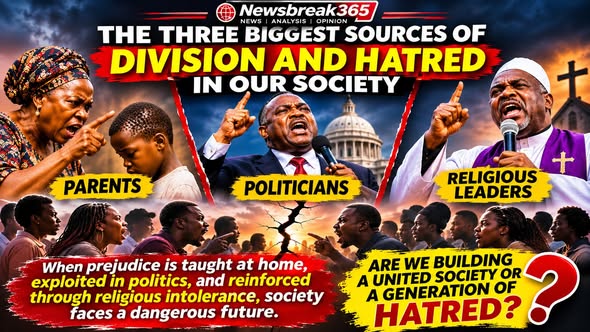
The Three Biggest Sources of Division and Hatred in Our Society: Parents, Politicians and Religious Leaders

Published

on

A society does not destroy itself in a single day. Sometimes, its destruction begins in the homes where children are raised, the political institutions where leaders seek power, and the religious institutions where people expect to find love, peace and spiritual guidance.**

We often complain about insecurity, intolerance, tribalism, religious conflicts, hatred and the growing division in our society. We blame the government, the economy, the younger generation and even social media.

But how often do we examine the influence of three powerful groups that help shape the attitudes, beliefs and behaviour of millions of people: parents, politicians and religious leaders?

These are supposed to be the people who teach us values, provide direction, promote unity and prepare future generations for a better society. Yet, when some among them use their influence to promote prejudice, hostility and division, the consequences can be devastating.

Let’s confront an uncomfortable reality.

## 1. Parents: When the Home Becomes a Classroom for Hatred

The first lessons a child learns about the world often come from home.

Children observe how their parents speak about other ethnic groups, religions, communities and families. They listen to conversations, absorb attitudes and sometimes adopt prejudices without understanding their consequences.

Some parents teach their children to distrust people simply because they come from another tribe, practise another religion, speak another language or belong to a different social class.

Some even encourage hatred against people who have done absolutely nothing wrong to them.

What kind of future are we building when children are raised to see fellow human beings as enemies?

A child who grows up believing that people from another background are inferior may carry that prejudice into adulthood, marriage, friendships, workplaces and even leadership positions.

**Parents must understand that raising successful children is not enough. We must also raise children who respect humanity.**

See also  Family confirms death of gospel singer Toluwanisings

Your child does not need to inherit your bitterness, tribal prejudice or personal conflicts.

Teach them to think independently, respect differences and judge people by their character rather than their background.

## 2. Politicians: Division as a Weapon for Political Power

Few things are more dangerous than politicians who discover that dividing the people is easier than developing the country.

Instead of competing through ideas, policies, performance and accountability, some politicians exploit ethnic identity, religious differences, regional loyalties and historical grievances to secure political support.

They turn neighbours into opponents, communities into rival camps and ordinary disagreements into dangerous conflicts.

During election campaigns, some politicians suddenly become champions of tribal and religious identity. They remind people where they come from, what religion they practise and whom they should fear.

But when the elections are over, those same political opponents may sit together, negotiate political arrangements and pursue their personal interests.

Meanwhile, ordinary citizens who were encouraged to fight one another are left to deal with the consequences.

**How can politicians preach democracy while deliberately encouraging hostility among the very people they are supposed to serve?**

A responsible politician should unite people through development, education, healthcare, employment, justice and equal opportunities.

Leadership should be about building a nation, not manufacturing enemies.

## 3. Religious Leaders: When the Pulpit Becomes a Platform for Intolerance

Religious institutions are expected to promote compassion, humility, forgiveness, moral responsibility and peaceful coexistence.

People enter places of worship seeking spiritual guidance, hope and direction.

But what happens when some religious leaders use their influence to encourage hostility towards people of different beliefs?

What happens when sermons become platforms for attacking other religions, promoting superiority, spreading fear and encouraging intolerance?

See also  Birds of a Feather: Does Your Circle Reflect Who You Really Are?

What happens when people are taught to hate their neighbours in the name of defending their faith?

There is a serious contradiction when leaders preach love but encourage hostility, speak about peace but promote division, and teach forgiveness while nurturing resentment.

People have the right to practise their religion and defend their beliefs. However, religious freedom should never become an excuse for hatred or the dehumanisation of others.

**Faith should inspire people to become better human beings, not teach them to despise those who believe differently.**

A religious leader’s influence should be measured not simply by the size of their congregation, but also by the positive values they promote.

## The Dangerous Consequences of These Three Influences

When prejudice is taught at home, exploited in politics and reinforced through religious intolerance, society faces a dangerous combination.

The consequences can include:

– Tribalism and ethnic discrimination.
– Religious intolerance and hostility.
– Broken friendships, marriages and family relationships.
– Political manipulation and unnecessary conflicts.
– Distrust between communities.
– A younger generation that inherits divisions instead of opportunities.
– The destruction of social unity and national development.

A divided society becomes vulnerable to manipulation. People become so occupied with defending their identities and attacking one another that they forget to demand accountability from those in power.

And while ordinary people fight over ethnicity, religion and political loyalty, the real problems affecting their lives remain unresolved.

## Who Will Break This Cycle of Hatred?

We cannot continue blaming young people for the problems of society without examining the examples they see from adults.

We cannot demand national unity while teaching our children to hate people from other communities.

We cannot condemn political division while celebrating politicians who exploit our differences.

See also  Brigadier General Enitan Ransome-Kuti: The Nigerian Officer Who Faced Court-Martial and Redemption

And we cannot demand religious tolerance while applauding religious leaders who insult or demonise people of other faiths.

Every parent must examine the values being passed down to their children.

Every politician must understand that political ambition should never be more important than human lives and social harmony.

Every religious leader must recognise that spiritual influence comes with a responsibility to promote peace, compassion and mutual respect.

Society needs people who build bridges, not people who constantly construct walls.

## The Final Question: Are We Building a Better Society or Preparing the Next Generation to Hate?

The future of any society depends heavily on the values it passes from one generation to another.

If we teach children hatred, reward politicians for dividing us and applaud religious leaders for promoting intolerance, we should not be surprised when society becomes increasingly hostile.

We must stop celebrating those who divide us and start holding influential people accountable for the consequences of their words and actions.

**A society cannot experience lasting peace when hatred is being taught at home, exploited in politics and justified in the name of religion.**

The change must begin with us.

—

### NEWSBREAK365 EDITORIAL QUESTION

Do you agree that parents, politicians and religious leaders are among the three most influential groups contributing to division and hatred in our society?

Or do you believe that social media, the education system and the wider society deserve equal blame?

**Who is doing the greatest damage to our society, and why?**

Share your thoughts. This is a conversation we cannot afford to avoid.

*Newsbreak365 — Challenging Perspectives, Exposing Issues and Inspiring Conversations.*

FOLLOW US ON:

FACEBOOK

WHATSAPP CHANNEL

TWITTER

PINTEREST

TIKTOK

YOUTUBE

LINKEDIN

INSTAGRAM

Continue Reading

Lifestyle

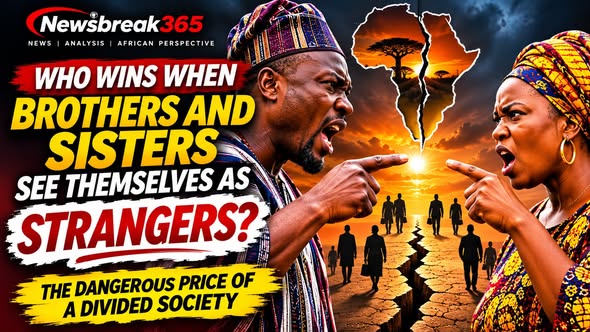
WHO WINS WHEN BROTHERS AND SISTERS SEE THEMSELVES AS STRANGERS? THE DANGEROUS PRICE OF A DIVIDED SOCIETY

Published

on

When people who share the same history, struggles, culture and aspirations begin treating one another as enemies, somebody is benefiting from their division. And more often than not, the people paying the highest price are those who can least afford it.**

There is something deeply disturbing about a society where brothers and sisters can live on the same land, share similar struggles and face the same challenges, yet look at one another as strangers.

People who should be working together to build a better future are busy fighting over religion, ethnicity, tribe, political affiliation, social class and personal interests.

The question we must ask ourselves is simple but uncomfortable:

**Who wins when brothers and sisters see themselves as strangers?**

## Division: A Powerful Tool of Manipulation

History has repeatedly demonstrated that divided societies are vulnerable societies.

When people are divided, they lose the ability to recognise their common interests. Instead of demanding accountability, good governance, economic opportunities and social justice, they become distracted by endless arguments over differences that should never prevent peaceful coexistence.

Those who understand the power of division can exploit these weaknesses.

They know that a population fighting among itself is less likely to unite around common problems. They understand that people consumed by hatred are easier to distract from the decisions that affect their lives.

And while ordinary people are busy fighting one another, those who benefit from the division can continue protecting their interests.

**A divided population can spend generations fighting battles that do not improve its collective future.**

## When Religion, Ethnicity and Politics Become Weapons

Religion should not become an excuse to hate another human being.

Ethnicity should not become a reason to discriminate against someone.

Political differences should not destroy friendships, families and communities.

See also  Report reveals petrol, diesel prices rise 86% in eight months

Yet, in many societies, these identities have become weapons used to create suspicion, resentment and hostility.

People are increasingly judged not by their character, integrity, competence or contribution to society, but by the group they belong to.

A person’s religion becomes more important than their honesty. Their ethnic background becomes more important than their ability. Their political loyalty becomes more important than their commitment to the common good.

What kind of society are we building when identity matters more than character?

And what future can we expect when people are encouraged to hate one another simply because they are different?

## The Real Victims of Division

The consequences of division are not limited to arguments on social media or political disagreements.

They affect education, economic development, security, employment, investment, social cooperation and the future of younger generations.

When communities refuse to cooperate, opportunities disappear.

When citizens cannot trust one another, collective progress becomes difficult.

When families and communities are divided, the next generation inherits suspicion instead of solidarity.

Meanwhile, poverty, unemployment, insecurity, poor infrastructure and inadequate public services do not discriminate according to tribe, religion or political affiliation.

These problems affect ordinary people regardless of the identity they proudly defend.

The painful irony is that people who are fighting one another often suffer from the same problems.

## Who Benefits From Our Hatred?

This is perhaps the most important question.

Who benefits when neighbours become enemies?

Who benefits when people who should demand better leadership spend their energy attacking one another?

Who benefits when citizens defend politicians more passionately than they defend their own future?

Who benefits when religious and ethnic loyalty becomes more important than justice, accountability and human dignity?

We must be courageous enough to examine these questions.

See also  Wase Rock: Plateau State’s Towering Natural Wonder

Not every disagreement is manipulation, and not every difference is deliberately created. But history and experience show that division can be deliberately exploited by individuals and institutions seeking power, influence or personal advantage.

The danger begins when ordinary people become willing participants in a system that weakens their own collective interests.

## Unity Does Not Mean Thinking Alike

It is important to understand that unity does not mean everybody must belong to the same religion, speak the same language, support the same political party or share identical opinions.

A healthy society allows disagreement.

People should be free to question, challenge, criticise and defend their beliefs without turning differences into hatred.

True unity means recognising that our shared humanity and collective future are bigger than our individual differences.

We can disagree without becoming enemies.

We can practise different religions without despising one another.

We can come from different ethnic backgrounds and still work towards common goals.

We can support different political parties without sacrificing our relationships or our responsibility to society.

That is the foundation of a mature and progressive society.

## Africa Must Rethink the Culture of Division

For African societies to make meaningful progress, there must be a serious conversation about the destructive consequences of division.

We cannot continue demanding development while celebrating hatred.

We cannot complain about exploitation while allowing ourselves to be manipulated against one another.

We cannot demand responsible leadership while blindly defending people simply because they belong to our preferred political, religious or ethnic group.

Development requires cooperation, critical thinking, accountability, mutual respect and a willingness to place collective progress above narrow interests.

Our differences should enrich our societies, not destroy them.

The younger generation deserves something better than inherited hostility. They deserve communities where intelligence is valued above tribal loyalty, integrity above religious pretence, and competence above political connections.

See also  Family confirms death of gospel singer Toluwanisings

## The Question We Must All Answer

Perhaps the greatest tragedy of a divided society is that people can spend so much time fighting those who share their struggles that they forget to question the systems keeping them in those struggles.

We must stop allowing differences to become instruments of destruction.

We must stop celebrating division as though it were a sign of strength.

And we must understand that no community, ethnic group, religious organisation or political faction can build a prosperous society entirely at the expense of everyone else.

**When brothers and sisters become strangers, the entire society loses. But those who profit from division may be the only ones celebrating.**

The time has come to look beyond our differences and ask a more important question: What kind of future are we building together?

Because at the end of the day, hatred will not build our roads, educate our children, create employment, secure our communities or put food on our tables.

**DIVISION MAY GIVE SOME PEOPLE POWER, BUT UNITY GIVES A PEOPLE A FUTURE.**

—

**NEWSBREAK365 EDITORIAL**

*Our society does not need more enemies. It needs more people willing to think critically, challenge manipulation, demand accountability and recognise the value of collective progress.*

**Join the Conversation:**

1. Who benefits the most when ordinary people are divided by religion, ethnicity and politics?
2. Have we allowed our differences to become more important than our shared future?
3. Can Africa achieve meaningful development without confronting its culture of division?

Share your thoughts. The conversation must continue.

#Newsbreak365 #AfricanUnity #SocialDivision #AfricanDevelopment #Unity #CriticalThinking #CollectiveProgress

FOLLOW US ON:

FACEBOOK

WHATSAPP CHANNEL

TWITTER

PINTEREST

TIKTOK

YOUTUBE

LINKEDIN

INSTAGRAM

Continue Reading

Lifestyle

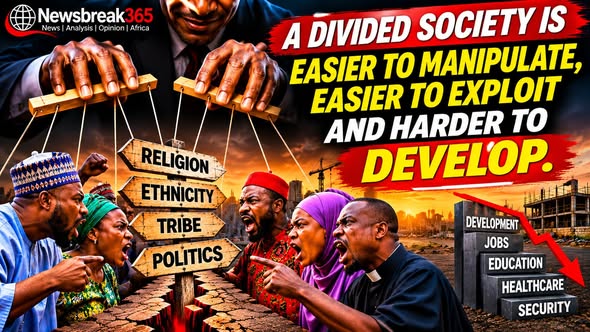
A Divided Society Is Easier to Manipulate, Easier to Exploit and Harder to Develop: Who Benefits From Our Division?

Published

on

When people are busy fighting one another over religion, ethnicity, tribe and political differences, those benefiting from their division are busy consolidating their power. Is our inability to unite becoming the greatest obstacle to our collective progress?**

There is a dangerous reality that many societies, particularly across Africa, must confront: a divided population is much easier to control than a united one.

A society that spends more time fighting over differences than demanding accountability will struggle to make meaningful progress. When citizens are constantly distracted by tribal rivalries, religious intolerance, ethnic suspicion and political hostility, the real issues affecting their lives are pushed into the background.

And the question we must ask is uncomfortable: **Who benefits when ordinary people are busy fighting one another?**

## The Politics of Division: Keeping the People Distracted

Division is one of the oldest and most effective tools of manipulation.

History has repeatedly shown how those seeking to maintain power can exploit existing differences within communities. They turn ethnicity into a political weapon, religion into a battlefield and political loyalty into an excuse for defending incompetence.

Instead of judging leaders by their performance, some citizens judge them by their tribe, religion, region or political affiliation.

A politician can fail to provide employment, improve healthcare, build infrastructure or address insecurity, yet still enjoy unquestionable loyalty simply because he belongs to the same ethnic or religious group as his supporters.

Meanwhile, someone who raises legitimate questions about governance is labelled an enemy.

This is how accountability dies.

When loyalty becomes more important than competence, society pays the price.

## Religion, Ethnicity and Politics: When Differences Become Weapons

There is nothing inherently wrong with belonging to a particular religion, ethnic group, political party or cultural community.

Our differences are part of what makes human societies diverse and interesting.

See also  Brigadier General Enitan Ransome-Kuti: The Nigerian Officer Who Faced Court-Martial and Redemption

The problem begins when people use these differences to justify hatred, discrimination, intolerance and blind loyalty.

Why should someone who shares your religion automatically deserve your support, even when their actions harm society?

Why should someone from another ethnic group automatically become your enemy?

Why should political disagreement destroy friendships, families and communities?

Why should citizens defend wrongdoing simply because the offender belongs to their group?

These are questions that every society must confront honestly.

**Your tribe cannot eat your future. Your religion cannot replace good governance. And your political loyalty cannot pay the price of bad leadership.**

## While We Fight, Poverty and Corruption Continue

Consider the ordinary citizens struggling to survive.

The unemployed graduate is still searching for work. The struggling family is still battling rising living costs. The patient is still waiting for affordable healthcare. The young entrepreneur is still struggling to access opportunities.

Yet public conversations are frequently dominated by tribal arguments, religious controversies and political insults.

People who should be demanding better schools, functioning hospitals, reliable electricity, security, employment and economic opportunities are sometimes more interested in defending political personalities.

The tragedy is that suffering does not recognise political affiliation.

Poverty does not ask which tribe you belong to before entering your home. Unemployment does not discriminate between religious groups. Corruption does not spare people simply because they support the government.

When public resources are mismanaged, the consequences affect ordinary citizens across different communities.

So why should citizens allow artificial divisions to prevent them from demanding what they collectively deserve?

## A Divided People Are Easier to Exploit

Think about the power of a united population.

When citizens speak with one voice against corruption, demand transparency and insist on responsible leadership, ignoring them becomes more difficult.

But when those same citizens are divided into hostile camps, their collective strength weakens.

See also  Immigration hikes passport fees to N100,000, N200,000

One group defends one politician. Another group attacks a different politician. One community blames another. Religious groups exchange accusations, while political supporters spend their energy insulting one another.

And in the middle of all this confusion, the people who should be answering difficult questions often escape serious scrutiny.

This is the danger of allowing division to dominate public life.

**A population that cannot unite around its common interests will struggle to defend those interests.**

## Development Requires More Than Buildings and Roads

True development is not measured by impressive government speeches, expensive political campaigns or isolated infrastructure projects.

It requires strong institutions, quality education, functional healthcare, economic opportunities, justice, security and responsible leadership.

It also requires citizens who understand that their collective future is bigger than their individual differences.

No nation can build a prosperous future when its people are constantly encouraged to distrust one another.

A country cannot achieve its full potential when competence is sacrificed on the altar of tribal loyalty, accountability is replaced by political worship and constructive criticism is treated as betrayal.

Development requires cooperation, critical thinking and a shared commitment to the common good.

## It Is Time to Stop Being Instruments of Our Own Division

Perhaps the most disturbing part of this problem is that division does not always need to be imposed from outside.

Sometimes, ordinary people willingly participate in it.

We spread hatred without questioning its consequences. We defend individuals who have failed us. We attack people simply because they hold different opinions. We allow politicians, religious figures and influential personalities to determine who deserves our friendship and who deserves our hostility.

We must begin to take responsibility for the society we are creating.

Disagree without hatred. Defend your beliefs without attacking other people’s identities. Question leaders regardless of their background. Demand accountability regardless of political affiliation.

See also  Report reveals petrol, diesel prices rise 86% in eight months

Unity does not mean everyone must think alike. It means recognising that our shared future deserves more attention than the differences that separate us.

## Final Thoughts: Who Really Benefits From Our Division?

A divided society is easier to manipulate, easier to exploit and harder to develop.

That is not just a political statement. It is a warning about the consequences of allowing hatred, intolerance and blind loyalty to replace critical thinking and collective responsibility.

The greatest service citizens can render to their society is not defending a politician at all costs, protecting a religious personality from criticism or promoting ethnic superiority.

It is demanding justice, accountability, equal opportunities and responsible leadership.

We must stop allowing those who seek our loyalty to benefit from our divisions while ordinary people continue to bear the consequences.

**Our differences should never become the chains that prevent us from moving forward together.**

The question is no longer whether division is hurting society. The real question is whether we are willing to recognise it and do something about it.

—

### THE BIG QUESTION: LET’S DEBATE!

1. Do politicians deliberately exploit religious and ethnic differences to maintain political power?
2. Why do some people defend incompetent leaders simply because they belong to the same tribe or religion?
3. Can Africa achieve meaningful development without overcoming tribalism, religious intolerance and political divisions?
4. Are ordinary citizens equally responsible for sustaining the divisions that hold society back?

**Drop your opinion in the comment section. Don’t just agree or disagree — tell us why.**

*Newsbreak365 — Questioning Narratives, Challenging Perspectives.*

FOLLOW US ON:

FACEBOOK

WHATSAPP CHANNEL

TWITTER

PINTEREST

TIKTOK

YOUTUBE

LINKEDIN

INSTAGRAM

Continue Reading

Trending