Connect with us

News

Gombe Commissioner seeks protection of northern water resources

Published

on

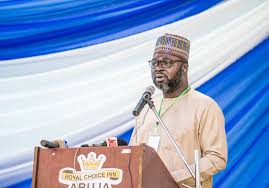
The Gombe State Commissioner for Water, Environment, and Forest Resources, Mohammed Fawu, on Tuesday called for collective action to safeguard Northern Nigeria’s water resources, warning that climate change, population growth, and poor land use continue to threaten livelihoods across the region.

Speaking at the opening ceremony of the stakeholders’ engagement for the development of strategic catchment management plans for the Gongola, Gali-Lamurde, and Hawal-Kilunga basins.

Fawu described the initiative as a “blueprint for sustainable water management and resilience against environmental shocks.”

According to him, the engagement, supported by the World Bank-funded ACRESAL project, aims to create a practical framework that will strengthen basin-wide conservation efforts across Bauchi, Gombe, Adamawa, Plateau, Taraba, Yobe, and Borno States.

He praised the Northern Governors’ Forum Chairman, Governor Muhammadu Iyahaya, whom he referred to as the “Green Governor,” for spearheading bold environmental interventions, including the Gombe Goes Green (3G) initiative, which has planted over five million trees in five years.

“With the Federal Government’s target of restoring four million hectares of degraded land by 2030, Gombe State has positioned itself as a beacon of climate action,” the commissioner said, noting that ACRESAL interventions such as gully stabilisation, afforestation, and bioremediation are already reshaping degraded landscapes.

He acknowledged the Federal Ministry of Environment, ACRESAL National Project Coordinator Dr. Abdulhamid Umar, and the World Bank Task Team Leader Dr Joy Agene for their technical guidance in steering the initiative.

Fawu stressed that the outcome of the engagement would serve as a cornerstone for wetland management, climate finance access, and institutional capacity building, ensuring long-term environmental security for millions of people across Northern Nigeria.

See also  Nigerians self-deport amid Trump’s deadly ICE raids

“Today, we gather not just as stakeholders, but as stewards of a shared future,” he declared.

FOLLOW US ON:

FACEBOOK

TWITTER

PINTEREST

TIKTOK

YOUTUBE

LINKEDIN

TUMBLR

INSTAGRAM

Continue Reading
Click to comment

Leave a Reply

Your email address will not be published. Required fields are marked *

News

Ukraine pushes AI combat robots despite defence minister’s dismissal

Published

on

Zigzagging between robots, weapons and computers in his garage workshop, Ukrainian engineer Eduard Trotsenko was bubbling with excitement as he showed off his latest prototypes and dreamed of sci-fi-inspired futuristic ideas.

Top of his ideas list are “mechanical birds” that can land on high-voltage power lines and recharge themselves, and “robot dogs” that can be sent into battle.

“In order to save human lives, to save soldiers, there must be robots,” Trotsenko told AFP.

Autonomous weapons have come to dominate the war with Russia.

Aerial drones are used on the front lines for reconnaissance and to drop explosives, while down below ground robots support logistics operations.

Ukraine has built a sprawling drone industry from scratch, hailed by President Volodymyr Zelensky as the best in the world.

But the dismissal last month of popular defence minister Mykhailo Fedorov — one of the most ardent backers of drones — raised some concerns over the future of the sector.

“I don’t understand why they sacked Fedorov,” Trotsenko, the founder and CEO of robot manufacturer Temerland, said.

Despite his removal, industry players and military personnel AFP spoke to said there was no going back now.

“The young people there won’t let it go. There’ll definitely be drones,” Trotsenko said.

When Russia invaded, 55-year-old Trotsenko — who was born in Soviet Kazakhstan — switched from making car charging stations to military robots.

His speciality is ground drones: autonomous vehicles that crawl the “kill zone” — the kilometres-deep stretch of territory where Russian and Ukrainian drones lurk in the skies, posing a constant danger to anybody below.

See also  Return recovered N32.7bn and $445,000 loot to NSIPA - Falana tells EFCC

For now, they mainly help evacuate wounded soldiers from the battlefield or ferry supplies — reducing the need to send more men into the kill zone.

But Trotsenko is looking at combat prototypes: one equipped with an RPG rocket launcher, the other with a heavy machine gun, controlled by onboard artificial intelligence (AI).

“They’re currently being tested in some brigades,” said Trotsenko, who is awaiting a green light for further rollout by the General Staff.

Fedorov had been crucial to pushing the technological shift within Ukraine’s army.

He created the Defence AI Center A1 — a hub dedicated to embedding AI in the military and using live feedback from the front to speed up the deployment of new technology.

Fedorov also pushed to bring private companies into the military system, putting competition at the heart of the army’s innovation.

“In a private company, you can take risks more quickly,” said Trotsenko, explaining how small companies were incentivised to modify and adapt at speed to win contracts.

Hundreds of kilometres away, a 45-year-old military commander who goes by the call sign “Jason”, was just back from a mission.

He heads a unit that operates the kind of ground drones that Trotsenko develops in his garage.

“You can afford to lose a drone, but not a person. The probability of human losses there is reduced,” he told AFP.

That kind of mantra — using drones to save lives — was precisely what Fedorov had been pushing at the defence ministry.

After he was sacked, protestors forced out the Soviet-style commander-in-chief, Oleksandr Syrsky, who had clashed with Fedorov’s reform drive — criticising him for not embracing drones and being too careless with soldiers’ lives.

See also  Girl Abducted By Boko Haram In Chibok Wins Startup Pitch Award

Asked whether Fedorov’s removal could upset Ukraine’s drone development, Jason brushes it off.

“It’s not that simple … the technological initiative was not flowing from the top down. It wasn’t a government order,” he said.

After Russia invaded, “there was an explosion of bottom-up initiative”.

Young engineers began to create new products, showed them to the military, who took what they wanted and then started their own development, he said.

Now, programmers, telecoms specialists and engineers are fully integrated into the army.

Jason said “the shortage of professionally trained people” is the biggest challenge he faces.

Back in Trotsenko’s workshop, his engineers are already working to redefine the technological and geographical limits of war.

On a whiteboard, he sketched out his vision of the future: conflicts fought by “humanoid robots”, controlled by operators in another country, or wounded soldiers lying in hospital beds.

“Things have really taken off,” he said confidently.

AFP

punch.ng

FOLLOW US ON:

FACEBOOK

TWITTER

PINTEREST

TIKTOK

YOUTUBE

LINKEDIN

Continue Reading

News

SEE FULL LIST: IG deploys new CPs to eight states, other police formations

Published

on

The Inspector-General of Police, Olatunji Disu, has approved the deployment of Commissioners of Police to eight state commands and several strategic formations across the country.

The deployment, announced in a statement on Thursday by the Force Public Relations Officer, CSP Ani Iniedu, followed the approval of the Police Service Commission and is aimed at strengthening operational effectiveness, enhancing leadership across commands and consolidating ongoing police reforms.

According to the statement, the newly deployed Commissioners of Police for state commands are Afolabi Wilfred Olutokunbo (Abia), Ayodeji Faniyan (Plateau), Saka Adewale Ajao (Bayelsa), Ajo Geoffrey Ordue (Cross River), Nanna Oji Ama (Anambra), Patrick Daaor (Edo), Tani Murtala (Jigawa) and Samuel Erale (Delta).

The IGP also approved the deployment of several commissioners to strategic formations, including the Force Intelligence Department, Force Criminal Investigation Department, Department of Finance and Administration, Department of Training and Development, Police Academy and the Police Staff College.

The statement read, “Other approved deployments are as follows; CP Intelligence & Training, Force Intelligence Department (FID), Abuja; CP Yemi John Oyeniyi, CP INTERPOL, Force Criminal Investigation Department (FCID), Abuja; CP Charles Ezekwesiri Dike, CP Department of Finance and Administration (DFA), Department of Training and Development (DTD), Force Headquarters (FHQ), Abuja; CP Aina Adesola.CP Anti-Human Trafficking (AHT), Force Criminal Investigation Department (FCID) Annex, Alagbon, Lagos; CP Uduak Ita Otu.

“CP General Investigation (G.I), Force Criminal Investigation Department (FCID), Abuja; CP Abdullateef Ajape Yusuf, CP Counter Terrorism Unit (CTU), Force Headquarters, Abuja; CP Taiwo A. Adedeji, CP Anti-Human Trafficking (AHT), Force Criminal Investigation Department (FCID), Abuja; CP Ajayi Oluyemi, CP Department of Finance and Administration (DFA), Force Headquarters, Abuja; CP Bolanle Aremu.

“CP Inspectorate, Department of Training and Development (DTD), Force Headquarters, Abuja; CP Ibrahim Lukunche Usman, Deputy Commandant, Police Staff College (PSC), Jos; CP Mohammed Hassan Ahmed, CP Department of Finance and Administration (DFA), Force Headquarters Annex, Lagos; CP Rita Oyintare Oki, CP Administration, Force Criminal Investigation Department (FCID) Annex, Kaduna; CP Ibrahim Umar D. Zungura.”

See also  Return recovered N32.7bn and $445,000 loot to NSIPA - Falana tells EFCC

Others affected by the deployment include CP Nelson Nwamana, who was posted to the Police Academy, Kano; CP Mohammed Hassan Ahmed, Deputy Commandant of the Police Staff College, Jos; CP Rita Oyintare Oki to the Department of Finance and Administration, Force Headquarters Annex, Lagos; and CP Danbaba Mohammed Labbo to the Force Criminal Investigation Department Annex, Gombe.

The statement said Disu charged the senior officers to bring their wealth of experience to bear in their new assignments by strengthening intelligence-led policing, enhancing operational effectiveness, promoting professionalism and deepening community engagement.

“He urged them to remain steadfast in safeguarding lives and property while upholding the highest standards of discipline, accountability, and service delivery,” the statement added.

The police said the redeployment forms part of ongoing reforms aimed at enhancing operational efficiency, strengthening internal capacity and improving policing services nationwide.

punch.ng

FOLLOW US ON:

FACEBOOK

TWITTER

PINTEREST

TIKTOK

YOUTUBE

LINKEDIN

Continue Reading

News

Fake agency probe: ICPC report clears Presidency, indicts embattled DG

Published

on

The Independent Corrupt Practices and Other Related Offences Commission has cleared the Presidency of any wrongdoing in the controversial Presidential Foreign Investment Promotion Council saga, while recommending the prosecution of the council’s promoter, Adeniyi Adeyemi.

President Bola Tinubu received the commission’s interim investigation report on Thursday at the Presidential Villa, Abuja.

This is as Adeyemi, on Thursday, declined to answer questions from members of the House of Representatives ad hoc committee investigating the establishment of the council, following the absence of his lawyers and his opposition to the closed-door interrogation adopted by the committee.

Briefing State House correspondents after presenting the report, ICPC Chairman, Musa Adamu (SAN), said the investigation established that Adeyemi was never appointed by the Federal Government and that the PFIPC, also referred to in some documents as the Presidential Foreign Intervention Promotion Council, was never created by any law, Executive Order or valid government instrument.

“The appointment letter presented by the suspect, along with other supporting documents, was completely forged and did not originate from the Presidency,” Adamu said.

According to him, investigators also uncovered two additional fictitious agencies allegedly created by Adeyemi using forged legislative instruments, the FCT Investment Promotion Agency and the Foreign Investment Promotion Agency/Public-Private Partnership, which were allegedly used to open bank accounts and conduct unauthorised activities.

Adamu further disclosed that Adeyemi unlawfully took over the office of the defunct Presidential Economic Advisory Council after gaining unauthorised access to the facility and used the location to project legitimacy for the fake agency before visitors, government officials and foreign diplomats.

He said the investigation found that no Federal Government funds were approved or disbursed to the fake agency and that there was no security breach within the Presidency or the Central Bank of Nigeria.

“No Federal Government funds were approved or disbursed to the fake agency, and no security breach was found within the Presidency or the Central Bank of Nigeria,” the ICPC chairman stated.

He, however, said the investigation exposed institutional weaknesses in verification processes, inter-agency coordination and oversight across several Ministries, Departments and Agencies, including the Office of the Secretary to the Government of the Federation, the Office of the Head of the Civil Service of the Federation, the Office of the Accountant-General of the Federation, the Budget Office and the National Information Technology Development Agency.

“The investigation identified weaknesses in verification processes, inter-agency coordination and oversight across several Ministries, Departments and Agencies… These lapses, compounded by negligence on the part of some public officers, enabled the suspect to operate unchecked,” Adamu said.

He said the commission recommended the prosecution of Adeyemi, administrative sanctions against public officers whose acts of omission facilitated the operation of the fake agency, and institutional reforms to strengthen internal controls across the affected MDAs.

According to him, the report submitted to the President is interim, with criminal investigations continuing to identify any collaborators and obtain additional evidence before charges are filed.

Adeyemi rejects interrogation

Adeyemi on Thursday declined to answer questions from members of the House of Representatives committee investigating the establishment of the PFIPC, citing the absence of his lawyers and the committee’s refusal to conduct the session publicly.

His refusal forced the lawmakers to reschedule the interrogation until Monday.

See also  Girl Abducted By Boko Haram In Chibok Wins Startup Pitch Award

However, Adeyemi insisted that he would not appear before the committee unless journalists and his lawyers were allowed to witness the proceedings.

Speaking with The PUNCH, his brother, Peter Adeyemi, said the committee had initially agreed to allow the media to cover the session before reversing its decision.

“They actually recorded everything that happened there. My brother even challenged the chairman that if he doesn’t have interest in the matter, he would not be compelling him to talk without any of his lawyers.

“They eventually rescheduled to Monday, and my brother told them that when they are coming, they should come with the media; otherwise, he will not grant them audience.

“Initially, they agreed to come with the media, but later they said they will not be coming with any media, and if he refuses to grant them audience, they will go ahead and conclude their investigation, and it will be said that he’s the one that failed to grant them audience,” he said.

The family had earlier alleged that members of the House committee attempted to question Adeyemi in police custody without the presence of his lawyers.

Peter said, “The Reps committee came and wanted to interrogate him, but he refused. They are still there trying to make him talk without any of his lawyers being present. We are crying out loud so that the right thing would be done.

“He has stated that he wants to be quizzed the same way others who have accused him have spoken. It’s not that he is not willing to state his side of the story.”

On Wednesday, Adeyemi’s lawyer, Ademola Oyedokun, also rejected the committee’s decision to question his client at an undisclosed location.

“We have read that the committee intends to interview our client at an undisclosed date and place. We ask it, respectfully, to think again.

“Everyone else in this matter has been heard in public, and what has been said about our client was said in public. He should be allowed to answer in the same place it was said,” Oyedokun stated.

On Tuesday, the committee chairman, Yusuf Gagdi, said the lawmakers opted to question Adeyemi in police custody to avoid interfering with ongoing investigations by the Nigeria Police Force, the ICPC and the Economic and Financial Crimes Commission.

The ICPC probe followed Tinubu’s July 7, 2026, directive ordering a comprehensive investigation into the PFIPC after weeks of controversy over Adeyemi’s claims of a presidential appointment.

Separately, the House of Representatives is investigating how the fictitious agency secured a N1.3bn allocation in the 2026 Appropriation Act, while Adeyemi is also facing criminal charges before the Federal High Court in Abuja bordering on conspiracy, forgery and impersonation.

Budget code controversy

Meanwhile, the House of Representatives committee investigating the controversial council on Thursday uncovered fresh inconsistencies in the documents used to establish the purported agency.

The State House also denied any involvement in requesting a budget code for the council or authorising its creation.

The latest revelations emerged during the committee’s investigative hearing at the National Assembly Complex, where officials from the State House and the Federal Road Safety Corps appeared before lawmakers to explain their respective roles in the activities of the council, which is alleged to have operated without lawful approval.

See also  ‘I Am Ready To Defend Myself’ – Malami Accuses DSS, EFCC Of Violating His Rights

The committee is investigating how the PFIPC was allegedly created, secured official government recognition and was integrated into aspects of the Federal Government’s administrative and budgetary processes in the 2026 Appropriation Act despite questions over its legal status.

Representing the Permanent Secretary, State House, the Director of Administration, Abdulkadri Idris, told lawmakers that the Presidency neither initiated nor authorised the establishment of the PFIPC and never requested the Office of the Accountant-General of the Federation to generate a budget code for the council.

“I want to state that we did not send any correspondence nor any request to the Office of the Accountant-General in respect of this council. We don’t even know anything about this council. We never heard about this council until we started seeing it in the media,” Idris said.

He further explained that the State House has no statutory responsibility for establishing government agencies and therefore could not have issued any communication creating the council.

Idris also dismissed as fraudulent documents presented to the committee that purportedly originated from the State House.

According to him, one of the documents allegedly signed by “Akande Adewale” as Director of Administration and Support Services could not have emanated from the Presidency because neither the office nor the official ever existed.

“I presented the list of Directors of Administration in the State House from 2003 to date, and there was no name resembling Akande Adewale.

“In addition, there is no department known as Directorate of Administration and Support Services in the State House. We have only the Department of Administration. Akande Adewale has never, ever been Director of Administration in the State House,” he clarified.

To support its position, the State House submitted official records earlier forwarded to the Nigeria Police National Cybercrime Centre, including authentic letterheads and a historical list of Directors of Administration.

Following the presentation, Gagdi said the testimony exposed significant inconsistencies between documents obtained from the Accountant-General’s Office and official records produced by the State House.

“The State House has denied that it ever wrote any letter to the Accountant-General requesting budget codes. Secondly, there is no Directorate of Administration and Support Services as contained in those documents.

“The Accountant-General responded to an office that the State House says does not exist, while the name of the signatory, Akande Adewale, is absent from all official records submitted to this committee,” Gagdi said.

He described the discrepancies as a major development in the committee’s efforts to determine how official government processes were allegedly manipulated to give legitimacy to the PFIPC.

The State House also denied issuing any appointment letter to the purported Director-General of the council, maintaining that appointments of chief executives of federal agencies are political appointments conveyed through the Office of the Secretary to the Government of the Federation.

“If the President approves any appointment, the conveyance is done by the Office of the Secretary to the Government of the Federation,” the State House representative said.

Number plate allocation

The FRSC also defended its decision to allocate seven official Federal Government vehicle number plates to the PFIPC, insisting that it acted in line with established administrative procedures based on documents and representations presented by the applicants.

In a memorandum dated August 6, 2026, and signed by Corps Marshal, Shehu Mohammed, the FRSC said it followed its standard verification process before approving the request.

See also  Natasha to serve out suspension as Senate enters recess

According to the Corps Marshal, the application originated from a letter dated April 4, 2025, signed by Adeyemi on behalf of the Office of the Director-General of the Presidential Economic Advisory Council/Presidential Foreign Investment Promotion Council.

A follow-up reminder dated April 11, 2025, was later received alongside documents purporting to establish the council, define its mandate and identify the vehicles requiring official registration.

Mohammed disclosed that Adeyemi personally submitted the request at the FRSC headquarters.

He said the Corps carried out additional verification because the PFIPC claimed to be a newly established federal agency.

According to him, officials examined the supporting documents, visited the government website supplied by the applicant, which carried a Federal Government domain name and physically inspected the council’s office at the Federal Secretariat Complex, Phase III, Central Business District, Abuja.

“Having completed the foregoing verification processes and being satisfied with the information presented, the Corps approved and allocated seven official Federal Government vehicle number plates to the agency,” Mohammed said.

The vehicles included a 2024 bulletproof Lexus LX, two Toyota Land Cruiser sport utility vehicles and four Toyota Hilux vehicles, which were issued official registration numbers ranging from PFIPC 01 to PFIPC 07 after their chassis numbers were verified.

The Corps Marshal, however, said the FRSC later discovered that the council was not an approved Federal Government agency.

“It therefore came as a profound shock to the Corps when it subsequently emerged that the Presidential Foreign Investment Promotion Council was not an approved Federal Government Agency and that the representations made by Prince Adeniyi Adeyemi were false,” he stated.

He added that the FRSC had commenced administrative steps to retrieve all seven official number plates issued to the purported agency and had strengthened its internal verification procedures to prevent a recurrence.

During the hearing, Gagdi questioned the thoroughness of the verification process after observing that the documents relied upon by the FRSC lacked standard government security features and unusually listed President Bola Tinubu, the Secretary to the Government of the Federation, the Head of the Civil Service of the Federation and several cabinet ministers as members of the council.

“Does this look normal to you?” Gagdi asked.

Responding, the Corps Marshal admitted: “No, not at all.”

He nevertheless maintained that the Corps acted on the information available at the time, including the operational office, official-looking documents, the government-domain website and verification of the vehicles’ chassis numbers.

The committee subsequently directed the FRSC to furnish it with the current status and location of all vehicles registered under the PFIPC.

Gagdi also announced that the committee would conclude its investigation next Wednesday and directed the clerk to invite all relevant agencies to appear for the final phase of the inquiry.

The House had constituted the panel following allegations that the PFIPC, despite lacking legal backing, operated as a Federal Government entity, obtained official documents and approvals and was allegedly integrated into government administrative processes.

Lawmakers say the investigation is aimed at establishing how the purported agency emerged, identifying those responsible and recommending measures to prevent similar breaches of public administration.

punch.ng

FOLLOW US ON:

FACEBOOK

TWITTER

PINTEREST

TIKTOK

YOUTUBE

LINKEDIN

Continue Reading

Trending