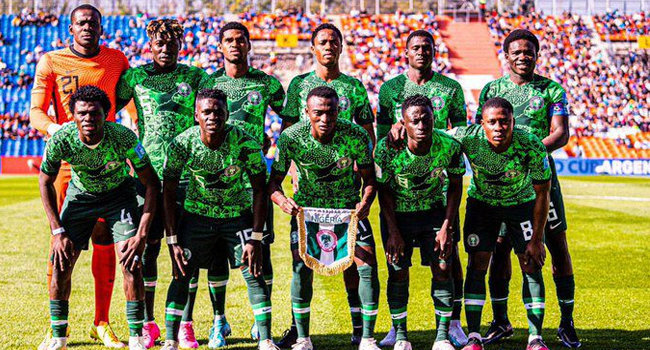

The Flying Eagles of Nigeria kept their U20 World Cup hopes alive with a dramatic 3-2 victory over Saudi Arabia in a Group F encounter at the Fiscal Stadium in Chile on Friday.
A stoppage-time penalty calmly converted by captain Daniel Bameyi proved decisive, capping off a tense contest that saw Nigeria twice surrender the lead.
The midnight kickoff saw Aliyu Zubair’s side bounce back from a disappointing opening loss to Norway. Goals from Nasiru Salihu and Amos Ochoche had put Nigeria ahead on two occasions, but defensive lapses allowed Saudi Arabia to equalize both times.
In the dying minutes, a handball in the box gave the Flying Eagles a lifeline, and Bameyi stepped up to secure all three points with a composed finish from the spot.
Then Kparobo Arierhi failed to convert with only the goalkeeper to beat, and his team was punished minutes after when the Nigerian defence failed to clear a long punt forward, allowing Amar Al-Ayuba to ghost in behind and poke the loose ball beyond Ebenezer Harcourt for 1-1 on 21 minutes.
The Flying Eagles regained the lead in the 21st minute after executing a three-player free-kick routine that ended with Ochoche’s mishit cross looping into the far top corner, giving Nigeria a 2-1 lead at the break.
However, another deep long ball was Nigeria’s undoing early in the second half, as an unsure defence allowed Talal Haji to send a looping header over Harcourt and into the net for 2-2 on 50 minutes.
The Saudi Arabians almost took the lead with another long punt forward, but the chance hit the post before Nigeria’s continued attacking foray paid off with a penalty kick awarded for handball from a cross.
Bameyi, the team captain, stepped up to send the keeper the wrong way, sealing a 3-2 victory four minutes into added time.
The win brightened Nigeria’s chance of reaching the round of 16. The Flying Eagles moved up to third place in Group F with three points, one point behind both Colombia and Norway, who are in first and second spot, respectively.
The Flying Eagles will face Colombia in their last group fixture at midnight on October 6.
Raphinha has officially been named Brazil’s new No. 10, the Brazilian Football Confederation confirmed on Thursday, as the national team begins a new cycle without Neymar Jr.
The Barcelona winger will wear the iconic shirt in the Seleção’s upcoming friendlies against Australia and India.
The CBF released the full squad numbers ahead of Friday’s match against Australia in Townsville, the first fixture since Brazil’s Round-of-16 exit from the 2026 World Cup.
As reported by football transfer expert, Fabrizio Romano on X on Friday, Romano posted “OFFICIAL: Raphinha, Brazil’s new number 10 after Neymar Jr’s international retirement.”
Endrick takes the No. 9 previously worn by Matheus Cunha, while Estêvão has been assigned No. 11 and Vinícius Júnior retains No. 7.
Goalkeeper Hugo Souza will wear No. 1.
Neymar, Brazil’s all-time leading scorer with 80 goals in 130 appearances, retired from international football after the World Cup.
The 34-year-old had worn the No. 10 shirt across four World Cup tournaments before confirming his decision in late July, saying his time with the national team had passed.
Raphinha has previously worn the shirt during Neymar’s absences, including during World Cup qualifying.
Now, following Neymar’s retirement, the number becomes permanently associated with a new generation of the Seleção.
The No. 10 carries deep historical significance in Brazilian football. It has been worn by some of the country’s greatest players, including Pelé, Zico, Rivaldo, Ronaldinho, Kaká and Neymar.
Raphinha will now enter that lineage as Brazil begins a new era under head coach Carlo Ancelotti.
While fans of an unprecedented 48 nations cheered on their teams at this summer’s World Cup, Nigerians had to make do with looking on from afar as the Super Eagles missed out on a second consecutive tournament. Éric Chelle was the man brought in to revive Nigeria’s qualification hopes, but his team fell short in the CAF play-off final, drawing 1-1 with DR Congo before losing 4-3 on penalties in November 2025.
Unlike many of the coaches who did make it to the finals in North America, Chelle is still in his job. In June, Nigerian officials confirmed that he would remain in charge of the Super Eagles and would also take responsibility for the country’s U-23 side. The focus now turns to the 2027 Africa Cup of Nations cycle and to building a more stable national-team structure.
All the best online sports betting sites will now be taking predictions on Nigeria’s chances of success in the qualification campaign for AFCON 2027. MyTopSportsbooks is the best place to find out about those betting sites. But what about all those coaches who lost their jobs this summer? At the last count, 17 national teams will be hiring a new leader in the weeks and months ahead. What caused this huge turnover of coaching talent?
The best online sports betting sites will now be taking predictions on Nigeria’s chances of success in the qualification campaign for AFCON 2027. But the aftermath of the World Cup has also been dominated by a remarkable number of coaching changes. Some managers had already decided that the tournament would mark the end of their tenure, while others paid the price for disappointing results.
One of the biggest departures was Didier Deschamps leaving France after 14 years in charge. His exit had been announced before the tournament, so the World Cup was always going to be his final competition with Les Bleus. France finished fourth after losing 6-4 to England in the third-place match, and Zinedine Zidane was appointed as Deschamps’ successor on July 28.
Carlos Queiroz had a very different summer with Ghana. Appointed in April, he guided the Black Stars into the Round of 32, where they lost 1-0 to Colombia. He initially left after the tournament when his short-term mandate ended, but that was not the end of the story: on September 2, the Ghana Football Association reappointed him for the next phase of the national team’s programme.
End of the Road
For several long-serving coaches, the World Cup marked the end of a natural cycle. Roberto Martínez left Portugal after their Round of 16 defeat by Spain and was replaced by Jorge Jesus in July. Zlatko Dalić also ended his long spell with Croatia after the tournament, with former national-team coach Slaven Bilić returning for a second spell in charge.
Mexico also moved into a new era. Javier Aguirre’s tenure ended after the World Cup and Rafael Márquez, who had worked as his assistant, was formally presented as the new national-team coach in September. Scotland made a change too, with Sébastien Pocognoli taking over from Steve Clarke after the tournament.
Jordan coach Jamal Sellami stepped down after his team’s historic World Cup debut ended with three defeats. The Jordan Football Association then appointed former Morocco coach Badou Zaki on a one-year contract. Australia, however, provides an important exception to the wider trend: Tony Popovic did not resign. He remains Socceroos coach through the 2027 Asian Cup after signing a contract extension before the World Cup and later declining a longer deal through 2030.
Results inevitably accounted for a number of the post-tournament changes. Ronald Koeman stepped down as Netherlands head coach after the Oranje were eliminated by Morocco on penalties in the Round of 32. Miroslav Koubek also left Czechia by mutual agreement after a disappointing group-stage campaign.
Senegal’s Pape Thiaw was dismissed after his side’s Round of 32 defeat by Belgium. The Senegalese federation subsequently appointed Patrick Vieira in August, giving the former France international his first job as a senior national-team head coach.
Belgium took a different decision after reaching the quarter-finals. Rudi Garcia’s contract was not renewed, and the Belgian federation appointed Mark van Bommel on a two-year deal through UEFA EURO 2028. The change showed that even a relatively deep World Cup run did not guarantee continuity once federations began planning for the next cycle.
Figure 2 A soccer coach’s position is a perilous one, whatever the level – Source: Pexels
With Immediate Effect
Some dismissals came after the tournament, but Tunisia made its decision while the World Cup was still under way. Sabri Lamouchi was removed after a 5-1 defeat by Sweden in the opening group game. In came the charismatic Herve Renard, appointed for the remainder of the tournament in an attempt to rescue Tunisia’s campaign. The team then lost 4-0 to Japan and 3-1 to the Netherlands, and Renard announced the end of his short spell in charge in early July.
Tunisia then appointed Moïne Chaâbani as head coach later in July on a contract running to 2030. The sequence – Lamouchi out after one match, Renard in for the rest of the World Cup, and Chaâbani appointed for the longer term – was perhaps the clearest example of how quickly a national team’s plans can change around a major tournament.
Nigeria’s absence from the World Cup was a major disappointment, especially after the Super Eagles had also missed the 2022 tournament. But the decision to retain Éric Chelle stands out against the wave of coaching changes elsewhere.
Chelle now has the chance to build on Nigeria’s third-place finish at the 2025 Africa Cup of Nations and prepare the team for the next continental campaign. After so much upheaval on national-team benches following the 2026 World Cup, continuity may prove to be one of Nigeria’s biggest advantages.
The 2027 Africa Cup of Nations qualifying series began on Thursday with eight Match Day 1 fixtures played across the continent, with Nigeria set to begin their campaign against Madagascar on Friday (today).
The Super Eagles will host Madagascar at the Godswill Akpabio Stadium, Uyo, in Group L, with kick-off scheduled for 5pm Nigerian time.
Nigeria are drawn alongside Madagascar, Guinea-Bissau and co-hosts Tanzania, who are already guaranteed a place at the 2027 AFCON finals.
The arrangement means only the highest-placed team among Nigeria, Madagascar and Guinea-Bissau will secure the remaining qualification spot from Group L.
Nigeria’s second Group L fixture will be away to Guinea-Bissau on Tuesday, while Madagascar will face Tanzania.
Thursday’s results
Group C
Côte d’Ivoire 2-0 Ghana
The Elephants opened their campaign with a comfortable victory over Ghana, with Malick Yalcouyé and Franck Kessié scoring for the hosts.
Group E
DR Congo 2-0 Equatorial Guinea
See more Punch stories on Google.
Chancel Mbemba gave DR Congo an early lead before Yoane Wissa doubled the advantage in the second half.
Group E
Sierra Leone 2-3 Zimbabwe
Sierra Leone led 2-0 at half-time through Alie Conteh and Sallieu Tarawallie, but Zimbabwe mounted a second-half comeback. Marshall Munetsi scored twice, while Tawanda Chirewa also found the net to secure a 3-2 victory.
Group F
Mauritania 3-1 Central African Republic
Mauritania recovered from a first-half setback to claim a 3-1 victory, with Aboubakary Koïta, Dawda Camara and Mamadou Diallo scoring for the hosts.
Group G
Namibia 1-0 Congo
Bethuel Muzeu scored in the 47th minute as Namibia began their campaign with a narrow victory.
David Roy Nyengue, Bryan Mbeumo and Daniel Namaso scored as Cameroon secured a 3-1 win, with Comoros briefly reducing the deficit through a free-kick goal.
Group H
Tunisia 1-1 Uganda
Tunisia were held to a 1-1 draw by Uganda, with Ali Arous putting the hosts ahead before Rogers Mato equalised for the visitors.
Group H
Libya 2-2 Botswana
Botswana surrendered a two-goal lead as Libya fought back to earn a point. Tumisang Orebonye scored twice for Botswana before Maruwan Alhibeeshi and Ezoo El Mariamy, from the penalty spot in stoppage time, levelled the contest.
Friday’s fixtures
Group A: Niger v Lesotho, Morocco v Gabon Group B: Malawi v South Sudan, Egypt v Angola Group C: Gambia v Somalia Group F: Burkina Faso v Benin Group I: Togo v Burundi, Algeria v Zambia Group J: Sudan v Ethiopia, Senegal v Mozambique Group K: Rwanda v Liberia, Mali v Cape Verde Group L: Tanzania v Guinea-Bissau, Nigeria v Madagascar
The Match Day 1 programme will be completed on Saturday with Kenya facing Eritrea and South Africa taking on Guinea.