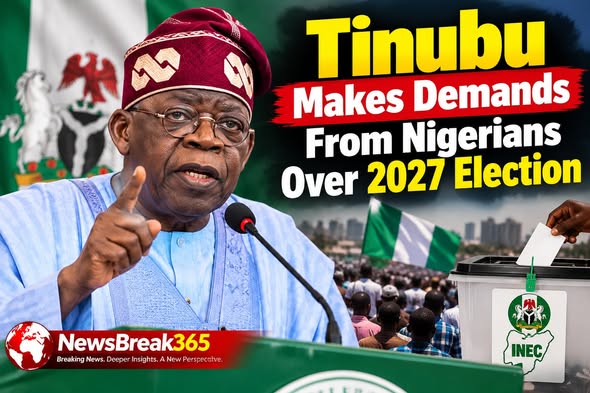
Former Presidents Olusegun Obasanjo and Goodluck Jonathan, state governors and other members of the Council of State are expected to advise Tinubu on the next INEC chair.
The Special Adviser to the President on Information and Strategy, Bayo Onanuga, in a statement on Tuesday, disclosed that Tinubu thanked the outgoing INEC boss for his services to the nation.
The statement titled ‘President Tinubu Accepts INEC Chairman’s Departure, Bestows National Honour on Him,’ read, “President Tinubu thanked Professor Yakubu for his services to the nation and his efforts to sustain Nigeria’s democracy, particularly through the organisation of free and fair elections throughout his two-term tenure.
“In recognition of Yakubu’s dedicated service to the nation, President Tinubu has bestowed on him the honour of Commander of the Order of the Niger.
“President Tinubu also directed that Professor Yakubu should hand over to the most senior national commissioner, May Agbamuche-Mbu, who will direct the affairs of the commission until the completion of the process to appoint a successor.”
In a letter dated October 3, 2025, Yakubu expressed gratitude to the President for the privilege of overseeing the commission for two terms.
Tinubu, in turn, thanked him for sustaining Nigeria’s democracy and conducting elections he described as “free and fair” across his tenure.
Yakubu was first appointed in November 2015 as INEC’s 14th chairman for a five-year term.
Following Senate confirmation, he was reappointed in 2020 for another five years, now concluded.
Over the decade, Yakubu oversaw the 2019 and 2023 general elections and numerous off-cycle polls.
Under his leadership, INEC introduced the Bimodal Voter Accreditation System for voter verification and the Results Viewing Portal to allow instant public access to polling unit results.
In November 2021, INEC piloted BVAS during the Anambra governorship election, which was the first time it was deployed in a state-wide election.
It was used in the FCT Area Council elections and some off-cycle governorship polls (Ekiti and Osun) in 2022.
It was fully implemented nationwide during the 2023 general elections, mandated by the Electoral Act 2022.
Yakubu institutionalised a system of continuous registration and updates of voter records, breaking away from only registering citizens ahead of elections.
During his tenure, the number of polling units increased significantly, bringing election access closer to many communities across Nigeria.
The erstwhile INEC boss also championed a consistent election timetable while increasing collaboration with political parties, civil society organisations, international observers, and media to ensure better oversight and trust in the process.
Yakubu established the Election Monitoring and Support Centre and other predictive systems to track performance across polling units using performance indicators.
Under him, INEC introduced provisions to support persons with disabilities, priority voting for the elderly and vulnerable groups and measures to ensure internally displaced persons could better participate.
Despite political pressure and intense public scrutiny, Yakubu managed to preserve INEC’s institutional independence. He continuously emphasised neutrality and adherence to constitutional guidelines.
However, Yakubu’s tenure was not without controversy as the 2023 election recorded technical glitches and delays blamed on system failures and transmission lags.
Political actors often accused INEC of favouring one side, especially during tight contests. During elections, polling units experienced late arrivals of materials or security lapses, particularly in volatile areas.
Furthermore, voter apathy and scepticism about election fairness remained concerns throughout his tenure.
Speaking on the agitation for a new selection guidelines for the appointment of a new INEC chairman, a Senior Advocate of Nigeria, Ifedayo Adedipe, dismissed the growing debate over who should appoint the INEC chair, describing it as a distraction from Nigeria’s deeper governance and electoral issues.
Speaking on the controversy surrounding the appointment process, Adedipe questioned the fixation on the matter, recalling that former President Goodluck Jonathan appointed Prof Attahiru Jega, who went on to conduct the election Jonathan lost in 2015.
“Was it not Jonathan that appointed Professor Jega? Didn’t Jonathan lose the election? We should focus on other things rather than this issue of who appoints who or what,” he said.
Adedipe argued that the challenges undermining Nigeria’s elections were not tied to who headed INEC but to the conduct and mindset of political actors and citizens.
“Does the chairman of INEC come to polling units? No. On election day, politicians give money to voters — they call it ‘see and buy.’ Those are the things you should think of how you are going to address, not who appoints who,” he stated.
According to him, the integrity of elections depends on the character and conduct of citizens and officials, not on who occupies the INEC chairmanship.
“The next chairman does not mean we are going to have a good election. It is who we are,” Adedipe added.
Adedayo Adedeji, SAN, maintained that nothing was wrong with the President appointing Yakubu’s successor.
He stated, ‘’Yes, he has the power to appoint subject to confirmation of the Nigerian Senate. Section 153 and 154 of the Constitution is instructive on this. I am of the view that there is nothing inherently wrong with the President appointing the chairman.
‘’We have established checks and balances through the Senate confirmation process, which allows the people’s voice to be heard. It’s crucial that any appointee undergoes a thorough screening process, free from political bias.’’ Adedeji, however, called for extensive consultation prior to any appointment to ensure a well-rounded decision.
‘’There was a time when a Committee on the Reform of INEC made a recommendation at a point in time. It was to the effect that the President should not be allowed to continue to appoint the INEC chairman but unfortunately, that reform did not see the light of day.
So, the question has come to the fore, in view of the fact that I heard today that the Chairman of INEC has submitted his retirement notice and the most senior national commissioner has been appointed to be in charge, in the name of Mrs. Agbamuche. So, I am strongly of the view, you see, there’s an attempt by the current president to bring in transparency and independence into the appointment of an INEC chairman.
‘’So, as it is now, the President will appoint, but the President will present such nominees at the Council of State. You know, the Council of State is made up of the Governor, the Vice President, the former President, the former Chief Justice of Nigeria, and all of them. Where it is, as it is now, it is simply for advisory purposes.
‘’It’s not as if they can actually reject it. So, people are now calling for more reform to be brought into the appointment, such as the fact that some people have even suggested that the Supreme Court should be the one to appoint. However, my candid view is in the quality and the calibre of person that is appointed.’’
Wale Balogun, SAN, proposed a credible selection process, noting that the checks and balances in the system is sufficient to produce a reliable INEC umpire.
He added, ‘’So, I am of the strong view that we just need to firm up the process in such a way that a credible person can be appointed and we have such a system that can independently vet such persons.
‘’The reform, the checks and balances that the system has, as it is today, is sufficient to produce a credible person but then, the system as it is now is also weak, so weak that it may not be able to actually checkmate the President if the President appoints a person that is not credible into that office. This is the concern that I have.’’
The senior lawyer observed that a rigorous screening process ought to guarantee a credible electoral system.
Yakubu hands over
During a stakeholders’ meeting with Resident Electoral Commissioners, where he handed over to INEC National Commissioner May Agbamuche-Mbu as the acting chairman of the commission on Tuesday at the INEC headquarters in Abuja, Professor Yakubu explained that he was stepping down in accordance with Section 306, Subsections 1 and 2 of the 1999 Constitution (as amended).
“In recognition of the significant challenges ahead, and having had the honour of serving the Commission for the past 10 years—with only a few weeks remaining in my tenure. I have taken a decision.
“In the interim, I am handing over to one of the most senior national commissioners by date of appointment. Following consultation with other national commissioners, May Agbamuche-Mbu will serve in acting capacity pending the appointment of a substantive chairman of the Commission.
“I hope that this will afford the appointing authorities adequate time to appoint a new chairman. It will also enable the new chairman to quickly settle down to the task of conducting elections and electoral activities in Africa’s most demographically and logistically complex environment.
“Since 2015, I have worked with 24 national commissioners and 67 resident electoral commissioners, so also to the staff of the Commission. Those involved in elections or vastly knowledgeable about election management understand the conduct of elections and what it entails. I will forever cherish the support of successive secretaries and staff of the Commission nationwide,” he noted.
Yakubu expressed gratitude to colleagues, stakeholders, civil society groups, development partners, and Nigerians, acknowledging their roles in supporting electoral processes during his tenure.
He also praised members of the National Youth Service Corps, calling them “among the most educated and most patriotic and also most knowledgeable election officials I have worked with.
“Above all, I thank Nigerians for their comments as well as criticisms which encouraged rather than discouraged us to persevere.”
As part of his farewell, Yakubu presented two publications documenting the commission’s work during his tenure: ‘Election Management in Nigeria 2015–2025’ and ‘Innovations in Electoral Technology 2015–2025.’
“All that remains at this point is for me to pray that God will continue to bless our country and our democracy,” Yakubu said as he handed over to Agbamuche-Mbu.
He added, “It is now my pleasure to sign my official handing over notes and present the same to Agbamuche-Mbu. And from that point, I will take my exit.”
Before taking his exit, the outgoing chairman outlined the Commission’s preparations for several upcoming elections, including the Anambra State governorship election next month, the Area Council election in the Federal Capital Territory in February 2026, the Ekiti State governorship election in June 2026, and the Osun governorship election in August 2026.
He also confirmed that “INEC has already begun preparations for the 2027 general elections” while awaiting the passage of “a new Electoral Act currently before the National Assembly.”
“Beyond these reviews, the commission needs to further clean up the voters’ register, review the locations of some of the polling units, and allotment of voters to them. The management of party primaries is another major area of activity,” he said.
Yakubu reflected on the logistics and challenges of managing Nigeria’s electoral process, highlighting issues such as insecurity, natural disasters like floods, and the need to update frameworks for internally displaced persons’ voting.
“Over the years, we achieved a lot in responding to challenges and monitoring our introducing many innovations. We have consolidated the biometric register of voters and replaced many of our manual processes with digital platforms and applications,” he said.
He listed innovations introduced under his leadership, including technologies for locating election facilities, virtual training, management of political party finances, and monitoring elections through the Election Monitoring and Support Centre.
“Indeed, we have made tremendous progress, but a lot more needs to be done,” he said.
Before his foray into electoral administration, Yakubu, born in May 1962 served as Executive Secretary of the Education Trust Fund.
Former President Muhammadu Buhari appointed Yakubu as INEC chairman on October 21, 2015 following Senate confirmation, and he assumed office on November 9, 2015, succeeding Professor Attahiru Jega.
In 2020, he was reappointed for a second five-year term, again confirmed by the Senate — first in Nigeria’s democratic history.
Agbamuche-Mbu is a seasoned legal practitioner with over 30 years of experience advising a diverse range of clients in both the public and private sectors.
She was confirmed as INEC’s National Commissioner in 2016.
A native of Delta State, she was born in Kano and attended St. Louis Secondary School. She earned her LLB from the University of Ife (now Obafemi Awolowo University) in 1984 and was called to the Nigerian Bar in 1985. She later qualified as a Solicitor of the Supreme Court of England and Wales after attending the College of Law, London. May also holds an LLM in Commercial and Corporate Law from Queen Mary and Westfield College, London, and has completed postgraduate programs in International Dispute Resolution and International Business Law.
An expert in Alternative Dispute Resolution, she is a member of the Chartered Institute of Arbitrators, Nigeria branch, where she served as Secretary. Between 2010 and 2011, she was the sole solicitor on the Presidential Projects Assessment Committee, which evaluated key unfinished public projects across Nigeria. In 2016, she was appointed to the Ministerial Committee responsible for drafting the Roadmap for the Solid Minerals Sector.
Before joining INEC, Agbamuche-Mbu
was the managing partner at her Lagos-based law firm, Norfolk Partners, and served as Editor of THISDAY LAWYER, a prominent weekly legal column. From 2014 to 2016, she published 120 legal editorials under her widely read column, Legal Eagle.
Meanwhile, the Speaker of the House of Representatives, Tajudeen Abbas, has pledged the commitment of the parliament to championing reforms bordering on electoral, economic and security sectors of the country.
He stated this on Tuesday in his welcome address to members of the House, following the resumption from their annual recess which commenced on July 24, 2025.
There have been calls by eminent Nigerians and civil society groups for the reform of the nation’s electoral laws, particularly in the areas of electronic transmission of results in real time.
In the past few months, mindless killings of hundreds of innocent Nigerians took place in Plateau, Zamfara, Benue and Kwara State, fuelling calls by some citizens for the adoption of state policing to complement the current centralised policing model in the country.
In his address, Abbas reminded the lawmakers not to forget that “The responsibilities before us are substantial, and the progress we have made so far is meaningful but incomplete.”
He continued, “In the coming months, our attention must turn to several urgent priorities. Chief among them is the constitutional amendment. Eighty-seven proposals concerning devolution of powers, local government autonomy, judicial reform, and socio-economic rights await debate and voting.
“We must now complete these votes and transmit the approved amendments to the State Assemblies before the end of December to enable early concurrence ahead of the election period.”
The speaker also stated that the House must finalise electoral reforms well ahead of the 2027 general elections, saying, “The Electoral Act Amendment Bill seeks not only to strengthen measures against violence, improve access for persons with disabilities, and establish clearer timelines for resolving disputes, but also to reduce the ambiguities that trailed the last elections.’’
He added, “Our goal is to make elections less contentious and litigious, lower their cost through single-day voting, and make the process of party primaries more democratic and inclusive. Related constitutional changes include provisions for an Electoral Offences Commission. Our goal is to produce a new Electoral Act that stands the test of time. ”
According to him, the Reserved Seats Bill for women is vital to gender inclusion in the political governance of the country, stressing that, “We are all HeForShe in advancing gender inclusion, and how we vote on this bill will shape how history and our daughters remember us.”
Abbas, who represents Zaria Federal Constituency, Kaduna State, further stated that security reforms remain a top priority, while the debate on multi-level policing “Must move from theory to decisive legislative action.”
He added that though state police remains an option, “We must strengthen community policing by revising the Police Act, 2020.
“While section 19 establishes Community Policing Committees and section 33(1) vests recruitment in the Inspector-General of Police, the Speaker pointed out that “these provisions centralise too much authority and limit local responsiveness.
“We should consider devolving recruitment, training, and deployment of community police officers to states under federal oversight. This would give states a greater role in shaping their security architecture while preserving national standards and coordination.’’
On the economy, Abbas stated, “We must utilise legislative measures to speed up the implementation of the Start-up Act, vocational training hubs, and technology parks. Equally important is progressive legislation to promote renewable energy, enhance grid reliability, and attract private investment to stabilise power supply and stimulate growth.
“The Nigerian people look up to us for more; they expect deliberate action that improves their daily lives. The Renewed Hope government of President Bola Ahmed Tinubu has pursued reforms to stabilise the economy, enhance security, and attract investment.
“These efforts require a legislature that provides rigorous oversight, crafts sound laws, and engages constructively with all arms of government.”
On insecurity, Abbas argued that the security agencies had disrupted insurgent networks and rescued abducted citizens.
‘’While progress has been made, Nigerians still experience high living costs, underemployment, and insecurity in some areas. These challenges present opportunities for us to implement targeted legislative actions and foster ongoing engagement to create a brighter future for all.”