Connect with us

Politics

UPDATED: New acting INEC chair takes over

Published

on

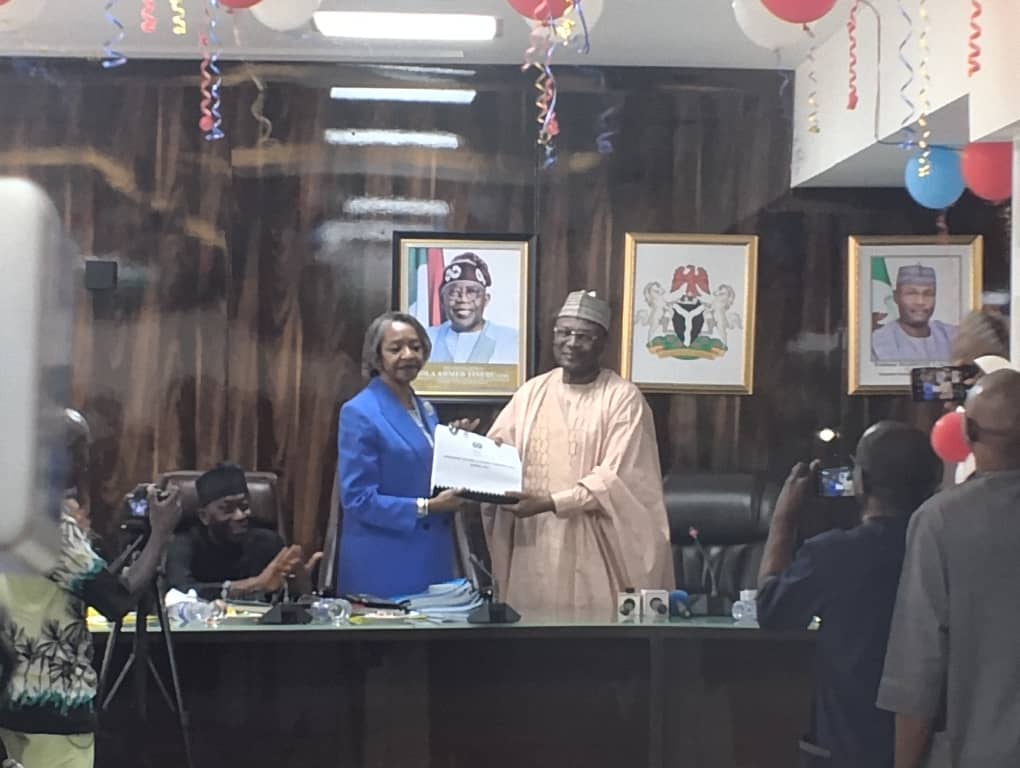
A National Commissioner at the Independent National Electoral Commission, May Agbamuche-Mbu, has taken over as the acting Chairman of the Commission.

This followed the formal handover of duties by Professor Mahmood Yakubu, who is proceeding on a terminal leave.

The transition was announced during a stakeholders’ meeting with Resident Electoral Commissioners held on Tuesday at the INEC headquarters in Abuja.

Speaking at the meeting, Yakubu explained that he was stepping down in accordance with Section 306, Subsections 1 and 2 of the 1999 Constitution (as amended).

“In recognition of the significant challenges ahead, and having had the honour of serving the Commission for the past 10 years, with only a few weeks remaining in my tenure. I have made a decision.

“In the interim, I am handing over to one of the most senior national commissioners by date of appointment. Following consultation with other national commissioners, May Agbamuche-Mbu will serve in an acting capacity pending the appointment of a substantive chairman of the Commission.

“I hope that this will afford the appointing authorities adequate time to appoint a new chairman. It will also enable the new chairman to quickly settle down to the task of conducting elections and electoral activities in Africa’s most demographically and logistically complex environment.

“Since 2015, I have worked with 24 national commissioners and 67 resident electoral commissioners, so also to the staff of the Commission. Those involved in elections or vastly knowledgeable about election management understand the conduct of elections and what it entails. I will forever cherish the support of successive secretaries and staff of the Commission nationwide,” he noted.

See also  ADC mobilises 3,000 delegates for Abuja convention ahead of 2027

Yakubu expressed gratitude to colleagues, stakeholders, civil society groups, development partners, and Nigerians, acknowledging their roles in supporting electoral processes during his tenure.

He also praised members of the National Youth Service Corps, calling them “among the most educated and most patriotic and also most knowledgeable election officials I have worked with.

“Above all, I thank Nigerians for their comments as well as criticisms, which encouraged rather than discouraged us to persevere.”

As part of his farewell, Yakubu presented two publications documenting the Commission’s work during his tenure: Election Management in Nigeria 2015–2025 and Innovations in Electoral Technology 2015–2025.

“All that remains at this point is for me to pray that God will continue to bless our country and our democracy,” Yakubu said as he handed over to Agbamuche-Mbu.

He added, “It is now my pleasure to sign my official handing over notes and present the same to Agbamuche-Mbu. And from that point, I will take my exit.”

Before taking his exit, the outgoing chairman outlined the Commission’s preparations for several upcoming elections, including the Anambra State governorship election next month, the Area Council election in the Federal Capital Territory in February 2026, the Ekiti State governorship election in June 2026, and the Osun governorship election in August 2026.

He also confirmed that “INEC has already begun preparations for the 2027 general elections” while awaiting the passage of “a new Electoral Act currently before the National Assembly.”

“Beyond these reviews, the commission needs to further clean up the voters’ register, review the locations of some of the polling units, and allotment of voters to them. The management of party primaries is another major area of activity,” he said.

See also  ADC crisis: Govs, lawmakers shelve defections

Yakubu reflected on the logistics and challenges of managing Nigeria’s electoral process, highlighting issues such as insecurity, natural disasters like floods, and the need to update frameworks for internally displaced persons’ voting.

“Over the years, we achieved a lot in responding to challenges and monitoring our introducing many innovations. We have consolidated the biometric register of voters and replaced many of our manual processes with digital platforms and applications,” he said.

He listed innovations introduced under his leadership, including technologies for locating election facilities, virtual training, management of political party finances, and monitoring elections through the Election Monitoring and Support Centre.

“Indeed, we have made tremendous progress, but a lot more needs to be done,” he said.

Before his foray into electoral administration, Yakubu, born in May 1962, served as Executive Secretary of the Education Trust Fund.

Former president Muhammadu Buhari appointed Yakubu as INEC on October 21, 2015, following Senate confirmation, and he assumed office on November 9, 2015, succeeding Professor Attahiru Jega.

In 2020, he was reappointed for a second five-year term, again confirmed by the Senate — first in Nigeria’s democratic history.

punch.ng

FOLLOW US ON:

FACEBOOK

TWITTER

PINTEREST

TIKTOK

YOUTUBE

LINKEDIN

TUMBLR

INSTAGRAM

Continue Reading
Click to comment

Leave a Reply

Your email address will not be published. Required fields are marked *

Politics

Wike-backed PDP fixes presidential form at N51m, gov N21m

Published

on

A faction of the Peoples Democratic Party backed by the Minister of the Federal Capital Territory, Nyesom Wike, has fixed its presidential nomination and expression of interest forms at ₦51m and governorship form at ₦21m ahead of the 2027 general elections.

The PDP National Organising Secretary of the faction, Umar Bature, disclosed this in a timetable made available to journalists on Wednesday.

According to the schedule, the faction will submit its register to the Independent National Electoral Commission on April 21, 2026, and notify the commission of its primaries on April 22.

The timetable shows that the expression of interest form for all positions costs ₦1m, while nomination fees vary across offices.

Aspirants for State Houses of Assembly are to pay ₦2m, House of Representatives ₦3m, Senate ₦5m, governorship ₦20m, and presidential aspirants ₦50m.

The sale of forms will begin on April 27 and close on May 4, while the deadline for submission of completed forms is May 9.

Screening of aspirants for State Houses of Assembly, National Assembly and governorship positions is scheduled for May 11, while that of presidential aspirants will hold on May 12.

The presidential primary has been fixed for May 18, while governorship primaries will be held on May 27.

House of Representatives primaries are scheduled for May 21 and Senate primaries for May 23, while State Houses of Assembly primaries will hold between May 21 and May 24. Appeals are expected to be concluded by May 30, 2026.

Bature added that female aspirants would only pay the expression of interest fee for their respective positions.

See also  No one can defeat me in Osun, Adeleke boasts

The PDP has been embroiled in an internal crisis, leading to a split into two factions—one led by Tanimu Turaki and supported by Oyo State Governor Seyi Makinde and Bauchi State Governor Bala Mohammed, and the other led by Abdulrahman Mohammed with the backing of Wike.

Several cases filed by both factions are pending in court.

At the Supreme Court on Wednesday, the justices said a date for judgment would be communicated to the parties.

Continue Reading

Politics

Supreme Court reserves judgment in PDP leadership dispute

Published

on

The Supreme Court of Nigeria on Wednesday, reserved judgment in the appeal filed by the Kabiru Tanimu Turaki-led faction of the Peoples Democratic Party, challenging the nullification of its 2025 national convention.

A five-member panel led by Justice Lawal Garba announced that a date for judgment would be communicated to all parties after counsel adopted their final written addresses.

The Turaki faction is seeking to overturn the March 9 ruling of the Court of Appeal, which affirmed earlier decisions invalidating the party’s Ibadan convention held on November 15 and 16, 2025.

At the apex court, the faction argued that the dispute falls within internal party affairs and is therefore not justiciable, insisting that due process was followed in organising the convention.

However, lower courts had consistently ruled against the group, nullifying the exercise, restraining the Independent National Electoral Commission from recognising its outcome, and issuing orders affecting access to the party’s national secretariat.

The appellate court had upheld two judgments of the Federal High Court in Abuja, which barred the PDP from conducting the convention pending compliance with the Electoral Act and the 2022 Regulations and Guidelines for Political Parties.

In one of the decisions, Justice James Omotosho held that the party failed to conduct valid state congresses as required by law and its constitution, thereby invalidating the planned convention.

Similarly, Justice Peter Lifu restrained the party from proceeding with the convention until it allowed former Jigawa State governor, Sule Lamido, to participate in the national chairmanship race after finding he was unjustly excluded.

See also  ADC mobilises 3,000 delegates for Abuja convention ahead of 2027

The suits leading to the rulings were instituted by aggrieved party members, including state executives from Imo, Abia, and the South-South zone, setting the stage for the protracted leadership crisis now before the apex court.

punch.ng

FOLLOW US ON:

FACEBOOK

TWITTER

PINTEREST

TIKTOK

YOUTUBE

LINKEDIN

INSTAGRAM

Continue Reading

Politics

Oyebanji re-election in Ekiti will validate Tinubu’s influence — APC chieftain

Published

on

A chieftain of the All Progressives Congress and House of Representatives aspirant, Henrich Akomolafe, has said the expected victory of Ekiti State Governor, Biodun Oyebanji, in the June 20, 2026, election would serve as a referendum on the leadership of President Bola Tinubu.

Speaking with journalists during a political consultation meeting on Tuesday, Akomolafe framed the Ekiti poll as more than a state contest, arguing that it would also reflect public confidence in the broader direction of the APC-led Federal Government.

He described Oyebanji as a performer and bridge-builder whose administration has brought stability, development and renewed confidence in governance in Ekiti State.

According to him, the governor’s leadership style—anchored on service, humility and visible results—has strengthened public trust and positioned him for electoral success.

“Ekiti people are politically conscious and always assess performance before making electoral decisions. Governor Oyebanji has built trust through his record, and that trust will translate into votes,” he said.

Akomolafe added that Oyebanji’s policies prioritised the welfare of workers, youths, farmers and traditional institutions, noting that his inclusive governance approach had helped sustain peace and unity across the state.

The APC chieftain also linked the governor’s anticipated victory to growing acceptance of Tinubu’s economic reforms, which he described as bold but necessary steps toward long-term national stability.

“Transformational leadership requires courage. The support Oyebanji will receive will also reflect public understanding of the President’s vision,” he added.

While acknowledging the short-term hardships associated with ongoing reforms, Akomolafe maintained that many Nigerians were beginning to see their long-term benefits.

See also  No one can defeat me in Osun, Adeleke boasts

He further called for unity within the party, particularly in Ekiti South Federal Constituency I, urging intensified grassroots mobilisation to secure victory for the APC across all levels in the election.

Akomolafe also appealed to youths, women and community leaders to rally behind leaders committed to service delivery, stressing that the upcoming governorship poll would be pivotal to consolidating development gains and sustaining peace in Ekiti State.

Continue Reading

Trending