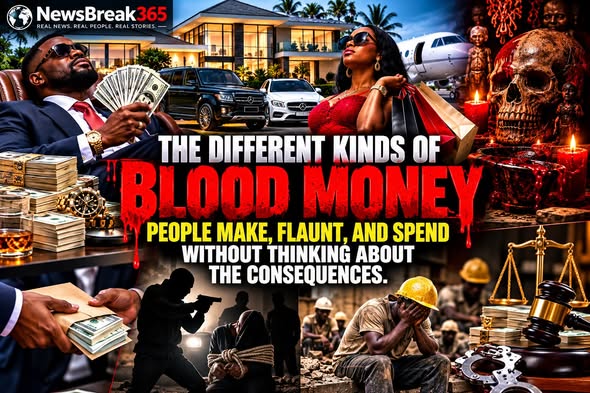
NOT EVERY FORTUNE IS A BLESSING. NOT EVERY LUXURY LIFESTYLE IS A SIGN OF SUCCESS. AND NOT EVERYONE WHO FLASHES MONEY CAN EXPLAIN THE HUMAN COST OF THEIR WEALTH!
Some people work hard, sacrifice their comfort, and build their wealth honestly. Others enrich themselves through corruption, fraud, exploitation, violence, betrayal, and other harmful or criminal activities.
The disturbing part? Some people do not just make this money. They flaunt it, celebrate it, use it to intimidate others, and demand respect without considering the suffering that may lie behind their riches.
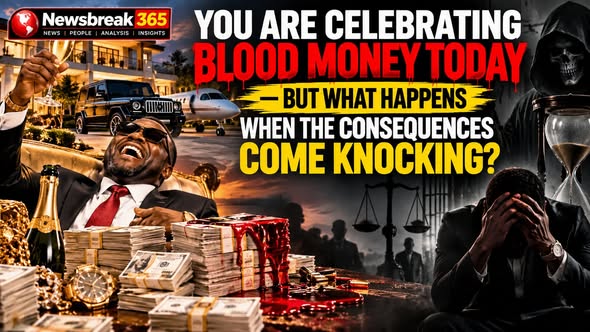
Let’s talk about the different faces of **BLOOD MONEY.**
1. MONEY MADE THROUGH HUMAN SACRIFICE
This is one of the darkest forms of what people commonly call blood money. It refers to wealth people believe they can obtain through ritual killings, human sacrifice, or other acts involving the deliberate taking of innocent lives.
A human life is not a price to be paid for luxury, power, fame, or riches. No mansion, private jet, or bank balance can justify the deliberate destruction of another person’s life.
**What kind of success requires another human being to suffer or die?**
2. MONEY MADE THROUGH CORRUPTION
When public officials or powerful individuals steal public funds, the consequences extend far beyond their personal wealth.
Money meant for hospitals disappears. Schools remain poorly equipped. Roads deteriorate. Public services collapse. Ordinary citizens struggle while those responsible display expensive cars, build mansions, and live in luxury.
Behind some corrupt fortunes are communities deprived of opportunities and people whose lives could have been improved by the money that was stolen.
When public money is stolen, the public pays the price.
3. MONEY MADE THROUGH CRIME AND VIOLENCE
Kidnapping, armed robbery, human trafficking, extortion, and other violent crimes can generate money for criminals at the expense of innocent people.
While criminals may spend their proceeds on luxury goods and lavish lifestyles, victims and their families may be left with trauma, financial hardship, physical injuries, or irreversible loss.
The price of such wealth cannot be measured by the amount in a bank account.
You cannot call it success when your prosperity depends on destroying somebody else’s life.
4. MONEY MADE THROUGH EXPLOITATION
Some people become wealthy by taking advantage of the vulnerable.
They underpay workers deliberately, deny employees their rightful wages, expose people to dangerous working conditions, or exploit desperate individuals who have few alternatives.
They count their profits while the people who helped generate those profits struggle to feed their families.
There is nothing admirable about building an empire by treating human beings as disposable tools.
A person’s poverty should never become another person’s opportunity for exploitation.
5. MONEY MADE THROUGH BETRAYAL AND DECEPTION
Some people are willing to destroy friendships, betray family members, cheat business partners, or abandon those who helped them simply to gain financial advantage.
They make promises they never intend to keep. They manipulate trust, exploit loyalty, and disappear when their victims discover the truth.
They may gain money in the short term, but their actions can destroy relationships, reputations, and the trust that makes genuine success possible.
Not every financial gain is worth the human relationship sacrificed to obtain it.
6. MONEY MADE THROUGH ABUSE OF POWER
Power can be used to protect people, create opportunities, and improve society. But some individuals use their positions and influence to enrich themselves at the expense of others.
They intimidate those who challenge them, manipulate systems for personal benefit, and use authority to silence people seeking justice.
Their wealth becomes a symbol of power, while those they harm are left feeling helpless.
But holding a powerful position does not make wrongdoing right.
Power is a responsibility, not a licence to destroy other people’s lives.
7. MONEY MADE THROUGH FRAUD AND SCAMS
Fraudsters sometimes present themselves as successful entrepreneurs, wealthy investors, generous benefactors, or financial experts.
Behind the appearance of success may be fake investment schemes, romance scams, identity theft, forged documents, or promises of extraordinary returns designed to deceive innocent people.
Victims can lose their savings, retirement funds, business capital, and years of hard work.
Meanwhile, the perpetrators may use the stolen money to purchase luxury items and convince others that they are financially successful.
Someone else’s life savings should never become the foundation of your luxury lifestyle.
8. MONEY MADE THROUGH DRUG TRAFFICKING AND ADDICTION-RELATED EXPLOITATION
Illegal drug trafficking and the deliberate exploitation of addiction can generate enormous profits while contributing to serious harm.
Families may experience financial distress, relationships may break down, and communities may struggle with the consequences of addiction and organised crime.
Those who profit while knowingly exploiting vulnerable people should not confuse financial gain with a positive contribution to society.
A profit is not proof that your actions have created value.
9. MONEY MADE THROUGH HUMAN TRAFFICKING AND MODERN SLAVERY
Some people make money by treating human beings as commodities, forcing people into labour, exploiting vulnerable migrants, or profiting from sexual exploitation.
Victims may be stripped of their freedom, wages, dignity, and basic human rights.
No amount of wealth can make such treatment acceptable.
Human beings are not merchandise, and human suffering is not a legitimate business model.
10. MONEY MADE THROUGH ENVIRONMENTAL DESTRUCTION
Some businesses or individuals pursue profit by knowingly dumping dangerous waste, illegally exploiting natural resources, or ignoring serious environmental harm.
The financial rewards may benefit a few, while entire communities bear the consequences through polluted water, damaged land, health risks, and lost livelihoods.
When the pursuit of money destroys the resources people depend on to survive, the cost is much greater than the financial profit.
The earth should not have to pay the price for somebody’s greed.
11. MONEY MADE THROUGH EXTORTION AND BLACKMAIL
Some people obtain money by threatening to expose private information, intimidate victims, or cause harm unless their demands are met.
Others use fear, shame, or a person’s vulnerable circumstances to force payments.
This is not legitimate bargaining. Depending on the circumstances and jurisdiction, such conduct can constitute a serious crime.
Money obtained by threatening another person’s peace is not a badge of honour.
12. MONEY MADE THROUGH WAGE THEFT AND BUSINESS DISHONESTY
Some employers or business owners deliberately withhold wages, refuse to pay suppliers, falsify accounts, or deceive customers to protect their profits.
They may appear successful because they have accumulated money that should have gone to other people.
But a business’s true value should be measured by more than its revenue. Honesty, fair treatment, and accountability matter too.
If your business can only prosper by cheating the people who sustain it, what exactly have you built?*
13. MONEY MADE THROUGH POLITICAL MANIPULATION AND ELECTORAL CORRUPTION
Where individuals buy votes, manipulate elections, or use political influence to obtain public resources unlawfully, the consequences can reach millions of people.
Citizens may lose confidence in democratic institutions, public resources may be misdirected, and communities may suffer from poor leadership and missed opportunities.
Those who profit from undermining the public interest should remember that political power is temporary.
A stolen opportunity for a nation can become a lasting burden for generations.
14. MONEY MADE THROUGH RELIGIOUS DECEPTION
Faith can inspire compassion, generosity, and service. However, some dishonest individuals exploit people’s religious beliefs, promising miracles, wealth, healing, or divine favour in exchange for money through deception or coercion.
They may use fear, guilt, or false promises to pressure vulnerable believers into giving beyond their means.
This criticism is not directed at every religious leader or place of worship. It is directed at those who deliberately manipulate faith for personal enrichment.
Never allow anyone to use your hope, fear, or faith as a weapon against your financial well-being.
15. MONEY MADE THROUGH DOMESTIC ABUSE AND FINANCIAL CONTROL
Some individuals use money to control, threaten, or trap partners and family members. They may steal a partner’s earnings, prevent access to shared finances, or use financial dependence to maintain power.
The harm is not always visible to outsiders, but financial abuse can leave victims feeling powerless and unable to escape a harmful situation.
Wealth should help people build secure lives, not become a weapon used to control them.
Money should never be used to purchase another person’s freedom or dignity.
THE REAL DANGER: WHEN DIRTY MONEY BECOMES A SYMBOL OF SUCCESS
Perhaps one of the most troubling aspects of blood money is not simply how it is obtained, but how society sometimes responds to the people who possess it.
People applaud the expensive cars.
They admire the mansions.
They celebrate the extravagant parties.
They envy the designer clothes, private jets, luxury holidays, and bundles of cash.
Some even ignore credible evidence of wrongdoing because the person involved is wealthy, influential, generous, or well connected.
But how often do we ask the questions that really matter?
WHO PAID THE PRICE FOR THIS WEALTH?
WHO WAS CHEATED, EXPLOITED, INTIMIDATED, OR HURT?
IS THIS PERSON TRULY SUCCESSFUL, OR ARE WE SIMPLY IMPRESSED BY WHAT THEIR MONEY CAN BUY?
And why do some people condemn wrongdoing in public while privately wishing they could enjoy the same ill-gotten riches?
These are uncomfortable questions, but they deserve honest answers.
MONEY MAY BUY LUXURY, BUT IT CANNOT ERASE THE CONSEQUENCES
Unlawfully obtained wealth can expose people to criminal investigations, prosecution, imprisonment, asset recovery, damaged reputations, and broken relationships.
Victims may seek justice. Evidence may emerge years later. Partnerships can collapse when deception is exposed.
Not every wrongdoer is caught, and consequences do not always arrive quickly. But the possibility of escaping punishment does not turn wrongdoing into righteousness.
Equally, we should not assume that every wealthy person is corrupt or that every person experiencing hardship has been victimised. The source of wealth must be judged on evidence, not appearance or rumour.
**The real measure of success is not simply how much money you accumulate, but how you earn it, how you treat people, and what you leave behind.**
It is better to build a modest life through honest work than to acquire extraordinary riches by deliberately destroying innocent lives.
A luxury car is not a character certificate.
A mansion is not proof of integrity.
A large bank balance is not evidence of a good conscience.
And public admiration is not the same as moral worth.
THE BIG QUESTION FOR EVERYONE:
If someone offered you unlimited wealth but you knew that obtaining it would require you to betray your loved ones, exploit the poor, steal public funds, deceive innocent people, or participate in the destruction of human lives, would you accept it?
Would you rather live modestly with your integrity intact, or live in luxury knowing that your wealth was built on other people’s suffering?
DROP YOUR OPINION IN THE COMMENTS. LET’S TALK ABOUT MONEY, GREED, MORALITY, AND THE TRUE PRICE OF WEALTH.
#BloodMoney #DirtyMoney #Corruption #Fraud #Greed #Humanity #Justice #WealthAndMorality #NewsBreak365
FOLLOW US ON:
FACEBOOK
WHATSAPP CHANNEL
TWITTER
PINTEREST
TIKTOK
YOUTUBE
LINKEDIN
INSTAGRAM







 Videos5 hours ago