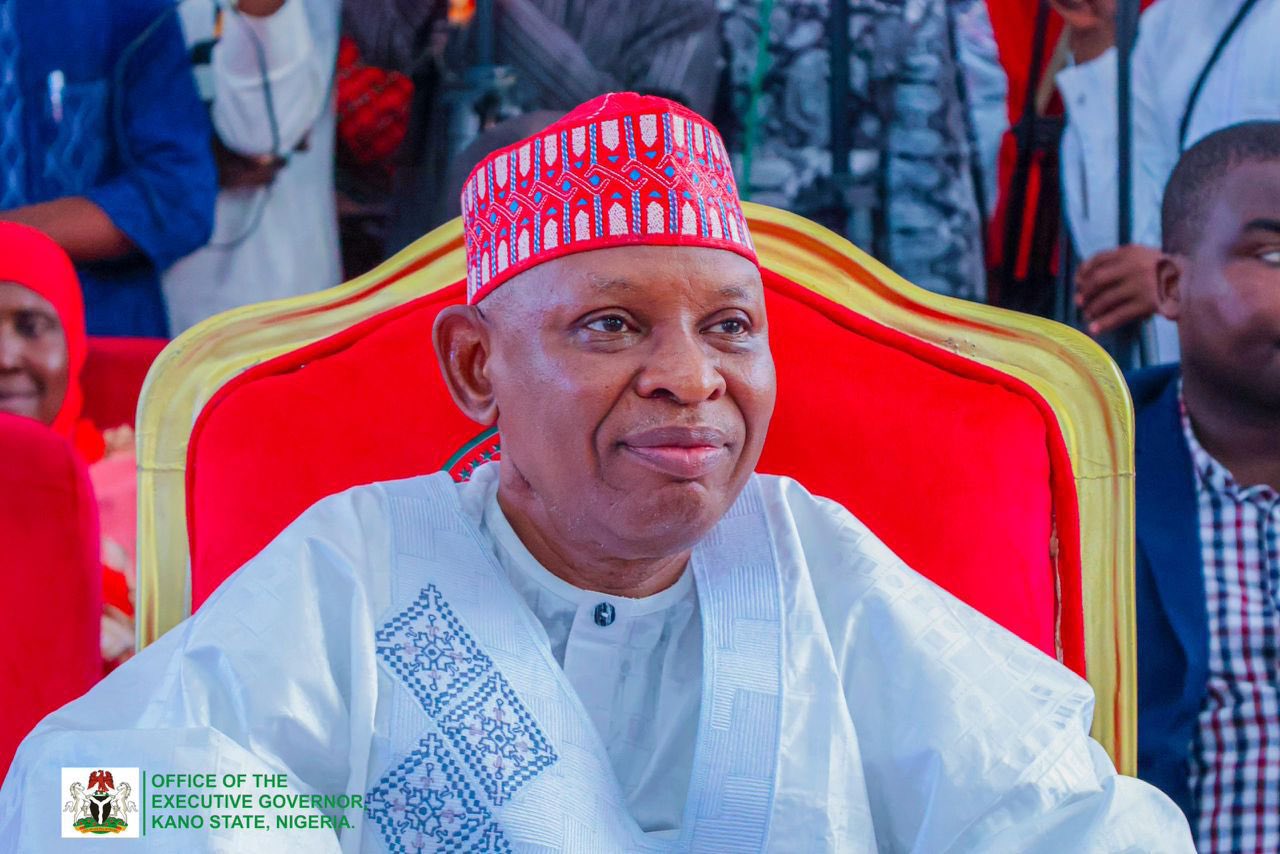
The Peoples Democratic Party, African Democratic Congress and Labour Party have strongly criticised the All Progressives Congress following the defection of the Kano State Governor, Abba Yusuf, from the New Nigeria Peoples Party to the ruling party, insisting that the development will not alter the political reality ahead of the 2027 general elections.
Reacting to the governor’s decision to join the APC on Monday, the National Publicity Secretary of the PDP, Ini Ememobong, and his ADC counterpart, Bolaji Abdullahi, said in separate interviews with The PUNCH that the defection reflects moral failure rather than political strength, stressing that moves driven by self-interest would not translate into votes for the ruling party.
Also, the Interim National Chairman of the faction, Senator Nenadi Usman, warned against confusing elite defections with widespread popular support, emphasising that opposition parties will continue to play a significant role ahead of the upcoming elections.
Meanwhile, the APC Director of Publicity, Bala Ibrahim, welcomed the Kano State governor into the party, describing the defection as a boost for the APC and a validation of its commitment to delivering democracy’s dividends to Nigerians.
Despite the support of a former Kano State governor and leader of the Kwankwasiyya Movement, Rabiu Musa Kwankwaso, Governor Yusuf announced his resignation from the NNPP on Friday, following weeks of speculation and rising political tension in the state.
In recent months, several PDP governors have defected to the APC, including Umo Eno of Akwa Ibom, Sheriff Oborevwori of Delta, Peter Mbah of Enugu, Douye Diri of Bayelsa, Agbu Kefas of Taraba, Siminalayi Fubara of Rivers State and, most recently, Caleb Mutfwang of Plateau State.
Beyond the governors, several influential political figures—such as National Assembly members, state legislators, former governors, ex-ministers, and other party leaders have also left the PDP for the APC.
President Bola Tinubu and other APC leaders have consistently rejected claims that the ruling party aims to establish a one-party state following the defection of the governors, maintaining that the APC remains inclusive and open to all Nigerians.
Speaking on Yusuf’s resignation, the NNPP National Publicity Secretary, Oladipo Johnson, in a statement on Friday, described the move as a betrayal of the Kano electorate and a blow to the Kwankwasiyya Movement that the governor once led.
He added that history shows that those who trade loyalty for convenience and integrity for deception rarely escape the judgment of the people.
NNPP stated, “We deeply regret that Governor Abba, a man entrusted by the people of Kano State on the strength of his decades of unwavering loyalty and dedicated service to the Kwankwasiyya Movement, has now chosen to betray that sacred trust. By this action, he risks returning the state to the very forces that have long opposed its progress and the aspirations of its people.
“It is noteworthy that our party, the NNPP, had recently conducted congresses for its leadership from the ward to the national convention, held on 20th December 2025, which the governor himself was present at, and INEC had supervised. The party had also participated in and won two supplementary elections for Bagwai/Shanono and Ghari/Tsanyawa constituencies, respectively held in August 2025, about three months ago. The assertion he made of an irredeemable crisis in the party is therefore baseless and an afterthought.
“This is not the first time such a betrayal has occurred in the political history of Kano. In the early 1980s, Alhaji Abubakar Rimi defected from the People’s Redemption Party to the Nigerian People’s Party, taking with him the vast majority of elected officials—including nearly all local government chairmen and councillors, 120 out of 126 members of the Kano State House of Assembly, and most Kano representatives in the National Assembly.
“Yet, the electorate delivered a resounding verdict: In the 1983 gubernatorial election, Rimi was humiliatingly defeated by Mallam Aliyu Sabo Bakin Zuwo of the PRP, finishing second. Even more telling, of the 120 state assembly members who joined Rimi’s defection, only one was re-elected—an outcome that should serve as a sobering lesson to any politician contemplating the path of disloyalty.”
The party called on its members and the people of Kano State to remain calm and avoid discord, emphasising that the loyalty of Kano’s citizens to principled leadership will ultimately triumph.
Despite objections from the NNPP, Yusuf is scheduled to officially join the APC today, marking a major shift in the political landscape of Kano State, the governor’s spokesperson, Sunusi Tofa, confirmed in a statement released on Sunday.
The statement highlighted that Governor Yusuf initially joined the APC in 2014 to contest the party’s primary for the Kano Central Senatorial seat, a position he yielded to Kwankwaso.
The Kano State governor is set to officially register as a member of the APC in Kano, alongside 22 members of the State House of Assembly, eight members of the House of Representatives, and all 44 local government chairmen.
He is also expected to inaugurate the APC’s e-registration exercise in the state.
Speaking on the significance of the registration exercise, Yusuf stated, “This is not just a political move; it is a step to ensure that governance remains people-centred and that our developmental agenda reaches every corner of Kano State.”
On the broader implications of his return, he added, “Our focus is on building unity, strengthening political cooperation, and ensuring that the people benefit from effective governance, irrespective of party affiliations.”
Reflecting on his earlier years in the APC, the governor remarked, “I am returning to a party I know, a platform where experience meets structure, and where we can collectively pursue progress for Kano State.”
In a related development, former Kano State Governor and ex-APC National Chairman Abdullahi Ganduje, who is currently abroad, is expected to return today.
A former Chief of Staff to Ganduje, Mohammed Garba, revealed on Sunday that he had travelled to London but would be back in Nigeria on Monday.
“He is presently in London and will return to the country tomorrow, Monday, ” Garba said.
Garba further stated that it is highly likely the former Kano State governor might head straight to Kano upon arrival to officially welcome the defecting governor.
“We are not yet certain, but there is the possibility that he may head straight to Kano to receive the governor,” he added.
Reacting, the PDP National Publicity Secretary accused Yusuf and other defecting governors of betraying their electoral mandate.
In an interview, Ememobong insisted that the APC would face defeat in 2027 despite the recent wave of defections.
He stated, “The troubling part is that this is not how the system is supposed to work. It does not address the issue of people who were elected, nor does it speak to the promises that were made. There are moral questions involved. A social contract exists between elected officials and the people, and that contract is entered into on the basis of a political party.
“Once elected on that platform, it is morally wrong to abandon it midway. If you intend to contest another election, you should wait until the end of your tenure and then contest on another platform. Alternatively, you should vacate the office and allow the party on whose platform you were elected to retain the mandate, especially when the party you are joining was a fierce opponent.’’
Continuing, he noted, “It is shocking that people now suffer from selective amnesia. After going through an election that was widely described as a political war, with all that transpired known to everyone, they simply take the fruits of that victory and hand them over to the APC, which was their main contender. All of this speaks to the moral deficiency of many political leaders, despite attempts by some to justify it.
“This will not count as an advantage for the ruling party in 2027. As I have said before, this does not diminish any political party. Electoral strength is determined only during elections, not by the defection of governors. Kano, for instance, remains an NNPP state until the next election.
“A governor may defect or plan to defect, but that does not change the political complexion of the state. If you look at the 2023 electoral map, it clearly shows that elections are contests decided by voters.
“This sudden push for defections is a sign of APC cowardice, not political strength. Presidential elections are not won by forcing people to defect or by making the electorate suffer.
“The people did not defect along with these governors or others who have joined the APC. The ruling party has failed, and Nigerians who have not defected and will not defect will vote the APC out. The Kano State governor and other defecting governors, who are holding mandates belonging to other parties, cannot save the ruling party.”
The ADC publicity secretary stated that governors defecting to the APC are seeking personal protection rather than serving the people, adding that failed governors will not be able to deliver their states to the party in the 2027 elections.
Abdullahi stated, “Well, obviously, we do not doubt that he is joining for the same reason other governors have joined: to seek protection. They all know that the easiest way to secure a second term is by joining the ruling party. They believe that is where they will get a free ride into a second term.
‘’They also believe they are answering the call of the APC—that whoever joins their party, no matter how sinful he is, will have his sins forgiven. That is why they are joining. They are not joining because they believe what the ruling party is doing to their people is right, or because they care about the people. They do not care about the people; they only care about themselves. So we are not surprised.
“It is not an advantage for APC, because when governors defect, some of them have already failed their people. And joining the ruling party does not mean the people are joining them. We have evidence of this from the last election. In Delta State, the governor belonged to one party, yet another party won the election. The same thing happened in Edo, and the same in Lagos, as a matter of fact. So, the situation is not as bad as it is being portrayed. We do not see this as any real advantage for the ruling party.
“If elections are conducted freely and fairly in any of these states, most of these governors will realise that their approval ratings among their people are actually below 20 per cent. They know exactly why they are doing what they are doing. So even within the APC, defeat awaits them all, because of the zero performance of the governors and President Bola Tinubu.”
On her part, the LP Interim National Chairman, Usman, said the movement of political office holders did not automatically translate to electoral dominance.
“I would reply by giving you a proverb in Hausa that says, just because all the governors have trooped to one side does not really mean that you should conclude that the opposition is not going to have any impact come 2027. I don’t really look at it like that,” she said.
She also expressed uncertainty over the motivations driving opposition governors to abandon their political platforms for the ruling party.
“Honestly, I don’t know what is making them flock to the APC. We hear a lot of news around. We hear stories of people who say that if you join the APC, your sins are forgiven. So, it could be that, I don’t know,” Usman added.
In a response, the APC Director of Publicity dismissed the opposition’s claims, while welcoming Yusuf and other returning members, noting that the defections reflect widespread acceptance of the party’s principles.
Ibrahim stated, “The party is looking forward to his arrival. After all, he was once a member of the APC before defecting to another party, the NNPP, so this move is more like a homecoming. While the party awaits his formal registration, it is expected that the national leadership will take a position once he officially joins.
“The more people who join, the better, especially when they are committed democrats, because the APC aims to continue to strengthen democracy, make it more vibrant, and deliver greater democratic dividends to the people. An increase in participation, support base, and membership reflects positively on the party, showing that its principles, policies, and programs are being welcomed by Nigerians. That is why these leaders are joining.
“As for claims from the PDP, ADC, LP and NNPP, including statements about Governor Yusuf and other defecting governors, that Nigerians will work with opposition parties to remove the APC in 2027, such wishes are simply speculation. While wishful thinking is allowed in a free society, it does not necessarily reflect the will of the majority. Given the way the APC continues to be embraced, the idea of a coalition ganging up to unseat the party remains a dream that will not come true.”
punch.ng
FOLLOW US ON: