Connect with us

Business

FG seeks Canadian tech, investment to fast-track mining reforms

Published

on

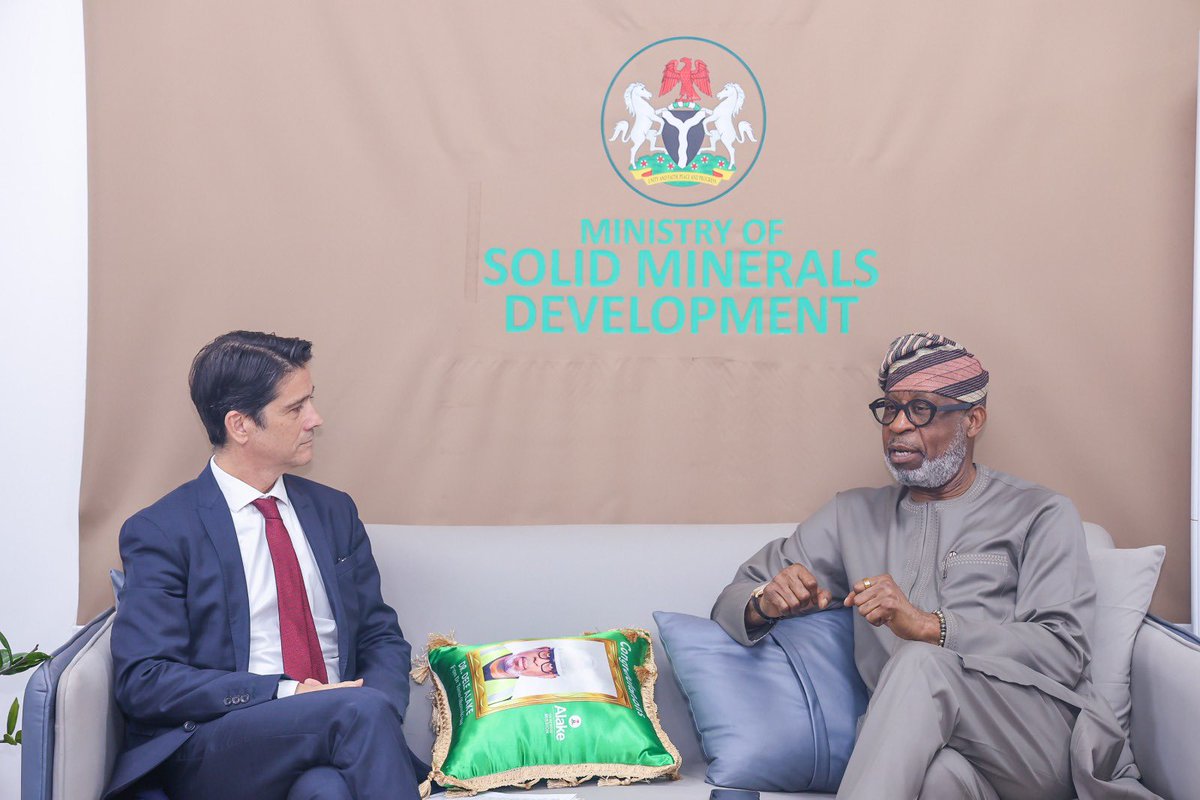
The Federal Government has intensified efforts to reposition Nigeria’s mining sector, with the Minister of Solid Minerals Development, Dele Alake, stating that the country is ready to leverage Canada’s advanced technology and global expertise to accelerate reforms and unlock the industry’s economic potential.

Alake made the disclosure while receiving the Canadian High Commissioner to Nigeria, Pasquale Salvaggio, at his office in Abuja on Thursday, according to a statement issued on Friday by his Special Assistant on Media, Segun Tomori.

The minister said deeper bilateral collaboration with Canada would support Nigeria’s quest to attract investment, entrench international best practices, and drive sustainable growth in the mining industry.

He also reflected on the long-standing diplomatic ties between the two countries, recalling Canada’s support for Nigeria during the pro-democracy struggle that followed the annulment of the June 12, 1993, presidential election.

“Canada stood firmly with the Nigerian people during our pro-democracy struggle. The cooperation we enjoyed from the Canadian High Commission was exemplary and deeply encouraging. We regarded Canada as an archetypal pro-democracy ally,” Alake said.

He added, “Today, we are committed to strengthening that relationship, particularly in mining and mineral development, where Canada’s global reputation for excellence is well established. We believe enhanced cooperation will help accelerate sectoral growth, attract investment, and institutionalise global best practices.”

The minister reaffirmed Nigeria’s commitment to building a transparent and investor-friendly mining environment, stressing that the Federal Government is prioritising the formalisation of artisanal mining, capacity building for professionals, technology transfer, and improved regulatory oversight.

See also  PHOTOS: Groundnut Pyramids, Kano – Northern Nigeria’s Cash Crop Symbol

“We are working deliberately to de-risk the mining environment. Our focus is on attracting foreign direct investment, strengthening regulatory frameworks, building the capacity of Nigerian mining professionals, and formalising artisanal mining to reduce illegal operations and enhance revenue generation,” he said.

Alake highlighted several incentives designed to boost investor confidence, including tax waivers on imported mining equipment and full repatriation of profits after statutory obligations such as taxes and royalties are met.

“These incentives reflect our commitment to creating a stable and competitive investment climate. Investors are guaranteed the full repatriation of their profits after fulfilling all legal obligations. We are also introducing fiscal measures to ensure that Nigeria remains one of the most attractive mining destinations globally,” he added.

In his remarks, Salvaggio appreciated Nigeria’s recognition of Canada’s historic role in its democratic journey and commended the minister for acknowledging Canada’s leadership in the global mining industry.

He noted that Nigeria is Canada’s second-largest trading partner in Africa and highlighted the potential to expand trade relations, particularly in mining.

“Nigeria is a strategic partner for Canada. We see significant opportunities to expand our trade and investment cooperation across several sectors, especially mining, where Canada has global expertise and Nigeria has immense potential,” the envoy said.

He also praised the establishment of the Nigeria Solid Minerals Company, describing it as a strategic initiative capable of boosting investor confidence and catalysing growth.

“The creation of the Nigeria Solid Minerals Company is a commendable step. It sends a strong signal to global investors about Nigeria’s seriousness in developing the sector and strengthening governance,” he added.

See also  Rising debt: Financial expert, Idakolo x-rays Nigeria’s situation

Salvaggio highlighted strong people-to-people ties between the two countries, including the Nigerian diaspora in Canada, noting that the relationship provides a solid foundation for deeper economic cooperation.

“I am confident that Nigeria could become Canada’s largest trading partner in Africa within the next five to ten years, given its dynamism, entrepreneurial spirit, and commercial outlook. Nigeria is currently the sixth-largest recipient of Canadian development cooperation globally, which underscores the depth of our partnership,” he said.

The envoy also emphasised Canada’s readiness to facilitate increased investment, urging the Federal Government to revisit the stalled Foreign Investment Promotion and Protection Agreement (FIPA).

“The ratification of FIPA will significantly enhance investor confidence and guarantee investment security. We encourage the Nigerian government to expedite this process,” he added.

He expressed Canada’s willingness to expand capacity-building initiatives, including replicating the 2025 training programme for Nigerian mining professionals at the University of Calgary in Alberta and supporting additional technical exchange programmes.

In response, Alake said the agreement predates the current administration but assured that the government is ready to review and fast-track its ratification.

He reiterated President Bola Tinubu’s commitment to attracting foreign direct investment as a pathway to economic growth and job creation.

“The current administration is focused on economic transformation. We recognise the role of foreign direct investment in job creation and sustainable development, especially for our youthful population. We are therefore open to reviewing the agreement and ensuring that it supports our national economic priorities,” he said.

Both countries agreed to establish a joint working group to identify priority areas of cooperation in the mining sector and develop clear timelines to ensure measurable outcomes from the renewed bilateral engagement.

See also  After N2.83trn Loss, Analysts See Stock Market Staying Cautious This Week

Nigeria has intensified reforms in the solid minerals sector in recent years as part of broader efforts to diversify the economy away from oil dependence.

The government has introduced policies aimed at curbing illegal mining, strengthening regulatory institutions, and improving transparency to attract global investors.

Canada, regarded as a global leader in mining technology, governance, and financing, hosts some of the world’s largest mining companies and remains a major source of investment and technical expertise in the sector.

Industry experts believe stronger Nigeria-Canada collaboration could help unlock the country’s vast mineral resources, including lithium, gold, and rare earth elements critical to the global energy transition.


Continue Reading
Click to comment

Leave a Reply

Your email address will not be published. Required fields are marked *

Business

Meta sues Brazil, China advertisers over celebrity deepfake scams

Published

on

US tech giant, Meta, filed lawsuits on Thursday against several individuals and companies in Brazil and China who used celebrity deepfakes to advertise products on its platforms, the company said in a statement.

AI technology is allowing criminals around the world to create sophisticated voice and video copies of well-known figures to endorse scam investments, and helping make dodgy online messages appear more genuine.

Meta, the parent company of Facebook, Instagram, and WhatsApp, filed “lawsuits against four scam advertisers who impersonated well-known celebrities and brands to deceive and defraud people,” the statement said.

In Brazil, the firm sued B&B Suplementos e Cosmeticos and Brites Academia de Treinamento as well as two individuals for “a scam operation that used deepfakes of a prominent physician to advertise healthcare products without regulatory approval.”

Brites also “sold courses teaching the same tactics,” according to Meta.

Renowned Brazilian oncologist Drauzio Varella was one of the public figures impersonated by Brites, and stated that Meta’s legal actions are insufficient.

It’s “a drop in the ocean of fraud against public health,” the doctor told the O Globo newspaper.

Varella said Meta’s platforms were “partners in the fraud” because of their reach.

“They earn billions by spreading this and ensuring the video reaches as many people as possible,” he told the newspaper.

The US company also sued Vitor Lourenco de Souza and Milena Luciani Sanchez for similar practices in Brazil.

In China, Meta sued Shenzhen Yunzheng Technology over “celeb-bait ads to target people in the US and Japan, among other countries, as part of a larger fraud scheme that lured people into joining so-called investment groups,” the company said.

See also  CBN warns that naira abuse is driving up printing costs

The tech giant also sued Vietnamese company Ly Van Lam for publishing fraudulent advertisements for Longchamp luxury handbags.

AFP

punch.ng

FOLLOW US ON:

FACEBOOK

TWITTER

PINTEREST

TIKTOK

YOUTUBE

LINKEDIN

TUMBLR

INSTAGRAM

Continue Reading

Business

FCCPC probes fare fixing by local airlines

Published

on

The Federal Competition and Consumer Protection Commission has uncovered patterns of price manipulation by some domestic airlines during the December 2025 festive season, raising fresh concerns about consumer exploitation and competition in Nigeria’s aviation sector, according to an interim review released by the agency on Thursday.

It said the development raised fresh concerns over consumer exploitation and market competition in Nigeria’s aviation sector. The interim report, released by the commission’s Department of Surveillance and Investigations, followed an industry-wide probe announced in January.

According to the report, preliminary analysis of data obtained from local airlines showed that ticket fares during the festive peak were significantly higher than post-peak levels in January 2026, despite relative stability in key operating variables such as aviation fuel, government taxes, and foreign exchange.

The commission, in a statement signed by its Director of Corporate Affairs, Ondaje Ijagwu, said the forensic exercise compared domestic pricing trends during the December festive rush with subsequent fare levels. It noted that the differences observed in ticket prices appeared to reflect airlines’ discretionary pricing decisions rather than external cost pressures.

The statement read in part, “A review undertaken by the Federal Competition and Consumer Protection Commission has uncovered patterns of price manipulation perpetrated by some local airlines during the last festive season.

“The forensic exercise benefited from data collated by the commission from airlines operating local routes in the country. The report compares domestic airline pricing from the December 2025 festive period with post-peak January 2026 fare levels.

“Preliminary analysis indicates that fares recorded during the December peak were materially higher than those observed in the post-peak period across several routes, despite relative stability in critical operating variables like fuel price, government taxes, and foreign exchange.

See also  Rising debt: Financial expert, Idakolo x-rays Nigeria’s situation

“The differences observed in fares therefore appear to reflect airlines’ arbitrary pricing decisions, including yield management and capacity allocation, rather than any variation in regulatory fees.”

The commission said route-level analysis showed that fare increases coincided with periods of reduced seat availability during predictable seasonal demand peaks, suggesting deliberate supply constraints. It added that on high-density routes, peak fares were often clustered within narrow ranges across several operators, a pattern that may indicate coordinated behaviour.

“For instance, on certain corridors such as Abuja–Port Harcourt, peak fares were several times higher than corresponding post-peak levels. On selected routes, the difference in the price of a single ticket reached approximately N405,000,” the report stated.

It further noted that median fares across sampled routes rose sharply during the festive window compared with January benchmarks. However, the commission acknowledged that seasonal demand, fleet utilisation, and scheduling constraints could also affect pricing during peak travel periods, noting that “these factors remain under consideration as part of the commission’s ongoing review.”

Speaking on the findings, the Executive Vice Chairman and Chief Executive Officer of the Commission, Tunji Bello, said the exercise was part of the agency’s mandate to promote competition and protect consumers.

“This assessment is intended to provide clarity on pricing behaviour during predictable peak travel periods. The commission’s role is not to disrupt legitimate commercial activity, but to ensure that market outcomes remain consistent with competition and consumer protection principles under the law,” Bello said.

He stressed that the report was interim and that the Commission would conduct deeper structural and route-level analysis before taking any regulatory steps.

See also  Wema Bank is the longest surviving indigenous bank in Nigeria.

“It is important to emphasise that this is an interim report. Our next action will be dictated by the full facts established at the end of the review exercise. Then, the Commission will decide whether any regulatory guidance, engagement, or enforcement steps are necessary, strictly in accordance with the law,” he added.

The report identified possible violations of provisions of the Federal Competition and Consumer Protection Act 2018, including those relating to anti-competitive agreements, abuse of dominance, price-fixing, and unfair contract terms.

According to the commission, the relevant sections include prohibitions against restraint of competition, abuse of a dominant position, conspiracy, and unfair or unjust dealings with consumers.

It noted, “The report identifies the possible relevance of Sections 59, 72, 107, 108, 124 and 127 of the Federal Competition and Consumer Protection Act 2018, which respectively address the prohibition of agreements in restraint of competition, the prohibition of abuse of a dominant position, the offence of price-fixing, conspiracy to commit offences under the Act, the right to fair dealings, and the prohibition of unfair, unreasonable or unjust contract terms.”

Meanwhile, Bello disclosed that the commission would extend its probe to international airlines amid widespread complaints that Nigerians are charged higher fares compared to travellers in neighbouring countries on similar routes.

“Following the ongoing review of domestic airlines, the Commission will also examine the pricing behaviour of foreign carriers operating in Nigeria. There have been persistent concerns that Nigerians pay higher fares on certain routes compared to countries of similar distance,” he said.

Airfare pricing in Nigeria has remained a major concern for travellers, particularly during festive periods when demand surges. Industry operators often attribute high fares to limited fleet capacity, rising aviation fuel costs, and operational challenges.

See also  PHOTOS: Groundnut Pyramids, Kano – Northern Nigeria’s Cash Crop Symbol

However, consumer groups have accused airlines of exploiting predictable seasonal demand by restricting seat supply and inflating prices. Nigeria’s aviation sector has also struggled with aircraft shortages, high maintenance costs, forex constraints, and infrastructure gaps, which have reduced capacity and increased pressure on fares.

The FCCPC’s probe could reshape pricing transparency and competition in the sector if enforcement actions follow. The development comes amid broader regulatory efforts to strengthen consumer protection and ensure fair market practices across critical sectors of the economy.

Responding to the allegations, spokesperson of the Airlines Operators of Nigeria, Prof Obiora Okonkwo, tongue-lashed the FCCPC, saying it lacks the required expertise to dabble in how airfares are fixed. He further said the FCCPC’s actions are detrimental to the survival of domestic airlines.

Okonkwo said, “I have not read the details of the report, but what the FCCPC is doing is very detrimental to the survival of domestic operators. They don’t know the economics of airlines and do not possess the professional expertise to dabble in how prices are fixed.

“They don’t understand airline operations, and, as far as the AON is concerned, they are playing to the gallery and should not be taken seriously. We have immense respect for all government agencies, but we would not accept any statement not based on realities or facts.”‎

punch.ng

FOLLOW US ON:

FACEBOOK

TWITTER

PINTEREST

TIKTOK

YOUTUBE

LINKEDIN

TUMBLR

INSTAGRAM

Continue Reading

Business

Transcorp Hotels posts N97bn revenue in 2025, declares N1.30 final dividend

Published

on

Transcorp Hotels Plc has reported strong financial performance, posting N97bn in revenue for the 2025 financial year, a 38 per cent increase over the previous year.

At the 12th annual general meeting held in Abuja on Thursday, Chairman of the company, Awele Elumelu, said the hospitality firm entered 2026 on a solid footing following what she described as a successful year.

“So for Transcorp Hotels PLC, 2025 was actually a good year. We’ve entered 2026 quite strongly. We ended the year with a profit of 97bn, which was a 38% increase on the preceding year. And even profit as well, that was our revenue. We’re very happy to be going into the new year,” she said.

She added that the company rewarded shareholders with an improved dividend payout.

“And we’re very pleased that this year we’ve been able to give our shareholders shares of N1.30 kobo per share as the final dividend,” Elumelu stated.

According to her, the company’s performance reflects a combination of shareholder support, effective management, and strong corporate governance.

“So we know actually we’ve been able to delight our shareholders. But we thank them at the same time for their support because it’s through their support and through their encouragement and all the advice that they tend to give us at sessions like this and give the management. And through the hard work and commitment of the management, we’ve been able to do that. So that’s what we’ve been able to do with regard to shareholding.”

Elumelu highlighted brand strength and operational efficiency as key drivers of growth.

“We have a strong brand, and this has worked very well for us, and it continues to improve. We’ve had our management team, they’ve increased their operational efficiency.”

She also noted efforts to diversify the company’s offerings, including the development of a major events facility.

See also  CBN warns that naira abuse is driving up printing costs

“We’ve also done some work in diversifying what we have. Just in 2025, we built and set up the Transcorp Event Center, which is a multifunctional center, which has a capacity of 5,000. We’ve had lots of big events in 2025, including the Afrexim event, which took up to 4,000 dignitaries from out of state.

“So that has played a major role in that. We’ve also had things like improving our digital technology and improving customer service generally. You can see from our rooms that we’ve seen a lot of digital improvements, from check-in to room service, and of course, our staff.

“We’re blessed with great staff, and so these are some of the things that have led to improvements in revenue.”

Looking ahead, she expressed optimism about the company’s prospects for 2026, including expansion plans.

“For 2026, the board is convinced and is confident that we will do better. Our management team is in line as well, and we just want to build on what we’ve been doing. We want to build on the brand that we’ve had.

“We want to build on investing in infrastructure, investing in technology, and investing in diversifying. We’re looking at setting up a branch in Lagos. We’ve been on this for a while. So this is also another avenue. And all this on the bedrock of good corporate governance, because we pride ourselves on being able to ensure that we carry out good corporate governance.”

Also speaking, the Managing Director of the company, Uzoamaka Oshogwe, said total dividend payout for the year stood at about N13 billion.

“Dividend in total is 13 billion. Because last year we paid, 10kobo, and then this year, that final dividend was 1 naira 20 kobo. So in total that was just slightly over 13 billion.”

On business performance in the new year, she said occupancy rates had picked up strongly after a slow start in January.

See also  Venezuela must buy only made in America products with money made from oil deal, Trump says

“January is kind of slow, but it’s been good. Our occupancy since the middle of January has been about 100%.”

Oshogwe disclosed that the company is collaborating with the Transcorp Group to address energy costs and sustainability concerns.

“Transcorp is known for hospitality, and we invest in hospitality and also in power. So what we’re doing is that we’re partnering with Transcorp Power to ensure that we begin to explore other options for cheaper power. One of the ones that we’ve actually implemented towards the end of last year was the dual gas burner.

“So that’s actually using gas to generate power. So all of our boilers, so if you think about the number of boilers we have in 667 rooms, that are powered by gas. So that not just saves us costs, it’s also very friendly to the environment.

“And then we’re also working with Transcorp Energy, and we’re looking at renewable energy. And that is also, what brings to mind the sustainability and the ESG factor into our operations.”

She added that capital allocation would be guided by projects capable of delivering multiple returns.

“We are putting in our money, where we can have multiple capital appreciations. So that is quite intentional, because funds are limited. So you must ensure that whatever projects you actually put your funds in have that multiplying effect in revenue generation.”

According to her, the company’s strategy for 2026 will focus on operational excellence, technology investment, and brand relevance.

“And then the second one is operational excellence. We started this last year. And that is just investing in our people and also in technology.

“So those are the two key areas that we’re actually going to pinpoint our operational excellence in. And then number three is brand relevance. Brand relevance is all about people beginning to understand what our brand stands for and equating that into sustainability in our growth.

See also  Nigerian Stock Market Soars with N27Tr Gain

“So those are the three key areas that we’re going to be concentrating on this year to ensure that we sustain the revenue growth, and we also multiply it. Because one of the shareholders, first of all, started by saying 100 billion. And I said, we are already there,” she concluded.

The company reported a profit before tax of N22.613bn for the year ended December 31, 2024, representing an impressive 138.48 per cent year-on-year growth. It also declared a final dividend of N0.64 per share, bringing the total dividend for the year to N0.74, including the N0.10 interim dividend previously paid.

Despite cost pressures, the company maintained solid margins. Although the cost of sales grew faster than revenue, gross profit margin remained strong at 70.89 per cent. Room sales, with an 84.5 per cent margin, remained the most profitable segment, while food and beverages, at 42.9 per cent, operated with comparatively tighter margins. Operational expenses increased during the year, largely driven by energy costs, which surged from N2.425 billion in 2023 to N4.763 billion.

On the balance sheet, total assets grew by 11.58 per cent to N140.696 billion, reflecting continued expansion. Total borrowings declined by 22.12 per cent, reducing financial leverage, while interest expenses fell 10.21 per cent year-on-year to N2.798 billion.

This improved the company’s interest coverage ratio to 9.30 times from 4.22 times in 2023, indicating that operating profit comfortably covered interest obligations. Shareholders’ funds also rose by 20.54 per cent year-on-year, supported by strong earnings growth and retained profits, further strengthening its financial position.

punch.ng

FOLLOW US ON:

FACEBOOK

TWITTER

PINTEREST

TIKTOK

YOUTUBE

LINKEDIN

TUMBLR

INSTAGRAM

Continue Reading

Trending