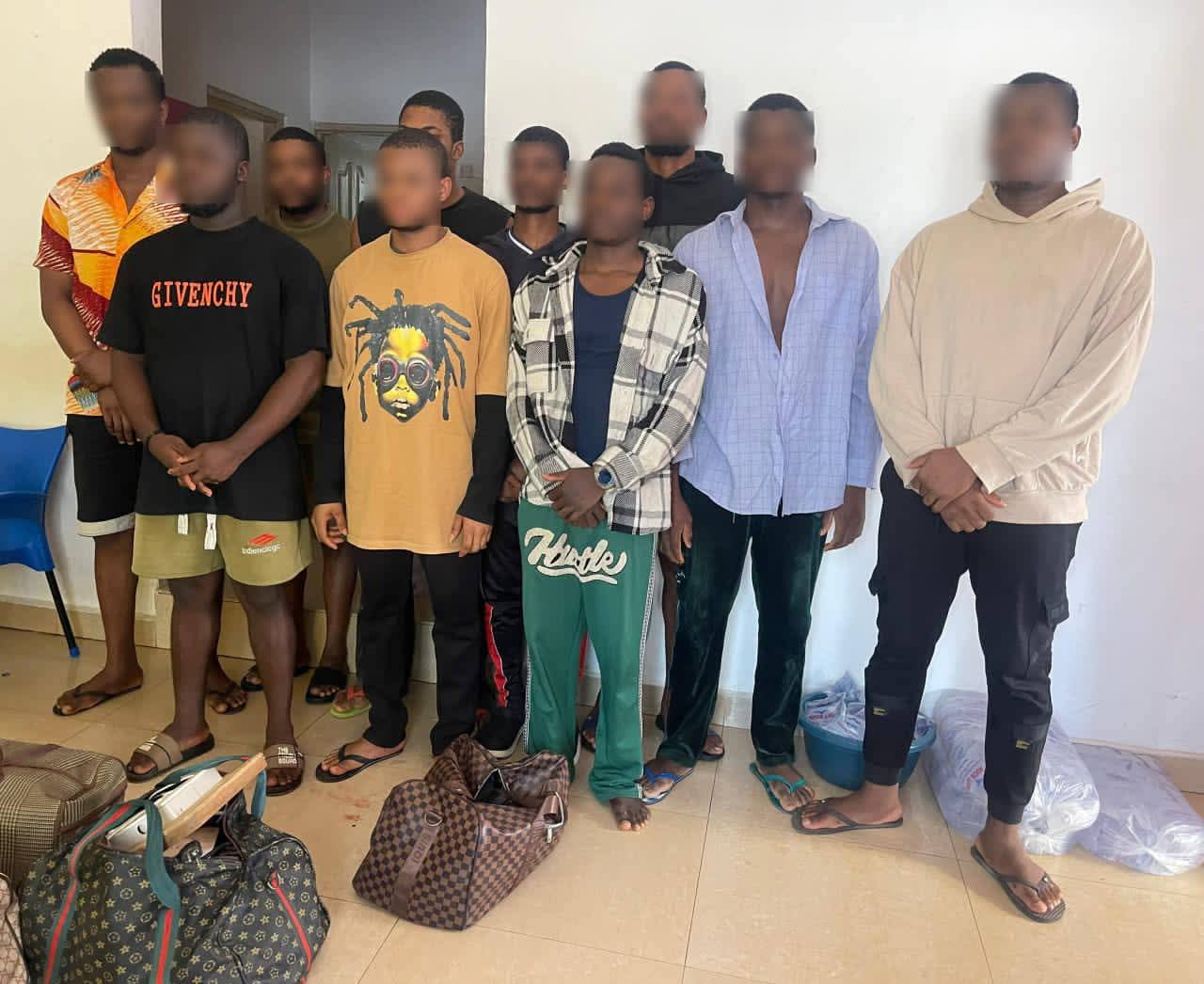
A joint operation by the IGP’s Cyber Vetting and Enforcement Team, the Surveillance Unit from the Criminal Investigations Department (CID) Headquarters and the Ghana Immigration Service (GIS) has led to the arrest of twelve Nigerian nationals suspected to be involved in organised cyber fraud and human trafficking-related activities.
The IGP’s Cyber Vetting and Enforcement Team, in a statement on Friday, said six other suspected Nigerian nationals are currently at large for illegal migration-related offences contrary to the laws of the Republic of Ghana.Nigerian Culture Showcase
The targeted operation which took place on Thursday, March 12, 2026, was led by Deputy Superintendent of Police (DSP) Mr Malaika Jibril Alhassan, from the Police Headquarters and Superintendent Mr Francis Baidoo, from the Amasaman Sector Command of GIS.
A search conducted at the premises led to the retrieval of the following suspected cybercrime tools including twenty-five laptop computers and seven mobile phones.
During the operation, the suspects attempted to obstruct enforcement by releasing German Shepherd dogs against the officers.
Consequently, reinforcement from the Cyber Vetting and Enforcement Team and the Surveillance Unit from the CID Headquarters helped ensure smooth operation.
Preliminary investigations indicate the suspects were engaged in the following offences: Internet Fraud (Online Scams), Identity Theft, Email and Phishing Fraud, Mobile Money (MoMo) Fraud, Cyber Extortion and Blackmail, Credit Card and ATM Fraud and Electronic Forgery.
The offences identified fall under the following legal instruments:
“The operation demonstrates the growing nexus between cybercrime networks and transnational migration activities,” the statement read.
“Effective intelligence gathering and inter-agency collaboration between the Ghana Police Service and the GIS remain critical in disrupting such criminal enterprises.
“The Ghana Police Service remains committed to intelligence-led operations, inter-agency coordination and collaboration and strict application of the law to safeguard national security and maintain the integrity of Ghana’s digital and migration space.”
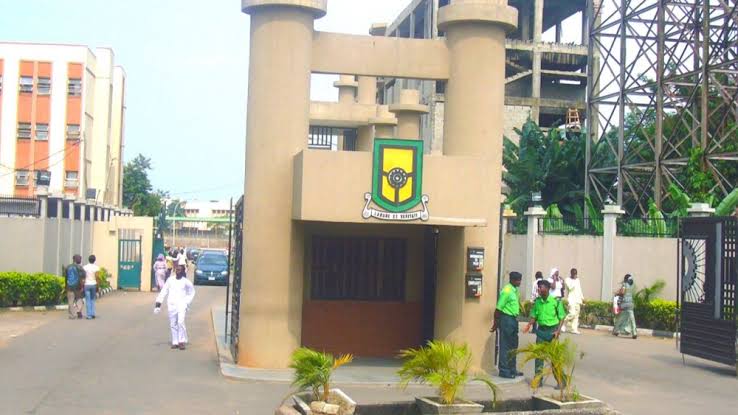
A yet-to-be-identified man has been shot dead by two suspected assailants near the back gate of the Yaba College of Technology in Lagos State.
PUNCH Metro learnt that the incident occurred on Saturday evening while the victim was riding a motorcycle in the area.
A community source, who spoke on condition of anonymity because of the sensitive nature of the incident, said the assailants crossed the victim’s path before opening fire on him.
“The incident happened in the evening, and the attack was sudden. He was on a motorcycle when two masked men emerged from nowhere, shot him and fled the scene,” the source said.
A police source told our correspondent on Sunday that an investigation had commenced to establish the circumstances surrounding the killing and identify those responsible.
“We received information about the incident and are working to establish what happened and identify those responsible. Although there are indications that the shooting is cult-related,” the source said.
The police source added that the deceased’s remains had been deposited in a morgue.
The state Police Public Relations Officer, Abimbola Adebisi, said she was not aware of the incident but promised to provide an update.
However, she had yet to do so as of the time this report was filed.
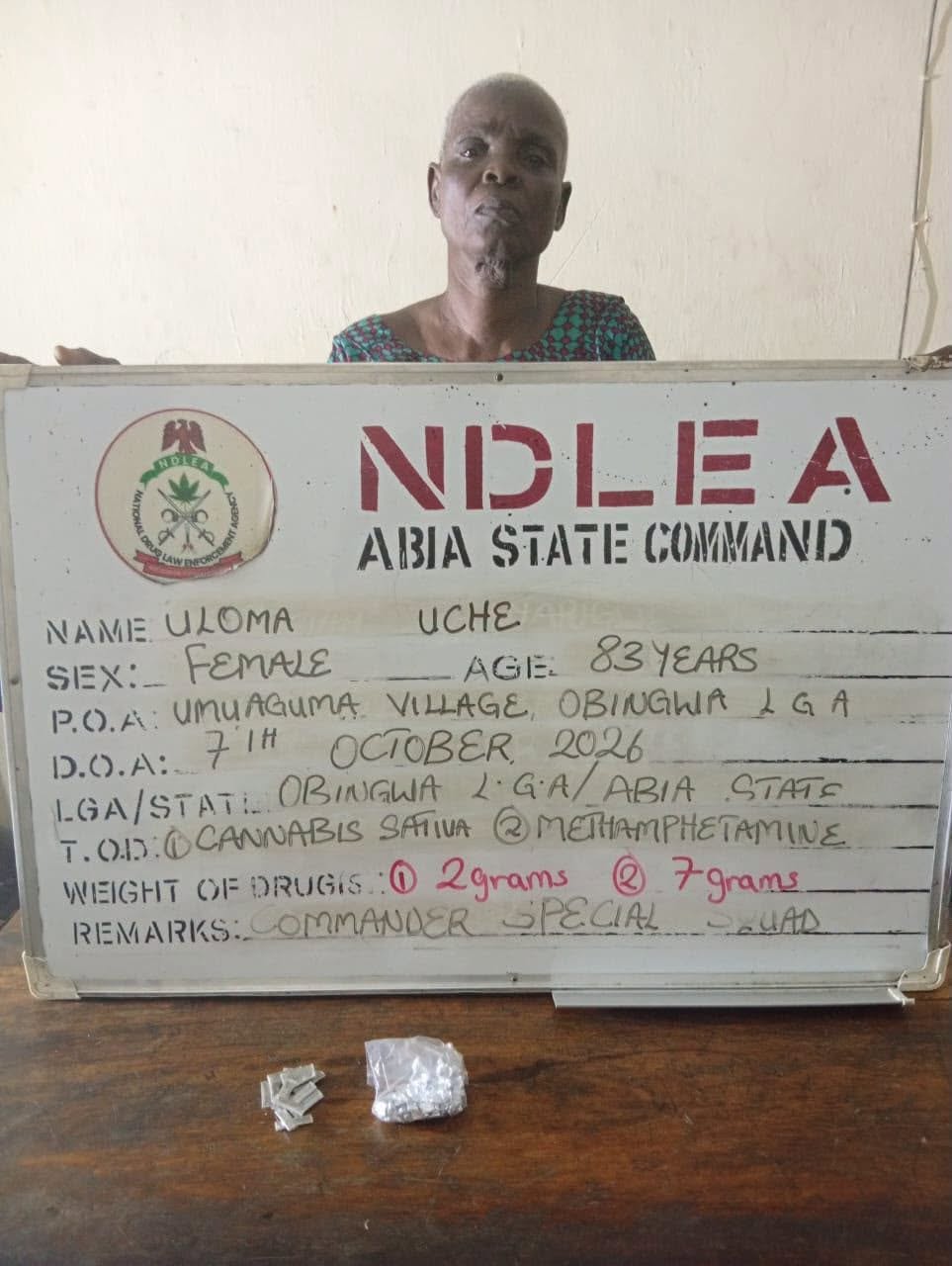
The National Drug Law Enforcement Agency (NDLEA), has rearrested an 83-year-old woman, Uloma Uchechi Sunday for alleged drug trafficking, barely a year after she was convicted for a similar offence.
The octogenarian was arrested on Wednesday, October 7, at her residence in Ite-Uzo, Umuaguma, Obingwa Local Government Area of Abia State, with quantities of methamphetamine and Colorado, a synthetic cannabinoid, allegedly tied around her waist with a wrapper.
According to the NDLEA, her arrest followed intelligence reports indicating that she operated a drug joint where criminal elements allegedly gathered.
The agency said Uloma was first arrested on May 17, 2025, alongside her 32-year-old daughter, Chisom Uchechi, at the same residence. See here
The two women were found with 50 grammes of methamphetamine, 522 grammes of skunk, 260 grammes of fresh cannabis leaves and 12 grammes of tramadol.
They pleaded guilty and were sentenced to 12 months’ imprisonment or a fine of N200,000 each. They opted to pay the fines and were released.
NDLEA spokesperson Femi Babafemi said the latest arrest was among a series of operations conducted by NDLEA operatives across several states, resulting in the seizure of large consignments of illicit drugs, the arrest of suspected traffickers and the recovery of firearms and ammunition in Plateau State.
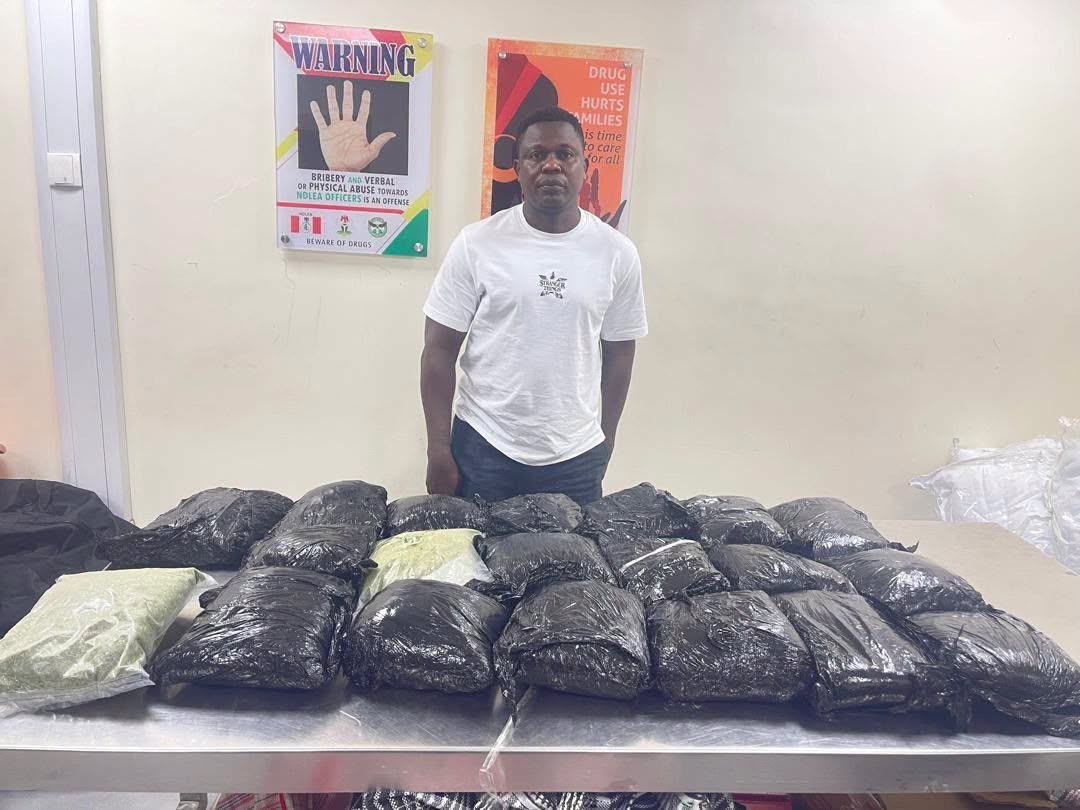
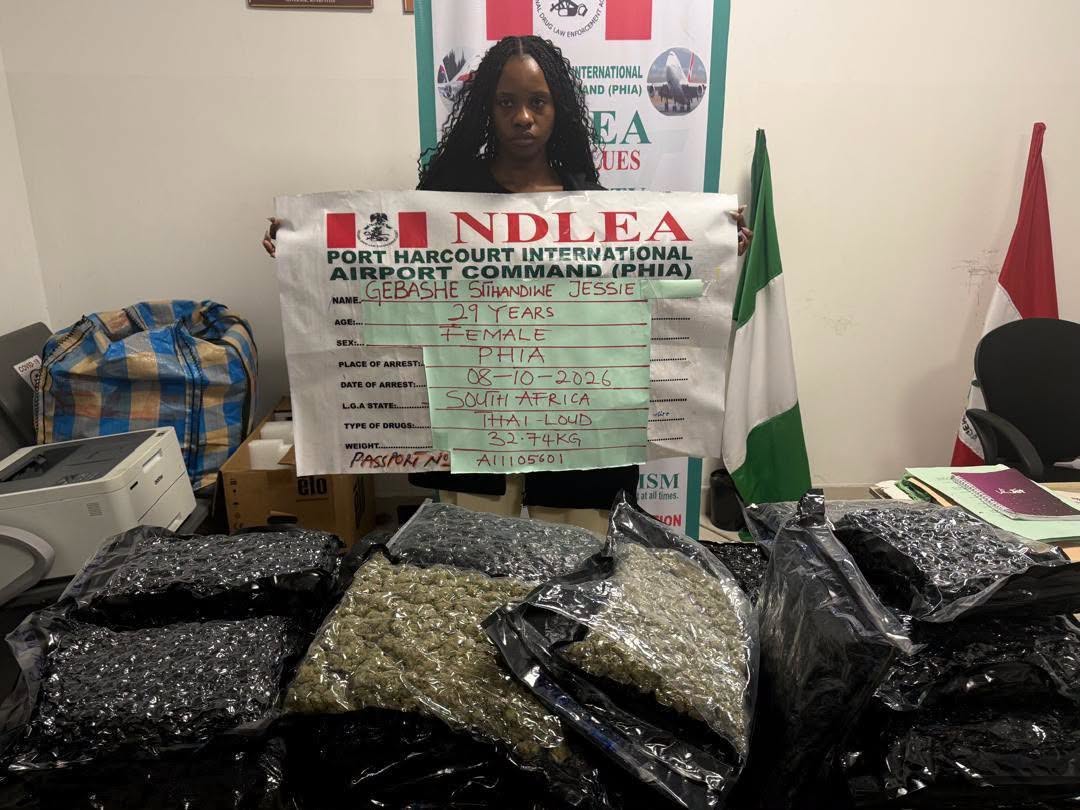
In a related operation, operatives at the Port Harcourt International Airport, Omagwa, Rivers State, arrested a South African national, Gebashe Sithandiwe Jessie, over the alleged importation of 32.74 kilogrammes of Thai Loud, a potent cannabis strain.
The suspect was intercepted with 30 parcels of the substance concealed in two travelling bags after arriving from Thailand through Doha aboard a Qatar Airways flight.
The NDLEA said she admitted to previously trafficking drugs through other African countries and attempting to expand her operations to Port Harcourt.
At the Murtala Muhammed International Airport, Ikeja, Lagos, NDLEA operatives intercepted 354,000 tablets of Tapentadol, each weighing 250mg, in a shipment from Pakistan.
The consignment, weighing 307.20 kilogrammes, arrived aboard a Royal Air Maroc flight on September 29 and was placed under surveillance.
A joint examination of the nine cartons on October 6 uncovered the pharmaceutical drugs.
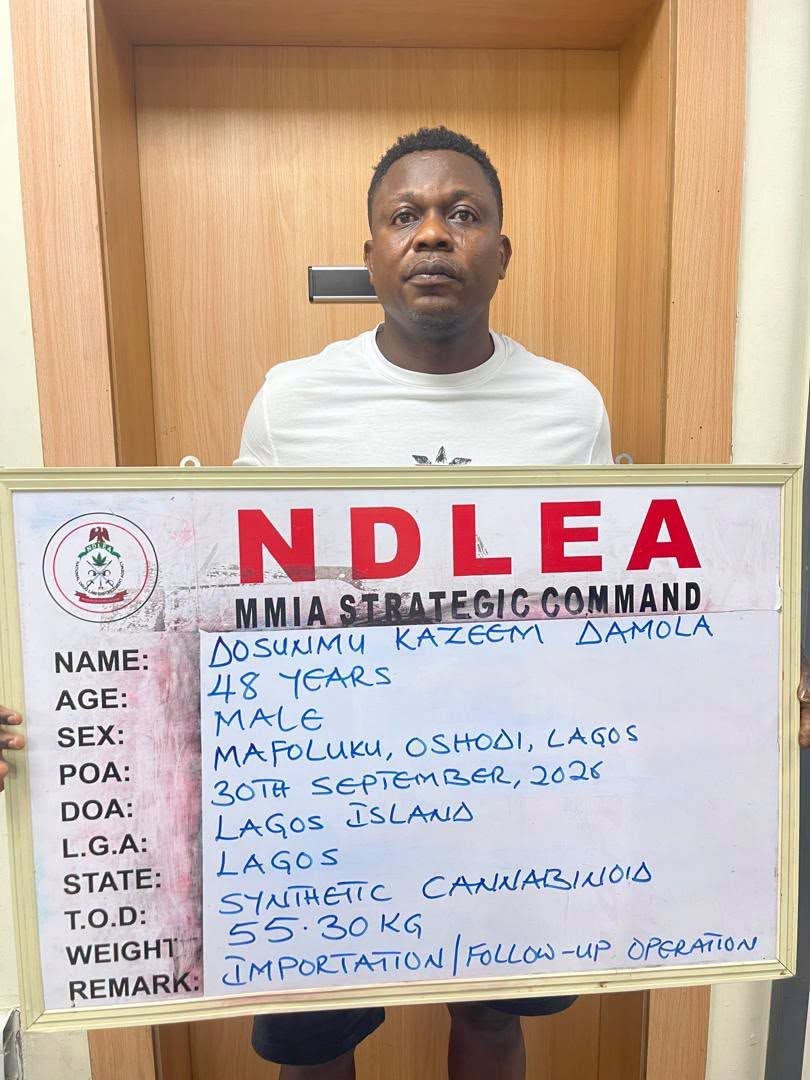
In another operation at the Lagos airport, operatives intercepted 70 parcels of Colorado weighing 75.90 kilogrammes in six Ghana-Must-Go bags contained in a consolidated cargo shipment from the United Kingdom.
The shipment arrived on September 29, after which the agency began monitoring the consignment.
A clearing agent, John Edrah, 54, was arrested on September 30. Other suspects subsequently arrested were Taofiq Ajibola, 54, an Uber driver; Adetunji Adebayo; and Kazeem Damola Dosunmu, 48, a clothing trader.
According to the NDLEA, Ajibola was arrested while attempting to collect one of the bags at a logistics company in the Mafoluku area of Oshodi, while Adebayo and Dosunmu were apprehended when they arrived to collect the remaining five bags.
The agency said Ajibola identified a UK-based associate, Lukman Sa’idu, as the sender of his consignment, while Dosunmu attributed his own shipment to another UK-based individual identified as Yusuf.
Over Two Tonnes of Cannabis Seized in Cross River, Edo, Ondo
In Cross River State, NDLEA operatives, acting on intelligence, raided Iyala Nkun village in Ikom Local Government Area on Sunday, October 4, arresting a 46-year-old suspect, Adama Inuwa.
The operation led to the recovery of 181 bags of cannabis weighing 1,100 kilogrammes and 17.15 kilogrammes of cannabis seeds.
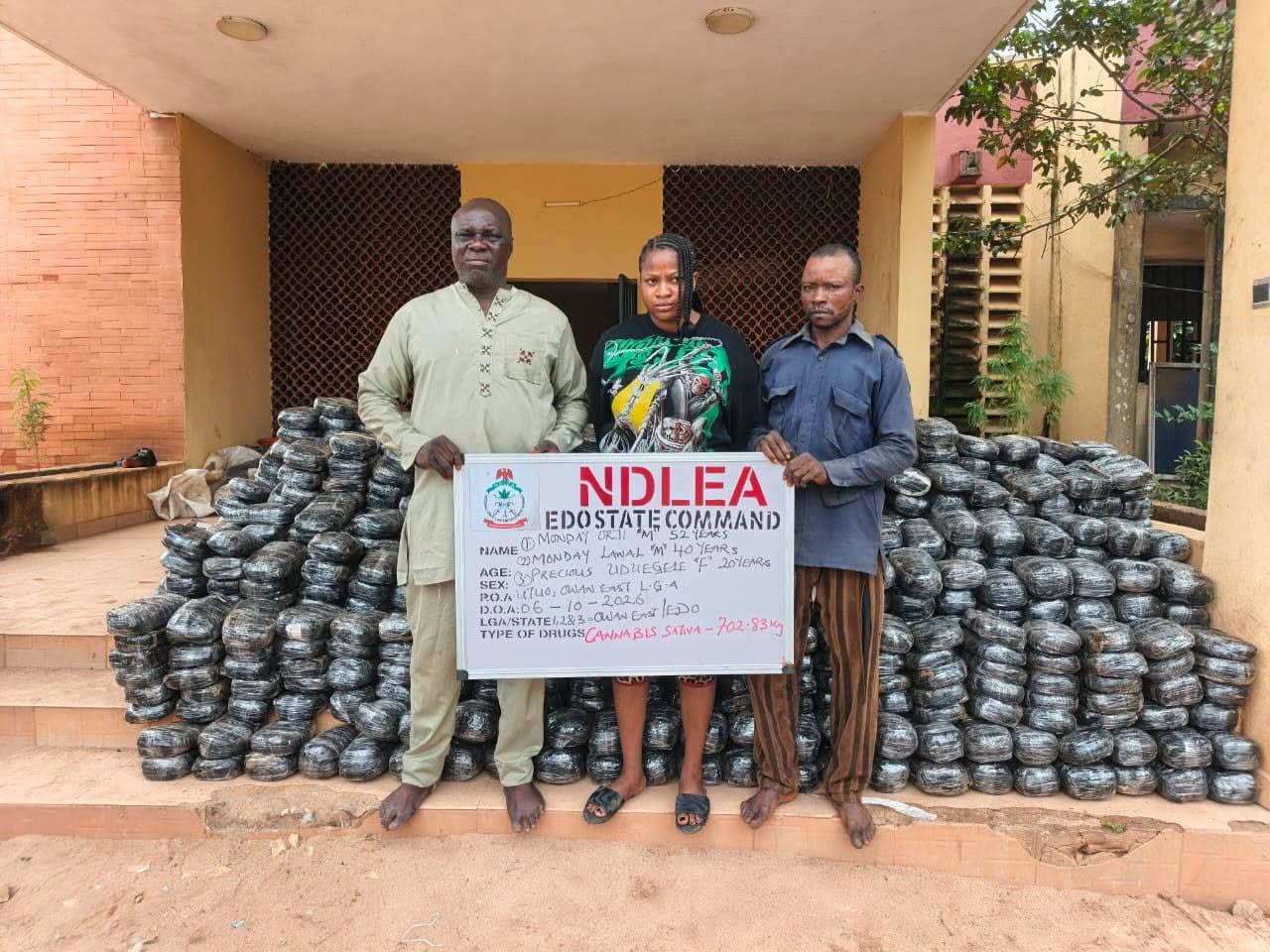
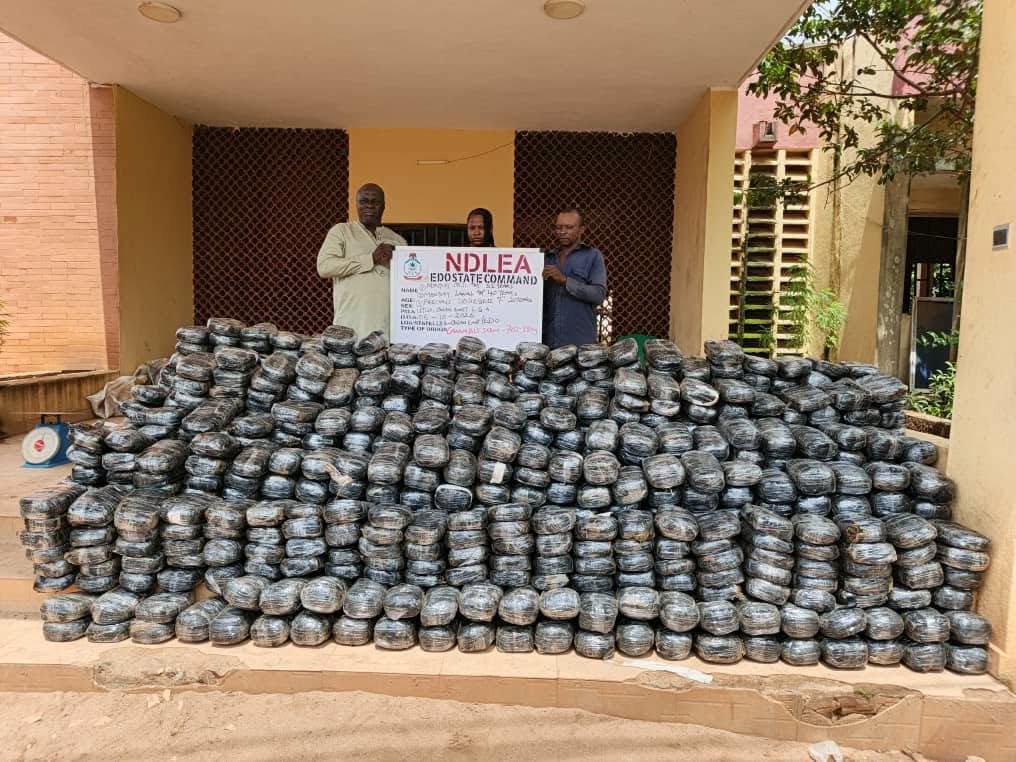
In Edo State, operatives intercepted a black Toyota Camry at Otuo, Owan East Local Government Area, on October 5.
The vehicle was allegedly conveying 1,049 blocks of compressed cannabis weighing 702.83 kilogrammes.
Three suspects — Monday Orji, 52; Monday Lawal, 40; and Precious Uduegele, 20 — were arrested in connection with the seizure.
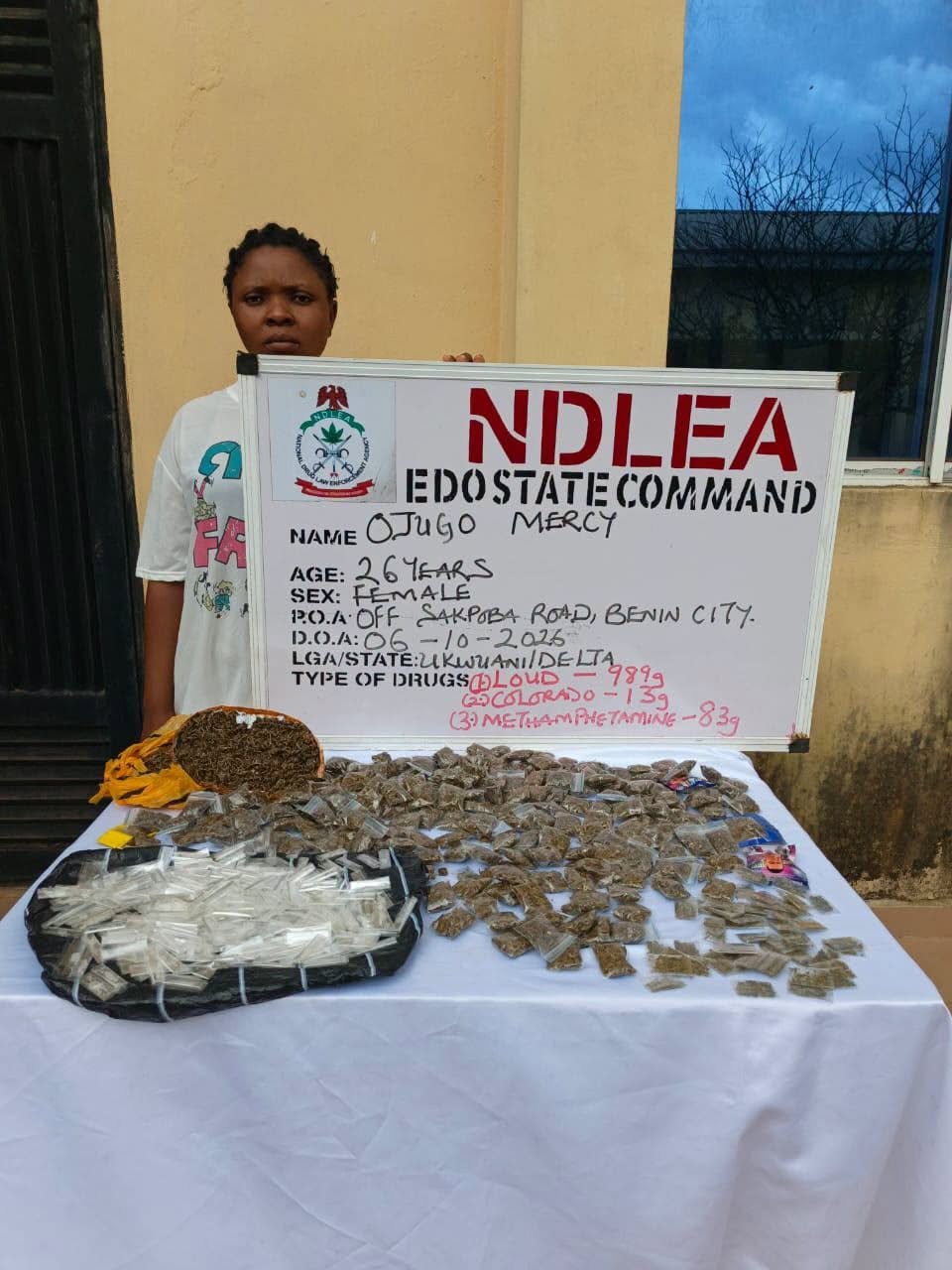
In a separate operation in Benin City, operatives arrested Ojugo Mercy, 26, at Asoro, off Sakponba Road, with 989 grammes of Loud, 13 grammes of Colorado and 83 grammes of methamphetamine.
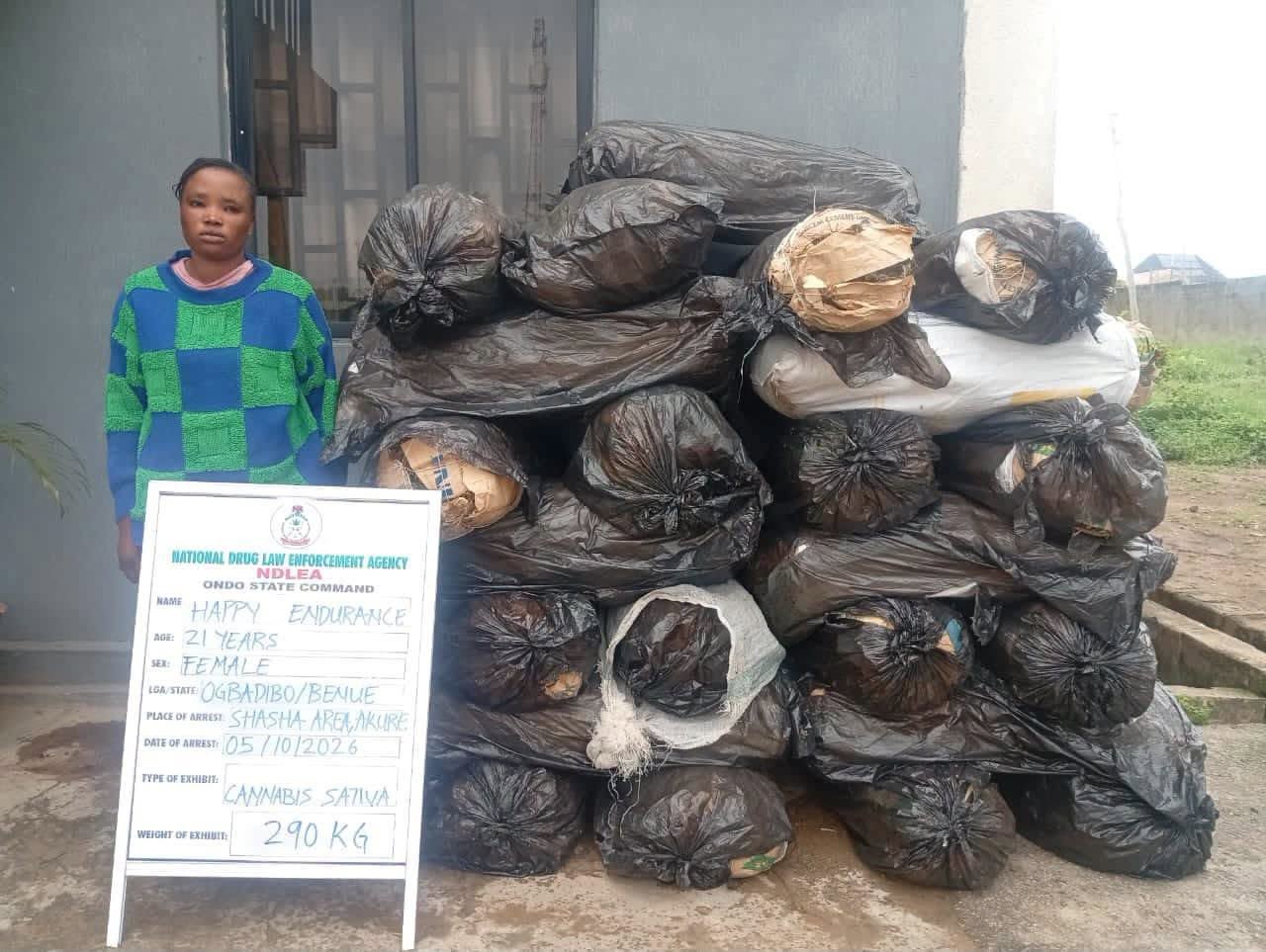
In Ondo State, a 21-year-old suspect, Happy Endurance, was arrested at her hideout in the Shasha area of Akure on October 5, following surveillance by NDLEA operatives.
The operation led to the recovery of 29 bags of cannabis weighing 290 kilogrammes.
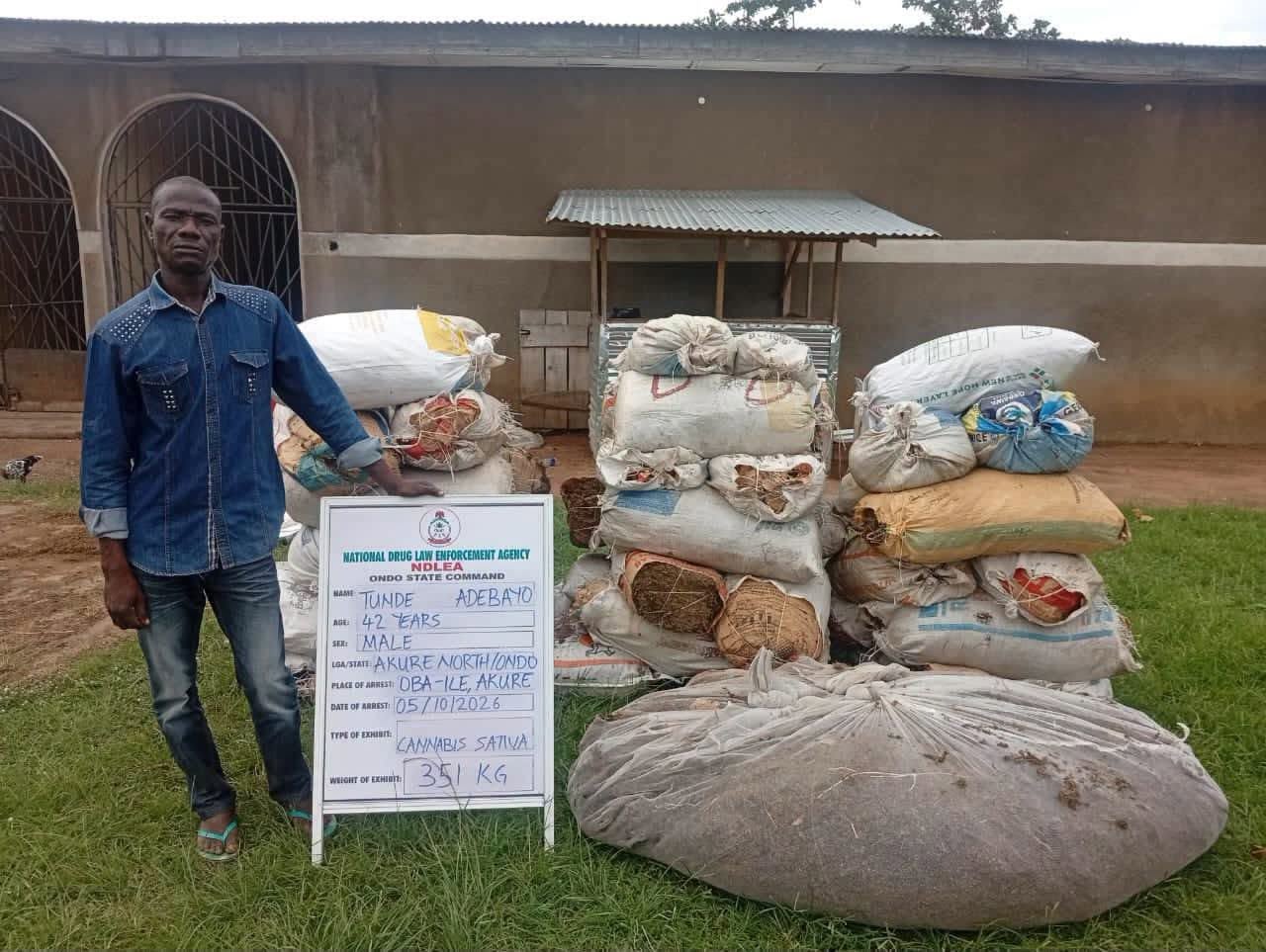
On the same day, another raid at an apartment in Oba-Ile, Akure, resulted in the arrest of Tunde Adebayo, 42, with 35 bags of cannabis weighing 351 kilogrammes.
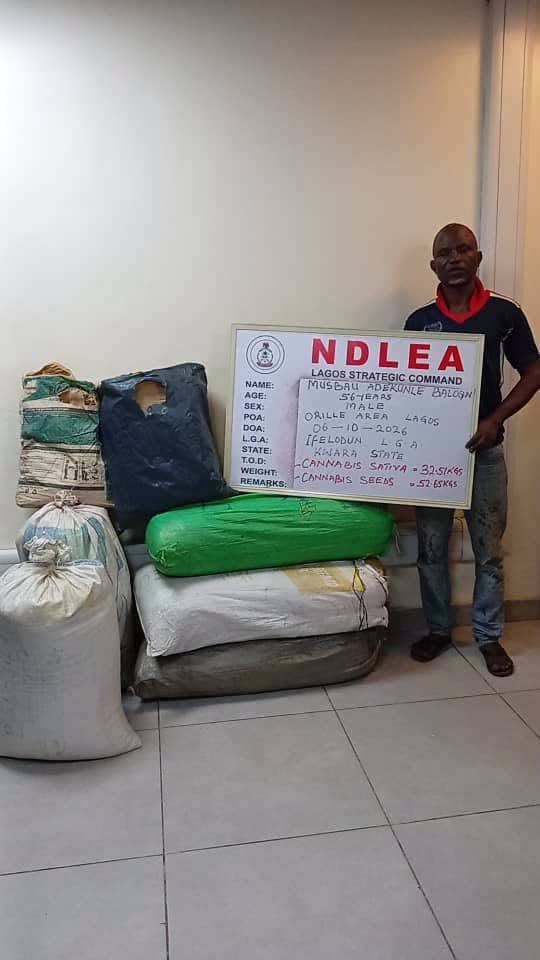
In Orile, Lagos, operatives on October 6 arrested Musbau Balogun Adekunle with 32.51 kilogrammes of skunk and 52.65 kilogrammes of cannabis seeds, bringing the total seizure to 85.16 kilogrammes.
Tramadol, Diazepam Seized in Taraba, Kano
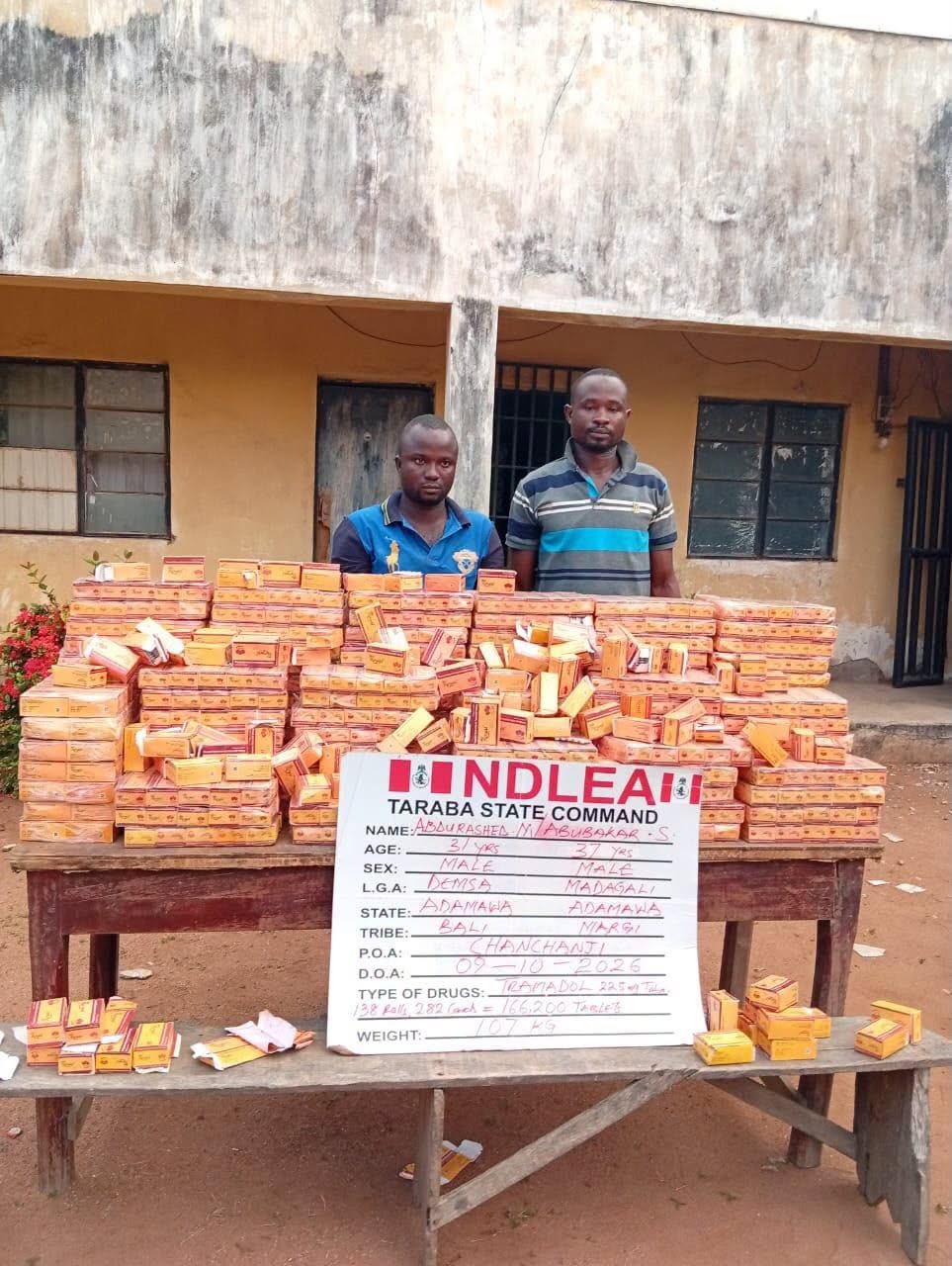
In Taraba State, NDLEA operatives, supported by soldiers, arrested Abdulrasheed Mohamed, 31, and Abubakar Saidu, 37, at Chanchanji village in Wukari Local Government Area on Friday, October 9.
The suspects were allegedly found with 166,200 tablets of tramadol, each weighing 225mg, with a combined weight of 107 kilogrammes.
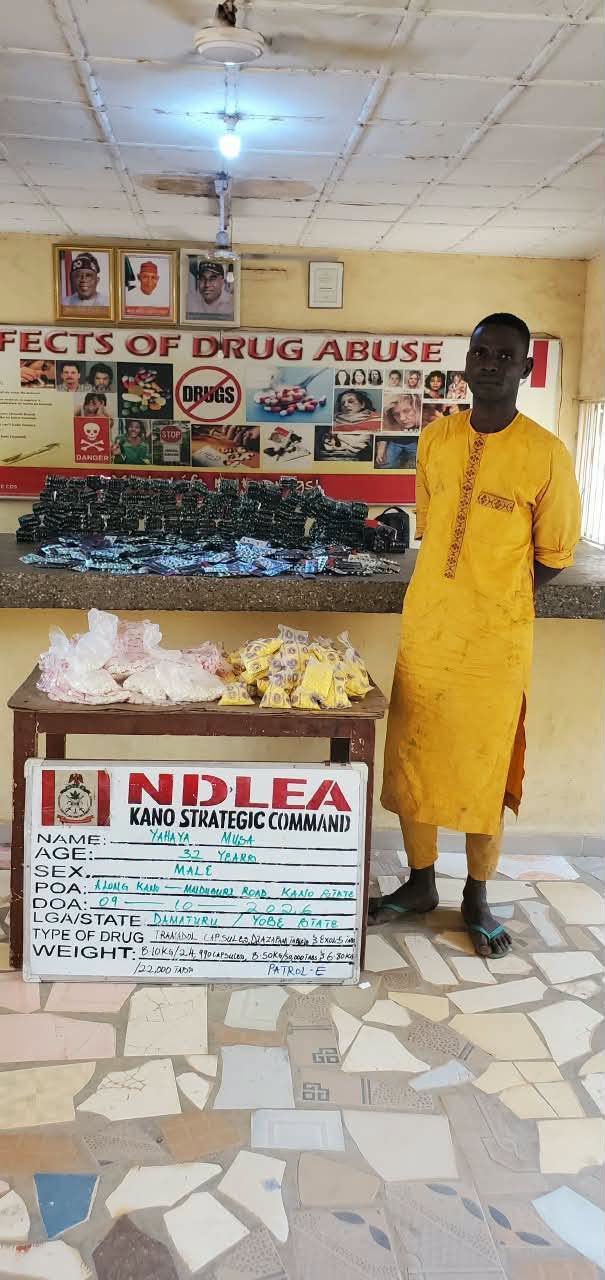
In Kano State, a stop-and-search operation along the Kano-Maiduguri Road on the same day led to the arrest of Yahaya Musa, 32.
The agency said 24,990 capsules of tramadol, 50,000 tablets of diazepam and 22,000 tablets of Exol-5 were recovered from him.
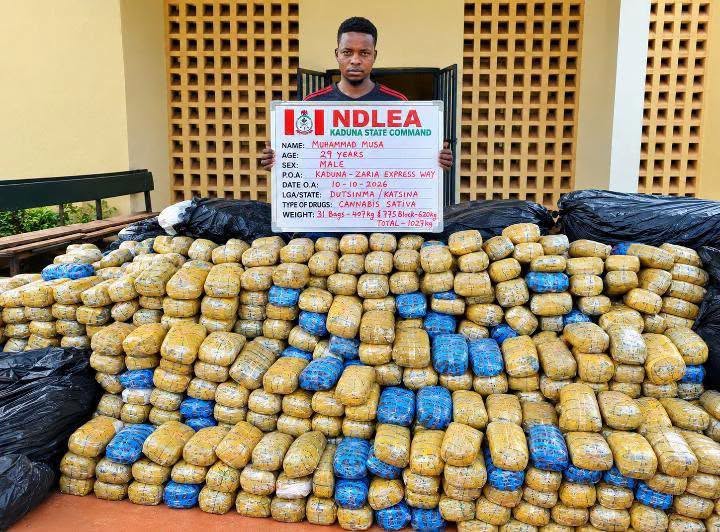
In Kaduna State, operatives on patrol along the Zaria-Kaduna Expressway arrested Mohammed Musa, 29, with 31 jumbo bags and 775 blocks of skunk weighing a combined 1,027 kilogrammes.
Rifles, Ammunition Recovered in Plateau
Meanwhile, NDLEA operatives recovered firearms and ammunition during a raid on the residence of Christian Chukwudi Uju, 45, at Rukuba Road, Jos, Plateau State, on Thursday, October 8.
The agency said the suspect was found with 47 grammes of methamphetamine, two pump-action rifles, one locally made gun, 199 live cartridges, five rounds of 7.62mm ammunition and one round of 9mm ammunition.
The recovery adds a firearms dimension to the series of drug-related operations carried out by the agency during the period.
Rifles, Ammunition Recovered in Plateau
Beyond the arrests and seizures, the agency said its commands and formations continued public enlightenment activities under its War Against Drug Abuse (WADA) campaign.
The sensitisation exercises were conducted in schools and communities across Oyo, Ebonyi, Niger, Kano, Lagos and Ogun states, among other locations.
Beneficiaries included students and staff of Progressive Grammar School, Tede, Oyo State; Ehugbo Technical College, Afikpo, Ebonyi State; Baptist High School, Lambata, Niger State; and Ipara Senior and Junior Community Secondary School, Badagry, Lagos State.
Other institutions reached included Madarasatul Tarbiyatul Islamiya in Tudun Wada, Kano State, and Manbahu Ridwanullah Nursery and Primary School in Olomore, Abeokuta, Ogun State.
Speaking on the operations, NDLEA chairman and chief executive officer, Brig. Gen. Mohamed Marwa (retd.), commended personnel of the Lagos, Murtala Muhammed International Airport, Port Harcourt International Airport, Taraba, Kano, Kaduna, Edo, Cross River, Ondo and Plateau commands.
Marwa urged officers across the country to sustain what he described as a balanced approach to drug control, combining intelligence-led enforcement with public education and preventive measures.
The agency said the operations formed part of its ongoing efforts to disrupt drug trafficking networks, intercept illicit substances and reduce the circulation of dangerous drugs across the country.
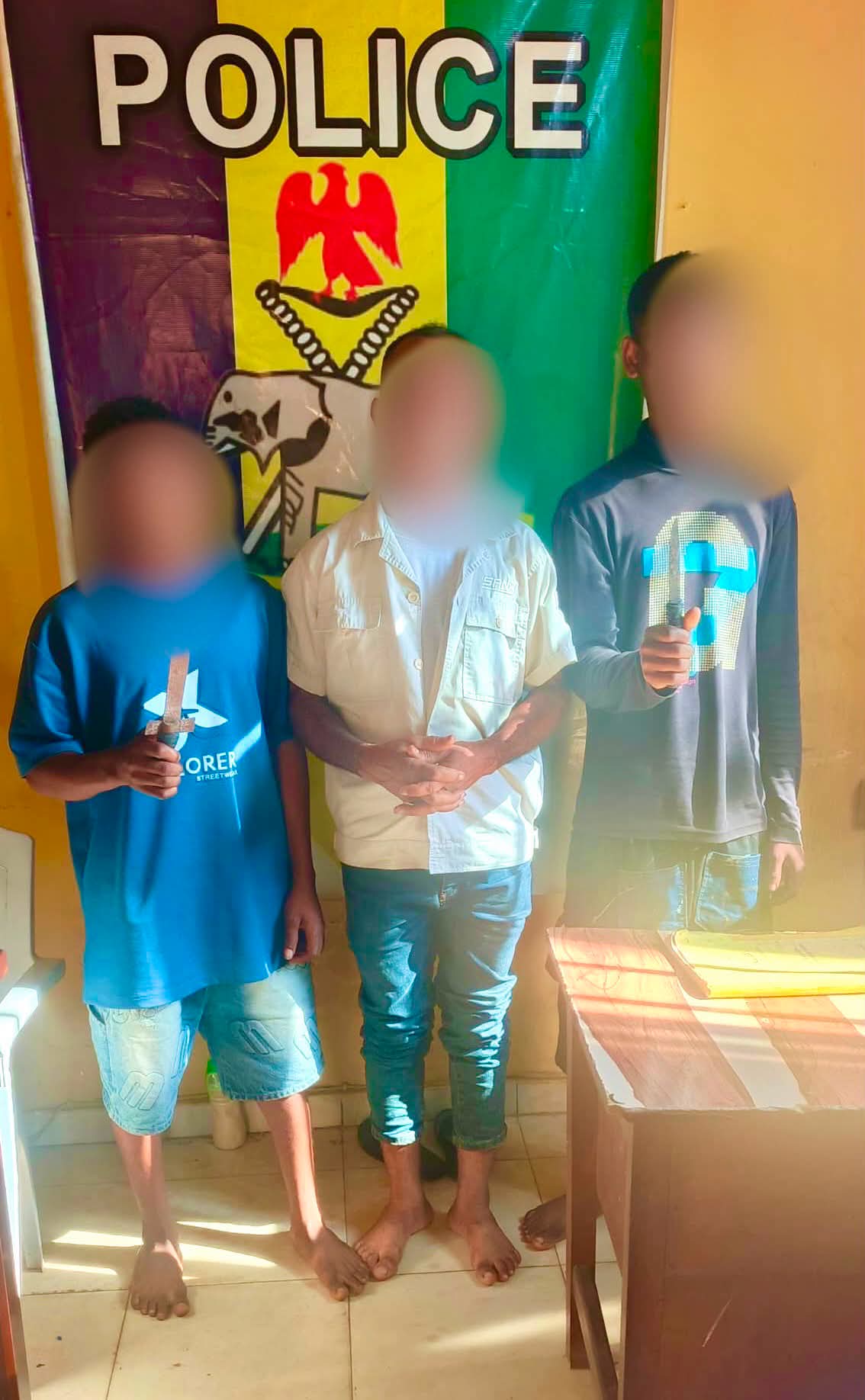
The Abia State Police Command has arrested three suspected kidnappers and rescued an 18-year-old victim, Ifeoma Obinna, in Umuimo Community, Osisioma Ngwa.
The spokesperson for the command, DSP Maureen Chioma Chinaka, disclosed this in a statement on Thursday, 8th October 2026.
According to the PPRO, the suspects, Chidozie Rainbow Hezekiah,65, Brave Rainbow, 21, Innocent Otodirichu,21, abducted the victim and demanded N5m ransom from her mother.
Chinada added that two daggers and the victim’s phone were recovered while efforts are ongoing to apprehend other members of the gang.
“Sequel to a distress call received at the Anti-Kidnapping Unit on 04/10/2026, that an unknown caller called Mrs. Obinna and demanded the sum of N5,000,000 (Five Million Naira) if they wanted to see their missing daughter,” the statement read.
“Leveraging on actionable intelligence, the above suspects were apprehended by the Anti-Kidnapping Unit, Abia State Command, in Umuimo Community, Osisioma Ngwa.
“The victim was rescued and exhibits recovered, while efforts are ongoing to apprehend other gang members of the syndicate.
“The Commissioner of Police, Abia State Command, CP Wilfred Olutokunbo Afolabi, reiterates the Command’s commitment to combating kidnapping and other forms of criminality in the state.
“He further assures members of the public that the Command will continue to leverage actionable intelligence, community partnerships, and other operational strategies to ensure the safety and security of residents.
“Members of the public are therefore encouraged to remain vigilant and provide the Police with useful information by reporting to the nearest police station or contacting the Command through its dedicated hotlines.