Connect with us

Lifestyle

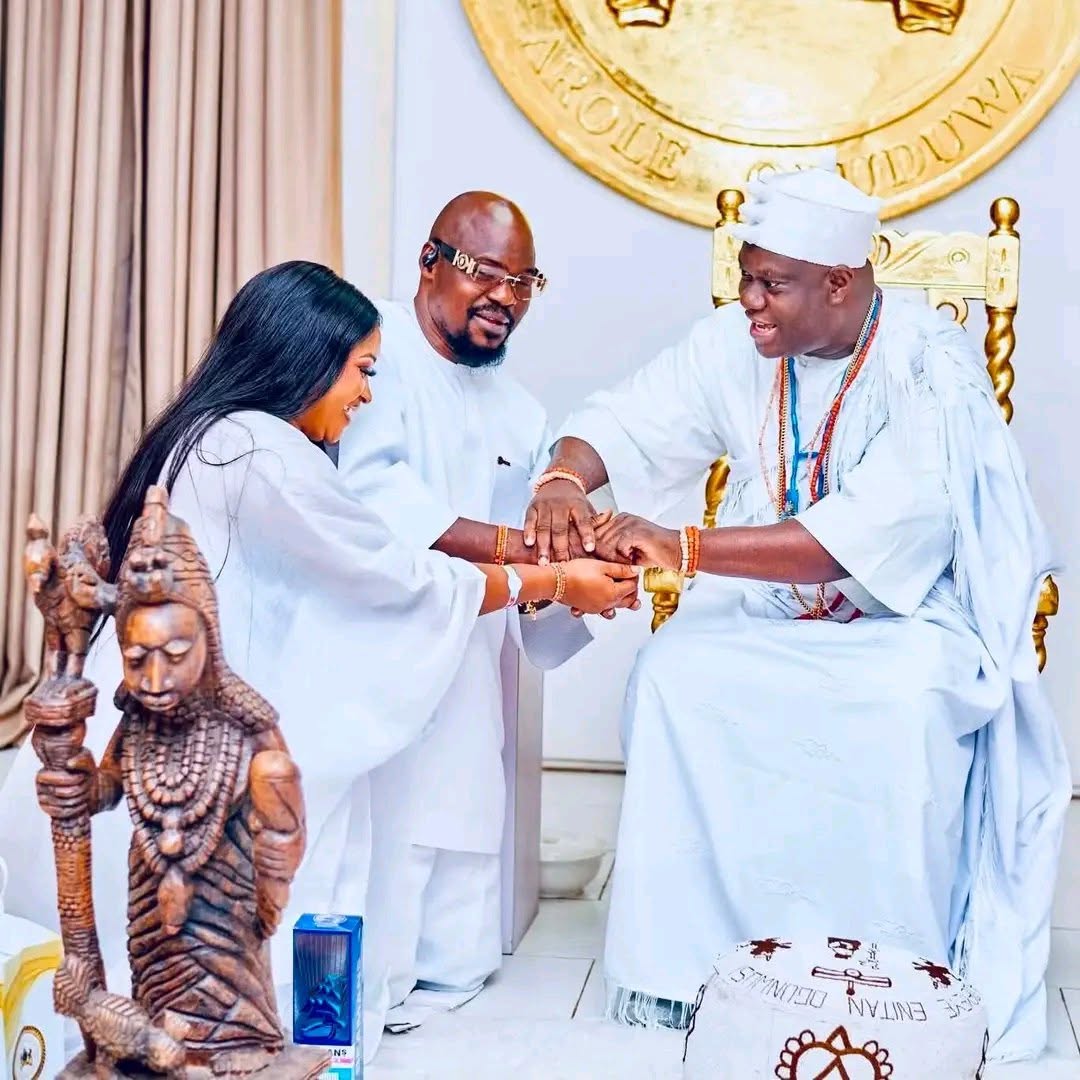
PHOTOS: Baba Ijesha says Ooni of Ife presented him with new car, gifts, chieftaincy title after son’s birth

Published

on

Nollywood actor James Olarenwaju, popularly known as Baba Ijesha, has disclosed that the Ooni of Ife, Oba Adeyeye Ogunwusi, honoured him with a brand-new car, luxury gifts and a traditional title following the birth of his son.

The actor made the announcement in a Facebook post on Thursday, where he publicly thanked the revered monarch for what he described as an overwhelming show of kindness and acceptance extended to him and his wife, fashion designer Abiodun Tokunbo, popularly known as Luminee.

Expressing appreciation to the Ooni, Baba Ijesha said the reception he and his family received in Ile-Ife exceeded their expectations.

“My deepest gratitude to His Imperial Majesty, Ooni of Ife. Baba, thank you for the royal welcome, fatherly love, and the confidence you gave my wife Afolashade Omiyinka and I,” Baba Ijesha wrote.

He further revealed that the monarch presented him with several gifts, including a new vehicle, and also conferred on him the traditional title of Baba Awada Konge Oduwa.

Read also: Appeal Court rules UI International School can enforce ban on hijab

“For the luxurious gifts you blessed us with, and the brand new car — I am truly humbled. As a son of the soil. I’m also honoured by the chieftaincy title Baba Awada Konge Oduwa. Ile Ife, Ile Oodua! … ATI IJOYE PELU GBOGBO OMO ILE IFE THANK YOU SIR/MA.”

The latest development comes only weeks after Baba Ijesha and Luminee attracted significant attention on social media with the announcement of the arrival of their baby boy.

See also  The History of the Awori Clan – First Settlers in Lagos

News of the child’s birth gained widespread attention on June 15, 2026, generating congratulatory messages as well as mixed reactions from members of the public.

Two days earlier, on June 13, Luminee had shared a post revealing that she had given birth to a son without identifying the child’s father. She subsequently posted maternity photographs featuring herself and Baba Ijesha, effectively confirming their relationship and prompting an outpouring of reactions from fans, colleagues and well-wishers.

Baba Ijesha returned to public life after regaining his freedom in November 2025, having completed a three-year prison sentence following his conviction for indecent treatment of a child and sexual assault of a minor.

FOLLOW US ON:

FACEBOOK

TWITTER

PINTEREST

TIKTOK

YOUTUBE

LINKEDIN

INSTAGRAM

Continue Reading
Click to comment

Leave a Reply

Your email address will not be published. Required fields are marked *

Lifestyle

Flood waters submerge homes, disrupt power supply in Lagos

Published

on

Flood waters swept through several communities in Lagos State on Tuesday following hours of heavy rainfall, submerging homes and roads, disrupting movement and knocking out electricity in parts of the state after critical transmission facilities were affected.

Videos obtained by PUNCH Metro showed flooded streets in FESTAC, Gbagada, Evans, Olushi, Anikantamo and Adeniji Adele on the Lagos Island, with residents wading through waterlogged roads and motorists struggling to navigate submerged streets.

Correspondents who monitored the situation in Ikeja observed that floodwaters entered several homes and shops, forcing some residents to temporarily relocate over fears of worsening conditions.

The flooding, worsened by blocked drains filled with plastic waste and inadequate drainage infrastructure, left many roads submerged in knee-deep water.

A resident of Ikeja, Abidemi Raji, blamed the flooding on the poor road design and blocked drainage channels.

“The way the road was constructed contributes to the flooding. Although there is a drainage channel, it usually takes between 30 minutes and one hour after the rain stops before the water recedes because of the volume of water,” he said.

Raji alleged that a drainage channel linking the area to another street had been blocked after a hotel was built.

“There is supposed to be a channel connecting this compound to the next street, but the back passage was blocked after the hotel was built. That has worsened the flooding,” he added.

The downpour also submerged several streets in the Festac area of Amuwo-Odofin Local Government Area, disrupting movement and leaving residents and motorists stranded.

See also  Funke Akindele makes history with ‘Behind The Scenes’ see details

A video shared by Lagos Reporters on X showed floodwaters covering major roads and inner streets, forcing pedestrians to wade through water while motorists struggled to move.

A resident, Okeke Mmesoma, described the flooding as a recurring challenge.

“Anytime it rains heavily, this place gets flooded. It is usually after the rain stops that the water begins to clear. My shoes were soaked this morning on my way to work,” she said.

She added that many motorists avoided the flooded roads to prevent their vehicles from breaking down, while commuters stayed away to avoid getting drenched.

Flooding was also reported in Ajah, while roads around Adeniji Adele, Evans, Olushi and Anikantamo on Lagos Island were inundated.

The heavy rainfall also caused electricity outages after floodwaters damaged facilities at the Oworo 132/33kV Transmission Station.

In a public notice issued on Tuesday, Ikeja Electric said severe flooding at the station affected two power transformers and several 33kV feeders.

The affected feeders include Oworo Injection Substations 1 and 2, serving Ladilak, Bariga, Araromi, Oworo, Pedro, GTB, Alapere, Agboyi, Araba, Hospital and Gbagada.

The electricity distribution company said it was working with the Transmission Company of Nigeria to restore supply as soon as the damaged facilities were returned to service.

The flooding also affected neighbouring Ogun State, where residents of Gloryland Estate in Ibafo appealed to the state government to urgently intervene.

Residents said the flooding had damaged buildings, disrupted movement and forced some families to temporarily vacate their homes during the rainy season.

A member of the Community Development Association, Oladipupo Awoyemi, blamed the flooding on blocked drainage channels linked to the Lagos-Ibadan Expressway.

See also  No other country sees daily killings like Nigeria – Kukah

“Whenever it rains continuously for two or three days, the whole community becomes flooded. We have reported the blocked drainage channels several times, but the problem remains unresolved,” he said.

Awoyemi added that indiscriminate construction and refuse dumping had further obstructed waterways.

“Years ago, the flooding was not this severe because water flowed freely. Today, many canals have been blocked by buildings and factories, while refuse dumped into the drains has made the situation worse,” he said.

According to him, the annual flooding has damaged buildings, disrupted economic activities and exposed residents to health risks.

“It affects everybody. People cannot use the roads freely, vehicles are forced to take longer routes, and some residents have to leave their homes whenever the flooding becomes severe,” he added.

Meanwhile, Lagos State Governor Babajide Sanwo-Olu has approved the dredging of 28 additional primary drainage channels to improve flood control across the state.

The Commissioner for the Environment and Water Resources, Tokunbo Wahab, disclosed this in a statement issued on Tuesday by the ministry’s spokesperson, Kunle Adeshina.

Wahab described Tuesday’s downpour as an extreme weather event that overwhelmed drainage infrastructure, resulting in temporary flooding in Victoria Island, Lekki, Ikeja, Gbagada, Mushin, Mafoluku and several other communities.

He explained that Lagos’ unique coastal geography, with its network of lagoons, rivers and tidal water bodies, naturally slows the discharge of stormwater into the sea during high tide, making temporary flooding inevitable after exceptionally heavy rainfall.

The commissioner assured residents that the government was closely monitoring drainage infrastructure and flood-prone locations while emergency response agencies remained on the ground to support affected communities.

See also  The History of the Awori Clan – First Settlers in Lagos

He also urged residents to stop dumping refuse into drainage channels, desist from illegal reclamation of wetlands and avoid building on drainage alignments, warning that such practices worsen flooding.

Wahab advised motorists to avoid driving through flooded roads during heavy rainfall and urged residents, particularly those in flood-prone areas, to comply with weather advisories and safety guidelines issued by relevant authorities.

punch.ng

FOLLOW US ON:

FACEBOOK

TWITTER

PINTEREST

TIKTOK

YOUTUBE

LINKEDIN

Continue Reading

Lifestyle

Adeboye, Oyedepo seek stronger US support against terrorism

Published

on

The General Overseer of The Redeemed Christian Church of God, Pastor Enoch Adeboye, and the Presiding Bishop of Winners’ Chapel, David Oyedepo, have called for stronger United States support in tackling terrorism in Nigeria, warning that the country is nearing a breaking point due to persistent insecurity.

They stated this at the 2026 Faith Defender Award Gala at the Hilton Garden Inn on Capitol Hill, Washington, D.C., on June 23, according to a press release signed by the President of Save Nigeria Group USA, Stephen Osemwegie.

Adeboye urged the United States and its allies to intensify support for Nigeria in its fight against insecurity, and he made a direct appeal for more international support.

“If you want to help us, help us more. No matter who is in office in Nigeria, only God can help us. Use your influence to help us,” the cleric emphasised.

“Thank God for Trump. He means business,” he added, commending U.S. President Donald Trump’s stance against terrorism, although he noted he did not agree with all of his positions.

In a keynote address delivered on his behalf, Oyedepo painted a grim picture of the situation in Nigeria, describing the country as being “virtually at the brink of collapse” due to unrelenting terrorist attacks and violence.

“My heart bleeds,” he said, while expressing support for proposed U.S legislation aimed at strengthening accountability for terrorism-related atrocities in Nigeria.

Former U.S Ambassador-at-large for International Religious Freedom, Sam Brownback, warned that Nigeria risked violent civil unrest if urgent steps were not taken.

See also  Koffi Idowu-Nuel: Nigeria’s Multi-Talented Comedian, Actor, and Musician

“Nigeria is at a fork in the road. Address this insecurity or face violent civil unrest,” he noted.

Human rights advocate Dr Katrina Swett also called for increased U.S. involvement in protecting religious freedom and supporting victims of extremist violence.

“The future is in the hands of Nigerians, but America has powerful leverage to do more,” she added.

The President of Save Nigeria Group USA, Osemwegie, urged the U.S. Congress to pass the Nigeria Religious Freedom and Accountability Act, noting that it would strengthen accountability for terrorism-related crimes.

The event, themed “Thank You, America,” marked the end of a week-long advocacy campaign that included engagements with U.S. lawmakers aimed at boosting international cooperation against terrorism.

Meanwhile, Trump was honoured at the event with the 2026 Faith Defender Award for what organisers described as his administration’s commitment to promoting religious freedom and combating terrorism globally.

punch.ng

FOLLOW US ON:

FACEBOOK

TWITTER

PINTEREST

TIKTOK

YOUTUBE

LINKEDIN

Continue Reading

Lifestyle

Doctors demand public ranking of govs on healthcare performance

Published

on

Medical doctors have called for the public ranking of governors and states based on health outcomes, saying such a system would promote accountability and encourage greater investment in healthcare delivery.

The physicians argued that assessing state governments using indicators such as maternal and child mortality, immunisation coverage, primary healthcare performance and disease control would provide a clearer picture of their commitment to improving citizens’ health.

They noted that making the rankings public could foster healthy competition among states and drive evidence-based policymaking.

Speaking exclusively with PUNCH Healthwise, the President of the Nigeria Medical Association, Prof. Afekhide Omoti, said healthcare failure should not primarily be that of the Federal Government alone.

He said the country must strengthen the state and local governments’ responsibility in financing healthcare.

“Healthcare failure is not only a federal problem. Many primary healthcare centres are under the state and local governments, but remain abandoned.

“States should match federal healthcare interventions, local governments should begin publishing PHC spending reports, governors should be assessed publicly on health outcomes, while federal allocations for health should be tied to measurable performance. Nigeria cannot centralise all blame in Abuja while states neglect frontline healthcare,” he said.

He urged relevant government agencies and health institutions to develop transparent performance assessment frameworks and publish regular scorecards on state health outcomes.

Omoti stressed that measuring and publicising progress is essential to improving health systems and accelerating Nigeria’s journey towards universal health coverage.

Omoti, who spoke on the effect of shrinking donor funding and poor release of budgetary allocation to health, said it was time for states and local governments to fully contribute to the healthcare of their residents.

See also  Bukunmi Oluwashina: A Rising Star in Nigerian Film and Music

The NMA president also said that the government should enforce full and timely budget releases to the healthcare sector.

“One major problem is that ministries and hospitals receive partial releases long after budgets are passed. We have observed that the problem is no longer only about budget allocation; it is now fundamentally about budget credibility, release efficiency, and accountability.

“Nigeria can decide to announce ambitious health budgets every year, but if funds are not fully released, poorly utilized, or diverted through bureaucratic bottlenecks, the health sector will continue to deteriorate,” he said.

According to him, the government must move from symbolic budgeting to enforceable health financing reforms.

“Critical healthcare funding should be treated like debt servicing and national security obligations. This means that certain health expenditures, especially primary healthcare, immunization, emergency response, and salaries, should receive automatic statutory releases,” he said.

He said that releases for healthcare funding should not depend on political discretion or quarterly cash-flow politics.

“Healthcare cannot remain the first victim whenever revenue falls short,” he said.

The NMA president said Nigeria’s heavy reliance on oil revenues to fund public services has made healthcare financing unstable.

He called for increased diversification of health financing through increased domestic resource mobilisation and expanded health insurance coverage, among others.

Although the FG finances healthcare through a combination of direct budgetary allocations, mandatory health insurance, the Basic Health Care Provision Fund, and tax-based revenue, donor funding is still used for some health services.

But the funding cuts by the Donald Trump administration in January 2025 are affecting many health services largely funded by donors in Nigeria.

See also  Koffi Idowu-Nuel: Nigeria’s Multi-Talented Comedian, Actor, and Musician

In the wake of the funding crisis, PUNCH Healthwise reported that experts warned Nigeria’s heavy reliance on donor support could trigger a rise in HIV, tuberculosis, and malaria infections, urging the immediate mobilisation of domestic resources.

In August 2025, the United Nations Children’s Fund stated that it faced a $160 million funding gap for crucial humanitarian aid in Nigeria.

But speaking on what the country can do, the NMA president said Nigeria can expand health financing beyond oil revenue.

He listed public-private partnerships, diaspora health investment bonds, among others, to support revenue from oil in financing healthcare in Nigeria.

“Depending heavily on oil revenues makes health financing unstable. Nigeria should diversify health funding through expanded health insurance contributions, sin taxes on tobacco, alcohol, and sugary drinks dedicated specifically to health, public-private partnerships, diaspora health investment bonds, and special intervention funds for health infrastructure,” he said.

punch.ng

FOLLOW US ON:

FACEBOOK

TWITTER

PINTEREST

TIKTOK

YOUTUBE

LINKEDIN


Continue Reading

Trending