Connect with us

Business

Dangote dumps naira, begins petrol sales in dollars

Published

on

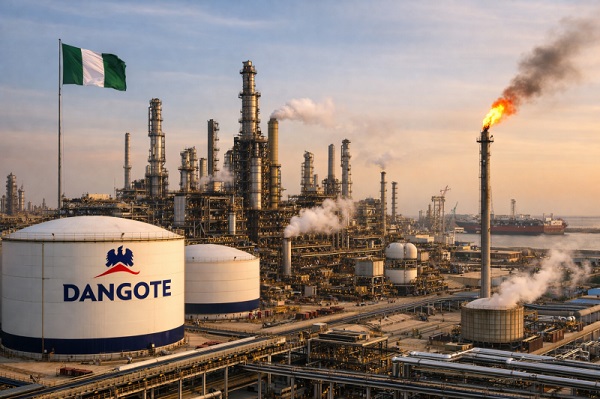
Dangote Petroleum Refinery has fixed the ex-depot price of Premium Motor Spirit (petrol) at $0.779 per litre, unveiling a new pricing template that also raised the benchmark prices for diesel and aviation fuel following its transition to dollar-denominated transactions.

This marks an end to naira payments for the purchase of refined products, which started after the October 1, 2024, commencement of the naira-for-crude deal.

The development also marks a major shift in the refinery’s commercial operations and could reshape pricing dynamics in Nigeria’s deregulated downstream petroleum sector, where Dangote has emerged as the country’s largest supplier of refined petroleum products.

The revised prices, which took effect on Monday, place Automotive Gas Oil (diesel) at $1.087 per litre, Aviation Turbine Kerosene at $0.942 per litre, while coastal deliveries of petrol were fixed at $1,044.62 per metric tonne.

The refinery disclosed the new rates in a notice issued to petroleum marketers and customers, stating that all previously issued naira-denominated Proforma Invoices and Deal Recaps for gantry and coastal transactions had become invalid.

The notice, signed by the refinery’s Group Commercial Operations, read, “Following our email on the 9th of July, 2026, regarding the transition from Naira to United States Dollars, please note that all issued Naira Coastal and Gantry PFIs/Deal Recaps are now invalid, and no payments should be made against them.

The applicable USD prices for each product, effective today, July 13, 2026, are provided below.”

Under the new pricing schedule, petrol sold through the gantry will cost $0.779 per litre, diesel $1.087 per litre, aviation fuel $0.942 per litre, while coastal PMS supplies will sell for $1,044.62 per metric tonne.

See also  NUPENG suspends strike as Dangote accepts union’s demands

The company, however, clarified that the new pricing arrangement does not affect Liquefied Petroleum Gas. “Also note that this transition to USD does not apply to LPG transactions,” the refinery said.

Findings by our correspondent indicate that the new dollar-denominated pricing reflects the refinery’s latest commercial pricing structure and is intended to align petroleum product sales with the currency used in procuring a significant proportion of its crude oil feedstock.

Sources familiar with the development said the refinery considered it necessary to adopt a uniform pricing framework after a growing imbalance between the currency used to procure crude oil and the currency in which refined products were being sold.

One official noted that Dangote refinery now receives a significantly larger share of its crude oil supplies from the Nigerian National Petroleum Company Limited under dollar-denominated supply arrangements, while a substantial volume of its refined products has continued to be sold domestically in naira.

The source explained that the mismatch had increased the refinery’s exposure to foreign exchange risks.

Explaining the rationale behind the move, another source added, “Dangote refinery is receiving fewer naira-denominated crude cargoes from NNPCL compared with dollar-denominated cargoes, while a larger volume of its petroleum products has been sold in naira. The resulting currency mismatch, combined with volatility in international crude oil prices and continued exchange-rate uncertainty, made it necessary to migrate product sales to dollars.”

The decision is expected to have significant implications for petroleum marketers, many of whom source products directly from the refinery for nationwide distribution. It could also influence fuel pricing in the downstream market, depending on movements in the foreign exchange market and international crude oil prices.

See also  State police: IG sets up panel to propose framework

The refinery had previously embraced naira-denominated transactions following the Federal Government’s domestic crude supply initiative, under which local refiners were supplied crude oil in naira to strengthen domestic refining, reduce pressure on foreign exchange demand and stabilise fuel prices. However, the arrangement has faced implementation challenges in recent months, with industry stakeholders reporting that a growing proportion of crude supplies has reverted to dollar-based transactions.

The latest shift underscores the lingering foreign exchange pressures confronting Nigeria’s downstream petroleum sector despite ongoing efforts to deepen local refining and reduce dependence on imported fuels. It also raises fresh questions about the future of the government’s naira-for-crude policy and its impact on domestic fuel pricing.

The new dollar benchmark will now serve as the reference price for marketers purchasing products directly from the refinery, although the eventual retail pump price of petrol will depend on the prevailing naira-to-dollar exchange rate, logistics costs, transportation margins, regulatory charges, and marketers’ operating expenses.

In recent months, pump prices have fluctuated in response to movements in crude oil prices, foreign exchange rates and competition among suppliers, with industry stakeholders closely monitoring pricing decisions by Dangote Refinery because of its growing influence on the domestic fuel market.

punch.ng

FOLLOW US ON:

FACEBOOK

TWITTER

PINTEREST

TIKTOK

YOUTUBE

LINKEDIN

Continue Reading
Click to comment

Leave a Reply

Your email address will not be published. Required fields are marked *

Business

Lawmakers oppose dollar billing for local petrol sales

Published

on

The House of Representatives has commenced moves to address mounting concerns in Nigeria’s downstream petroleum sector, opposing the continued imposition of US dollar-denominated charges on locally refined petroleum products and announcing plans to investigate alleged irregularities in the allocation of fuel import licences.

The House Committee on Petroleum Resources (Downstream) disclosed this on Tuesday during an interactive session with key industry stakeholders, including the Independent Petroleum Marketers Association of Nigeria, the Depot and Petroleum Products Marketers Association of Nigeria, and the Major Energies Marketers Association of Nigeria.

The engagement forms part of the committee’s ongoing consultations on proposed amendments to the Petroleum Industry Act and broader reforms aimed at strengthening domestic refining, guaranteeing national energy security and ensuring a competitive downstream petroleum market.

The Chairman of the committee, Ikenga Ugochinyere, said the lawmakers would invite the Nigerian Midstream and Downstream Petroleum Regulatory Authority, the Nigerian Upstream Petroleum Regulatory Commission, the Nigerian Ports Authority, the Central Bank of Nigeria, refiners and other relevant agencies to respond to issues raised by industry operators.

“We’ll be meeting with the NMDPRA, NUPRC, the refiners—both modular refinery owners and the large refinery operators—as well as the NPA, the CBN and other relevant agencies on the issues that have been raised. These will form part of our downstream reforms, including proposed amendments to the Petroleum Industry Act and legislative motions to correct identified gaps,” Ugochinyere said.

The lawmaker expressed concern over the continued charging of port fees in U.S. dollars for petroleum products refined and transported within Nigeria, describing the practice as detrimental to the economy.

“We have taken special note of the issue of dollar-denominated charges by the Nigerian Ports Authority. It is not good for the economy that, at a time like this, people involved in domestic downstream activities are still being charged in dollars. That ultimately affects the pump price of Premium Motor Spirit,” he said.

Ugochinyere also pledged to investigate allegations that fuel import licences for the first three quarters of 2026 were issued to the same group of marketers.

See also  CBN introduces overnight rate to deepen money market, read details

“We have also taken note of what you said about the lopsidedness in the issuance of import licences, where allocations for the first, second and third quarters went to the same set of operators. We will raise these questions when the NMDPRA appears before the committee to explain the criteria used in issuing those licences,” he added.

The committee chairman stressed the need to strike a balance between protecting Nigeria’s expanding domestic refining capacity and preserving the investments of marketers who have built storage and distribution infrastructure over several decades.

“How do we encourage and protect owners of domestic refineries while also protecting the investments of marketers? We cannot continue importing the same volume of petroleum products as before, given that more refineries are coming on stream. At the same time, we must guarantee national energy security in case local refineries experience disruptions.

“We need a balanced framework that supports domestic refining, preserves healthy competition and ensures the country always has a reliable fuel supply. That is the direction this committee is pursuing,” he said.

Presenting DAPPMAN’s memorandum, the association’s Executive Secretary, Mr Olufemi Adewole, urged lawmakers to address what he described as structural distortions affecting petroleum marketers and depot operators.

According to him, at least 72 of Nigeria’s 154 licensed petroleum depots recorded little or no trading activity over the past year because of what he described as an uneven operating environment.

“From the records of the NMDPRA, not fewer than 72 of the 154 depots nationwide had no regular or consistent trading activity in the last one year. They are merely paying salaries without engaging in meaningful business. This is largely due to an uneven playing field, persistent trading losses and the inability to access alternative sources of supply,” he said.

While welcoming the commencement of operations at the Dangote Refinery, Adewole warned against what he described as a near-monopoly in the supply of PMS.

“Our experience has been one of mixed feelings, bordering on an almost total monopoly in the supply of PMS by the mega refinery. Although the Petroleum Industry Act provides for a fully deregulated market where prices are determined by market forces, that has not been our experience,” he said.

See also  Jonathan revealed why Niger Delta suffered

The association also accused the NMDPRA of allocating import permits repeatedly to the same group of marketers. “The same set of marketers received import allocations in the first, second and third quarters of 2026, as though other qualified operators do not exist. This is unacceptable, and we urge this committee to ensure greater transparency and fairness in future allocations,” Adewole said.

DAPPMAN argued that retaining the option of fuel imports remains necessary to prevent shortages during refinery maintenance, operational disruptions or logistics challenges.

“In order to avoid the return of fuel queues, the import option provided under the Petroleum Industry Act must remain available as a regulated contingency mechanism whenever domestic supply is insufficient,” he said.

The association also decried what it described as duplicated port charges and the continued billing of domestic petroleum transactions in foreign currency.

“Marketers are invoiced at the loading point and again at the discharge port for products moved entirely within Nigeria. More critically, certain charges are still imposed in US dollars despite the purely domestic nature of these transactions. This practice persists despite a presidential directive suspending foreign currency-denominated billing for local operations. We urge the committee to ensure compliance,” Adewole added.

DAPPMAN further called for accelerated dredging of major waterways, rehabilitation of pipelines and depots, improved rail transportation for petroleum products and the creation of a national downstream logistics master plan.

IPMAN National President, Abubakar Shettima, commended the Federal Government for encouraging private investment in refining but said marketers continue to grapple with high financing costs, multiple taxation, foreign exchange volatility, inadequate storage infrastructure and limited access to refinery products.

See also  Disu declares total war on police corruption, impunity

He called for policies that would support domestic refining while preserving competition. “We support strengthening domestic refining, but we also need equitable access to locally refined petroleum products, affordable financing and reduced regulatory costs that ultimately increase pump prices,” he said.

Shettima proposed the establishment of a specialised Petroleum Bank to provide single-digit interest loans to operators. “Today, marketers borrow from commercial banks at interest rates of up to 32 per cent. Those costs are eventually passed on to consumers. We are proposing a Petroleum Bank that will provide single-digit interest loans, similar to what exists in the agriculture and industrial sectors,” he said.

He also urged multinational oil companies involved in fuel importation to invest in local refining. “Before now, we depended almost entirely on imported petroleum products. Today, Nigeria is exporting refined products. Multinational companies should invest in domestic refineries to complement the existing capacity rather than relying solely on imports,” he added.

On the future of Nigeria’s state-owned refineries, Shettima suggested that independent marketers be allowed to participate in their management.

“If independent marketers are allowed to participate in operating the government refineries, we believe we can contribute significantly to their revival. We have done it before. Independent marketers invested in what is today NIPCO, which has become one of Nigeria’s leading petroleum marketing companies,” he said.

The committee’s consultations come as Nigeria seeks to consolidate gains from recent reforms in the downstream petroleum sector following the implementation of the Petroleum Industry Act and the expansion of domestic refining capacity.

Lawmakers are expected to engage regulators, refiners, NNPC Limited and other stakeholders before proposing legislative measures aimed at creating a more competitive, transparent and sustainable petroleum market while safeguarding the country’s long-term energy security.

punch.ng

FOLLOW US ON:

FACEBOOK

TWITTER

PINTEREST

TIKTOK

YOUTUBE

LINKEDIN

Continue Reading

Business

Nigeria tops Africa in petrol price surge during US-Iran war

Published

on

Nigeria recorded the sharpest increase in petrol price across Africa during the first half of 2026, with pump prices surging by 39.5 per cent as the Middle East conflict disrupted global crude oil supplies and exposed the country’s vulnerability to external market shocks despite growing domestic refining capacity.

The disclosure was contained in the Nigeria Half-Year Downstream Industry Report (January–June 2026) released on Tuesday by the Major Energies Marketers Association of Nigeria.

According to the report, the conflict involving Israel, Iran and the United States, which began on February 28, 2026, triggered widespread uncertainty in global oil markets, sending crude oil prices above $100 per barrel and sharply increasing the cost of transporting petroleum products worldwide.

The report explained that the temporary disruption of shipping through the Strait of Hormuz forced oil tankers to abandon the traditional route and sail around the Cape of Good Hope, more than doubling voyage time from about 18 days to nearly 40 days.

MEMAN stated, “During the first half of 2026, severe geopolitical tensions in the Middle East sparked immediate supply anxieties, injecting a heavy risk premium that drove international crude benchmarks past $100/bbl.

“This price surge was quickly compounded as the conflict bottlenecked traffic through the Strait of Hormuz, forcing maritime oil tankers to reroute around the Cape of Good Hope and stretching what is typically an 18-day voyage into a nearly 40-day journey.”

The association said Nigeria’s deregulated petrol market transmitted the global price shock directly to consumers, making the country the hardest hit in Africa.

It said, “Operating under a newly deregulated system, Nigeria experienced an immediate price transmission at the pumps. Data from the height of the crisis revealed that Nigeria recorded a 39.5 per cent gasoline price surge, the sharpest increase across Africa, more than doubling the price jumps seen in regional peers like Egypt (14.3 per cent).”

Despite the sharp rise in prices, the report said the period also marked a significant turning point in Nigeria’s downstream petroleum industry as local refining displaced imported fuel at an unprecedented pace.

See also  UK bans over 100 jobs from foreign recruitment to curb migration

According to MEMAN, the expansion of the Dangote Petroleum Refinery significantly reduced Nigeria’s dependence on imported Premium Motor Spirit.

The report stated, “Against the backdrop of this intense price shock, the downstream sector achieved a significant structural shift away from import dependence toward domestic refinery supply, driven primarily by the operational scale-up of the Dangote Refinery, which by the review period accounted for the majority of local PMS supply.”

It added, “Premium Motor Spirit (PMS) local refining share expanded from 38.9 per cent in 2025 to 81.7 per cent over the review period. Concurrently, local units met an average of 64 per cent of diesel demand, while domestic gas processing facilities captured 90.5 per cent of the cooking gas market.”

However, the association warned that increased domestic refining had yet to eliminate Nigeria’s dependence on imported petroleum products. According to the report, local refinery production remained below national demand during critical periods between February and April, forcing regulators to approve fuel imports to prevent shortages.

MEMAN said, “However, the charts also highlight that domestic production alone was still structurally unable to fully bridge national demand, especially during peak periods. This supply-to-consumption deficit became visually evident between February and April, when the national consumption curve systematically crossed above domestic refinery output lines.”

It added, “To prevent severe product stockouts and stabilize the grid, the regulatory framework actively intervened by issuing refined product import licenses to selected marketers, a hybrid supply approach that successfully buffered fuel security during the worst of the international logistical shocks.”

The report further revealed that marketers drastically reduced fuel inventories because of soaring replacement costs, leading to a sharp decline in Nigeria’s strategic fuel reserves.

According to MEMAN, “The high-cost, volatile open-market environment forced aggressive realignments in inventory management across the value chain, as marketers optimized liquidity by drawing down physical buffers rather than holding expensive static wet stocks.”

See also  Domestic refiners dump $3.13bn crude over pricing disputes

It added, “This structural shift caused national PMS stock sufficiency to drop progressively from 33 days in January to a low of 16 days by May, falling drastically short of the statutory 30-day safety benchmark, before recovering to roughly 20 days in June as licensed imports began filtering into the system.”

The marketers warned that the rapid depletion of fuel reserves highlighted the need for government-backed strategic petroleum reserves to cushion future global supply disruptions.

The report stated, “The rapid depletion of refined sufficiency days during the global shipping crisis underscored Nigeria’s lack of a resilient buffer, prioritizing the urgent downstream requirement to establish robust, state-backed Strategic Product Reserves and a dedicated Crude Oil Feedstock Reserve to insulate domestic refineries and consumers from sudden external supply chain closures.”

MEMAN also disclosed that persistently high fuel prices forced consumers to cut back on fuel purchases. It stated, “Furthermore, sustained open-market pricing triggered strong consumer demand elasticity, reducing average daily consumption by 22.3 per cent for PMS and 17.5 per cent for AGO.”

The association maintained that while Nigeria’s downstream reforms were beginning to yield results through higher domestic refining capacity, effective regulation would remain essential to sustain competition and protect consumers.

It added, “As domestic refining expands and the downstream sector evolves, sustained regulatory vigilance will remain essential to fostering fair competition, protecting consumers, strengthening investor confidence, and ensuring that the benefits of ongoing reforms are realised across the entire petroleum value chain.”

Under a section titled “Impact of the Middle East Conflict – Strait of Hormuz,” MEMAN said the conflict fundamentally altered global petroleum trade routes after the strategic waterway became temporarily inaccessible.

The report explained that suppliers increasingly shifted cargoes from the Persian Gulf to the U.S. Gulf Coast and West Africa as shipping companies sought safer alternative routes.

According to MEMAN, “The start of the conflict in the Middle East on 28th February 2026 and the subsequent temporary closure of the Strait of Hormuz significantly reshaped global crude oil and petroleum product trade flows during the first half of the year. Under normal market conditions, the Gulf serves as the primary export hub for refined petroleum products moving to Europe, Asia and parts of Africa.”

See also  Jonathan revealed why Niger Delta suffered

It continued, “However, with access through the Strait severely restricted, cargoes were rerouted to alternative supply sources, particularly from the U.S. Gulf Coast and West Africa. The longer sailing distances, coupled with higher freight and insurance costs, increased delivered product costs and placed additional pressure on global shipping capacity.”

MEMAN further stated, “Under normal conditions, some Gulf-origin cargoes could reach key Asian markets in approximately 18 days via the Strait of Hormuz; however, rerouting around longer alternative routes extended voyage times to nearly 40 days, significantly delaying supply flows and increasing logistical costs. The disruptions reinforced the importance of diversified refining centers and demonstrated the growing strategic role of Atlantic Basin suppliers in maintaining global product availability during supply shocks.”

The first half of 2026 was one of the most volatile periods for Nigeria’s downstream petroleum sector since the full deregulation of the petrol market. Pump prices became fully responsive to movements in international crude oil prices, foreign exchange fluctuations, freight costs and supply chain disruptions following the removal of petrol subsidies.

Although the operational expansion of the 700,000-barrels-per-day Dangote Petroleum Refinery substantially reduced Nigeria’s reliance on imported petrol during the review period, local refining capacity was still insufficient to meet peak national demand, prompting the Nigerian Midstream and Downstream Petroleum Regulatory Authority to approve imports by selected marketers to maintain energy security.

The report underscores the opportunities and challenges of Nigeria’s transition to a market-driven downstream sector, where increased domestic refining has strengthened supply resilience but global geopolitical events continue to exert a significant influence on domestic fuel prices.

punch.ng

FOLLOW US ON:

FACEBOOK

TWITTER

PINTEREST

TIKTOK

YOUTUBE

LINKEDIN

Continue Reading

Business

Dangote to donate one-third of wealth to charity, daughter reveals

Published

on

Africa’s richest man, Aliko Dangote, plans to donate one-third of his wealth to charity as part of his succession plan, his daughter, Halima Dangote, has revealed.

Halima, a trustee of the Aliko Dangote Foundation, disclosed the arrangement in an interview with Bloomberg published on Tuesday, saying the billionaire had secured his family’s support to dedicate 33 per cent of his estate to philanthropy.

According to the Bloomberg Billionaires Index, Dangote’s net worth is estimated at $35.1 billion, meaning one-third of his current fortune would amount to about $11.7 billion if maintained at that level.

Explaining the decision, Halima said her father considers philanthropy central to his legacy and has embedded it into the family’s long-term succession plans.

“He sort of put all the structure in place whereby we focus a lot on health and education. He actually donated 25 per cent to the foundation. If you look at it, it is what we call in Sharia Code in Islam; it means he has donated 33 per cent of his whole inheritance to his foundation,” she said.

“That is how important it is to him because philanthropy needs to be in existence generation after generation.

“So giving back is part and parcel of what we do. We believe we’re here, that our business is successful because of the giving back and because of the philanthropic aspect. That is why the 33 per cent is important.

“And that is why he made an announcement and he asked myself, my two sisters and his mother to sign under that will that he is able to give that 33 per cent to humanity.”

See also  Jonathan revealed why Niger Delta suffered

The planned donation builds on Dangote’s existing philanthropic work through the Aliko Dangote Foundation, established in 1994.

According to Halima, the foundation was endowed with $1.25 billion about a decade ago and has since received an additional $700 million in funding.

She said about 70 per cent of the foundation’s spending is directed to Nigeria, while 20 per cent supports projects across Africa and the remainder funds initiatives in other parts of the world.

The foundation’s interventions span health, education, nutrition and humanitarian relief, and include partnerships with the Bill & Melinda Gates Foundation and state governments in northern Nigeria that contributed to the eradication of wild poliovirus in Africa.

Dangote’s planned charitable commitment comes amid growing global attention on billionaire philanthropy. While the proposed 33 per cent allocation falls short of the 50 per cent threshold commonly associated with the Giving Pledge, it would rank among the largest philanthropic commitments ever announced by an African billionaire.

Earlier this year, TIME magazine named Dangote among the world’s most influential philanthropists in its inaugural TIME100 Philanthropy list, recognising his charitable work through the Aliko Dangote Foundation, which spends more than ₦50 billion annually on programmes across Africa.

punch.ng

FOLLOW US ON:

FACEBOOK

TWITTER

PINTEREST

TIKTOK

YOUTUBE

LINKEDIN

Continue Reading

Trending