Connect with us

Business

Read how to apply for FG’s loan for laptops, smartphones, others

Published

on

The Federal Government’s newly launched consumer credit scheme for digital devices, the Credit for Laptops, Internet, Connectivity and Knowledge Digital Devices Programme, is now accepting applications from Nigerians seeking affordable, credit-based access to laptops, smartphones and tablets.

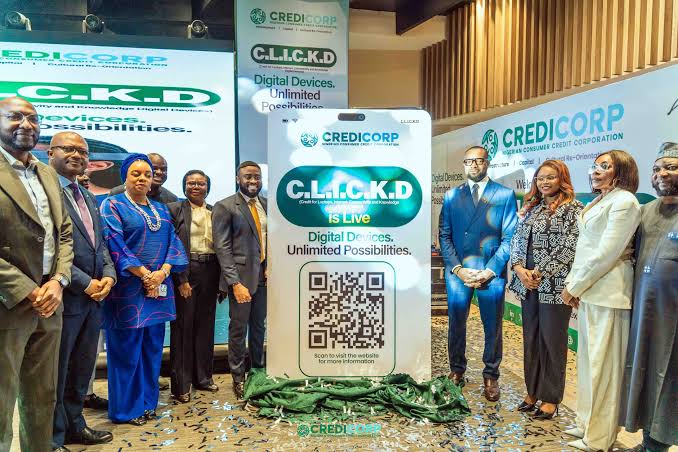
The programme, implemented by the Nigerian Consumer Credit Corporation (CREDICORP) in partnership with the Federal Ministry of Communications, Innovation and Digital Economy, was unveiled on Tuesday in Abuja by the Minister, Dr Bosun Tijani, alongside CREDICORP’s Managing Director and Chief Executive Officer, Uzoma Nwagba.

C.L.I.C.K.D. is designed to help Nigerians own digital devices through structured, spread-out payments rather than paying the full cost upfront, starting with locally assembled laptops as CREDICORP prioritises local manufacturing.

How to apply

  1. Visit the website. Go to credicorp.ng/clickd, the official C.L.I.C.K.D. landing page.
  2. Click “I’m Interested.” This takes you to the application form.
  3. Fill in the required details:
  • State of residence — select from all 36 states and the FCT.
  • What best describes you — Employed (Salary Earner), Freelancer/Self-Employed, Business Owner, Student, Job Seeker or NYSC Member.
  • Monthly income (optional) — ranges from below ₦100,000 to above ₦1,000,000.
  • Digital talent programme — applicants indicate whether they are part of one, choosing from 3MTT, Andela Learning Community, Learn2Earn, ALX, HNG Internship, AltSchool Africa, Genesys Tech Hub or “Other.”
  • Device needed — laptop, smartphone, tablet or other.
  • Reason for the device — applicants can select multiple options, including learning and certifications, work/remote work, freelancing, business growth, school, software development, content creation or other.
  • How you heard about C.L.I.C.K.D. — 3MTT, social media, friend or family, school, employer, Google search or other.
  • Confirm and consent. Before submitting, applicants must tick three boxes: confirming the information provided is accurate, agreeing to be contacted regarding the application, and consenting to CREDICORP and its partners using their information to assess eligibility.
    Submit.
See also  Jide Kosoko laments debt following N300m movie cinema loss

Who qualifies, for now

The current 1,000-laptop pilot is limited to fellows of the Federal Government’s Three Million Technical Talent (3MTT) Programme, under which C.L.I.C.K.D. was launched as a national pilot.

Nwagba said the rollout began in Abuja, where 77 beneficiaries received devices, with the remaining laptops to be distributed to qualified fellows in other states in phases.

CREDICORP has a track record of this phased approach: its main consumer credit scheme launched in April 2024, targeting only federal civil servants before later widening its reach.

The application form’s coverage extends beyond 3MTT, listing Andela Learning Community, Learn2Earn, ALX Africa, HNG Internship, AltSchool Africa and Genesys Tech Hub as talent-programme options — suggesting these fellows may also be able to apply, even though CREDICORP’s public statements so far have referenced only 3MTT beneficiaries for the current 1,000-laptop batch.

CREDICORP has also yet to disclose the specific interest rates, repayment tenure or down-payment structure for C.L.I.C.K.D. loans.

punch.ng

FOLLOW US ON:

FACEBOOK

TWITTER

PINTEREST

TIKTOK

YOUTUBE

LINKEDIN

Continue Reading
Click to comment

Leave a Reply

Your email address will not be published. Required fields are marked *

Business

How Moniepoint customers can check eligibility for FG’s ₦50,000 relief support

Published

on

Moniepoint Microfinance Bank says eligible customers can now check their status and access the Federal Government’s ₦50,000 emergency relief support through its Unstructured Supplementary Service Data (USSD) channel.

The bank said in a statement issued on Wednesday that “customers could dial *5573*27# from their registered phone numbers and select the option to check their eligibility for the National Emergency Relief and Stabilisation Intervention (NERSI).”

It said customers confirmed as beneficiaries would be guided through the steps to accept the support and receive the funds into their Moniepoint accounts at no additional cost.

The intervention, led by the Federal Ministry of Humanitarian Affairs and Poverty Reduction, is designed to provide direct financial assistance to vulnerable households to help them meet essential needs amid prevailing economic pressures.

On Tuesday, PUNCH Online reported that that FG had begun payment to eligible Nigerians.

Moniepoint said it was “among the payment providers selected by the Federal Government to facilitate the disbursement of the relief funds.”

It explained that beneficiary selection was based on the government’s eligibility criteria and verification processes, which relied on verified national identity records and the National Social Register.

The bank noted that the programme was being implemented in phases across the country, adding that not all customers would qualify or be selected at the same time.

What moniepoint customers should know?

Babatunde Olofin, Managing Director and Chief Executive Officer of Moniepoint Microfinance Bank, said the “bank was pleased to support eligible customers in receiving assistance under the government initiative.”

See also  FG, NLC clash over minimum wage talks

Olofin said Moniepoint would deploy its technology and financial infrastructure to make the process accessible, seamless and secure.

He urged “customers to use only the bank’s official USSD channel when checking their eligibility or accessing the funds.”

He added that the process required “no additional payment, documentation or third-party intervention.”

The bank also advised customers with enquiries to contact its customer service team or the NERSI helpdesk.

Moniepoint said its nationwide network of financial services infrastructure, including Point-of-Sale terminals across the country’s 774 local government areas, would support efforts to extend access to the intervention.

Source: punchng.com

FOLLOW US ON:

FACEBOOK

WHATSAPP CHANNEL

TWITTER

PINTEREST

TIKTOK

YOUTUBE

LINKEDIN

INSTAGRAM

Continue Reading

Business

$196m NIN funds unspent, FG seeks extension

Published

on

The Federal Government has requested another 12-month extension of Nigeria’s $430 million digital identity project as approximately $196m of its financing remains undisbursed and National Identification Number (NIN) issuance trails the target by 59 million.

This is contained in a World Bank restructuring paper dated 22 October, 2026, obtained by The PUNCH from the bank’s website on Wednesday.

The proposed extension would move the Nigeria Digital Identification for Development Project’s closing date from 31 December, 2026, to 31 December, 2027.

“The proposed Level 2 restructuring seeks to extend the project closing date by 12 months, as requested by the Government on May 8, 2026,” the report stated.

“This would be the third closing date extension under this project since Board Approval in February 2020, for the cumulative period of 42 months (3.5 years).”

The project was originally scheduled to close in June 2024 before receiving a six-month extension and another two-year extension.

An analysis by The PUNCH showed that approximately $196m, representing 45.6 per cent of the financing, remained undisbursed after total disbursements reached about $234m.

“The overall project disbursement rate inclusive of co-financiers stands at approximately $234m or 54.4 per cent,” the bank stated.

The financing comprises $115m from the World Bank’s International Development Association, $100m equivalent from the French Development Agency and $215m equivalent from the European Investment Bank.

The undisbursed balance therefore covers all three financiers. The report’s financing summary separately puts IDA’s undisbursed balance at $18.83m.

Approved in February 2020 and effective from December 2021, the project seeks to expand access to identification and services through a secure, inclusive national identity system.

See also  When celebration becomes a luxury: Inside Nigerians’ costly Christmas struggle

However, about 121 million people had received NINs by September 30, 2026, against the 180 million target, leaving a shortfall of 59 million.

Although this represents an increase of approximately 84 million from the baseline, NIMC must substantially accelerate enrolment to meet the target.

“NIMC reconfirmed the commitment to reach the target of 180 million noting that this would require an increase in monthly enrollment rates from the current average of 1.5 million to 3.9 million,” the report stated.

This implies a 160 per cent increase in monthly enrolment.

The bank also distinguished enrolment records from successfully generated NINs, noting that more than 140 million enrolments had been recorded by September 14, but only 121 million had completed biometric and demographic validation and duplicate checks.

Women and children remained behind their respective targets. As of June, 40.4 million women and girls had NINs against a target of 79 million, while 26.3 million children under 16 had NINs against 60.83 million.

The report identified unpaid enrolment partners as another constraint, stating that the billing system must produce audited payment reports to enable payments to partners “which have not been paid since January 2026.”

Other priorities include deploying 7,000 procured mobile devices by January 2027, training agents, expanding ward-level enrolment nationwide and beginning school enrolment by December 2026.

The ward campaign had generated 10 million NINs since March, according to the report.

A major reason for the extension is the delayed replacement of NIMC’s existing technology with the National Identity Management System 2.0.

The contract was signed on September 15, 2026, following lengthy procurement. Implementation, normally requiring approximately 18 months, was compressed into 15 months, with full deployment and data migration scheduled for December 15, 2027.

See also  Free zones attract $200bn FDI, create 500,000 jobs – FG

The new platform would replace fragmented proprietary systems with an open-source system designed to improve capacity, interoperability and data protection.

Although NINAuth was launched in May 2025, the project’s digital authentication targets remained unmet pending integration into the new platform.

The bank warned that failure to extend its involvement would also halt implementation by the other financiers.

“If the project is not extended by WBG, all other co-financiers will also close,” it stated.

Source: punchng.com

FOLLOW US ON:

FACEBOOK

WHATSAPP CHANNEL

TWITTER

PINTEREST

TIKTOK

YOUTUBE

LINKEDIN

INSTAGRAM

Continue Reading

Business

Read how FG selects beneficiaries for N50,000 relief

Published

on

The Federal Government has explained how it selects beneficiaries for its N50,000 cash relief under the National Emergency Relief and Stabilisation Intervention.

The clarification comes as payments continue and many Nigerians seek to understand how the government identifies recipients and determines their eligibility.

According to information on the Federal Ministry of Humanitarian Affairs and Poverty Reduction’s NERSI website, sighted by PUNCH Online on Wednesday, beneficiaries are selected from verified national identity records and the National Social Register.

“Beneficiaries are selected from verified national identity records and the national social register, then screened to reach poor and vulnerable households,” the website states under its eligibility and selection section.

The National Identification Number (NIN) is issued by the National Identity Management Commission (NIMC) after enrolment.

It is used to verify an individual’s identity and is linked to the mobile wallet through which selected beneficiaries receive the relief.

The National Social Register (NSR), on the other hand, is a database of poor and vulnerable households in Nigeria, coordinated by the National Social Safety-Nets Coordinating Office.

According to NASSCO, the register contains data on more than 70 million individuals.

It said registering vulnerable persons is a multi-process activity that begins with states identifying their poorest local government areas and communities, after which trained teams work with residents and community leaders to identify vulnerable households.

The identified households are then registered digitally and assessed using poverty indicators.

Those ranked within the bottom six deciles may qualify for inclusion in the National Beneficiary Register, which is used for programmes such as cash transfers.

See also  Consolidated Hallmark, CHI Life Assurance seek deeper broker partnerships

Enrollment in both NIMC and NSR is a prerequisite for being selected for N50,000 cash relief, according to NERSI.

However, the office does not provide further details on the specific screening criteria used to determine relief recipients.

It stresses that Nigerians cannot apply or pay to be included in the beneficiary list.

“You cannot apply or pay to be added,” the website says. “Not everyone is in the first group. Your data is used only for this programme.”

The Humanitarian Assistance Programme is described as the Federal Government’s shock-responsive cash transfer initiative for poor and vulnerable households. It provides financial support through mobile wallets.

“Under NERSI, selected beneficiaries receive support of ₦50,000 into a mobile wallet,” the website explains. “It is a grant from the Federal Government. You do not pay it back.”

According to the office, selection is based on need and covers all six geopolitical zones, regardless of religion, ethnicity or political affiliation. Payments are made in phases, meaning beneficiaries are not contacted at the same time.

PUNCH Online reported that the Minister of Humanitarian Affairs and Poverty Reduction, Dr Bernard Doro, announced the commencement of disbursement in a statement on October 30.

Nigerians can check if they are selected through the approved providers by dialling their USSD codes: ALAT by Wema (*945*23#), MoMo PSB (*671*0#), NairaGram (*726*00#), OPay (*955*20#) and Moniepoint (*5573*27#).

Source: punchng.com

FOLLOW US ON:

FACEBOOK

WHATSAPP CHANNEL

TWITTER

PINTEREST

TIKTOK

YOUTUBE

LINKEDIN

INSTAGRAM

Continue Reading

Trending