Connect with us

Crime

‘We’ll spare you, kill your children’: Kaduna community recounts midnight horror

Published

on

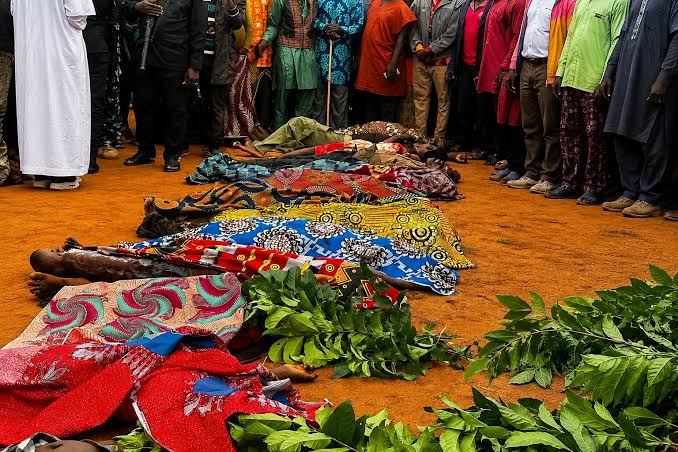
Nothing could have prepared the people of Naridon community in Kaduna State for what unfolded shortly before midnight. By sunrise, at least 30 people were confirmed dead, homes had been reduced to ashes, dozens of residents were dead and one family’s world had collapsed. Five siblings were killed in the violence, leaving one critically injured child as the only surviving link to a family that, just hours earlier, had gone to bed expecting another ordinary Monday, GODWIN ISENYO reports

The first light of dawn on Monday revealed a village struggling to comprehend the unimaginable.

Smoke still rose from the charred remains of mud houses in Naridon, a quiet farming settlement in Kamaru Ward of Kauru Local Government Area of Kaduna State. Burnt mattresses, twisted roofing sheets, blackened cooking pots and melted plastic containers lay scattered across compounds that, only hours earlier, had been homes filled with laughter, family meals and hopes of another planting season.

The silence was repeatedly broken by piercing cries of grief as women wailed while neighbours dug fresh graves. Men who had spent their lives cultivating the fertile land now found themselves burying loved ones instead of preparing their farms.

Children wandered through the ruins, searching for anything that could be salvaged from homes reduced to ashes.

But perhaps the most heartbreaking scene was unfolding several kilometres away in a hospital ward.

There, the only surviving child from a family of six siblings was fighting for life.

Five brothers and sisters had been killed during the midnight attack. The lone survivor is now the only living witness to a family almost completely erased.

“It is difficult to explain this kind of pain,” a community leader said quietly. “How do you console parents who have lost almost all their children in one night?”

That question now hangs heavily over Naridon — a community that has become the latest symbol of the recurring violence that continues to haunt Southern Kaduna.

Peaceful village shattered

Naridon is typical of many rural communities in Southern Kaduna, where life revolves around farming.

Before sunrise, farmers head to their fields while women prepare meals for their families. During the school term, children attend classes before returning home to assist their parents on the farms.

Evenings are predictable. Men gather beneath large trees to discuss harvests and community affairs, while children play until darkness falls.

Sunday ended like every other day. Families retired to bed believing another routine Monday awaited them.

Instead, shortly before midnight, gunfire shattered the silence.

Residents said heavily armed men stormed the village at about 11:55 p.m., shooting indiscriminately at sleeping residents. Some escaped into nearby bushes, while others never made it out alive.

Within minutes, flames consumed homes, food stores and business premises. By the time the attackers disappeared into the darkness, dozens of villagers lay dead.

Several others sustained gunshot wounds. Entire households were wiped out—five siblings killed, while one child now fights for life.

Five siblings killed…

Among the many stories of unimaginable loss, one stands above all others.

Five children from the same family—Deborah Emmanuel, Friday Emmanuel, Yusuf Emmanuel, Yunana Emmanuel and Irimiya Emmanuel—were killed during the attack.

Their parents survived after fleeing into nearby bushes. When they returned at daybreak, they found the lifeless bodies of their children.

Community leader Yunusa Babados alleged that the attackers deliberately targeted the family.

See also  Hospital cleaner arrested for allegedly trying to sell placentas

“In one family, they killed six children and told the parents, ‘We will spare you and kill all your children,’” he said.

However, another account from community leaders indicated that one of the six children survived and is currently receiving treatment for critical injuries.

For many residents, the fate of that lone child represents both the unimaginable cruelty of the attack and the fragile hope that life can still emerge from tragedy.

‘We are counting people, not statistics’

The Secretary to the Village Head of Naridon, Mr Dogon Rana, struggled to maintain his composure while speaking with journalists.

“We are still searching,” he said, adding that “some people are injured while others are still missing.”

Then came the revelation that stunned even experienced relief workers.

“One family lost five children. Only one child survived, and that child is now struggling for life.”

As rescue efforts continued, villagers moved from house to house identifying bodies.

At least 30 residents were confirmed dead.

Among them were Geoffrey Monday, Maria Pius, Ladi Monday, Tabawa Monday, Guntu Balla, Enock Balla, Markus Gashi, Mariyamu Joseph, Maria Istifanus, Nuhu Bulus, Bulus Markus, Ayalla Markus, Monday Danladi, Kaka Umaru, Gundumi Umaru, Joy Ali, Dominion Danladi, Danladi Ibrahim, Mama Ibrahim, Deborah Emmanuel, Friday Emmanuel, Yusuf Emmanuel, Yunana Emmanuel, Irimiya Emmanuel, Pheobe Markus, Saviour Monday, Audi Musa and Sunday Yakubu.

Three other victims had yet to be formally identified when community leaders compiled the casualty list.

Every name represented another shattered family, another home left empty and another future violently interrupted.

When leader becomes victim

Unlike many leaders who merely documented the destruction, Dogon Rana became one of the victims himself.

His shop was among the properties destroyed by fire.

Years of investment disappeared within minutes.

“My own property was destroyed,” he said.

“Many houses and shops were burnt.”

Residents estimated that property worth millions of naira was lost.

Among the destroyed buildings was the residence of the late Hosea Garba, alongside several shops belonging to local traders.

For many affected families, those businesses represented their only means of livelihood.

Now they face the daunting task of rebuilding their lives from nothing.

‘If only…’

As survivors recounted the horror, one issue repeatedly surfaced—the road leading to Naridon.

Residents insisted that the deplorable condition of the access road significantly worsened the tragedy.

Community leader Yunusa Babados alleged that the attackers deliberately targeted the family.

“In one family, they killed six children and told the parents, ‘We will spare you and kill all your children,’” he said.

However, another account from community leaders indicated that one of the six children survived and is currently receiving treatment for critical injuries.

For many residents, the fate of that lone survivor now represents both the unimaginable cruelty of the attack and the fragile hope that life can still emerge from tragedy.

Three terrifying hours

According to Dogon Rana, security operatives and emergency responders could not reach the community quickly because of the poor condition of the road leading to Naridon.

“If there was a good road, security personnel could have arrived earlier,” he lamented.

Development experts have long argued that infrastructure is not only about economic growth but can also determine whether lives are saved during emergencies.

Remote communities with poor road networks are often more vulnerable because security patrols are limited and emergency responders face difficulties reaching victims quickly. For Naridon, residents believe that reality became painfully clear.

See also  Three children found dead in Anambra native doctor’s residence

Another resident, who spoke on condition of anonymity for security reasons, recounted the ordeal villagers endured.

According to the resident, the attackers operated for almost three hours.

“We kept hoping help would come,” the resident recalled.

The source alleged that military formations exist in nearby Kamaru and Ungwan Magaji, but no intervention occurred before the attackers withdrew.

The resident further claimed that about 22 members of the Rana family were killed.

Although security authorities had yet to independently confirm that figure, the allegation reflected growing frustration among residents who believe rural communities remain dangerously exposed.

For many Nigerians outside Kaduna State, Naridon may appear to be another isolated tragedy.

But residents of Southern Kaduna know otherwise.

Communities across Kauru, Kajuru, Chikun and Zangon Kataf Local Government Areas have endured repeated deadly attacks over the past decade. Hundreds of people have been killed, thousands displaced, and several settlements abandoned as insecurity continues to reshape life in the region.

Tinubu, Sani react

President Bola Tinubu condemned the attack and directed security agencies to track down those responsible.

In a statement issued by his Special Adviser on Information and Strategy, Bayo Onanuga, the President described the killings as an unprovoked act of terror against innocent citizens.

“I have directed the Armed Forces, police and relevant intelligence agencies to intensify operations across the affected areas to swiftly track down the perpetrators, secure the release of abducted individuals and restore normalcy to the region,” Tinubu said.

He assured Kaduna State Governor Uba Sani and residents of the state’s support from the Federal Government.

The President also pledged to strengthen security infrastructure and dismantle criminal networks threatening peace across the country.

Governor Uba Sani also condemned the killings, describing the attack as unacceptable.

In a statement issued by the Commissioner for Information, Ahmed Maiyaki, the governor directed security agencies to intensify operations across the affected communities.

He equally ordered the Kaduna State Emergency Management Agency to provide immediate humanitarian assistance to displaced residents.

Beyond emergency relief, Sani pledged closer collaboration with neighbouring Plateau State, security agencies and traditional institutions to improve security around the Kaduna-Plateau border.

Reacting to the attack, the Peoples Democratic Party governorship candidate in Kaduna State, Usman Shehu Bawa, popularly known as “Shehu ABG,” described the killings as “a horrifying act of barbarity” and said the continued bloodshed across the state had become unacceptable.

He called for a comprehensive investigation, the arrest and prosecution of those responsible, as well as urgent humanitarian support for survivors, injured victims and displaced families.

Atiku Amnesty join condemnation

Former Vice President Atiku Abubakar described the killings as heartbreaking and unacceptable.

He argued that no country could achieve meaningful development while citizens continued to lose their lives in their homes.

Atiku called for a comprehensive review of Nigeria’s security architecture and urged governments at all levels to make the protection of lives a priority.

Amnesty International also condemned the attack, describing it as one of the deadliest assaults on communities in Southern Kaduna in recent years.

The organisation said it had gathered evidence indicating that entire families were killed inside their homes.

It urged authorities to conduct a thorough investigation and ensure that those responsible were brought to justice.

The Southern Kaduna Peoples’ Union, the umbrella organisation representing the Southern Kaduna people, said the Naridon attack was another indication that existing security measures were inadequate.

See also  PHOTOS: Nigerian man jailed for multiple s3xual offences in UK

In an open letter to the Kaduna State Commissioner of Police, the group called for intelligence-led policing, rapid deployment of Mobile Police units, improved surveillance around farming communities and faster responses to distress calls.

The union argued that responding after attacks was no longer sufficient, insisting that communities needed preventive security measures.

Intelligence over firepower

Security analyst Mohammed Ali believes intelligence gathering remains one of Nigeria’s biggest weaknesses in tackling insecurity.

According to him, timely and reliable intelligence could help security agencies prevent attacks before they occur.

He argued that criminal groups exploit information gaps, weak surveillance and poor coordination among security agencies.

Ali identified Kauru, Kajuru, Chikun and Kachia as areas requiring sustained intelligence-led operations.

He also linked persistent attacks to financial incentives from ransom payments and cattle rustling, arguing that proceeds from criminal activities enable armed groups to acquire more sophisticated weapons.

Beyond rebuilding houses

Development specialists insist that recovery efforts in communities like Naridon must go beyond rebuilding destroyed homes.

They argue that survivors require psychological support, trauma counselling, educational assistance for children who lost parents or siblings, and long-term livelihood programmes.

Without such interventions, experts warn, the consequences of violence can leave emotional scars that persist across generations.

Children who witness killings may carry the trauma into adulthood.

Widows may suddenly become sole providers for their families.

Parents forced to bury their children may struggle for years to recover from the loss.

The burden of survival often proves as painful as the loss itself.

Region longing for lasting peace

The Naridon massacre occurred barely two weeks after the 19 Northern governors launched the Northern Nigeria Security Trust Fund in Kaduna.

The governors pledged N1bn monthly to strengthen regional security coordination and improve responses to insecurity.

The latest attack has, however, renewed questions about whether such initiatives will translate into meaningful protection for vulnerable communities.

For residents of Southern Kaduna, the issue goes beyond policy announcements and official statements. They want a visible security presence. They want accessible roads. They want timely emergency response.

Above all, they want to sleep without fear.

Waiting for justice

As another evening descended on Naridon, survivors gathered around the blackened remains of their homes.

Some prayed quietly.

Others stared into the distance.

The fields would eventually need to be cultivated again.

Markets would reopen.

Children would one day return to school.

Life would continue.

But it would never be the same.

The names of the dead would remain etched in family histories.

The burnt compounds would stand as painful reminders of a night when peace gave way to horror.

And somewhere inside a hospital ward, one child—the lone survivor among six siblings—continues the most difficult battle of all.

Whether Naridon becomes another forgotten headline or a turning point in Nigeria’s response to rural insecurity will depend on the actions taken long after the graves have been filled.

For now, another farming community mourns. Another generation carries fresh scars.

And across Southern Kaduna, anxious residents once again wonder whether the next knock at midnight will bring help — or death.

punch.ng

FOLLOW US ON:

FACEBOOK

TWITTER

PINTEREST

TIKTOK

YOUTUBE

LINKEDIN

Continue Reading
Click to comment

Leave a Reply

Your email address will not be published. Required fields are marked *

Crime

Drug lords’ assets must be seized – Marwa

Published

on

The Chairman and Chief Executive Officer of the National Drug Law Enforcement Agency, Brig Gen Buba Marwa (retd.), has said arrests alone cannot defeat drug trafficking without a corresponding effort to seize and recover the proceeds of crime.

Marwa stated this on Tuesday while delivering a presentation titled, “Criminal Property and the Criminal Process: How Can We Make It More Effective?” at the ongoing 43rd Cambridge International Symposium on Economic Crime, organised by the Centre for Geopolitics, University of Cambridge, United Kingdom.

This was contained in a statement by the spokesman of the agency, Femi Babafemi.

Speaking before an international gathering of judges, law enforcement chiefs, financial intelligence experts and academics, the NDLEA chairman said the success of the criminal justice system should not be measured solely by the number of convictions secured.

He said the process should also be assessed by its ability to make crime unprofitable.

According to him, “A trafficker who loses his liberty but retains his fortune has not truly been defeated. His wealth can finance another operation, support his associates and sustain the criminal enterprise.”

Marwa said the ultimate objective should be to deny criminals the proceeds of their crimes promptly and lawfully while preserving the value of seized assets.

He likened arresting a trafficker without dismantling his financial empire to “pruning a weed at the stem while leaving its roots undisturbed,” warning that illicit wealth could resurface under different names, front companies or jurisdictions.

The NDLEA boss outlined six strategies adopted by the agency to strengthen asset recovery, anchored on the NDLEA Act 2004, the Proceeds of Crime (Recovery and Management) Act 2022 and the Money Laundering (Prevention and Prohibition) Act 2022.

See also  PHOTOS: Nigerian man jailed for multiple s3xual offences in UK

He cited the forfeiture of the Hook Hotel, a property linked to a fugitive drug suspect, as an example of the agency’s use of non-conviction-based forfeiture.

According to him, the property was sold for $4.2m, with the proceeds paid into the Federal Government’s forfeited assets account domiciled with the Central Bank of Nigeria.

Marwa said the development demonstrated that fleeing the country could not enable a fugitive to retain the benefits of alleged criminal activities.

He also disclosed that NDLEA investigators and prosecutors were now working together from the commencement of cases, a development he said had shortened the period between arrest and the securing of restraint orders.

The NDLEA chairman said the agency froze bank accounts containing more than $7m in the previous month and secured interim forfeiture orders covering multibillion-naira assets, including filling stations, multi-storey buildings and exotic vehicles allegedly linked to a fugitive methamphetamine syndicate.

On the case involving Nigerian businessman Amadi Simon, whom the agency described as a suspected drug baron, Marwa said three hotels linked to the suspect were placed under professional asset managers instead of being shut down.

He said the measure was aimed at preserving the value of the hotels as going concerns pending the outcome of the trial.

Marwa further highlighted the use of provisions relating to unexplained wealth and living beyond legitimate means as investigative triggers, as well as the interlocutory sale of perishable and depreciating assets to prevent their values from declining before final judgment.

He said the measures had been incorporated into Nigeria’s National Drug Control Master Plan 2026–2030, making financial disruption of drug trafficking organisations a sustained national priority.

See also  US Releases List, Names Of 5 Popular Yahoo Boys Facing Deportation

The NDLEA chairman identified speed, preservation of value and institutionalisation as three principles guiding the agency’s asset recovery efforts.

He, however, acknowledged challenges, including delays in mutual legal assistance, limited forensic accounting capacity and the need to balance the rights of accused persons with the responsibility of the state to preserve assets pending trial.

Marwa called for faster international cooperation and stronger cross-border recognition of non-conviction-based forfeiture orders.

He reaffirmed the agency’s readiness to strengthen partnerships with foreign jurisdictions and institutions in efforts to dismantle the financial structures supporting drug trafficking.

Source: punchng.com

FOLLOW US ON:

FACEBOOK

TWITTER

PINTEREST

TIKTOK

YOUTUBE

LINKEDIN

INSTAGRAM

Continue Reading

Crime

Police uncover Ogun baby factory, rescue pregnant women, children

Published

on

Operatives of Mowe Division of the Ogun State Police Command, through an intelligence-led operation, have dismantled an illegal ‘baby factory’ syndicate at Abaren Village, Mowe.

The operation resulted in the rescue of two heavily pregnant women and four children, as well as the arrest of six suspects: Florence Ogbona ‘f’ (58), Magdalene Julius ‘f’ (63), Chidike Egwuonwu ‘m’ (40), Onyechu Chidike ‘m’ (35), Stephen Ogbona ‘m’ (39), and an attending nurse, Oseni Idaya ‘f’.

The command described the arrest of the members of this baby factory syndicate as a significant breakthrough in its ongoing fight against human trafficking and child exploitation.

The spokesperson of the state police command, DSP Oluseyi Babaseyi, disclosed this in a statement made available to journalists on Tuesday.

Babaseyi said, “The operation was carried out on 24th August, 2026, at about 8:00 a.m., when operatives acting on sustained intelligence stormed the syndicate’s hideout located at Toluwalase Street, Abaren Village, via Gbarinmole, a suburb of Mowe, as preliminary investigation revealed that human trafficking and illegal adoption activities had been occurring at the facility over time.

“During the raid, operatives safely rescued two pregnant victims: Ilesanmi Foluke ‘f’ (23), seven months pregnant, and Ejekwa Melody ‘f’ (20), eight months pregnant. Four young children, comprising two males and two females, were also recovered from the scene.”

He explained that further intelligence-led follow-up operations led officers of the command to a hospital within the Mowe axis, where another victim, Blessing Bright Effiong ‘f’ (26), had given birth to a baby boy on 20th August, 2026.

See also  No abduction of 15 Akwa Ibom students, says CP

Babaseyi said that while the mother was receiving medical care, the whereabouts of the newborn child could not be accounted for, prompting the arrest of the attending nurse in an attempt to locate the infant.

PUNCH Metro learnt that the case has been transferred to the State Criminal Investigation Department, Eleweran, Abeokuta, to establish the full extent of the syndicate’s activities, locate the missing newborn, and ensure the prosecution of every culpable suspect.

Babaseyi noted that the public would be kept informed as further developments unfold.

Meanwhile, the state Commissioner of Police, Bode Ojajuni, commended the operational efficiency and prompt response of the Mowe Division operatives over the illegal acts of those reported to be operating a baby factory.

Ojajuni reaffirmed the Command’s unwavering commitment to stamping out human trafficking, child trading, and all forms of violent crime across Ogun State.

The CP further urged residents to remain vigilant and continue to support the police by providing timely and credible information, assuring them that the command will sustain intelligence-led policing to ensure the safety and protection of all citizens.

Members of the public are encouraged to promptly report suspicious persons or activities through the following channels: Gateway Shield (Toll-Free): 0800 000 9111. Emergency Lines: 09164859299, 09154293464.

Source: punchng.com

FOLLOW US ON:

FACEBOOK

TWITTER

PINTEREST

TIKTOK

YOUTUBE

LINKEDIN

INSTAGRAM

Continue Reading

Crime

Five hospitalised as transport unions clash in Kwara

Published

on

Pandemonium broke out in Ilorin, the Kwara State capital, on Monday as members of rival transport unions clashed, leaving more than five persons injured and hospitalised.

PUNCH Online gathered that the violence, which disrupted activities around the Idi-Araba and Itakudimo areas of the metropolis, was said to have followed an alleged attack on the office of the National Association of Road Transport Owners, as residents and motorists fled the area when the situation escalated.

A resident, Mubaraq Bello, said the disturbance began when some youths arrived in tricycles, armed with cutlasses and other weapons, and moved towards the NARTO office.

“We were at home when we suddenly saw some youths alighting from tricycles with cutlasses and other dangerous weapons before moving towards the NARTO office. Some of them started throwing stones at the building, and that was when the situation became tense”, Bello told our correspondent.

A member of NARTO, Abubakar Olatunbosun, accused members of the National Union of Road Transport Workers, the Road Transport Employers’ Association of Nigeria and the Tricycle Owners and Operators Association of Nigeria of attacking members of his association.

Olatunbosun alleged that the attack occurred as NARTO members were heading to the Kwara State Police Headquarters to seek intervention over the dispute. “We were on our way to the police headquarters when we were attacked by members of the other unions. More than 100 tricycles belonging to our members have also been seized, and we are appealing to the state government to intervene before the situation gets out of hand,” Olatunbosun said.

He added that the association would not resort to self-help, insisting that its members had chosen to pursue redress through lawful means. “We respect the law, and we will not take the law into our own hands. Kwara has always been known as a peaceful state, and we do not want this matter to degenerate further,” he stated.

See also  PHOTOS: Tears , Fears As Residents Paint Gory Pictures Of Kasuwan Daji Market Terrorists’ Attack

Two persons injured during the violence, Abdulwasiu Jamiu and Lukman Iyanda, also alleged that their tricycles were forcefully taken from them. Jamiu alleged that several tricycle operators were attacked and injured during the clash. “They attacked us, took away our tricycles and injured some of our members,” Jamiu said.

Iyanda, who was said to have sustained an injury to his hand, alleged that he was attacked while operating his tricycle at Itakudimo. “I was working with my tricycle at Itakudimo when I was attacked. My hand was injured during the incident,” he said.

The clash came amid growing tension over the operation of tricycles and the activities of transport unions in parts of the state.

The Financial Secretary of the Kwara State Tricycle Riders, Abdullahi Abdulraheem, in a video obtained by PUNCH Online, alleged that tricycles operating on major roads in the state were being seized following a directive allegedly issued by the Commissioner for Transportation, Aliyu Korasabi.

Abdulraheem said the alleged development had prevented many riders from carrying out their daily business and earning a living.

“We have chosen to work for our daily bread. We do not want to engage in theft, banditry or any other illegal activity, but we are being deprived of the opportunity to work. The seizure of our tricycles has become a serious problem for our members, whose livelihoods depend on this business,” Abdulraheem said.

He further claimed that a court had previously ruled that tricycle operators should be allowed to operate without harassment or interference. “We have a court order that allows us to operate without disturbance from any agency or authority, and we are calling on the Kwara State Government to intervene before this matter escalates,” he said.

See also  I staged my kidnap to extort N25m from family — Delta man

Another tricycle operator, Mustapha Abdulateef, alleged that the rising cost of union tickets, police harassment and other challenges faced by riders had contributed to the decision of some operators to join NARTO.

“The cost of tickets we pay, coupled with police harassment and other challenges on the road, made some of us decide to join a union that we believe can better protect our interests. The government should allow tricycle operators to belong to any union of their choice,” Abdulateef said.

He also alleged that officials of the state Ministry of Transportation disrupted a meeting of riders and damaged office equipment, parked tricycles, mobile phones and other valuables. Abdulateef said NARTO had also been assisting unemployed youths to acquire tricycles through instalment payments, describing the arrangement as a means of creating jobs and supporting livelihoods.

“We are only trying to create opportunities for unemployed youths through the tricycle business. We have a court order recognising our right to operate independently, and we should not be intimidated or prevented from carrying out our legitimate business,” Abdulateef added.

However, the Kwara State Ministry of Transportation denied allegations of intimidation, bias and preferential treatment in the dispute, insisting that it had maintained a neutral position among the transport unions operating in the state.

The ministry, in a statement issued on Tuesday by its Press Secretary, Alabere Ahmed, described the allegations as unfounded and an attempt to cast aspersions on its integrity.

The Commissioner for Transportation, Korasabi, also expressed concern over what the ministry described as a late-night visit by some NARTO members to its premises.

“I wish to reiterate that the Ministry of Transportation has no arrangement or special treatment for any transport union in the state. As a government, our sole mandate is to continue coordinating the operations of all transport sectors in a lawful and equitable manner”, Korasabi said.

See also  NDLEA arrests musician, uncovers Lagos illicit drug laboratory

The commissioner said the disagreement involving NARTO, the NURTW, RTEAN and TOAN had been addressed on several occasions by the ministry in the presence of relevant stakeholders and government officials. He said efforts to resolve the dispute amicably had yet to produce a final resolution, prompting NARTO to seek legal redress.

According to Korasabi, the matter is still before a court, which he said had directed the parties to maintain the status quo pending the determination of the case. The ministry also denied carrying out the impoundment of tricycles reported earlier on Monday, saying the action was not undertaken at its instance.

It said the impoundment followed actions by other parties involved in the court case amid what it described as an initial disregard of the subsisting court injunction by NARTO. The ministry said the intervention of the police prevented the disagreement from escalating into a wider confrontation.

It added that the affected tricycles were taken into custody as a precautionary measure to prevent possible loss, damage or theft while the dispute remained unresolved.

The state government urged the public to disregard what it described as unsubstantiated allegations against the ministry and cautioned against demonstrations at government premises while the matter remained before the court.

The ministry reaffirmed its commitment to fair and equitable treatment of all transport unions, adding that it would continue to pursue peaceful engagement and an orderly transportation system in the state.

Source: punchng.com

FOLLOW US ON:

FACEBOOK

TWITTER

PINTEREST

TIKTOK

YOUTUBE

LINKEDIN

INSTAGRAM

Continue Reading

Trending