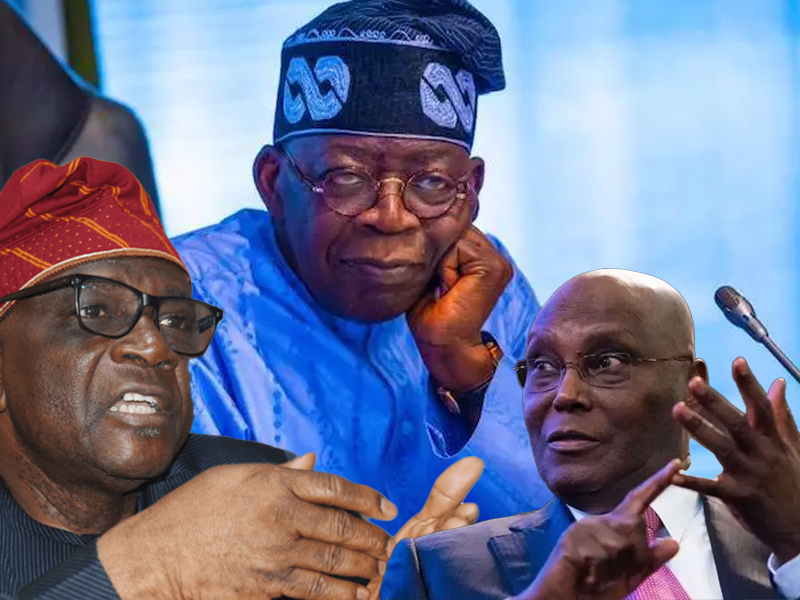
The African Democratic Congress presidential candidate in the 2027 election, Atiku Abubakar, on Thursday, came under vitriolic attacks over his plan to restore petrol subsidy if he wins the 2027 presidential election.
While the Presidency and the Organised Private Sector faulted the proposed policy reversal, the Nigeria Labour Congress was divided over Atiku’s plan to restore the petrol subsidy, which President Bola Tinubu removed during his inaugural address in May 2023.
Meanwhile, in the run-up to the 2023 presidential election, Atiku, then the Peoples Democratic Party candidate, had pledged to remove petrol subsidy within 100 days in office if he won the election.
Under his latest proposal contained in his Atiku Economic Recovery Plan 2027, the ex-vice president said his government would provide qualifying Nigerian refineries with crude oil at preferential prices, but only under strict conditions designed to ensure that the benefit reaches consumers.
He noted that the new petroleum subsidy model would shift government support from imported fuel to locally refined products.
In a statement signed by his Senior Special Assistant on Public Communication, Mr Phrank Shaibu, on Thursday, Atiku called for a detailed explanation of nearly N12tn in energy security expenses recorded by the Nigerian National Petroleum Company Limited in 2023 and 2024.
“My proposal is not to resurrect the old subsidy regime. We will move subsidy from importation to production, from middlemen to Nigerian refineries, and from unverifiable claims to verifiable barrels. The principle is simple: the subsidy will follow the barrel,” he said.
Atiku’s proposal comes against the backdrop of the consequences of the subsidy withdrawal, which had triggered a hike in transportation costs, subjecting millions of Nigerians to untold hardship as families struggle to afford basic needs.
Though the Federal Government has consistently defended it as necessary to prevent fiscal collapse and redirect public finance to infrastructure, education, healthcare and job creation, Nigerians have continued to contend with elevated petrol prices and the wider cost-of-living impact of the subsidy removal.
On Wednesday, the Minister of Finance and Coordinating Minister of the Economy, Taiwo Oyedele, disclosed that the removal of the subsidy and the liberalisation of the naira had generated N15.8tn in savings for the federation between June 2023 and December 2025.
But the ADC presidential flag-bearer argued that Nigeria’s experience since the removal of the subsidy demonstrated the need for a different approach—one that supports domestic production without creating an open-ended liability for the federation.
Under the AERP model, both public and private refineries that meet prescribed requirements would be eligible for preferential crude allocations. The allocation, according to Atiku, would be based on independently verified refining capacity, efficiency, domestic supply, production performance and regulatory compliance rather than political connections.
However, access to cheaper crude would come with a corresponding obligation.
According to the plan, a refinery receiving preferential crude would be required to refine it domestically and supply an agreed quantity of petroleum products to the Nigerian market under a transparent pricing formula reflecting the value of the crude concession.
The ex-VP further argued that crude allocation, refinery intake, production yields, inventories and domestic deliveries would be reconciled so that each subsidised barrel could be traced from the point of allocation to the final consumer.
“No phantom cargoes. No fictitious imports. No unverifiable under-recoveries. No retrospective claims,” the statement read.
He added that operators that divert subsidised crude or products, falsify production records or fail to pass the prescribed benefit to consumers would lose eligibility, repay the subsidy benefit and face regulatory and legal sanctions.
A major component of the proposed model is a fixed annual spending limit.
Unlike the previous system, Atiku said the intervention would be incorporated into the federal budget, allowing the National Assembly and the public to know in advance the maximum financial exposure.
“No refinery gets unlimited support. No marketer brings government a surprise bill. No agency manufactures an under-recovery after the transaction,” he said.
The former vice president also proposed that the opportunity cost of supplying crude below its market-equivalent value should be openly reflected in the accounts of the federation, including the implications for revenues accruing to the federal, state and local governments.
He noted that any additional oil revenue available above a predetermined budget benchmark could only be deployed within the established fiscal ceiling and through a legally appropriated framework.
Atiku also renewed his criticism of the government’s handling of subsidy removal.
He specifically drew attention to NNPCL’s 2023 audited financial statements, which record energy security expenses of approximately ₦4.84tn in 2023 and ₦7.13tn in 2024, a combined figure of about ₦11.97tn.
Atiku said Nigerians deserved a detailed explanation of the economic substance of the energy security expenses and the extent to which they included under-recoveries, pricing differentials or other petroleum supply costs.
“We are not interested in playing games with accounting terminology. If government continued absorbing differences between the economic cost of petroleum products and what was recovered from the market, then Nigerians are entitled to ask how that differs economically from the subsidy they were told had disappeared,” he stressed.
Atiku argues that Nigerians should not simultaneously face market-level pump prices while public resources continue to absorb petroleum-related costs that have not been sufficiently explained.
“Nigerians cannot pay for subsidy removal twice — through punishing pump prices and through unexplained subsidy-like costs against their commonwealth.’’
Atiku’s proposed system would also have a statutory sunset clause, with the level of support expected to decline as domestic refining capacity expands, refinery utilisation improves, and production costs fall.
“Our objective is not permanent subsidy. It is to use temporary and disciplined support to build a refining industry strong enough eventually not to need subsidy,” he said.
The ADC presidential candidate also revived his demand for a comprehensive reconciliation of federation revenues, deductions, savings and transfers.
He said his team’s examination of published Federation Account figures had identified approximately ₦30tn requiring month-by-month reconciliation.
He, however, stressed that he was not alleging that the entire ₦30tn represented fuel subsidy or had been stolen.
“We are not saying ₦30tn is fuel subsidy or that ₦30tn has been proven stolen,” he clarified, adding, “we are saying that approximately ₦30tn reflected across Federation revenues, deductions, savings, transfers and related classifications requires a complete, month-by-month public reconciliation.”
He challenged the Federal Government to publish details of the deductions, beneficiaries, transfers, balances and legal authority behind the transactions.
Presidency faults ex-VP
On Thursday, President Bola Tinubu, while welcoming Governor Ademola Adeleke of Osun State on a courtesy visit after his re-election victory, described the pledge by Atiku to restore petrol subsidy if elected in 2027 as a demonstration of serious ignorance of governance and the economy.
“I saw one of my opponents now say he will go back to subsidy. I read it. That is a demonstration of a serious ignorance on governance and economy,” Tinubu told the delegation.
“Before I came here, 27 states are unable to pay salaries, not to even talk of pensioners, salary of workers. I know a man in your state that I raised who is nicknamed ‘half salary.’ They come to the federal, capping hand, unable to do anything.”
Also, the Presidency dismissed Atiku’s plan as fiscally reckless and politically desperate, accusing the former Vice President of an opportunistic reversal of his own previously stated economic position, five months to the election.
In a statement on Thursday titled, ‘Restoring Petrol Subsidies: Atiku’s Volte-Face and Desperation for Power,’ by the Special Adviser to the President on Information and Strategy, Bayo Onanuga, said Atiku’s promise reflected a man who “least comprehends the present economic dynamics.’’
The Presidency challenged the former VP to explain the fiscal arithmetic behind his latest pledge.
“Against expectations that he would announce a more creative and ingenious alternative to the programme being executed by the Tinubu administration, Atiku Abubakar behaved like a man from an archaic past who least comprehends the present economic dynamics and suggested that he would restore the much-abused, wasteful, pillaged, corruption-ridden fuel subsidy regime, which the Petroleum Industry Act made illegal from the end of June 2023,” the statement read.
It added, “Even though he used to believe that the subsidy regime must be eliminated, a point he canvassed in the run-up to his defeat in the 2023 election, he has now opportunistically recanted the major plank of his economic doctrine and turned a renegade.”
The Presidency rejected the premise of Atiku’s questions, disputing the existence of a N30tn unaccounted windfall.
It argued, “Contrary to Atiku’s claim in his interview, no N30tn subsidy windfall or savings exists anywhere except in his imagination.
“It is not some money sitting in the treasury to be disbursed to offer cheap fuel to Nigerians. It is the massive discount the NNPC offered the Nigerian government: selling fuel it bought at N100 at N50 at the pump, leading to under-recovery of costs and massive losses.
“Somewhere in the NNPC books are still trillions of naira in subsidy costs that the Nigerian government has not paid.”
The Presidency noted that Tinubu’s subsidy removal owes its legal basis to the Petroleum Industry Act, which had scheduled the abolition of subsidies for the end of June 2023 regardless of who succeeds former President Muhammadu Buhari.
“President Tinubu only accelerated it by weeks to stop further bleeding before the due date,” it said, arguing that any reversal “would require a clear legal, fiscal and administrative framework, including identifying the source of the funds and determining how such a policy would be implemented under the present petroleum-market structure.”
The Presidency further argued that Atiku’s promise to restore petrol subsidy would lead to massive job losses and reverse progress made in domestic refining and export.
It said, “Atiku’s proposal portends a reversal of current local production, and it will spell bankruptcy for smaller local refineries like Aradel’s, causing attendant job losses and a loss of foreign exchange.
“Indeed, the Dangote Refinery would not have kickstarted production for local consumption were the subsidy regime operative. This is an important point that Atiku deceptively ignored.”
It contrasted the current export-oriented petroleum sector with the import dependency of previous administrations in which Atiku served.
“Because the sector is now market-driven, Nigeria now exports refined products to Europe, Asia, and the United States, restoring national pride.
“This development is a sharp contrast to when Obasanjo and Atiku were in power: Nigeria’s largest import, costing about $10bn, was refined products! President Tinubu has flipped that to Nigeria’s advantage,” he stated.
On the fiscal dividends of the reform, the presidency credited the removal of the subsidy and the accompanying naira reforms for a dramatic improvement in the finances of state governments.
According to Onanuga, “The N15tn that would have been borrowed and spent on selling discounted petrol has now significantly gone into the coffers of the three tiers of government.
“Now all states are fiscally stable and can pay salaries regularly and embark on infrastructure projects. In July, the three tiers shared about N3 trillion, a record, from the federation account.
“That is a major achievement, since the abolition of petrol price discount and distortions in the foreign exchange regime.”
The Presidency added, “Nigeria is increasingly moving from a model in which scarce foreign exchange is used to import refined petrol to one in which crude oil, largely sold in naira, can be processed domestically and supplied to the Nigerian market.
“That transition creates opportunities for greater energy security, foreign-exchange conservation, industrial development and ultimately a boost to employment generation.”
The Presidency noted that at various points under the subsidy regime, the FG financed the shortfall through borrowing and crude oil-backed loans, with “millions of barrels of crude oil” pledged against such facilities.
It said the NNPC reached a breaking point in 2024, owing suppliers billions of dollars.
“If the subsidy is restored, who pays for it? What will the new pump price be? N200 or N500? If petrol is sold below its economic cost, which is about N1,200 to N1,300, someone must absorb the difference.
“Ultimately, that cost falls on the public finances, through reduced funds for infrastructure and social services, reduced allocation to states and 774 local councils, increased borrowing, higher public debt, or some combination of these,” the statement read.
While acknowledging that households continue to struggle with fuel and transportation costs, the Presidency cited the administration’s Compressed Natural Gas drive as its preferred alternative to relieving the burden.
It said, “The Tinubu administration has been encouraging the use of Compressed Natural Gas, 70 per cent cheaper than petrol, to power taxis, cars and distribution trucks.
“Even Dangote and BUA have CNG trucks in their fleet. What remains is for commercial trucks, buses, and taxis to pass on the benefits of reduced energy costs to our people.”
“We believe sustainable relief is different from recreating a fiscal arrangement that will again cripple our country,” the statement added.
According to Onanuga, Atiku owed Nigerians further explanations before his promise could be taken seriously.
“Specific answers should accompany any promise to restore fuel subsidy. How much will the programme cost annually? What revenue source will finance it? Will the government borrow to fund it? Will the National Assembly be asked to amend existing PIA legislation and petroleum-sector rules? How will subsidy payments be verified and protected from abuse, as witnessed some years ago?” the statement read.
The Presidency also questioned Atiku on what a restored subsidy would now be subsidising, given the changed structure of the market.
It said, “Now that Nigeria has substantially increased domestic petrol production, what precisely would the proposed subsidy be subsidising, the cost of local production, transportation and distribution, or some other component of the petroleum value chain?”
“Nigeria cannot afford to return to policies whose costs are hidden from citizens until they appear later as debt, reduced government spending on social services, and further pressure on the national currency,” the statement added, urging Atiku and other political actors to present Nigerians with the full fiscal and legal implications of any proposal to restore fuel subsidy.
Also, the Special Adviser to the President on Media and Public Communication, Sunday Dare, in a tweet lampooned the ADC candidate, saying, “Atiku Abubakar, your pronouncement that you will bring back fuel subsidy is drenched in hypocrisy and deceit. It is an unpardonable manipulation of the public psyche, designed to hoodwink unsuspecting Nigerians into voting for you.
“The ongoing recovery across various sectors of our national life annoys you, and will be halted if this thinking of yours is implemented. By the Grace of God, it will not happen, and all good men of conscience must rise up against you.’’
OPS opposes subsidy
The Organised Private Sector and economists cautioned against the proposed return of petrol subsidy, saying the policy could worsen Nigeria’s fiscal burden and discourage investment in the energy sector.
In separate interviews with The PUNCH, OPS leaders, including the President of the Association of Small Business Owners of Nigeria, Femi Egbesola, observed that subsidy could offer immediate relief to businesses, but warned against returning to the old system.
“The proposed return of fuel subsidy by the ADC presidential candidate would provide some immediate relief to Nigerians and businesses, particularly MSMEs, because fuel costs feed directly into transportation, logistics, power generation and the prices of goods.
‘’However, we must be careful not to return to the old subsidy regime without addressing its huge fiscal cost and the leakages that characterised it. The Federal Government says the removal generated about N15.8tn in resources between June 2023 and December 2025,” Egbesola said.
He urged the government to adopt a targeted intervention rather than a blanket subsidy.
Egbesola said the government should focus on reducing the cost of energy and improving productivity rather than subsidising consumption.
The National Deputy President of the National Association of Small-Scale Industrialists, Segun Kuti-George, described the proposed reversal as economically damaging, warning that the country had already endured the difficult phase of the reform.
“For me, it is a sign of desperation, political desperado, in the bid to win at all costs. I’m not a politician, and I’m not making a political statement. I’m talking from the point of view of a Nigerian and a businessman and an economist,” Kuti-George said.
He added that reversing the subsidy removal would amount to turning back after making significant progress.
“For anyone to be thinking of reversing this subsidy now, it will be very unfair, and it will be economic suicide. It is like you are going to a promised land and then you’ve gone halfway and then you now said, let us return,” he said.
Kuti-George argued that the government could now deploy resources previously spent on subsidies to infrastructure and other productive investments.
“We could not have gone this far, borne all this suffering, and then we now reverse it. What is that going to get us? Then where will the resources for the subsidy come from? That’s another question.’’
He said the government should sustain the reform and invest the savings in infrastructure to support economic growth.
The Chief Executive Officer of Economic Associates, Dr Ayo Teriba, pointed out that the debate should focus on the type and method of subsidy rather than whether subsidies should exist.
He warned that politicians could make populist promises during campaigns but would still face constitutional and institutional limits when they assume office.
“Politicians have a right to campaign. They have a right to appeal to populist sentiments. But for the education of the public, I would say the following: The debate is not about whether or not to subsidise. The debate is about what is being subsidised and how it is being subsidised,” Teriba said.
The economist noted that price subsidy creates distortions because it encourages wasteful consumption and discourages investment in supply.
“What is inefficient in any country anywhere in the world at any time is price subsidies because it will lead to irrational decisions. When petrol was subsidised, everybody would fill their tank and use it wastefully. When the subsidy was removed, people would think twice about whether to drive their car or use public transport.”
Teriba also warned that subsidising prices could discourage investors from committing capital to refining and other energy infrastructure.
He said the government could still support vulnerable Nigerians through income and expenditure subsidies without fixing the market price of petrol.
He cited support for compressed natural gas, electricity, farmers and other vulnerable groups as examples of alternatives to blanket price subsidies.
The Director of the Lagos Business School Public Sector Initiative, Prof. Franklin Ngwu, said restoring fuel subsidy would repeat the fiscal and governance problems that plagued the policy for years.
Ngwu said the country should consider the history of subsidy administration, particularly the corruption associated with the scheme, before embracing any proposal to reinstate it.
“The first thing is to acknowledge that we had an oil subsidy for so many years. And if we appreciate the history of subsidy, the management of subsidy, and particularly inherent corruption in subsidy administration and management, from a good sociopolitical and economic point of view, I do not think that bringing it back would be the best policy for Nigeria,” Ngwu said.
He acknowledged that the proposal could appeal to Nigerians struggling with the rising cost of living but warned that its economic consequences could outweigh the immediate relief.
“While it might sound very populist, while it might sound like it’s going to address or help the poor or the vulnerable Nigerians or the masses, from strategic assessment and economic analysis, I think it might not be the best,” he said.
Ngwu urged the government to channel the savings from subsidy removal into education and healthcare, saying those sectors could deliver more sustainable benefits to Nigerians.
“The two critical areas that can be used to sustainably develop a society which contributes to Human Development Index include education and health. So, from an economic point of view, I think that deploying the resources saved from subsidy removal into health and education would make a more meaningful impact on Nigerians than bringing it back,” he said.
He said the government should also invest in productivity, manufacturing and cheaper credit for small businesses after addressing education and healthcare.
“We have close to maybe about over 18 million out-of-school children in Nigeria. These out-of-school children, that’s what we had 20 years ago, 25 years ago, 15 years ago, have now transformed into bandits, into all kinds of criminals and all that. So, if we want to really create a sustainable development of this country, we need to focus on education and health,” Ngwu said.
He added that the government could use available resources to reduce the financing burden on MSMEs and strengthen productive sectors.
“Then, if there is still money, we can focus on productivity, manufacturing. If there is money as well, we can also focus on helping and reducing the interest rate paid by MSMEs, micro, small and medium enterprises, so they can be able to get loans at a cheaper rate,” he said.
On his part, Economist, Dr Vincent Nwani, said Atiku’s pledge lacked details on how his proposed subsidy reversal would work without undoing other economic reforms implemented since 2023.
Nwani said returning fuel subsidy would amount to taking the economy back to the conditions that existed before the removal of the scheme, with implications beyond the petrol market.
“Unfortunately, the former vice president, Mr Atiku Abubakar, did not go deeper to tell us how he wanted to achieve that, because returning fuel subsidy is as good as restating the economy back to where it was on the morning of May 29, 2023. So it’s not just the demand side but the supply side. It’s not just the payment side but the spending side,” Nwani said.
He questioned how a new government would reconcile subsidy restoration with other changes, including the current minimum wage and the broader fiscal adjustments that followed the removal of subsidy.
“Is he also telling us that he will adjust the wages from N70,000, the minimum wage from N70,000 back to N29,000 or N28,000? We remain to see how he wants to do that. But as I said, it’s about readjusting the whole economic quotient. You cannot just bring back the subsidy and not have a lot of issues,” he said.
Nwani warned that reversing the policy could produce another wave of economic disruption, arguing that Nigeria had already endured significant shocks from recent reforms.
“For me, the impact will be as much as the impact that removal of fuel subsidy has. Not just one leg, so many other legs. But does Nigeria need those types of shocks again? No, in my own professional thinking. If you ask me, if I’m the incoming president, what I will do, I will not go back to fuel subsidy,” Nwani said.
Instead, he urged any incoming administration to focus on governance, infrastructure and security while maintaining the subsidy reform.
“What I will do is I will improve on transparency, good governance that is properly communicated. That’s what I’ll go back to. There’s a lot of debt covenant we entered into with the IMF,” he said.
Nwani said the government should prioritise electricity, roads, rail transport and security instead of returning to petrol price subsidy.
“If I were to advise, leave it as it is, but get things going. In all of these things that we are talking about, get the power to be constant, get the roads fixed, get the rails running, get your security addressed,” he said.
The economist added, “The major problem we have is not even the fuel price, to be honest. It’s not even the fuel price. Get your security addressed. Give us good roads, give us rails across the country. Good governance is what we are seeking, not the fuel price at all. Solve this security in the North, solve this security in the South.”
Wike reacts
Meanwhile, the Minister of the Federal Capital Territory, Nyesom Wike, has defended the Federal Government’s removal of fuel subsidy, accusing Atiku of inconsistency over his position on the policy.
According to a statement issued by the Senior Special Assistant to the minister, Lere Olayinka, Wike questioned Atiku’s rationale for seeking to reverse a policy he had previously supported.
“Now, in 2026, he is not going to remove the fuel subsidy. Is he going back to the fraud, which he had alleged that the fuel subsidy was?” Wike asked.
Describing Atiku as a “voodoo economist”, the minister accused him of changing his positions to appeal to voters.
“Atiku is confused and acts like a voodoo economist; Atiku will say anything just to be president,” Wike said.
He argued that presidential aspirants should demonstrate consistency in their policies rather than adjust their positions to suit political circumstances.
“Leadership is not you coming out, you say one thing now in the morning, in the afternoon you say a different thing, in the night you are talking of a different thing. That is not it,” he said.
He also questioned how Atiku intended to reintroduce fuel subsidy given the transformation of Nigeria’s petroleum industry following the enactment of the PIA and the commercialisation of the NNPCL
“He (Atiku) is living in the past. If not, he will know that with the PIA, NNPCL is now fully commercialised. It has transformed the old NNPC into a limited liability company, and no longer the sole importer or producer of fuel,” Wike said.
The minister asked, “Will Atiku, as president (Which he never will be), pay subsidy on fuel produced by Dangote Refinery? It also shows that he is confused, having insisted in the past that he will remove subsidy, which he described as a fraud. Does it now mean that he will restore what he said was a fraud?’’
The ex-governor stated that restoring subsidy would contradict the direction of the Petroleum Industry Act, which was designed to make the midstream and downstream petroleum sector commercially driven and competitive.
“Reintroducing government-controlled fuel prices would reverse this policy direction, create regulatory uncertainty and weaken investor confidence in the sector. It will also recreate the distortions Nigeria has spent years trying to eliminate, “ Wike argued.
Defending President Tinubu’s policy, Wike said the savings had resulted in increased allocations to the three tiers of government.
Atiku’s position strange- NDC
Speaking on the issue, the National Democratic Congress described the position of the ADC presidential candidate on petroleum subsidy retention as strange, noting that while contesting the presidential election in 2023, Atiku pledged to remove subsidy if elected.
In an interview with our correspondent on Thursday, the National Publicity Secretary of the Party, Osa Director, said, “In 2023, Atiku said he was going to remove petroleum subsidy if elected. Our presidential candidate, Mr Peter, also said the same thing: he was going to remove the petroleum subsidy if elected in 2023. So, what the former vice president is saying today is strange.”
The NDC publicity scribe, however, stressed that Atiku’s new position might be a reflection of the economic realities of today’s Nigeria.
When asked about the stand of the NDC presidential candidate on petroleum subsidy ahead of next year’s election, he said, “Mr Peter Obi is in the process of analysing and reviewing the situation, and he will make his position known on whether he will sustain subsidy removal or restore it if elected president in 2027.”
NLC divided
Atiku’s proposal has, however, divided the Nigeria Labour Congress, with officials of the union taking different positions. The NLC spokesperson, Benson Upah, said the labour centre is open to the restoration of fuel subsidy if the policy will reduce the economic burden on Nigerians, particularly workers.
In an interview with one of our correspondents, Upah stated that the labour movement was not opposed to subsidy in principle, arguing that governments across the world often subsidise essential goods and services to cushion the impact of rising costs on citizens.
He said, “We are open to anything that will lighten the burden on Nigerians as a whole, but workers in particular.”
According to him, subsidy should not automatically be regarded as a bad policy, stressing that responsible governments could adopt subsidies to protect citizens from the impact of high prices.
“It is important to note that subsidy is inherently not evil. Every responsible country or government acting reasonably subsidises the consumption of petrol by its citizens in one way or the other,” he said.
Upah, however, said the major problem with Nigeria’s subsidy regime was not the concept itself but the alleged corruption surrounding its implementation.
“What is evil is the crime or the criminal content of subsidy in our shores which the government of the day not only condones but encourages,” he said.
The NLC spokesperson said the government should focus on identifying and prosecuting those allegedly exploiting the petroleum supply chain instead of transferring the consequences of such activities to ordinary Nigerians.
He said, “Sadly, when the roof caves in, instead of government going after the crooks doing round-tripping, over-invoicing, excess-ex or in-coastal charges, hoarding products or even selling substandard products, smuggling, government turns on the people—the victims who have no hand in any of these.”
Upah argued that Nigerians should not be made to pay for leakages and fraudulent practices allegedly perpetrated by individuals within the fuel supply chain.
On his part, the National Assistant Secretary of the NLC, Christopher Onyeka, said the union would support Atiku or any government if its objective was to make petroleum products cheaper for Nigerians, but would not support a return to the subsidy regime.
He questioned the basis for bringing back a policy that the current administration has abolished.
“If he says he wants to reduce the price of petroleum products when he comes back, that’s fine,” the executive told The PUNCH. “If he says when I come back, I will reduce the price of petroleum products, we are cool with him. But pricing on that subsidy is unacceptable.”
Source: punchng.com
FOLLOW US ON: