Connect with us

Business

CBN holds rates as OPS flags manufacturing risks

Published

on

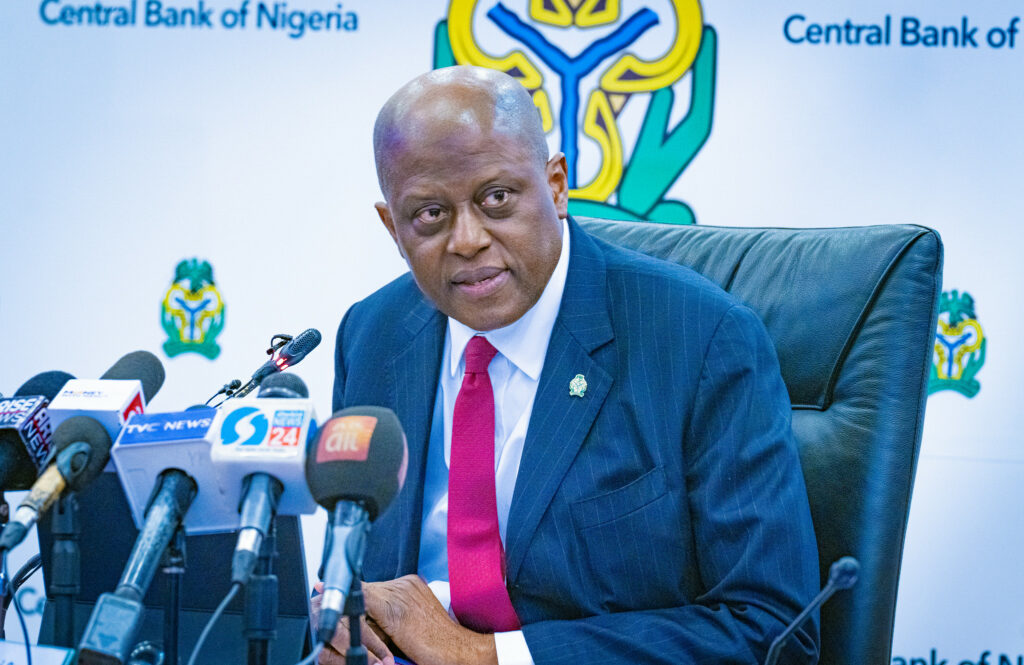
The Monetary Policy Committee of the Central Bank of Nigeria (CBN) on Wednesday retained the benchmark interest rate at 26.5 per cent, citing rising external risks, renewed inflationary pressure, and the need to sustain exchange rate stability.

The CBN Governor, Olayemi Cardoso, announced the decision at the end of the committee’s 305th meeting held in Abuja. He said, “The committee’s decision is as follows: retain the monetary policy rate at 26.5 per cent.”

The decision also elicited mixed reactions from members of the Organised Private Sector. They acknowledged the justification for retaining interest rates and, on the other hand, cautioned that high rates hamper private sector investment in SMEs and manufacturing, leading to lower output and hampering job creation.

The committee also retained the standing facilities corridor around the MPR at +50/-450 basis points, the Cash Reserve Requirement of Deposit Money Banks at 45 per cent, Merchant Banks at 16 per cent, and non-TSA public sector deposits at 75 per cent.

The decision came after Nigeria’s headline inflation rose for the second consecutive month to 15.69 per cent in April 2026 from 15.38 per cent in March, according to the latest Consumer Price Index report released by the National Bureau of Statistics.

Food inflation also increased to 16.06 per cent in April from 14.31 per cent in March, reflecting higher transportation and logistics costs as well as seasonal pressures, while core inflation moderated to 15.86 per cent from 16.21 per cent.

The MPC said the renewed inflationary pressure was largely caused by external shocks, particularly spillovers from the Middle East crisis, which had pushed up global energy prices and logistics costs.

However, the committee said the impact on Nigeria had been muted by earlier reforms, including exchange rate stability, improved external reserves, stronger monetary policy transmission, a better-capitalised banking system, and ongoing fiscal consolidation.

It said, “Although inflation has risen marginally for two consecutive months, largely induced by external shocks, the MPC recognised its transitory nature and remained confident that the current macroeconomic environment is sufficiently robust to support a return to disinflation.”

Speaking during the post-meeting press briefing, Cardoso said the CBN would sustain its current policy direction, noting that the country had recorded 11 straight months of disinflation before the recent uptick.

“We’ve got to remember that we’ve been coming from 11 straight months of disinflation. And we believe that what we have now is something that has resulted from external shocks,” he said.

He added that the apex bank had built buffers to protect the economy, saying Nigeria’s recent sovereign rating upgrade by Standard & Poor’s showed that current policies were moving the economy in the right direction.

According to him, exchange rate stability remains central to the CBN’s inflation-control strategy. “It is key that the centrepiece of our toolkit is ensuring that our foreign exchange rate remains stable,” Cardoso said, adding that the bank would continue to work with fiscal authorities to reduce inflation pass-through.

See also  FCCPC flags rising circulation of substandard goods

On the foreign exchange market, the governor dismissed claims that the CBN was aggressively intervening to defend the naira. “The answer is that it’s not true,” he said. “The foreign exchange system has changed considerably.”

Cardoso said daily foreign exchange turnover had risen from about $100m when the current administration took office to roughly $550m, with occasional spikes to $1bn. He said the CBN’s intervention in 2025 was only about 1.2 to 1.3 per cent of total market turnover, adding that the market was increasingly being driven by willing buyers and willing sellers.

The governor also said Nigeria’s external reserves remained dynamic and resilient, despite recent concerns over declines in reserve levels. The MPC communiqué showed that gross external reserves stood at $49.49bn as of May 15, 2026, compared with $48.35bn at the end of March, providing 9.04 months of import cover.

Cardoso said some reserve movements reflected normal payments for government obligations and loans, but added that new inflows were also coming in.

Addressing the new foreign exchange manual, the apex bank chief said the document, which became effective on June 1, was part of ongoing reforms to deepen transparency and improve market confidence.

He said the last major revision was done in 2017, adding that the new manual would make it easier for exporters to repatriate foreign exchange earnings and access their funds without unnecessary restrictions.

OPS reacts

In separate phone interviews with The PUNCH, business leaders expressed more cautiousness. They backed the retention as a necessary move to shield the economy from instability linked to tensions in the Middle East and election-related inflation risks. In the same vein, they argued that the high borrowing cost would further weaken small businesses and deepen poverty.

President of the Lagos Chamber of Commerce and Industry, Leye Kupoluyi, explained that while the Chamber acknowledges market expectations for a rate cut to ease credit conditions and stimulate growth, it recognises that persistent inflationary pressures justify policy prudence at this stage.

He warned that “an elevated interest rate continues to constrain private sector investment, especially SMEs and manufacturing, thereby weighing on output and job creation.”

The LCCI described the 26.5 per cent rate as “A necessary stance to anchor inflation expectations, given the rise in headline inflation to 15.69 per cent in April 2026 from 15.38 per cent in March.”

Kupoluyi concluded that LCCI would continue to constructively support the apex bank as it “firmly calls for a clear, data-driven path toward gradual monetary easing once disinflation becomes sustained and exchange rate stability is reinforced.”

On his part, the Deputy President of the National Association of Small-Scale Industrialists, Segun Kuti-George, described the decision as appropriate given prevailing uncertainties.

“It is the sensible thing to do in this unstable atmosphere. Both at the local and world stages, there are serious instabilities, so it’s difficult to respond to them. The best thing is to retain the rates so you don’t get yourself into unnecessary problems due to the general instability,” Kuti-George said.

Also supporting the decision, the Director of the Centre for the Promotion of Private Enterprise, Dr Muda Yusuf, said the committee acted in line with expectations by resisting further tightening.

See also  FG rallies private sector to bridge broadband gap

“The MPC decision to retain the rate is in line with the CPPE’s expectation. We were trying to caution that we don’t want to see further tightening of monetary policy,” Yusuf said.

The CPPE chief observed that businesses were already grappling with harsh operating conditions and could not absorb additional increases in borrowing costs. “The situation is bad enough for many businesses. We don’t want an additional hike in interest rates,” Yusuf said.

He explained that although inflation edged higher in March and April, month-on-month indicators for headline, core, and food inflation had declined, giving the apex bank room to maintain rates rather than tighten policy further.

Yusuf added that the prevailing geopolitical tensions involving Iran, Israel and the United States, rising crude oil prices, and increasing election-related spending posed major inflationary threats that made a rate cut unrealistic at this stage.

“Those inflation risks are a lot. So you can’t expect the CBN to be relaxing when you are facing so much inflation risk. Our own position is that even despite that, they should not tighten monetary policy. And they didn’t tighten,” Yusuf said.

However, the President of the Association of Small Business Owners of Nigeria, Dr Femi Egbesola, faulted the decision and called for a reduction in rates at the next MPC meeting.

“Many of us were very hopeful that the interest rate would come down. We believe that lowering the interest rate will go a long way to support more access to funding for SMEs and will also make it more affordable,” Egbesola said.

He said the retention would worsen the challenges facing businesses and households already struggling with rising energy costs and inflation.

“I’m not too sure that this is going to be good for SMEs and the business community. I’m not too sure that it is also going to be good for the citizens because this will continue to mean that poverty will remain or become deeper,” Egbesola said.

He added, “Our prayer is for it to be lowered. We hope that in the next MPR session, something more reasonable will be done to lower it.”

Earlier predictions from CPPE chief, Muda Yusuf and analysts at United Capital Plc Research held that the MPC would likely retain the current monetary policy stance despite rising inflationary pressures, citing inflationary pressures and rising liquidity ahead of the 2027 elections.

Recapitalisation, SMEs credit

The CBN governor also addressed the recent banking recapitalisation exercise, saying 33 banks had met the new capital requirements. He said the outcome showed investor confidence in the Nigerian economy, with domestic investors accounting for about 74 per cent of the capital raised and foreign investors contributing about 26 per cent.

See also  Voltage disturbance hits Gombe substation, triggered partial grid collapse — NISO 

Cardoso said banks yet to meet the threshold were dealing with legal, regulatory, and judicial issues, but remained under close supervision by the apex bank. “We are fully on top of all of the banks that are still on that road of travel. And there is business continuing as usual,” he said.

On credit to small and medium enterprises, Cardoso said the CBN was working with other government institutions to improve lending to the sector, noting that SME financing was not the exclusive responsibility of the apex bank.

He disclosed that new credit to the SME sector rose to about N199bn in April 2026 from N153bn in March, driven largely by retail, SME, and short-term facilities.

He said the CBN had also signed a memorandum of understanding with the Nigerian Communications Commission to tackle fraud and improve digital connectivity, while the Global Standing Instruction framework was helping lenders manage credit risks.

Cardoso said development finance institutions had also been given higher single obligor limits to enable them to extend more credit to SMEs.

On bank charges and customer complaints, the governor clarified that the N50 stamp duty did not originate from banks but from tax authorities, with banks only serving as collection channels.

He said the CBN had set up a committee led by its Consumer Protection Department, involving deposit money banks and the top 10 microfinance banks, to review customer complaints and improve service delivery.

Cardoso said one issue under review was the multiplicity of debit alerts and transaction notifications sent by banks, which often created confusion for customers.

He added that the CBN’s compliance department was also reviewing market conduct and how banks handle complaints, including their ability to compensate customers where necessary.

The MPC also noted that real GDP grew by 4.07 per cent in the fourth quarter of 2025 from 3.98 per cent in the previous quarter, supported by growth in industry, agriculture, services, and the oil sector.

The committee projected that output growth would remain resilient in 2026 despite risks from the Middle East conflict, while inflation was expected to moderate as the previous tightening, exchange rate stability, and improved food supply began to take effect.

The next MPC meeting is scheduled for July 20 and 21, 2026. The PUNCH earlier reported that the Central Bank of Nigeria noted that 63.3 per cent of Nigerians want interest rates reduced.

The apex bank disclosed this in its April 2026 Inflation Expectations Survey Report, released by its Statistics Department under the Economic Policy Directorate, and obtained by The PUNCH. The report found that most respondents preferred lower borrowing costs despite persistent inflationary pressures across the economy.

Continue Reading
Click to comment

Leave a Reply

Your email address will not be published. Required fields are marked *

Business

Domestic gas sales rise 30% on reforms – Report

Published

on

Nigeria’s domestic gas market recorded a significant increase in sales, rising by about 30 per cent between January 2022 and January 2025, driven by reforms under the Petroleum Industry Act 2021 and recent executive orders by President Bola Tinubu, according to a legal analysis by Tope Adebayo LP.

The Lagos-based full-service law firm said in a statement made available to our correspondent that the reforms have improved regulatory clarity, fiscal attractiveness and investor confidence across the gas value chain, even as infrastructure gaps and implementation challenges continue to slow the pace of growth.

It stated that Nigeria, which holds more than 206 trillion cubic feet of proven gas reserves, has long struggled to convert its resource base into domestic energy supply due to underinvestment, weak infrastructure and gas flaring.

According to data cited in the report, domestic gas sales rose from 49.3bscf in January 2022 to 64.2bscf in January 2025, reflecting the gains attributed to ongoing reforms under the PIA.

The report noted that the legislation marked a turning point for the sector.

“The PIA represents the most comprehensive reform of Nigeria’s petroleum sector in decades and has established a stronger foundation for domestic gas development through regulatory clarity, pricing liberalisation mechanisms, infrastructure support and enhanced investment incentives,” the firm stated in a report titled ‘From Policy to Practice: Legal and Regulatory Drivers of Nigeria’s Domestic Gas Market Under the PIA and Recent Executive Orders’.

It explained that structural reforms under the Act, including the creation of separate regulatory authorities for upstream and midstream/downstream operations, have helped to improve oversight and reduce regulatory bottlenecks.

See also  Technology key to implementing new tax laws – Adedeji

The analysis also highlighted the Domestic Gas Delivery Obligation framework as a key intervention aimed at boosting supply to strategic sectors such as power generation and industry. The framework includes enforceable penalties for non-compliance.

It further noted improvements in gas utilisation and supply performance, alongside modest reductions in gas flaring and the expansion of the Nigerian Gas Flare Commercialisation Programme, which it said has seen multiple flare sites auctioned for monetisation projects.

Beyond production measures, the PIA, it stated, introduced open-access provisions for infrastructure, partial liberalisation of gas pricing and the establishment of the Midstream and Downstream Gas Infrastructure Fund to support investments in processing, transportation and distribution.

The law firm maintained that recent executive orders and presidential directives have also strengthened the investment climate through tax incentives, faster contracting timelines and more flexible local content implementation.

“These interventions signal a deliberate effort by the government to improve project economics and enhance Nigeria’s competitiveness as a destination for gas investments,” Tope Adebayo LP noted.

However, the firm warned that policy gains alone are insufficient to deliver the market’s full potential.

“Large-scale outcomes remain constrained by persistent infrastructure gaps, payment risks within the power sector, legacy debts, and implementation inefficiencies. The transition from policy to practice is clearly underway, but it remains incomplete,” it stated.

According to the analysis, achieving a fully functional and scalable domestic gas market will require sustained investment in pipelines, processing facilities, transportation networks and distribution systems, alongside stronger institutional coordination and consistent regulatory execution.

The report stated that the foundations had been laid, but long-term success would depend on effective implementation and continued market reforms. It added that, to unlock the full promise of the Decade of Gas initiative, Nigeria must bridge the gap between legal design and operational reality.

See also  Middle East war may force Nigerians to work from home – Dangote

punch.ng

FOLLOW US ON:

FACEBOOK

TWITTER

PINTEREST

TIKTOK

YOUTUBE

LINKEDIN

INSTAGRAM

Continue Reading

Business

Nigerians, others buy $3.1bn airtime on credit

Published

on

Mobile phone subscribers in Nigeria and other emerging markets borrowed airtime worth $3.18bn on credit in 2025, with Africa accounting for more than 94 per cent of the total, according to the latest financial statements of fintech firm Optasia.

The company’s 2025 consolidated financial statements showed that airtime advances granted through telecom operators rose to $3.18bn last year from $2.83bn in 2024, reflecting a 12.3 per cent increase.

Optasia stated, “Airtime credit services represent service fees charged on airtime credit amounting to $3,176.34m (2024: $2,829.2m) granted to subscribers of the telecom operators during the year.”

Using the exchange rates disclosed in the financial statements, the airtime advances amounted to about N4.61tn in 2025 in naira terms, up from approximately N4.38tn in 2024.

Despite the growth in dollar terms, the naira value rose by a slower pace as the exchange rate strengthened to N1,450.58/$ at the end of 2025 from N1,547.30/$ a year earlier.

The report showed that Africa remained the dominant market for the service, accounting for $2.99bn, or 94.2 per cent, of all airtime credit disbursed in 2025. This was up from $2.53bn recorded in 2024. Europe and Asia accounted for $96.1m, while the Middle East contributed $87.7m.

The figures highlight the growing dependence of millions of mobile users across Africa on small-value digital credit products, particularly in economies where access to formal financial services remains limited, and household purchasing power is under pressure.

Optasia, which provides airtime advances and nano-loan services through partnerships with mobile network operators and financial institutions, said its technology platform assesses subscribers’ behaviour and determines their eligibility for credit.

According to the company, the platform handles “scoring, financial decisioning and disbursements” by analysing subscribers’ credit history and other relevant data before determining the amount of advance that can be granted.

The report explained that the company also assumes part of the credit risk associated with the service. “As part of the airtime credit service, the Group also commits to indemnify the MNO for the amount of advance so granted, in case the subscriber fails to pay the same within a specified period of time from the date of grant of advance,” it stated.

Beyond airtime lending, the company recorded a sharp increase in nano-loan transactions during the year. Its Mobile Financial Services segment facilitated nano-loans worth $2.30bn in 2025, more than double the $967.9m recorded in the previous year.

Africa accounted for $1.41bn, representing 61.4 per cent of the total, while Europe and Asia contributed $888.9m. The company said the loans were provided through arrangements involving telecom operators and financial institutions, with its proprietary platform supporting credit scoring, approvals, disbursements and collections.

The growth in airtime lending and nano-loan transactions boosted the firm’s earnings during the year. Revenue rose by 75.5 per cent to $265.36m in 2025 from $151.19m in 2024. Mobile Financial Services contributed $167.53m to revenue, while airtime credit services generated $96.86m.

See also  NISO cuts transmission losses to 7% from 10% in one year

Africa remained the company’s biggest revenue source, contributing $234.81m, or 88.5 per cent of total revenue, compared with $121.31m in the previous year. Europe and Asia generated $25.43m, while the Middle East accounted for $5.12m.

Profit after tax increased to $43.13m from $36.23m in 2024, while total assets more than doubled to $302.17m from $141.79m.

The company described itself as “an analytics technology services provider in the fintech sector offering its services to large mobile telecom operators to provide airtime/data credit, micro- and nano-cash loans to underbanked populations in the emerging markets.”

According to the financial statements, Optasia operates across more than 25 countries, including Nigeria, South Africa, Ghana, Tunisia, Algeria, Zambia, Uganda, Rwanda, Ethiopia, Egypt, Benin, Côte d’Ivoire, Liberia, Lesotho, Mozambique, Pakistan, Bangladesh, Myanmar, Indonesia, Malaysia, Qatar, Brazil, Greece, Cyprus and the United Arab Emirates.

However, the report showed that Africa remained the dominant market for the firm, with operations in 16 African countries, including Nigeria, South Africa, Ghana, Egypt, Ethiopia, Algeria and Zambia.

The financial statements also showed that Optasia has a direct operating presence in Nigeria through two wholly owned subsidiaries, Nairtime Nigeria Limited and Xtra MFS Nigeria Limited.

Both entities are listed as Nigerian subsidiaries, with Optasia holding a 100 per cent beneficial ownership stake in each company. Nairtime Nigeria Limited was incorporated in 2012, while Xtra MFS Nigeria Limited was incorporated in 2019.

Although the company did not disclose separate revenue or profit for its Nigerian operations, the report suggests that Nigeria remains one of its more significant African markets. The report showed that Nigeria was material to Optasia’s foreign exchange exposure, with the Nigerian naira listed among the currencies that expose the group to currency risk.

Under its financial risk management note, the company stated that it was exposed to currency risk on revenues, expenses and intercompany transactions denominated in currencies outside its functional currency.

It listed the Nigerian naira alongside the euro, Congolese franc, Tanzanian shilling, South African rand, Zambian kwacha and Ghanaian cedi. As of December 31, 2025, Optasia reported total naira-denominated assets of N19.72bn and naira-denominated liabilities of N357.09m, leaving a net naira exposure of N19.37bn.

This was lower than the N25.03bn net naira exposure recorded in 2024, when naira-denominated assets stood at N25.11bn and liabilities at N81.01m. The decline means the group’s net naira exposure fell by N5.66bn, or 22.6 per cent, year-on-year.

However, the remaining N19.37bn exposure still makes Nigeria one of the company’s major currency-risk markets, meaning movements in the naira can affect the value of its earnings, assets and liabilities when translated into dollars.

Optasia also disclosed that a five per cent movement in the dollar against the naira would have affected equity by $668,000 in 2025, compared with $809,000 in 2024. This means the company’s sensitivity to naira movement reduced during the year, in line with the fall in its net naira exposure.

At the end of 2025, Nigeria accounted for $7.73m in gross trade receivables, more than double the $3.80m recorded a year earlier. The increase of 103.6 per cent was one of the strongest among the group’s disclosed markets, indicating a substantial rise in transaction activity and outstanding balances linked to Nigerian operations.

See also  FCCPC flags rising circulation of substandard goods

The report also highlighted the company’s exposure to Nigeria’s financial system through naira-denominated credit facilities obtained from local banks. According to the financial statements, Optasia maintained an invoice discounting facility and a cash-backed term loan facility in Nigeria, both denominated in naira and carrying interest rates of 30 per cent per annum.

While the facilities were not utilised as of December 31, 2025, they demonstrate the company’s access to local currency funding to support its operations in the country. Nigeria also featured prominently in the company’s discussion of its investment in Quickcheck Holding Limited, a digital lending business in which Optasia holds a 10.05 per cent stake.

The report noted that Quickcheck is “primarily exposed to operations in Nigeria”, making developments in the Nigerian economy important to the investment’s performance.

In its assessment of the investment, the company pointed to policy measures introduced by the Central Bank of Nigeria and broader economic reforms as factors supporting a more stable operating environment.

The report stated that recent policy actions by the CBN, alongside improved oil revenues and narrowing foreign exchange risk spreads, were early indicators of macroeconomic stabilisation.

It added that these developments could help strengthen local-currency earnings and reduce the impact of foreign exchange volatility on businesses operating in Nigeria.

The report further shows that telecom-linked lending is becoming an increasingly important source of short-term financing for underbanked consumers, particularly in Africa, where mobile phone penetration significantly exceeds access to formal banking services.

However, the rapid growth of digital lending also carries rising credit risks. The company’s provision for expected credit losses on financial guarantee contracts climbed to $65.21m in 2025 from $33.42m a year earlier, reflecting the growing exposure associated with airtime advances and nano-loan products.

Despite the higher risk provisions, the strong growth in transactions, revenue and profitability indicates that demand for small-ticket digital credit remains robust across the markets in which the company operates.

However, in Nigeria, Optasia faces a push by the Federal Government to open the country’s airtime credit and data advance market to indigenous fintech firms.

Reports claimed that the Presidency backed regulatory efforts championed by the Federal Competition and Consumer Protection Commission to dismantle what it described as Optasia’s 12-year dominance of the sector, arguing that broader participation would promote competition, support local content development and reduce capital flight.

According to recent reports, the FCCPC convinced the Presidency that the current market structure had limited opportunities for Nigerian firms while enabling significant profit repatriation abroad.

See also  FG allays fears over tax reforms

However, the FCCPC has distanced itself from reports that it recommended the opening of the airtime credit market to nine new operators or submitted the names of local fintech firms to the Presidency for approval.

In a statement issued recently, FCCPC Director of Corporate Affairs, Ondaje Ijagwu, said the commission was neither aware of nor involved in the claims attributed to it, describing reports linking it to the alleged approvals as inaccurate.

“The commission wishes to state clearly that it is not aware of, and was not involved in, the claims attributed to it in the report absolutely,” Ijagwu said.

The reports had alleged that President Bola Tinubu approved plans to restructure the airtime credit market and endorsed the participation of nine Nigerian fintech firms.

However, the FCCPC maintained that it had no involvement in any such approvals and noted that the regulatory framework under which the firms were reportedly approved remains suspended.

According to the commission, implementation and enforcement of the DEON Consumer Lending Regulations 2025 were halted following an interim injunction granted by the Federal High Court in Lagos on April 15, 2026, in a suit filed by the Wireless Application Service Providers Association of Nigeria.

The commission said it remained bound by the court order pending the determination of the substantive case, which is scheduled for further hearing on July 20, 2026.

The FCCPC’s position leaves unresolved the basis of the earlier reports that detailed alleged policy proposals, market reforms and a list of companies said to have been approved to participate in the airtime credit market.

The Presidency has yet to publicly comment on whether any directive relating to the DEON framework or the sector was issued, further depending the controversy around airtime lending.

The controversy began in April when MTN, Airtel, Glo and T2mobile suspended airtime credit offerings following an FCCPC directive requiring compliance with the DEON framework.

The commission had classified airtime credit as a form of consumer lending, bringing it under regulations originally designed to address abuses by digital lending platforms. The move sparked a regulatory dispute with the NCC, which oversees telecommunications services under the Nigerian Communications Act 2003.

However, airtime and data credit services gradually have been restored across Nigeria’s telecommunications networks after weeks of disruption that affected millions of subscribers.

The Association of Licensed Telecommunications Operators of Nigeria earlier applauded the FCCPC for suspending the enforcement of the Digital, Electronic, Online, or Non-traditional Consumer Lending regulations against telecommunications operators, describing the move as a major boost for regulatory certainty and investor confidence in the sector.

punch.ng

FOLLOW US ON:

FACEBOOK

TWITTER

PINTEREST

TIKTOK

YOUTUBE

LINKEDIN

INSTAGRAM

Continue Reading

Business

Banks earn N225bn from ATM, e-banking charges

Published

on

Nigerian banks generated N224.69bn from electronic banking services and ATM/card-related charges in the first quarter of 2026, representing a 12.56 per cent increase from N199.61bn recorded in the corresponding period of 2025, an analysis of the unaudited financial statements of 11 listed lenders has shown.

The increase came as banks continued to deepen digital banking adoption and electronic payment services, with income from e-banking channels accounting for a significant share of non-interest revenue during the period under review.

Findings by The PUNCH showed that electronic banking and ATM/card management fee income rose by N25.06bn year-on-year, from N199.61bn in Q1 2025 to N224.67bn in Q1 2026. A breakdown showed that income from electronic banking and e-business activities increased by 11.57 per cent to N177.97bn from N159.52bn recorded a year earlier.

Similarly, earnings from ATM and card management fees climbed by 16.48 per cent to N46.70bn from N40.09bn in Q1 2025.

The growth in digital banking revenue coincided with a broader increase in banking sector fee income. The PUNCH earlier reported that the total fee and commission earnings of the 11 lenders rose by 13.64 per cent to N984.47bn from N866.30bn. Also, account maintenance fee income increased by 14.07 per cent to N209.18bn from N183.37bn.

Among the lenders reviewed, Access Holdings recorded the highest earnings from e-banking services, generating N55.71bn in Q1 2026. UBA followed with N46.93bn, while Ecobank earned N35.53bn from card management fees. GTCO posted N21.90bn in e-business income, and Zenith Bank generated N21.54bn from electronic product fees.

Other notable contributors included First Holdco with N20.75bn, Wema Bank with N6.10bn, Fidelity Bank with a combined N8.81bn from ATM charges and e-banking commissions, Stanbic IBTC with N4.33bn from card-based commissions and electronic banking fees, Sterling Financial Holdings with N2.89bn, and Jaiz Bank with N187.05m.

See also  Middle East war may force Nigerians to work from home – Dangote

An analysis of growth rates showed that Fidelity Bank recorded the strongest expansion in digital banking-related income. The lender’s combined ATM charges and e-banking commissions rose by 164.9 per cent to N8.81bn from N3.08bn in the corresponding period of 2025, driven largely by a 240.8 per cent jump in ATM charges.

GTCO followed with a 68.64 per cent increase in e-business income to N21.90bn from N12.99bn. Stanbic IBTC’s combined card-based commission and electronic banking income rose 52.8 per cent to N4.33bn, while Zenith Bank’s fees on electronic products increased by 58.91 per cent to N21.54bn.

Sterling Financial Holdings recorded a 22.15 per cent increase in e-business commissions and fees, while Access Holdings posted a 15.2 per cent rise in channels and e-business income to N55.71bn.

However, some lenders recorded declines in digital banking-related income. Wema Bank posted the sharpest decline, with fees on electronic products dropping by 50.68 per cent to N6.10bn from N12.37bn.

Stanbic IBTC’s electronic banking fees declined by 20.57 per cent to N865m, while UBA’s electronic banking income slipped marginally by 1.91 per cent to N46.93bn. Ecobank’s card management fees also declined slightly by 1.52 per cent to N35.53bn.

Further analysis showed that digital banking channels accounted for a significant portion of banks’ fee income. At Access Holdings, e-banking income contributed 27.2 per cent of total fee and commission earnings of N205.03bn. GTCO derived 27.27 per cent of its fee income from e-business services, generating N21.90bn out of N80.31bn total fee income.

UBA’s electronic banking income represented 37.82 per cent of its N124.07bn fee and commission revenue, making it the bank’s largest fee-generating line item. First Holdco generated 21.59 per cent of its fee income from electronic banking services, while Zenith Bank earned 25.4 per cent of its fee and commission income from electronic product fees.

See also  Technology key to implementing new tax laws – Adedeji

Ecobank’s card management fees accounted for 14.94 per cent of total fee income, while Wema Bank’s electronic product fees contributed 35.08 per cent despite the sharp decline recorded during the quarter.

Stanbic IBTC’s combined card-based commission and electronic banking income represented 5.21 per cent of total fee income, while Sterling Financial Holdings generated 17.13 per cent of fee income from e-business commissions and fees.

The strong performance of digital banking income comes amid signs of improving economic activity, according to analysts.  Nigeria’s private sector expanded to a nine-month high in May 2026, with the Stanbic IBTC Purchasing Managers’ Index rising to 54.1 points on the back of stronger demand, increased output and improved logistics.

The growth also aligns with ongoing reforms in the banking sector. Earlier this year, the Central Bank of Nigeria said financial-sector reforms, including the recapitalisation programme and efforts to stabilise the foreign exchange market, were strengthening the foundations of the economy and positioning banks to support long-term growth.

Payment digitalisation drive

Digitalisation of financial services has also become a major policy conversation across Africa, with development institutions increasingly linking digital payments and electronic banking adoption to economic formalisation, financial inclusion and government revenue mobilisation.

In its Africa Economic Outlook 2026 report, the African Development Bank said digitalisation was helping countries lower the cost of business registration, reporting and payments, making it easier for firms and individuals operating outside the formal economy to participate in regulated financial systems.

The report noted that countries with higher usage of digital public administration services tend to record stronger domestic revenue mobilisation and lower levels of informality.

See also  ‘Price Of 5kg Cooking Gas Increased To ₦8,324’

According to the AfDB, digital platforms improve taxpayer registration, enhance transaction traceability and strengthen compliance monitoring, enabling governments to capture previously unregistered economic activities without increasing tax rates.

The bank stated that digitalisation also improves administrative efficiency, reduces leakages and broadens the tax base, creating a sustainable pathway for strengthening domestic resource mobilisation and fiscal capacity.

Beyond revenue generation, the AfDB said digitalisation promotes economic and financial inclusion by providing informal businesses with access to digital payment platforms and financial services.

The report stated that digital financial tools enable small businesses to build transaction histories, reduce information gaps with lenders and gain access to savings, credit and risk-management products.

The AfDB explained that these developments help improve the resilience and productivity of micro, small and medium-sized enterprises while encouraging gradual migration from the informal to the formal economy.

The growing contribution of e-banking, card services and other digital channels to banks’ fee income reflects the broader shift toward digital finance across Africa, as consumers and businesses increasingly rely on electronic payment systems for everyday transactions.

Continue Reading

Trending