Connect with us

Lifestyle

Take Pleasure in Iniquity: When Wrongdoing Becomes Entertainment

Published

on

There is something deeply troubling about a society where wrongdoing is no longer simply tolerated—but sometimes celebrated, defended, and turned into entertainment.

From social media to everyday life, behavior that once attracted condemnation can now generate applause, followers, money, and attention. Lies can become content. Corruption can be normalized. Immorality can be defended as personal freedom. And people who speak against certain behaviors can themselves become the target of ridicule.

But the bigger question is not simply “Why are people doing wrong?”

It is:

Why are we beginning to take pleasure in it?

When Wrong Becomes Normal

Every society has standards of right and wrong. Those standards may differ across cultures and generations, but problems arise when people lose the ability—or willingness—to distinguish between what is constructive and what is destructive.

Social media has amplified this problem.

Controversial behavior often attracts attention. Outrage generates clicks. Scandals become entertainment. The more shocking something is, the more likely it may be shared.

Over time, repeated exposure can make behavior that once seemed unacceptable appear ordinary.

That does not mean everyone has abandoned morality. Many people continue to stand firmly for honesty, accountability, compassion, and justice.

But the growing normalization of questionable behavior deserves serious discussion.

The Biblical Warning

For Christians, the issue has a clear biblical dimension.

Isaiah 5:20 (KJV) says:

“Woe unto them that call evil good, and good evil.”

The warning is not merely about committing wrongdoing. It also speaks to the danger of reversing moral values—describing evil as good and good as evil.

See also  PHOTOS: William Kumuyi Celebrates His 85th Birthday Today

That raises an uncomfortable question:

Are we becoming too comfortable with things we once considered wrong?

Entertainment or Moral Decline?

Not every controversial trend represents moral decline. Society changes, and people legitimately disagree about values, traditions, and personal freedoms.

However, there is a difference between disagreeing about morality and deliberately celebrating dishonesty, exploitation, corruption, cruelty, or injustice.

When wrongdoing becomes something people proudly display and others enthusiastically reward, we should at least pause and ask what our culture is encouraging.

What gets rewarded gets repeated.

The Choice Before Us

Perhaps the real challenge is not to judge everyone around us, but to examine ourselves.

Are we laughing at things that should concern us?

Are we defending behavior simply because it benefits someone we support?

Are we condemning wrongdoing when our opponents do it but excusing it when our friends do?

And are we allowing popularity, money, or social-media attention to determine what we consider acceptable?

A healthy society needs the courage to ask difficult questions—even when the answers make us uncomfortable.

So, what do you think?

Has society become too comfortable with wrongdoing, or are people simply becoming more tolerant of differences?

Share your thoughts in the comments.

NewsBreak365 — People. News. Perspective.

FOLLOW US ON:

FACEBOOK

TWITTER

PINTEREST

TIKTOK

YOUTUBE

LINKEDIN

INSTAGRAM

Continue Reading
Click to comment

Leave a Reply

Your email address will not be published. Required fields are marked *

Lifestyle

What Is One Thing Your Parents Did for You That You Will Never Forget?

Published

on

Some of the greatest gifts in life don’t come wrapped in a box. They come through the sacrifices, love, lessons, and support of our parents.

There is a question that can make almost anyone stop and think:

What is one thing your parents did for you that you will never forget?

For some people, the answer may be something big — paying school fees when the family had very little money, helping them through a difficult period, or making enormous sacrifices to give them a better future.

For others, it may be something much smaller but deeply meaningful.

Perhaps it was a mother who stayed awake all night when you were sick.

Perhaps it was a father who worked long hours so his children could have food on the table.

Perhaps it was a parent who encouraged you when you failed, defended you when you were misunderstood, or simply told you:

“Don’t give up. You can do it.”

The sacrifices we didn’t understand as children

When we are young, we don’t always understand what our parents are giving up for us.

A child sees the new school uniform.

A child sees the food on the table.

A child sees the money for school fees.

But the child may not see the parent working late, going without something they wanted, borrowing money, or quietly carrying financial and emotional pressure.

It is often only when we become adults that we begin to understand the true meaning of those sacrifices.

And sometimes, becoming a parent ourselves makes us appreciate our own parents in an entirely different way.

See also  Story of how Herbert Macaulay went to jail two different times

It wasn’t always about money

Parents don’t necessarily need to give their children wealth to make a lasting impact.

Sometimes, the greatest gift is presence.

A parent who listens.

A parent who gives good advice.

A parent who teaches discipline.

A parent who believes in their child’s dreams.

A parent who prays for their children.

A parent who says, “I am proud of you.”

These moments can remain in someone’s heart for decades.

Some parents gave their children opportunities they never had

Many parents make a conscious decision to give their children a better life than the one they experienced.

They may not have had the opportunity to attend university.

They may have grown up in poverty.

They may have started working at a very young age.

They may have faced challenges their children never knew about.

Yet they worked, struggled and sacrificed so their children could have opportunities that were unavailable to them.

That kind of sacrifice can become a family’s greatest legacy.

Don’t wait until it is too late

One painful reality is that many people only fully appreciate their parents after they are gone.

We often assume there will always be another opportunity to say:

“Thank you, Mum.”

“Thank you, Dad.”

But life doesn’t make such promises.

If your parents are still alive, perhaps today is a good day to call them.

Ask how they are doing.

Tell them you appreciate them.

And if there is something they did for you that you have never forgotten, tell them.

Sometimes, a simple “Thank you” can mean more than we realize.

Now it’s your turn

See also  Sunday Igboho revealed how he escaped from DSS operatives sent to his house in 2021

Every family has a story.

Maybe your parents sacrificed everything to educate you.

Maybe they stood by you during your darkest moment.

Maybe they helped you start your business.

Maybe they travelled long distances to support you.

Maybe they simply loved you when you felt that nobody else did.

So, what is ONE thing your parents did for you that you will never forget?

Share your story in the comments.

Your experience might remind someone else to appreciate their parents while they still have the opportunity.

Parents may not give us everything we want, but the love and sacrifices of good parents can become part of the foundation on which we build our entire lives.

FOLLOW US ON:

FACEBOOK

TWITTER

PINTEREST

TIKTOK

YOUTUBE

LINKEDIN

INSTAGRAM

Continue Reading

Lifestyle

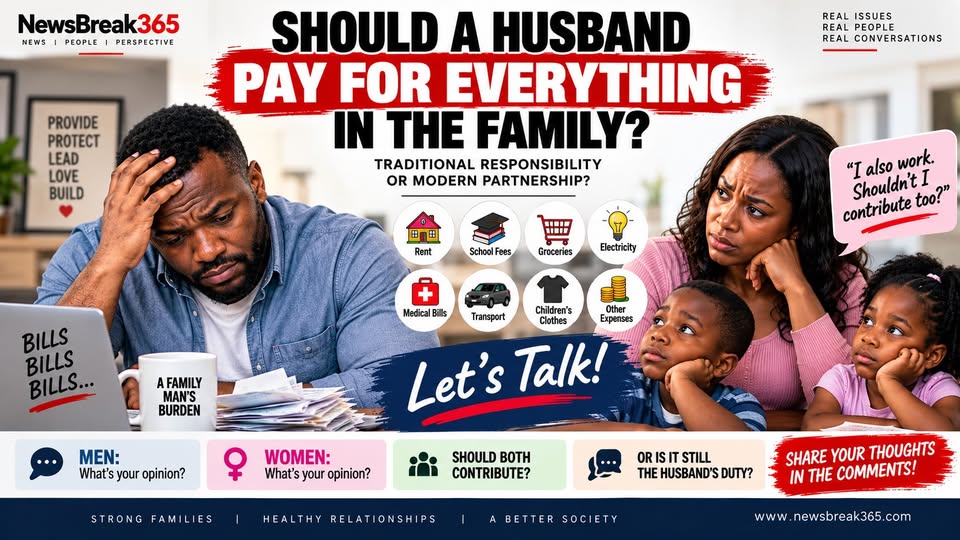
SHOULD A HUSBAND PAY FOR EVERYTHING IN THE FAMILY?

Published

on

Should a husband be expected to pay for everything in the family simply because he is the man?

This is one of those questions that can quickly turn a peaceful family discussion into a serious argument.

For generations, many African families have been raised with the belief that the man is the provider. He is expected to pay the rent, school fees, electricity bills, food, medical expenses, transportation costs and almost every other major household expense.

But times are changing.

Today, many husbands and wives both work. Some women earn as much as their husbands, and in some families, the wife earns even more.

So the big question remains:

If both husband and wife earn money, should the husband still pay for everything?

“A MAN MUST PROVIDE”

Many people strongly believe that providing for the family is part of a man’s responsibility.

According to this view, a husband should not complain about paying the bills simply because his wife earns an income. His responsibility is to make sure his family is comfortable and protected.

For some men, providing is not just about money. It is also about fulfilling what they believe their role as a husband and father should be.

But there is another side to the argument.

WHAT HAPPENS WHEN BOTH PARTNERS WORK?

Imagine a husband earning a monthly salary while his wife also earns a good income.

The husband pays the rent.

He pays the children’s school fees.

He buys food.

He pays electricity and other bills.

He handles medical emergencies.

See also  The Creation of the Council of Obas in South West Nigeria

He pays for transportation and other family expenses.

Meanwhile, the wife’s salary remains largely untouched.

Is that fair?

Some people would say yes—the husband is the man and therefore the primary provider.

Others would argue that marriage should be a partnership, and both partners should contribute according to their financial ability.

IS CONTRIBUTION ONLY ABOUT MONEY?

There is also an important argument that should not be ignored.

A wife may contribute to the family in ways that are not easily measured financially.

She may take care of the children, cook, clean, organize the household, support her husband’s career and carry many responsibilities behind the scenes.

Therefore, some couples may decide that the husband handles most of the financial responsibilities while the wife contributes more through other forms of support.

The problem begins when one partner feels exploited or unappreciated.

THE REAL QUESTION MAY BE ABOUT TEAMWORK

Perhaps the bigger issue is not whether the husband should pay for everything.

Perhaps the real question is:

Are both partners genuinely working together to build the family?

Every marriage is different.

One couple may decide that the husband pays the major bills while the wife handles other expenses.

Another couple may combine their incomes.

Another may divide expenses according to their salaries.

There is no single financial arrangement that will work for every family.

What matters is that both partners understand the arrangement, agree on it and feel that the responsibilities are reasonably shared.

SO, SHOULD A HUSBAND PAY FOR EVERYTHING?

Here is where the debate begins.

See also  Flora Azikiwe: Nigeria’s First First Lady and Pillar of Early Nationhood

If a wife earns a good income, should she contribute financially to the household?

Or should the husband continue paying for everything because providing is traditionally considered the man’s responsibility?

And if the wife contributes financially, should her contribution be 50/50, or should expenses be divided according to each person’s income?

For example, if the husband earns twice as much as the wife, should he also pay twice as much?

These are questions every modern couple should be willing to discuss honestly.

WHAT DO YOU THINK?

Should a husband pay for everything in the family?

Or should a husband and wife who both earn an income share the financial responsibilities?

👇 Share your opinion in the comments.

Men: Would you expect your wife to contribute financially if she earns a salary?

Women: If you earn your own money, should your husband still be responsible for every household expense?

Let’s have the conversation without insults.

Different families have different realities. The goal should not be to prove who is right—it should be to build stronger families.

FOLLOW US ON:

FACEBOOK

TWITTER

PINTEREST

TIKTOK

YOUTUBE

LINKEDIN

INSTAGRAM

Continue Reading

Lifestyle

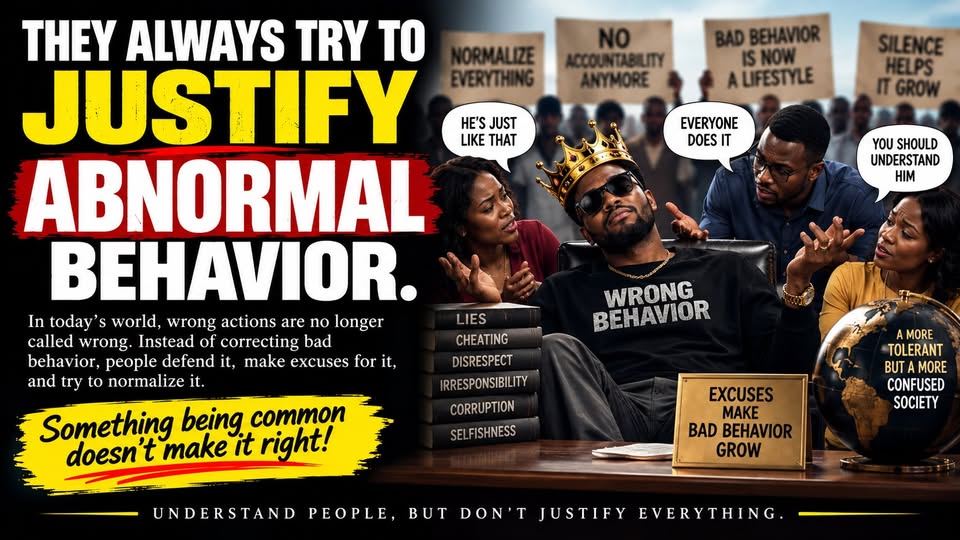
They Always Try to Justify Abnormal Behavior

Published

on

One disturbing trend in society today is the growing tendency to justify behavior that should instead be questioned, challenged, or corrected.

When someone behaves badly, people often rush to find an explanation for it. They say, “That’s just the way they are,” “Everybody does it,” “You should understand them,” or “It’s not really a big deal.”

But understanding a person’s behavior is not the same as approving it.

There is a difference between explaining why someone does something and justifying what they do.

People can have difficult backgrounds, painful experiences, social pressures, or personal struggles that influence their behavior. Those circumstances may help us understand them, but they should not automatically become excuses for actions that hurt other people or damage society.

When Wrong Becomes Normal

The danger begins when society repeatedly excuses the same behavior until people stop seeing anything wrong with it.

Something can become common without becoming right.

If dishonesty becomes widespread, that does not make dishonesty acceptable. If disrespect becomes normal, it does not make disrespect healthy. If people repeatedly break their promises, exploit others, or behave irresponsibly, popularity does not transform those actions into virtues.

Normalization is not the same as morality.

Sometimes people defend questionable behavior simply because confronting it would make them uncomfortable. It is easier to say “leave them alone” than to have an honest conversation about accountability.

Accountability Still Matters

A healthy society needs compassion, but it also needs standards.

We should be willing to understand people without excusing everything they do. We can forgive someone while still acknowledging that their actions were wrong. We can show empathy without abandoning personal responsibility.

See also  PHOTOS: Reactions as one million bibles are to be distributed nationwide in honour of Seyi Tinubu

The moment every form of bad behavior is given an excuse, accountability begins to disappear.

And when accountability disappears, people can become convinced that they have the right to do whatever they want without consequences.

Not Everything Should Be Accepted

There is nothing wrong with accepting differences between people. Everyone has different personalities, opinions, cultures, beliefs, and ways of living.

But accepting people does not mean accepting every behavior.

We should be able to distinguish between harmless differences and behavior that causes genuine harm.

The real question is not whether something has become common. The real question is:

Is it right? Is it healthy? Is it respectful? Does it harm others?

Those are the questions society should be asking.

Perhaps we have become too quick to defend people’s behavior and too slow to hold them accountable.

What do you think? Are we becoming a society that justifies too much, or are we simply becoming more tolerant and understanding?

FOLLOW US ON:

FACEBOOK

TWITTER

PINTEREST

TIKTOK

YOUTUBE

LINKEDIN

INSTAGRAM

Continue Reading

Trending