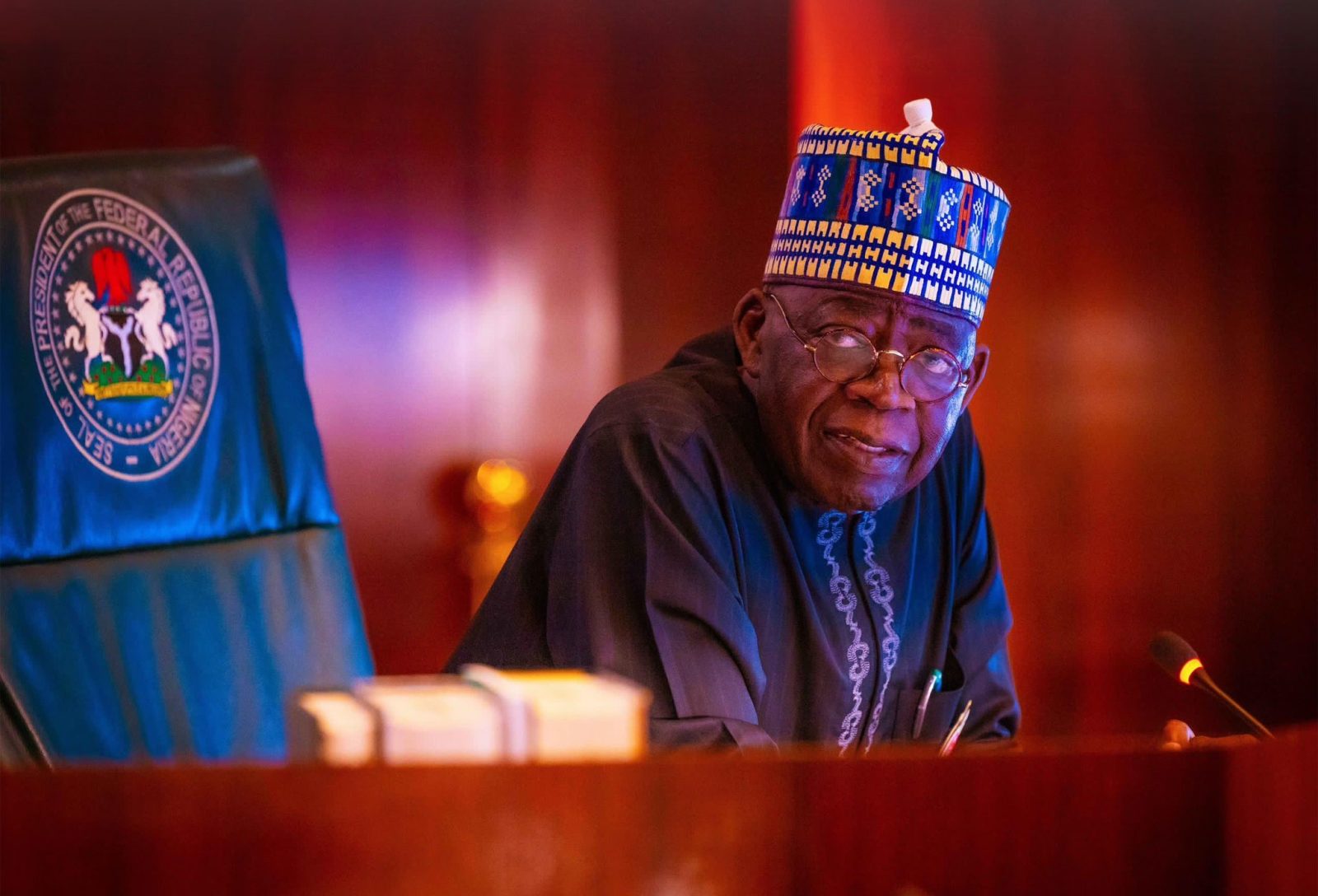
President Bola Tinubu has said he has no regrets over the removal of the fuel subsidy, vowing that Nigeria will never go back to it as he likened any return to asking the biblical Moses to go back to Egypt.
Tinubu spoke on Monday evening at the forum tagged ‘Together till 2027: An Evening with Original City Boy’, organised by the City Boy Movement in conjunction with the Relax-Tinubu-Is-Fixing-Nigeria movement, both of which are geared towards his reelection at the 2027 polls.
Recalling the start of his administration, the President said he scrapped the subsidy on his first day in office.
“I came, and I removed the subsidy the first day,” he said, adding that Nigeria was heading for bankruptcy, with “nothing left to pay subsidy.”
The President threw jabs at the African Democratic Congress presidential candidate, Atiku Abubakar, who promised a return to subsidy.
Citing what he called his studies of scripture in the Bible and the Holy Quran, Tinubu recalled how the Red Sea parted when Moses left Egypt.
He likened the end of the subsidy regime to the exodus of the ancient Israelites from Egypt, saying, “You cannot ask Moses to go back to Egypt.”
Continuing, he said, “I could listen to my political opponents promising a return to subsidy. Most of all, sometimes I remember my scripture studies, both the Bible and the Holy Quran. When Moses left Egypt, they faced the challenge, and the Red Sea parted and gave way.
“You cannot ask Moses to go back to Egypt. We wake up with ideas, original thoughts, and deep thinking to move this country forward. With your energy, your support, Nigeria will never go back to Egypt. No regrets.
“Before I left home, I saw one of the greatest Chinese economic news growing by 4.6 per cent or thereabouts. We are on the right trajectory. We are in good company. The economy is growing steadily. You will have a future, a future to believe in.”
The President added, “Nigeria must win this election before any candidate does. You are not campaigning for me. You are campaigning for your own future, and that future is renewed hope. There’s nothing that will push us back.”
Tinubu said the past three years had not been easy, adding that his administration “took hard decisions.”
He described the condition in which he took over, stating that, “We owed money to airlines. They were almost cutting their flights to Nigeria. Our foreign reserve was nothing. We printed currencies as if there were no tomorrow.”
He said that rather than dwell on the flaws of the past, he chose to assume the responsibility and liability of his predecessor.
“We understood that a nation cannot borrow its way to greatness,” Tinubu said, adding that many people had predicted that young Nigerians would turn their backs on the reforms.
“They were wrong. You are here,” he said.
Turning to the January 16, 2027, presidential election, the President told the youths to take the message to their campuses, markets and villages.
“Make sure every young person you know has a PVC and use it. Tell them what we have done, and tell them what we will do. Campaign with your ideas.
“You are not campaigning for me. You are campaigning for your own future, and that future is Renewed Hope,” he stated.
On the Students Loan Act, which he signed in 2023, he said he also had no regrets, adding, “Today, more than a million students have been supported through NELFUND.”
Tinubu announced the end of the petrol subsidy when he took office on May 29, 2023.
The pump price rose from about N180 per litre to about N620 after the announcement, and to about N1,200 roughly a year later.
Atiku, on August 20, in an English rendering of a Hausa-language interview, said: “If elected, I will bring back the oil subsidy.”
He, however, proposed a capped, audited production subsidy tied to domestic refining, saying his proposal was not to resurrect the old subsidy regime.
The Presidency called the proposal a return to a “wasteful, corruption-ridden and financially burdensome” system.
At the event, Tinubu assured the City Boy Movement, especially the youth who had stood with him, that they would not be left behind.
“The future of this country does not belong to me, and it does not belong to my generation. It belongs to you.
“I am very proud, once again, that when I signed the Student Loan Act, I had no regrets.
“Today, more than a million students have been supported through NELFUND,” Tinubu stated.
On his son, Seyi, he said: “He is running after his father. Your young colleagues would have seen that you are investing your time effectively. We are with you. Thank you. You did it humbly.
“You did not ask for a title or an office. You went to the young people, your age mates, your group. You listened to them and organised them.
“I am proud of all of you. But I will tell you what every father tells a son: you have only started. Do more, not less. Serve harder. Set an example that your own children, my grandchildren, will be proud to follow.”
Speaking earlier, Vice President Kashim Shettima said Nigeria’s economy would have collapsed had President Bola Tinubu not taken what he called far-reaching decisions.
He said, but for the tough decisions, critics would by now be writing epistles on a collapsed economy from the comfort of their homes in Dubai, United Arab Emirates, and New York, United States.
The Vice President credited the President’s decisions for the economy’s recovery.
He said, “The President took those far-reaching decisions. He had the courage of conviction and the knowledge to take those far-reaching decisions that repositioned the Nigerian economy, so that now, the economy grew by 4.43 per cent in the last quarter.
“Most importantly, our foreign reserves are now hovering at the level of $60bn.
“Remember how far we have come. It’s only those who have been in the deepest valley that will appreciate how magnificent it is to be on a mountain top.”
To the critics of the administration, Shettima said, “The same people that are crying wolf, if the President had not taken those far-reaching decisions, Walahi, I am not talking to you as a politician. I am talking to you as a Nigerian; our economy would have collapsed.
“These people, by now, would be writing epistles on a collapsed economy from the comfort of their homes in Dubai, in New York, or in marriage with their young Moroccan wives. I have not mentioned anybody’s name.”
He admitted that Nigerians had endured hardship, but said it could have been worse.
“Your Excellency, distinguished ladies and gentlemen, the President has to be commended, not demonised. Yes, Nigerians have gone through some tough times, but it could have been worse.
“Be reassured that in the coming weeks, the President will come up with robust responses to agricultural challenges, and prices of foodstuffs will certainly come down,” he stated.
The Vice President said efforts were being made to reposition the economy, citing the Nigerian Education Loan Fund and investments in infrastructure.
He then asked the youth to carry the message to the streets.
“I urge the youth of Nigeria. I beseech thee. I implore you to go out to the streets and tell the truth to other Nigerians,” he stated.
At the inauguration of the All Progressives Congress Presidential Campaign Council on October 14, Shettima mocked the former Vice President, Atiku Abubakar, and the former Anambra State governor, Peter Obi, over their economic proposals.
Also speaking at the event on Monday, the Deputy Senate President, Barau Jibrin, commended the City Boy Movement, describing it as a “special purpose political vehicle” that was not only human-driven but also technology- and AI-driven.
He said he believed no other political organisation in the country was doing what the group was doing, and urged others to take a cue from it.
Jibrin asked the movement to build Tinubu’s ideology and philosophy into its AI content, citing his “spirit of philanthropy, the spirit of resilience, the spirit of perseverance, and of course patriotism.”
The Deputy Senate President also urged the group to load its AI platform with questions and answers to counter some of the candidates in the election whom he accused of “churning out things that they cannot achieve” in “false populism”.
He said, “We know their track records; we know their scorecards when they held offices before. So that people will not fall for their lies, so that people will not fall for the fallacy they are turning out every day.”
He further asked that the content explain the global rise in the cost of living, which he blamed on armed conflicts. He said the President was working very hard to deal with the situation.
The Speaker of the House of Representatives, Tajudeen Abbas, announced that he would publish an audit of what Tinubu had done for his Zaria constituency in Kaduna State, and called on all political officeholders serving under the President to do likewise.
He said he would hold a media briefing within 14 days, where he would also present a scorecard of the House’s bills, reforms and oversight work done in partnership with the administration.
“It will not be a celebration; it will be an audit. Every intervention will carry a location, a value and a status.
“And where something remains undone, I will say so, because an account that tries to hide its gap is merely an advertisement,” he said.
Abbas said many people who carried the President’s portrait on their posters had “never carried your record to their people.”
He urged officeholders, elected and appointed alike, to render an account of what their share of the President’s mandate had produced, and proposed a common format and a 90-day timeframe.
“The question before us will not be, whose side are you on. It will be, what did you do?” he stated.
Addressing the City Boy Movement, the Speaker asked it to verify these accounts by photographing projects and holding town halls where officeholders face their constituents.
“A leader learns nothing from applause. Become the feedback loop this administration requires, carrying the President’s record down to the people and the people’s verdicts back to the President,” said Abbas.
On his part, the Director-General of the City Boy Movement, Francis Shoga, told the President that Nigerian youths were ready to work and ready to serve.
“We are not a generation waiting helplessly on the sidelines. We are not a generation without direction, courage or purpose.
“We are a generation prepared to rise above every limitation, organise with discipline, confront challenges with courage and build the Nigeria of our dreams.
“Your Excellency, we are your foot soldiers, ambassadors of hope, defenders of our national unity and committed partners in the great task ahead of national transformation. Wherever young Nigerians are found, we will carry the message of Renewed Hope,” he stated.
Shoga said the movement drew its inspiration from the “courage, persistence, patriotism, visionary leadership and bold decision-making” that had defined Tinubu’s political journey and public service.
“Our mission,” he affirmed, “is to inform, engage, inspire and empower Nigerian youths so that they understand the direction of government, recognise available opportunities and participate confidently and responsibly in national development.”
Source: punchng.com
FOLLOW US ON:
FACEBOOK
WHATSAPP CHANNEL
TWITTER
PINTEREST
TIKTOK
YOUTUBE
LINKEDIN
INSTAGRAM