Connect with us

News

Sanwo-Olu visits Lagos dumpsite amid escalating waste crisis

Published

on

Lagos State Governor, Babajide Sanwo-Olu, has declared a state of emergency on waste collection in the state, ordering immediate measures to address the challenges affecting the sector.

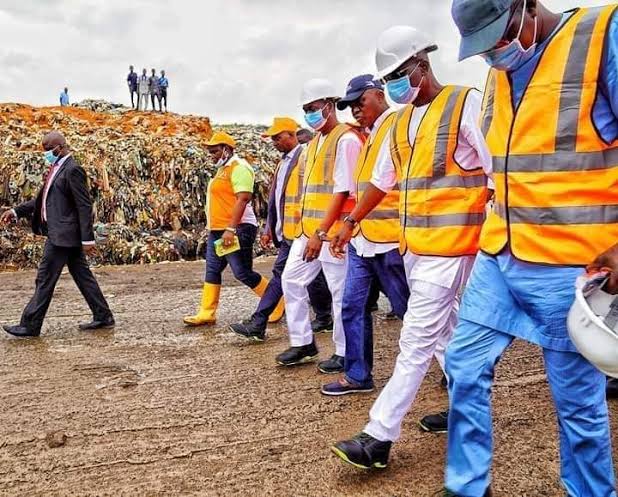
Sanwo-Olu, accompanied by his deputy, Dr Obafemi Hamzat, made the declaration during an inspection of the Olusosun dumpsite in Ojota on Wednesday.

The governor also held a meeting with stakeholders in the waste management sector at the dumpsite, where he assessed the challenges affecting municipal waste collection and outlined immediate, medium and long-term solutions.

Sanwo-Olu acknowledged the slow pace of waste collection in different parts of the state, attributing the situation partly to the inability of Private Sector Participation operators to meet their obligations in recent weeks.

He said waste compaction activities were ongoing simultaneously at the Olusosun and Solous 3 dumpsites, adding that the completion of the exercise would facilitate faster waste collection.

The governor said recent fire incidents at the dumpsites had slowed down operations, but added that work had resumed, with contractors working to clear the sites for daily waste disposal.

He explained that the completion of the ongoing projects would enable each of the dumpsites to receive about 450 trucks of municipal waste daily, effectively doubling the capacity of the PSP operators.

Sanwo-Olu said, “In the past couple of weeks, we have seen pressure and slow turnaround in waste collection in different parts of the city. We have seen residents throwing waste indiscriminately at undesignated areas in the city.

“We are here to see what the problem is and for us to be able to declare a state of emergency so that we can take the state out of this unpleasant situation.

See also  FG tightens border control due to fresh Ebola Outbreak

“At Olusosun dumpsite, we are planning with our development partners to build a 2,400-metric-tonne transfer loading station that will receive compacted waste which will, in turn, be transported to Material Recovery Facilities being built at the moment.

“We are currently building two transfer loading stations of the same size that will receive over 500 trucks of waste daily. The second transfer loading station is at Solous 3 in Alimosho. We need to open up the road, and that should be ready in two to three weeks.”

The governor said one of the immediate measures being implemented was the stabilisation of access roads to the five dumpsites to facilitate easier access and faster waste collection.

He directed the rehabilitation of access roads to the dumpsites at Ewu Elepe and Oke Oso, adding that the state government had procured 160 modern compactors to boost waste collection.

Sanwo-Olu said development partners working with the Lagos State Waste Management Authority would also provide additional compactors, while the government would procure landfill compactors specifically designed for use at dumpsites.

He said, “The other solution we are throwing into the mix is raising the capacity of the PSP operators. We currently have a number of compactors that are not fit and proper for the size of the city.

“We have ordered 160 modern compactors, and they will start coming in soon. This will immediately increase the capacity of waste collection from the tenements and roads to bring them to the dumpsites.

“The PSP operators’ leadership has also appreciated the solutions we are proposing, and they are working with us to ensure these solutions work.

See also  Returning displaced Nigerians at risk of landmine explosions – United N

“The PSP operators have pledged to reassess their own operations and purge themselves of unserious players in the business. They are willing to take only operators who have the capacity, knowledge and willingness to make additional investments in the business.

“We don’t want to have a situation where we will have 800 PSP operators for a job that can only be done by 400 operators.”

The governor added that the PSP operators had assured the government that they would also procure additional trucks for their members as the government increased its fleet of compactors.

He said the state government would work with the operators to de-risk the financing of the investments and prevent them from going bankrupt.

Sanwo-Olu identified the construction of transfer loading stations and Material Recovery Facilities as part of the medium- to long-term measures to address waste management challenges in the state.

He said Lagos residents would begin to see physical infrastructure being developed at the transfer loading stations and Material Recovery Facilities before the end of the year, although the facilities were not expected to be completed until the first quarter of next year.

“We are building two Material Recovery Facilities. One of them is in Oke Oso, Epe; the other is at Erekiti in Badagry.

“The plan is, if the transfer loading stations are open, waste disposal will be rapid, and from there, we can transfer the compacted waste to recovery stations for further sorting and recycling.

“This is a medium- to long-term plan which, we believe, will come up by the second quarter of next year,” he said.

See also  Missing Ebonyi engineers’ families demand fresh probe

Sanwo-Olu also read the riot act to residents who dump waste indiscriminately in unauthorised areas, directing the immediate prosecution of offenders caught in the act.

The governor also criticised the inefficient supervision of waste management operations by officials, disclosing that the Lagos State Waste Management Authority would undergo organisational reforms to improve its efficiency.

Source: punchng.com

FOLLOW US ON:

FACEBOOK

TWITTER

PINTEREST

TIKTOK

YOUTUBE

LINKEDIN

INSTAGRAM

Continue Reading
Click to comment

Leave a Reply

Your email address will not be published. Required fields are marked *

News

Kebbi warns civil servants against lateness, absenteeism

Published

on

The Kebbi State Government has directed civil servants across the state to strictly observe the official working hours of 8:00 a.m. to 4:00 p.m., Monday to Friday, warning against lateness and absenteeism.

The directive, according to a statement made available to our correspondent on Wednesday, was contained in a circular issued by the Head of the Civil Service, Malami Shekare, dated September 23, 2026, from the Office of the Head of the Civil Service, Cabinet Office, Birnin Kebbi.

Shekare said the directive followed observations that some civil servants had developed the habit of reporting late for work or staying away from their duty posts without official communication or approval.

He said, “The approved official working hours for the State Civil Service are 8:00 a.m. to 4:00 p.m., Monday to Friday, and all civil servants are expected to strictly adhere to them.”

The Head of Service added that the prescribed working hours were provided for under Chapter 13, Section 4, Sub-section 140122 of the Public Service Rules, 2021 Edition.

He directed civil servants to “be punctual at their duty posts and comply strictly with the approved working hours.”

Shekare further warned that any absence or lateness must be officially communicated to and approved by the appropriate authority.

“Any absence from duty or lateness must be officially communicated to, and approved by, the appropriate authority,” he said.

He also directed heads of ministries, departments and agencies to bring the circular to the attention of their staff and ensure strict compliance.

See also  Tompolo distances self from call for Kanu’s release

The circular was addressed to the Chief of Staff, Government House; Director, Deputy Governor’s Office; Secretary to the State Government; commissioners; permanent secretaries; and chief executives of commissions, boards and parastatals across the state.

Source: punchng.com

FOLLOW US ON:

FACEBOOK

TWITTER

PINTEREST

TIKTOK

YOUTUBE

LINKEDIN

INSTAGRAM

Continue Reading

News

Army activates three new battalions to boost security in Zamfara

Published

on

The Nigerian Army has operationalised three new Infantry Battalions in Zamfara State as part of efforts to strengthen security operations and improve rapid response across the state.

In a statement by the Acting Assistant Director, Army Public Relations, 1 Brigade Nigerian Army, Gusau, on Tuesday on X, the newly activated units are the 12 Infantry Battalion in Bakura, 23 Infantry Battalion in Kaura Namoda and 28 Infantry Battalion in Anka.

The battalions are expected to expand the Army’s operational coverage and secure their respective Areas of Responsibility (AOR).

Speaking during the activation ceremonies, the General Officer Commanding (GOC) 8 Division Nigerian Army and Commander, Sector 2 Joint Task Force, North West, Operation FANSAN YAMMA, Major General BP Koughna, represented by the Acting Commander, 1 Brigade, Colonel Joseph Umaru, reaffirmed the Army’s commitment to strengthening security operations in the state.

Colonel Umaru said the military would continue to work towards protecting law-abiding citizens, stressing that lasting peace required cooperation among security agencies, traditional institutions and communities.

He called on residents to support security agencies by providing “timely, credible, and actionable intelligence.”

Addressing the newly deployed troops, Umaru charged them to maintain discipline, professionalism and operational vigilance while carrying out their constitutional responsibilities and adhering to established Rules of Engagement.

The traditional rulers in the three locations also welcomed the establishment of the new battalions.

The Emir of Bakura, Alhaji Bello Sani; Emir of Anka, Alhaji Attahiru Muhammad Ahmad; and Emir of Kaura Namoda, Maj. Dr Sanusi Mohammed Ahmed (rtd), commended the Nigerian Army for establishing the additional units.

See also  Electoral Act standoff: Senate calls emergency plenary as protests loom

The monarchs described the deployments as a “crucial milestone” towards restoring normalcy and improving safety in communities across Zamfara.

They also assured the Army of the continued support of traditional institutions, particularly through community mobilisation and information sharing.

“We urge residents to provide timely, credible, and actionable intelligence,” Umaru said

The army said the new battalions are expected to enhance its ability to respond rapidly to security threats and strengthen operations across their respective areas of responsibility.

Source: punchng.com

FOLLOW US ON:
FACEBOOK

TWITTER

PINTEREST

TIKTOK

YOUTUBE

LINKEDIN

INSTAGRAM

Continue Reading

News

Workers set October strike over petrol price hike

Published

on

Public servants under the Joint National Public Service Negotiating Council have reaffirmed their September 30, 2026, ultimatum to the Federal Government over the rising cost of petrol, the demand for a wage award and the commencement of negotiations for a new national minimum wage.

The JNPSNC, made up of eight public sector unions, issued a three-day warning strike notice to the Federal Government, beginning October 2, should the government fail to slash the price of petrol to N500 per litre, announce a wage award and introduce other measures to cushion the crushing hardship in the country.

Members of the JNPSNC include the Nigerian Civil Service Union; Medical and Health Workers Union; Association of Senior Civil Servants of Nigeria; and National Association of Nigerian Nurses and Midwives.

Others are the Amalgamated Union of Public Corporations, Civil Service Technical and Recreational Employees; Nigeria Union of Public Service, Reportorial, Secretarial, Data Processors and Allied Workers; National Union of Printing, Publishing and Paper Products Workers; and National Union of Agriculture and Allied Employees.

The council said it had mobilised public servants across the country for a three-day warning strike if the Federal Government failed to address the issues raised in its letter to President Bola Tinubu before the deadline.

Recall that the JNPSNC had, on September 21, written to Tinubu, demanding that the price of petrol be slashed to N500, the immediate announcement of a wage award and the beginning of negotiations for not less than N500,000 minimum wage from 2027, among others.

In a statement on Tuesday, September 29, 2926, leaders of the JNPSNC warned that should the issues of fuel pump prices and the wage award not be addressed by September 30, especially during the Independence anniversary speech by the President, public servants nationwide would commence a three-day warning strike beginning October 2, 2026.

See also  Electoral Act standoff: Senate calls emergency plenary as protests loom

The statement issued by the National Secretary of the JNPSNC and General Secretary of the Nigeria Civil Service Union, Gbenga Olowoyo, said the September 30 deadline remained sacrosanct, stressing that the concerns of Nigerian workers could no longer be ignored.

According to him, “The three critical issues requiring urgent attention are as follows: reduction of fuel price to N500 per litre. The Federal Government should take urgent steps to bring down the price of Premium Motor Spirit (PMS) to N500 per litre.

“This can be achieved through the provision of an intervention fund to address landing costs and support oil and gas operators.

“It is equally important for the Federal Government to ensure the sale of crude oil to the Dangote Refinery and operators of modular refineries at appropriate terms to facilitate increased domestic refining and help bring down the price of petroleum products.

“The current price of PMS, ranging from N1,450 to N2,000 and, in some locations outside major communities and cities, as high as N2,500 per litre, is unacceptable to Nigerian workers.

“The council maintains that the economic hardship occasioned by the high cost of fuel is placing the survival of Nigerian workers, their dependants and the general populace under severe pressure, making it increasingly difficult for Nigerians to live normal and dignified lives.

“The Federal Government should urgently approve a wage award for Nigerian workers to cushion the effects of the prevailing harsh economic conditions being experienced by workers, their dependants, and vulnerable Nigerians.

“The council believes that urgent action on this demand will further enable public servants to consolidate their loyalty, commitment and productivity within the public service ecosystem.”

See also  Fire guts shops in three-storey building in Anambra

Minimum wage committee

The workers asked the Federal Government to urgently establish a committee to facilitate negotiations for the new minimum wage.

“The Federal Government should urgently establish a tripartite committee to commence and facilitate negotiations for the new national minimum wage expected to become due in 2027.

“The Nigerian workers’ demand for the immediate constitution of the committee is informed by the need to avoid any administrative or procedural delay that could affect the implementation of the new National Minimum Wage once it is eventually negotiated and passed into law by the National Assembly,” the statement added.

Warning strike

“Consequently, the council states that failure by the Federal Government to take the necessary steps to address these issues on or before 30th September 2026 will leave Nigerian workers with no option but to commence a three-day warning strike, with effect from Friday, 2nd October 2026, to press home their demands.

“It is imperative to state clearly that the Independence Day address of the President of the Federal Republic of Nigeria should adequately address these critical issues.

“Failure to address the concerns raised, according to the Council, will attract the displeasure of Nigerian workers and their dependants, as well as other vulnerable Nigerians who continue to bear the brunt of the prevailing economic hardship,” the statement concluded.

Source: punchng.com

FOLLOW US ON:

FACEBOOK

TWITTER

PINTEREST

TIKTOK

YOUTUBE

LINKEDIN

INSTAGRAM

Continue Reading

Trending