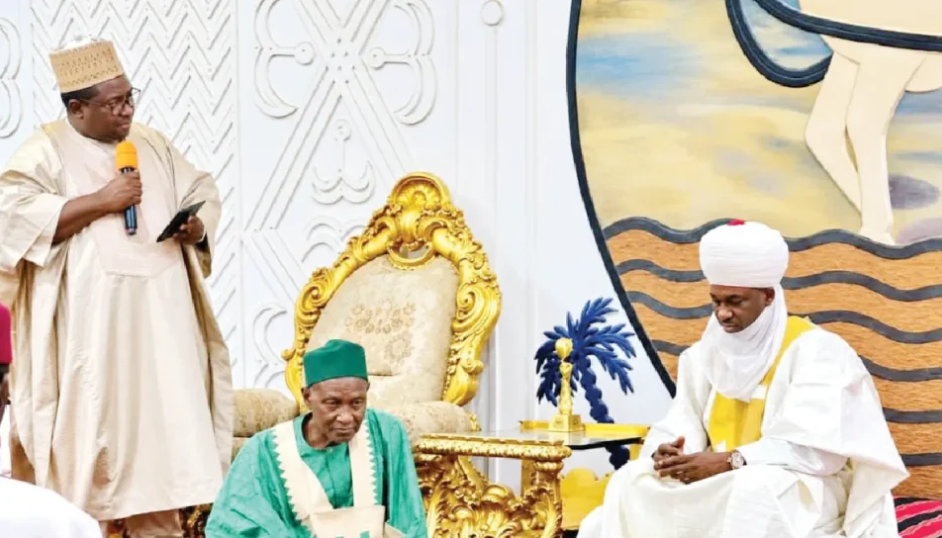
As political interests increasingly seek the influence of traditional institutions, Nigeria’s royal fathers face a delicate battle to preserve their neutrality, authority and place above partisan divisions, writes CHIMA AZUBUIKE
When the Emir of Gombe, Abubakar-Shehu Abubakar III, declared that traditional rulers belonged to no political party and would not allow personal considerations to divide the communities entrusted to their care, his message resonated beyond the confines of his palace. Abubakar echoed this imperative when the Chairman of the Independent National Electoral Commission, Prof Joash Amupitan, visited him in his palace last Monday. The visit touched on one of the most delicate questions in Nigeria’s political landscape: whether traditional institutions can remain impartial despite the fact that their positions, privileges and continued relevance are often tied to the political establishment. It was also a timely reminder of the responsibility traditional rulers bear as custodians of community values, mediators in local disputes and influential voices in grassroots political engagement. The visits of political office holders, political office seekers to palaces is bound to increase ahead of the 2027 elections.
Amupitan’s visit was part of INEC’s North-East zonal interactive meeting with electoral officials and stakeholders ahead of the 2027 general election. Beyond seeking royal blessings and prayers, the engagement offered an opportunity to reflect on the influence traditional rulers wield over their subjects and the extent to which that influence can contribute to credible elections.
The emir’s position was unambiguous: traditional rulers must serve everyone, regardless of political affiliation, religious beliefs or social background. He said, “As royal rulers, we recognise that free and peaceful elections are essential to the stability, unity and progress of our country.
“Our task is to ensure that we are in a unique position in this regard. Royal fathers serve all our subjects irrespective of their political affiliation, religious beliefs or social backgrounds.
“We belong to no political party, and we have never allowed our personal considerations to divide the community entrusted to our care. This is a responsibility we take very seriously.”
It was a statement of principle, but one that also raises the question: How can traditional rulers remain politically neutral when the political system within which they operate sometimes rewards loyalty and punishes perceived disloyalty?
Across Nigeria, traditional rulers occupy a complicated position. They are expected to be above partisan politics, yet they operate in an environment where political actors frequently seek their endorsement, blessings and influence. Their palaces are important stops for politicians seeking legitimacy, while their public appearances can be interpreted as signals of political preference.
For many politicians, a royal reception is more than a courtesy call. It is an opportunity to demonstrate acceptance by the community, mobilise grassroots support and communicate political strength to rivals.
Conversely, an absent monarch, a closed palace gate or a reception organised away from the traditional seat of authority can become a political statement in itself.
The emir’s declaration invites a deeper examination of whether traditional rulers can successfully separate their public responsibilities from the political calculations that increasingly shape their relationships with elected officials.
Traditional rulers have long occupied an important place in Nigeria’s community life. Their influence extends beyond ceremonial functions to conflict resolution, cultural preservation, mobilisation for development and mediation between governments and citizens.
In many rural communities, they remain among the most accessible authorities. Their words carry weight because of longstanding cultural relationships, inherited institutions and their familiarity with local grievances. That proximity to the people makes them valuable partners in electoral administration.
While INEC is responsible for organising elections, it cannot independently resolve issues of voter apathy, community tensions, misinformation and resistance to electoral participation. Traditional rulers can easily help bridge that gap. They can explain the importance of voter registration, encourage eligible citizens to collect their Permanent Voter Cards, discourage political violence and urge residents to resolve disagreements through lawful democratic processes. They can also challenge attempts by political actors to exploit ethnic, religious or communal divisions for electoral advantage.
But the same influence that makes traditional rulers valuable to electoral administration can become problematic when deployed in the service of partisan interests.
Recollections by some Nigerians suggest that the relationship between traditional institutions and political competition has not always matched the ideal of neutrality expressed by the Emir of Gombe.
Samaila Dati, a Gombe resident, recalled an incident in which an emir allegedly shut his palace gates because he feared receiving a governor who was then seeking election.
According to Dati, the experience illustrated the difficulties politicians can encounter when traditional rulers are caught between their responsibility to serve the entire community and their relationship with the incumbent political leadership.
“Today’s Gombe governor tasted that bitter pill during his campaign to one of the emirates in the north. The emir failed to turn up despite being informed about the engagement. It took party loyalists who are members of the emirate to organise a reception in another location to welcome the current governor, who was then a candidate,” he added.
The account, as recalled by Dati, illustrates how a palace can become an arena for political calculations even when the traditional ruler’s public responsibility is to maintain open channels of communication with all political actors.
For a candidate seeking office, access to a traditional ruler can be an opportunity to present campaign promises, discuss community needs and demonstrate respect for local institutions. When that access is denied because of political considerations, the encounter risks sending a message that the community is closed to a particular political interest.
The consequences can extend beyond the immediate political contest. Where residents perceive that a traditional ruler favours one political camp, those who support opposing parties may begin to question whether the palace remains an impartial institution.
Such perceptions can weaken the palace’s ability to mediate disputes after elections, especially when political disagreements spill into family relationships, community associations and local development initiatives.
Dati’s recollection offers a perspective on the political pressures facing traditional rulers, but the circumstances surrounding the incident would require independent verification and a response from the emir concerned.
Dati’s account raises the question: should access to traditional institutions depend on a politician’s relationship with the government of the day, or should every credible political actor be treated with the same measure of courtesy?
For those who believe that traditional rulers must remain impartial, the answer should be straightforward.
Danladi Adamu, a teacher, said that tensions could emerge in the relationship between political officeholders and traditional institutions when monarchs are perceived to be close to politicians opposed to the sitting governor.
Adamu referred to the political disagreements between Governor Muhammadu Yahaya and his predecessor, Governor Danjuma Goje, during which, according to him, some traditional rulers came under pressure.
He said, “Recall Governor Inuwa Yahaya’s political tussle with his former boss, Governor Danjuma Goje. Some emirs were nearly affected, including the Emirs of Gona in Akko Local Government Area and Deba in Yamaltu-Deba LGA, but thank God for how they were resolved.”
The accounts point to the vulnerability of traditional institutions when political disagreements between powerful individuals extend into the structures of customary authority.
Adamu’s recollection does not, on its own, establish the full circumstances of the tensions he described. But it reflects a concern that deserves serious attention: the extent to which political rivalries can expose traditional rulers to pressure and threaten their ability to serve communities impartially.
For Mohammed Ahmed, a civil servant, the problem runs deeper than individual incidents involving palace visits. He believes the process through which traditional rulers are selected, nominated or recognised can influence their willingness to challenge political authorities. Ahmed invoked a popular maxim to explain his position. “He who pays the piper determines the tune,” he said. He argued that traditional rulers would struggle to remain neutral while depending on politicians for their selection and continued security in office.
“Until traditional rulers stop depending on politicians for their selection and nomination, they cannot be neutral; they can’t see something bad and say it. They will continue to be underdogs, busy watching the body language of the governors and chairmen. They will continue to be partisan,” Ahmed added. His argument raises a structural question about the relationship between traditional institutions and democratic governance.
In Nigeria, traditional institutions are not uniform. Their succession arrangements differ according to local customs, historical practices and the legal frameworks governing chieftaincy matters in individual states.
In some communities, succession involves kingmakers or other customary authorities. State governments may also have formal roles in recognition, approval or the administration of chieftaincy affairs, depending on the applicable law.
Ahmed’s argument is that such dependence can turn traditional rulers into observers of political signals rather than independent voices of community interest.
The visit by Amupitan to the Gombe Emir’s Palace, therefore, carried significance beyond its ceremonial setting. The INEC chairman said the commission was consulting traditional rulers across the country to seek their blessings, prayers and support ahead of the 2027 general elections.
He explained that the North-East was the fourth geopolitical zone visited by the commission as part of its readiness assessment, following similar engagements in the South-West, North-West and South-East.
“We have visited other zones. We started with the South-West. From there, we moved to the North-West, and then to the South-East. Today, we are in the North-East,” he said.
Amupitan acknowledged the importance of traditional rulers in electoral administration, particularly in mobilising voters and promoting peaceful participation.
“Your role cannot be underestimated, most especially in ensuring the success of the 2027 general election. I am delighted to lead my team here today to seek your blessings, prayers and support,” he told the emir.
The chairman said the North-East had approximately 19.96 million registered voters, representing 13.51 per cent of Nigeria’s total registered voters.
The figures underline the region’s significance in the national electoral process and the need to ensure that eligible citizens are able to participate without intimidation, misinformation or avoidable administrative obstacles.
Amupitan appealed to the emir to mobilise eligible voters to collect their Permanent Voter Cards, emphasising that the cards were necessary for exercising their voting rights.
“Collection of PVCs is currently ongoing. It is not a favour anybody is doing the electorate to come out and vote, but you cannot vote without your PVC. We want your Royal Highness to help INEC mobilise the electorate to go out and collect their PVCs so that they can exercise their voting rights,” he said.
He urged the emir to appeal to political leaders to conduct their campaigns peacefully and discourage actions capable of undermining the electoral process.
The INEC chairman also sought the support of traditional rulers in tackling misinformation and disinformation, warning that false reports circulated on social media could cause panic, discourage voter participation and incite violence.
“People will start posting fake news, claiming that there is fighting or killing when it is not true, most of the time. We are appealing to your Royal Highness to help educate our people so that they will not be carried away by fake news and can verify information before it causes panic,” he said.
Amupitan reaffirmed the commission’s commitment to impartiality, assuring Nigerians that INEC would work towards delivering free, fair, inclusive and credible elections.
“INEC is committed, I can assure you, sir, and the good people of Gombe State that under my watch, INEC will remain absolutely impartial. We have no candidate of our own, but we will do everything possible to conduct a free, fair, inclusive and credible election come 2027,” he said.
The parallel between INEC’s commitment and the emir’s declaration is significant. Both institutions must demonstrate impartiality not merely through public statements but through decisions that citizens can observe and evaluate.
For INEC, that means applying electoral rules consistently, providing accurate information and ensuring that eligible voters can participate in accordance with the law.
For traditional rulers, it means opening channels of communication to competing political interests, discouraging violence regardless of who is responsible and resisting pressure to turn customary authority into an instrument of electoral advantage.
The INEC chairman’s appeal for traditional rulers to combat misinformation is especially relevant. False reports can inflame communal tensions, undermine confidence in electoral procedures and create confusion about where and when citizens can vote.
Traditional rulers can help counter such narratives by communicating verified information through community meetings, religious and cultural gatherings, local networks and other trusted channels.
The Emir of Gombe’s declaration provides a standard against which the conduct of traditional institutions can be assessed as Nigeria approaches another general election.
But it is not enough for a monarch to announce that he belongs to no political party. It must be reflected in how the palace treats competing political actors and how the ruler responds when political interests threaten to divide the community.
A traditional ruler need not pretend to have no personal political opinions. Like other citizens, he may have views about public affairs. The more important distinction is between personal preference and the exercise of public authority.
The responsibility of the office requires that personal sympathies should not determine access to the palace, the distribution of communal attention or the willingness to mediate disputes involving competing political interests.
As the 2027 elections approach, Nigeria’s traditional institutions face an important opportunity to reaffirm their relevance in a changing political environment. Their influence will be most valuable when it is used to strengthen peaceful coexistence, protect civic participation and preserve channels of communication across political divisions.
The challenge is particularly acute in communities where access to public authorities is often mediated through traditional leaders. If a palace closes its doors to political opponents, it risks narrowing the space for democratic engagement. If it welcomes competing interests fairly, it can demonstrate that political disagreement does not have to become social hostility.
The experiences recalled by Dati, Adamu and Ahmed suggest that the question of royal neutrality cannot be resolved through appeals for good conduct alone. It also requires attention to the institutional arrangements and political relationships that may discourage traditional rulers from acting independently.
Governments must respect the distinction between their constitutional responsibilities and the customary authority exercised by traditional institutions. Political parties must recognise that a monarch’s willingness to receive an opponent is not an act of hostility. Traditional rulers, for their part, must resist the temptation to trade impartiality for political favour.
Communities also have a role to play by demanding fairness, encouraging accountability and rejecting attempts to portray political access as a privilege reserved for supporters of those in power.
Ultimately, the credibility of a traditional institution is measured not by the number of politicians who visit its palace but by the confidence people across political divides place in its ability to serve them fairly.
The Emir of Gombe’s declaration that traditional rulers belong to no political party offers a starting point. The more difficult task is ensuring that the principle survives the pressures of electoral competition.
For Nigeria’s democracy to benefit fully from the influence of traditional institutions, the palace must remain a place where political differences can be acknowledged without becoming grounds for exclusion.
The true test of neutrality, therefore, is not whether traditional rulers can avoid wearing party colours. It is whether they can protect the dignity and rights of people who wear different political colours.
As the countdown to 2027 continues, Nigeria needs traditional institutions that can stand above partisan rivalries without standing apart from the concerns of their communities.
The palace should not be a campaign office, an extension of a governor’s political structure or a refuge for one faction against another. It should remain a meeting point for the community in all its diversity. Only then will the declaration that traditional rulers belong to no political party become more than a believable statement.
Source: punchng.com
FOLLOW US ON: