Lifestyle
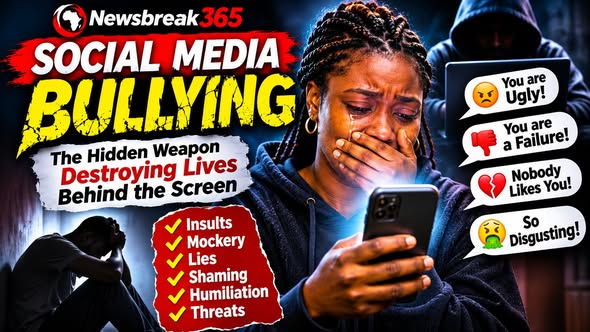
SOCIAL MEDIA BULLYING: THE HIDDEN WEAPON DESTROYING LIVES BEHIND THE SCREEN
Published
1 hour agoon
Behind the likes, comments, shares and smiling profile pictures lies a growing digital nightmare. Social media has given everyone a voice, but some people are using that voice to humiliate, intimidate, emotionally destroy and silence others.**
Social media was created to connect people, share ideas, exchange information and bring communities together. Unfortunately, what was supposed to be a powerful communication tool has increasingly become a platform where some individuals find pleasure in destroying the dignity and happiness of others.
Welcome to the disturbing world of social media bullying.
Today, you do not need a gun, a knife or any physical weapon to hurt someone. Sometimes, all you need is a smartphone, an internet connection and an audience willing to participate in cruelty.
A single insulting comment can trigger hundreds of abusive responses. A photograph can become an opportunity for public humiliation. A personal disagreement can turn into an organised campaign of online harassment.
And the frightening part? Some people celebrate it.
## THE KEYBOARD HAS BECOME A WEAPON
Some social media bullies would never have the courage to say certain things to someone’s face. Yet, behind a screen, they suddenly become fearless.
They hide behind fake accounts, anonymous profiles and borrowed identities. They attack people’s appearance, family background, financial situation, education, relationships and personal struggles.
They spread rumours, manipulate information, encourage others to attack their targets and turn private disagreements into public entertainment.
They may eventually close their phones and go to sleep peacefully, forgetting that the person they attacked might spend the entire night crying.
This is the cruelty of cyberbullying: the person causing the pain may never witness the damage.
## THE PSYCHOLOGICAL DAMAGE NOBODY SEES
One of the biggest mistakes society makes is assuming that online bullying is harmless because it does not involve physical violence.
That assumption is dangerous.
Victims of cyberbullying may experience:
– Anxiety, emotional distress and persistent fear.
– Depression and loss of self-confidence.
– Social isolation and withdrawal from friends and family.
– Difficulty concentrating at school or work.
– Fear of expressing themselves publicly.
– Serious psychological consequences, including suicidal thoughts.
Not everyone who is being bullied online will speak about it. Some people hide their suffering because they are embarrassed, afraid of being judged or worried that reporting the abuse will make things worse.
Behind a smiling photograph may be someone fighting an emotional battle.
## WHY DO PEOPLE ENJOY HUMILIATING OTHERS?
What motivates someone to spend hours insulting, mocking and attacking another human being?
For some, it is jealousy. For others, it is insecurity, anger, the desire for attention or the excitement of having an audience.
Some people use social media bullying to feel powerful. They believe that humiliating another person makes them superior.
Others participate simply because everyone else is doing it.
But there is something deeply troubling about a society where public humiliation has become entertainment and cruelty attracts applause.
When did making another person miserable become a source of entertainment?
## FREEDOM OF SPEECH IS NOT FREEDOM TO ABUSE
People have the right to disagree, criticise public figures, challenge opinions and expose wrongdoing.
However, criticism and bullying are not the same thing.
You can disagree with someone’s political opinion without attacking their family. You can challenge someone’s religious beliefs without threatening them. You can expose wrongdoing without spreading false allegations or encouraging harassment.
Freedom of expression should never become an excuse for cruelty.
Social media platforms must also take their responsibilities seriously by responding to harassment reports, addressing abusive behaviour and protecting vulnerable users.
## THE SILENT AUDIENCE IS PART OF THE PROBLEM
Online bullying does not always involve the person writing the abusive comment.
Sometimes, the audience makes the situation worse.
People share humiliating videos, laugh at abusive comments, spread private information and encourage others to join the attack.
Some even record someone’s emotional breakdown and circulate it for entertainment.
When you share abusive content, you may be helping the bully reach thousands of additional people.
Ignoring bullying does not always make you responsible for it, but deliberately promoting it makes you part of the problem.
## WHAT CAN WE DO TO STOP SOCIAL MEDIA BULLYING?
The fight against cyberbullying requires responsibility from individuals, parents, schools, communities and social media companies.
Here are some important steps:
1. **Think before posting:** Ask yourself whether your words are necessary, truthful and respectful.
2. **Stop sharing humiliating content:** Do not help abusive material spread.
3. **Report abusive behaviour:** Use platform reporting tools when you encounter harassment or threats.
4. **Preserve evidence:** Keep screenshots and records of serious harassment.
5. **Support victims:** Listen without judgment and encourage them to seek appropriate help.
6. **Teach children digital responsibility:** Parents must teach children that online behaviour has real-world consequences.
7. **Hold perpetrators accountable:** Serious threats, stalking and harassment should not be dismissed as jokes.
## CONCLUSION: YOUR WORDS MAY DISAPPEAR, BUT THE SCARS CAN REMAIN
The internet may be virtual, but the pain it causes is real.
The person you are mocking today could be someone’s child, parent, brother, sister, husband, wife or best friend.
They have feelings. They have dreams. They have struggles. They have a life beyond the screen.
You may receive hundreds of likes for an insulting comment, but those likes do not make your cruelty acceptable.
A society that celebrates humiliation while ignoring human suffering is gradually losing its sense of compassion.
**Remember: You do not have to destroy someone’s confidence to prove that you are powerful. You do not have to humiliate someone to demonstrate that you are intelligent. And you do not have to make another person cry to make yourself feel important.**
The next time you pick up your phone to insult, mock or humiliate someone, pause for a moment.
Ask yourself:
**WHAT IF THE PERSON BEHIND THAT SCREEN WERE SOMEONE YOU LOVE?**
Stop cyberbullying. Stop normalising cruelty. Start treating people with dignity.
*Your keyboard is in your hands. Choose whether to use it to build people up or tear them down.*
—
**NEWSBREAK365 EDITORIAL**
*Newsbreak365 believes that social media should be a platform for communication, education, constructive criticism and positive engagement—not a weapon for destroying human dignity.*
FOLLOW US ON:
You may like
Lifestyle
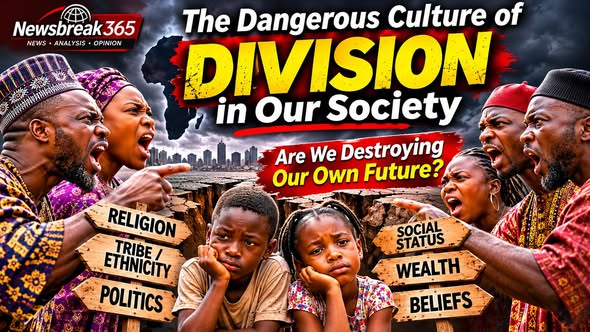
THE DANGEROUS CULTURE OF DIVISION IN OUR SOCIETY: ARE WE DESTROYING OUR OWN FUTURE?
Published
34 minutes agoon
November 5, 2026
A society that allows religion, ethnicity, politics, wealth and social differences to turn its people against one another is slowly destroying itself. But who really benefits from our division?**
There is something deeply disturbing about the direction in which our society is heading. People who should be working together for a better future are increasingly becoming enemies because of differences they should have learned to respect.
Religion has become a battlefield. Ethnicity has become a weapon. Politics has become an excuse for hatred. Wealth has become a measure of human worth. Social status has become a reason to look down on others.
We are gradually creating a society where people are judged not by their character, honesty, intelligence or contribution to humanity, but by where they come from, what they believe, who they support and how much money they possess.
The question we must ask ourselves is this: **When did our differences become more important than our shared humanity?**
## THE DIVISION THAT IS TEARING OUR SOCIETY APART
Division does not always begin with violence. Sometimes, it begins with words, prejudice, stereotypes, manipulation and the refusal to accept that other people have the right to think differently.
It grows when people are taught to hate those who belong to different communities. It becomes dangerous when disagreements turn into hostility and when loyalty to a particular group becomes more important than justice and truth.
Consider some of the most damaging forms of division in our society.
### 1. Religious Division: When Faith Becomes a Weapon
Religion should encourage compassion, humility, kindness and peaceful coexistence. Yet, in many communities, religious differences have become reasons for discrimination, hostility and even violence.
Some people have become so attached to defending their religious identity that they forget the basic principles of humanity.
They condemn people who worship differently, insult those who question their beliefs and sometimes celebrate the suffering of people outside their religious communities.
But what is the value of religious devotion if it cannot teach people to respect one another?
Must someone follow your religion before you recognise their humanity?
### 2. Ethnic and Tribal Division: The Enemy Within
One of the most destructive attitudes in society is the belief that people from one ethnic group are naturally superior to others.
People are stereotyped, marginalised and discriminated against because of their ancestry, language, culture or geographical origin.
In Africa, where cultural diversity should be a source of strength, ethnic suspicion and tribal loyalty have repeatedly undermined social cooperation and national development.
We celebrate our ethnic identities, which is perfectly reasonable. But celebrating your culture should never require insulting another person’s culture.
**Your tribe is part of your identity, not proof that you are better than another human being.**
### 3. Political Division: Fighting for Politicians Who Do Not Fight for Us
Perhaps one of the most embarrassing spectacles in modern society is watching ordinary citizens fight bitterly over politicians.
People destroy friendships, insult family members and spread hatred because they support different political parties.
Meanwhile, the politicians they defend may be enjoying privileges, travelling comfortably and pursuing their personal interests.
When election campaigns end, political opponents can sometimes sit together, negotiate and share political interests. Yet ordinary supporters remain enemies long after the elections.
Why should citizens fight one another over political personalities who may not even remember their sacrifices?
Political loyalty should never be stronger than loyalty to truth, accountability and the welfare of society.
### 4. Wealth and Social Status: When Money Determines Human Worth
Another dangerous form of division is the growing obsession with wealth and social status.
People are increasingly judged by the cars they drive, the houses they own, their professional positions, their clothing and their financial influence.
The wealthy are celebrated regardless of how they acquired their money, while the poor are sometimes treated as though they have failed as human beings.
This culture encourages arrogance, envy, exploitation and unhealthy competition.
But when did money become the measurement of human dignity?
A person’s financial situation does not determine their intelligence, character or value to society.
### 5. Division Through Personal Beliefs and Ideologies
A healthy society should allow people to express different opinions without fear of intimidation or persecution.
Unfortunately, disagreement is increasingly interpreted as betrayal.
Question someone’s argument, and you become an enemy. Challenge a popular opinion, and you are labelled. Refuse to follow the crowd, and suddenly you become a problem.
A society that punishes independent thinking cannot expect to make meaningful progress.
We must learn that disagreement is not hatred, criticism is not necessarily disrespect, and asking questions is not a crime.
## WHO REALLY BENEFITS FROM OUR DIVISION?
This is perhaps the most important question of all.
Who benefits when neighbours become enemies?
Who benefits when citizens are too busy fighting over religion and ethnicity to demand good leadership?
Who benefits when poor people attack one another while powerful individuals continue exploiting their differences?
Who benefits when communities refuse to cooperate because of historical grievances and political manipulation?
Division creates opportunities for manipulation.
When people are emotionally consumed by hatred, they become less willing to question those who exploit their loyalty.
They defend individuals and institutions even when their actions contradict the values they claim to represent.
They spend more energy attacking one another than confronting the problems affecting their communities.
**A divided society is easier to manipulate, easier to exploit and much harder to develop.**
This does not mean every disagreement is deliberately manufactured. Genuine differences exist, and some divisions have deep historical, political and economic roots. However, those who exploit these differences for personal advantage must be held accountable.
## THE NEXT GENERATION WILL INHERIT THE CONSEQUENCES
Perhaps the most painful part of this culture of division is the future we are creating for our children.
Children observe how adults behave. They listen to the insults, witness the hostility and absorb the prejudices around them.
When parents teach children to hate people from other ethnic groups, they are passing hatred from one generation to another.
When communities teach young people that members of another religion are enemies, they are creating barriers that may take decades to dismantle.
When political differences become family conflicts, children grow up believing that disagreement must end in hostility.
What kind of future are we preparing for them?
Do we want a generation that values intelligence, innovation, education, cooperation and human dignity, or one that inherits the bitterness and prejudices of previous generations?
Our children deserve better than a society where their opportunities are determined by their surname, religion, ethnicity or political connections.
## UNITY DOES NOT MEAN WE MUST THINK ALIKE
It is important to understand that unity does not require everyone to share the same religion, ethnicity, political ideology, culture or personal beliefs.
Real unity means recognising that people can be different and still coexist peacefully.
You can disagree with someone’s religious beliefs without insulting them.
You can belong to a different ethnic group without becoming an enemy.
You can support a different political party without destroying a friendship.
You can be wealthy without looking down on the poor.
You can be successful without celebrating another person’s failure.
A mature society does not demand uniformity. It demands mutual respect, fairness, accountability and equal human dignity.
## IT IS TIME TO BREAK THE CYCLE OF DIVISION
We cannot continue planting the seeds of hatred and expect to harvest peace.
We cannot continue encouraging tribalism and expect national unity.
We cannot continue defending corruption because of political loyalty and expect good governance.
We cannot continue treating people as inferior because of their religion, background or financial circumstances and expect a fair society.
Every individual has a responsibility to challenge prejudice, reject manipulation, encourage critical thinking and treat others with dignity.
Our leaders must also recognise that governing a diverse society requires fairness, inclusion and accountability, not the exploitation of differences for political advantage.
The future of society depends not on how successfully we defeat one another, but on how effectively we learn to live and work together.
## THE BIG QUESTION: ARE WE BUILDING A SOCIETY OR DESTROYING ONE?
Imagine a society where people are judged by their character rather than their ethnicity.
Imagine communities where religious differences do not produce hatred.
Imagine political debates where people challenge ideas without threatening one another.
Imagine a society where wealth does not give someone the right to humiliate the poor.
Is that kind of society impossible, or have we simply become too comfortable with division?
We must ask ourselves whether we are genuinely interested in progress or whether we have become addicted to fighting over differences while ignoring the problems that unite us.
The uncomfortable truth is that nobody wins when hatred becomes the foundation of society.
**A divided people may win arguments, defend their tribes, protect their political heroes and celebrate their differences, but they risk losing something far more valuable: their collective future.**
The time to rethink our priorities is now.
—
## LET’S DEBATE: YOUR OPINION MATTERS!
1. Who benefits most from the growing division in our society: ordinary citizens or the powerful?
2. Has religion become a source of division in some communities rather than a force for compassion?
3. Why do people fight and destroy relationships over politicians who may not even care about their personal struggles?
4. Is tribalism one of the biggest obstacles to African unity and development?
5. Are parents and society unconsciously raising a generation that will inherit hatred and prejudice?
6. Can genuine development happen when people cannot respect one another’s differences?
**DROP YOUR HONEST OPINION IN THE COMMENT SECTION. DON’T JUST READ AND SCROLL PAST. LET US HAVE THIS IMPORTANT CONVERSATION!**
*Newsbreak365 — Challenging Perspectives, Questioning Narratives and Encouraging Conversations That Matter.*
#Newsbreak365 #Society #Division #Unity #AfricanSociety #Tribalism #ReligiousTolerance #PoliticalDivision #Humanity #SocialAwareness
FOLLOW US ON:
Lifestyle
They Don’t Need Guns or Knives to Destroy You: The Deadly Power of a Wicked Tongue
Published
56 minutes agoon
November 5, 2026
Gossip, lies, rumours, jealousy and character assassination are weapons that can destroy reputations, poison relationships, divide families and leave emotional scars that may last a lifetime.**
There are people who do not need guns, knives or any physical weapons to inflict serious damage on another person’s life. They have something they consider far more convenient: their tongues.
They use words as weapons, gossip as ammunition and lies as bullets. Their targets are not always strangers. Sometimes, they are their own family members, friends, neighbours, colleagues and people who once trusted them.
Welcome to the dangerous world of malicious gossip, where a single rumour can destroy years of friendship, a false accusation can damage an innocent person’s reputation, and a carefully manipulated story can turn an entire community against someone.
## The silent assassins of human dignity
One of the most disturbing things about malicious gossip is that its perpetrators often operate behind the scenes.
They may smile with you, celebrate with you and pretend to care about your happiness. But behind closed doors, they are busy discussing your weaknesses, exaggerating your mistakes, questioning your character and spreading stories they cannot prove.
They rarely consider the consequences of their actions.
They do not see the sleepless nights of their victims. They do not witness the tears, embarrassment, family conflicts or emotional suffering their words may cause.
For them, it is entertainment. For their victims, it can become a painful experience that affects their confidence, relationships and peace of mind.
## How gossip destroys lives
Gossip is not always harmless conversation. When it is deliberately used to humiliate, manipulate, intimidate or damage another person, it becomes a serious form of social cruelty.
Consider the damage it can cause:
**1. It destroys reputations.**
An innocent person can become the subject of public suspicion because someone decided to spread an unverified story. Before the truth has an opportunity to emerge, people’s opinions may already have changed.
**2. It poisons family relationships.**
Some families have become battlefields because of rumours, jealousy, accusations and unnecessary interference. Brothers stop speaking to sisters, relatives become enemies, and people who should protect one another begin treating one another with suspicion.
**3. It destroys friendships.**
A friendship built over many years can collapse because someone carries a distorted story from one friend to another. Instead of encouraging direct communication, gossip creates suspicion and mistrust.
**4. It damages emotional well-being.**
Being constantly talked about, falsely accused or publicly humiliated can cause serious emotional distress. Some people silently struggle with the consequences long after the gossip has moved on to another target.
**5. It creates division in society.**
Communities cannot develop meaningful unity when people spend more time spreading rumours, fighting over personal differences and destroying one another’s reputations than working together.
## The dangerous people who hide behind friendship
Perhaps the most painful form of gossip comes from people who are supposed to love and protect you.
It is one thing to be criticised by an enemy. It is another thing to discover that someone you trusted has been secretly working to damage your reputation.
Some people are uncomfortable when others succeed. They struggle to celebrate another person’s progress and may use rumours, insults and character assassination to undermine those they envy.
They cannot always compete with your achievements, so they attempt to destroy your image.
But here is an important question: What kind of satisfaction does anyone gain from watching another person’s reputation collapse?
Why should someone’s happiness depend on another person’s humiliation?
## Why do people believe rumours so easily?
Another dangerous aspect of gossip is the audience that encourages it.
People who spread malicious stories would have less influence if others refused to entertain them.
Unfortunately, some people are quick to believe the worst about others without asking questions, checking facts or hearing the other side.
They forward messages, repeat allegations and pass information from one person to another without considering whether it is true.
In this way, gossip becomes a chain reaction. One person starts the rumour, another person adds a new version, and several others spread it until an unverified story begins to look like the truth.
The person being discussed may not even know that their reputation is being destroyed.
**Not everything you hear deserves to be repeated, and not everything you are told deserves to be believed.**
## Words have consequences
Freedom of speech should never become an excuse for cruelty, dishonesty or deliberate character assassination.
There is a difference between offering constructive criticism and deliberately destroying someone with malicious words.
There is a difference between discussing a genuine concern and spreading rumours to create hatred.
There is also a difference between exposing wrongdoing with credible evidence and inventing stories to settle personal scores.
Society must learn to recognise these differences.
Parents must teach their children the importance of responsible communication. Religious leaders must discourage destructive gossip and promote honesty. Political leaders must understand that inflammatory language can deepen divisions. Ordinary citizens must also accept responsibility for the stories they spread.
Unity cannot survive where malicious gossip is celebrated.
## A wicked tongue can be more destructive than a loaded gun
A gun can cause physical injury, but malicious words can leave invisible wounds that are difficult to heal.
A person may recover from public humiliation, rebuild a damaged reputation and restore broken relationships, but the experience can leave lasting scars.
Before spreading a rumour, ask yourself: Would I be comfortable if someone spread the same story about me?
Before repeating an accusation, ask whether you know it to be true.
Before joining a conversation designed to destroy someone’s reputation, ask yourself whether you are contributing to a solution or becoming part of the problem.
Sometimes, the most powerful thing you can do is refuse to participate.
**You do not need to destroy another person’s name to make your own name shine. You do not need to spread hatred to gain attention, and you do not need to pull someone down to prove that you are better than them.**
A society that celebrates gossip will eventually become a society where nobody feels safe trusting anybody.
The question is not whether people will talk. People will always talk.
The real question is whether we will continue to give malicious gossip the power to destroy our families, friendships and communities.
—
## THE BIG DEBATE: LET’S HEAR YOUR OPINION!
1. Is malicious gossip as destructive as physical violence?
2. Why do some people take pleasure in destroying the reputations of their friends and family members?
3. Who is more responsible for spreading gossip: the person who starts it or the people who keep repeating it?
4. Can a family or community truly experience unity when its members constantly engage in backbiting, jealousy and character assassination?
**What is your experience? Have you ever been a victim of malicious gossip, or witnessed it destroy a relationship?**
Share your thoughts in the comment section.
*Newsbreak365 — Raising conversations that matter.*
FOLLOW US ON:
Lifestyle
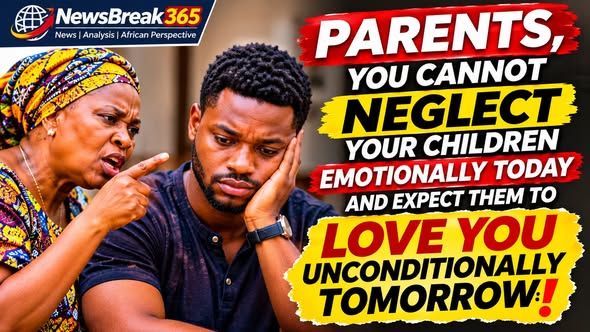
Parents, You Cannot Neglect Your Children Emotionally Today and Expect Them to Love You Unconditionally Tomorrow
Published
15 hours agoon
November 4, 2026
Some parents spend years neglecting their children’s emotional needs, yet expect unlimited love, respect and attention when they grow old. But have we forgotten that family relationships are built through years of actions, not simply blood connections?**
There is an uncomfortable conversation many families avoid: the emotional responsibility of parents towards their children.
In many African households, parents expect unquestionable respect, obedience, loyalty and lifelong support from their children. Children are often reminded that their parents brought them into the world, paid their school fees, provided food and shelter, and made sacrifices to give them a better future.
But there is another side of parenting that rarely receives enough attention.
**What happens when parents provide everything materially but fail to provide the emotional love their children desperately need?**
What happens when a child grows up in a home where affection is absent, encouragement is replaced with criticism, and emotional expression is treated as weakness or disrespect?
And what happens when that child becomes an adult and begins to distance themselves from the very parents who raised them?
## Providing for Children Is Not the Same as Loving Them
Some parents believe that providing food, clothing, education and shelter is sufficient proof of love.
While financial provision is an important parental responsibility, children need much more than material things.
They need parents who listen when they speak, comfort them when they are hurting, encourage them when they fail and celebrate their achievements without jealousy or unnecessary comparison.
A child needs to feel safe enough to express emotions without being insulted, humiliated or constantly reminded that they are worthless.
Unfortunately, some parents spend more time correcting their children’s mistakes than recognising their achievements.
Some constantly compare their children with their neighbours’ children. Others use insults, threats, intimidation and emotional manipulation as methods of discipline.
Over time, these experiences can damage the emotional connection between parents and children.
## The Emotional Wounds Children Carry Into Adulthood
Not every wound is visible.
A child may grow up with a roof over their head and enough food to eat while silently struggling with emotional neglect.
Some adults still remember being rejected by their parents, never receiving a genuine compliment, being constantly criticised or feeling that nothing they did was ever good enough.
Others remember how their parents treated them differently from their siblings.
Some children grow up believing that they must achieve something extraordinary before they deserve their parents’ affection.
These experiences can affect how people develop relationships, express emotions and build confidence as adults.
And when they eventually become financially independent, some choose to create emotional distance from their parents.
This does not automatically mean they hate their parents. Sometimes, it means they are trying to protect themselves from relationships that have caused them years of emotional pain.
## Why Do Some Parents Demand Love They Never Demonstrated?
One of the biggest contradictions in some family relationships is that parents who rarely demonstrated affection while raising their children later expect constant attention and devotion.
They expect their children to call every day, visit frequently, provide financial assistance and make personal sacrifices for them.
But they rarely stop to ask themselves whether they built the emotional foundation for that relationship.
Some parents believe that age automatically guarantees respect and affection.
Others interpret every disagreement as disrespect, forgetting that children eventually become independent adults with their own opinions, boundaries and experiences.
Being a parent deserves respect, but parenthood does not make anyone immune to criticism or accountability.
**You cannot demand an emotional connection while refusing to acknowledge the emotional damage that may have weakened it.**
## The African Parenting Culture: Is It Time for a Change?
In many African societies, questioning parental behaviour is often considered disrespectful.
Children are frequently told that parents are always right, regardless of how they behave.
Phrases such as “I am your father,” “I am your mother,” and “You must never question me” are sometimes used to shut down conversations about emotional pain.
Respect for parents is an important cultural value. However, respect should not become an excuse for emotional cruelty, intimidation or the refusal to accept responsibility.
African parents must understand that modern parenting requires more than authority and discipline.
Children need guidance, boundaries, affection, emotional security and understanding.
A healthy family should be a place where children feel loved, not a place where they constantly fear making mistakes.
We must also recognise that many parents were raised in difficult environments themselves. Some never experienced affection from their own parents and therefore struggle to demonstrate it.
Understanding their background may help explain their behaviour, but it does not mean harmful patterns should continue into another generation.
## Children Also Have Responsibilities
This conversation should not be interpreted as permission for adult children to mistreat their parents.
Children also have responsibilities to treat their parents with kindness, dignity and respect.
Not every parent-child disagreement is evidence of emotional neglect, and not every distant relationship is entirely the parent’s fault.
There are parents who genuinely sacrificed everything for their children and still experience rejection or abandonment.
There are also children who behave unfairly towards loving parents.
Every family situation is different.
However, parents and children must understand that meaningful relationships require effort from both sides.
Love cannot thrive where there is constant humiliation, resentment, manipulation and a refusal to communicate.
## The Lesson Every Parent Must Understand
If you want your children to remember you with affection, give them reasons to remember you with affection.
Be present in their lives. Listen to them. Encourage them. Apologise when you are wrong. Celebrate their successes and support them through their failures.
Do not make your children feel that they must earn your love.
And when they become adults, understand that your relationship with them must evolve. They are no longer little children who must obey every instruction without question.
**The truth is simple: You cannot spend years planting emotional pain and expect to harvest unconditional affection without addressing the damage.**
Parenting is not just about bringing children into the world. It is also about creating an environment where they feel valued, protected, respected and loved.
Because one day, your children will grow up, build their own lives and make their own choices.
The question is: When they look back at their childhood, will they remember a home filled with love or a place they spent their adult lives trying to recover from?
—
## LET’S HEAR YOUR OPINION
Do you believe parents who emotionally neglect their children while growing up should expect unconditional love, attention and financial support from them in old age?
Should children always forgive their parents, regardless of how they were treated?
**Share your thoughts in the comment section. This is a conversation African families need to have.**
*NewsBreak365 — Bringing important conversations to the forefront.*
FOLLOW US ON:
THE DANGEROUS CULTURE OF DIVISION IN OUR SOCIETY: ARE WE DESTROYING OUR OWN FUTURE?
They Don’t Need Guns or Knives to Destroy You: The Deadly Power of a Wicked Tongue
SOCIAL MEDIA BULLYING: THE HIDDEN WEAPON DESTROYING LIVES BEHIND THE SCREEN
‘Sleeping Prince’ of Saudi Arabia dies after 20 years in coma
2027: Atiku delays ADC membership card collection amid rumoured Jonathan comeback
How A Class Of 24 Students Produced 2 Presidents, 4 Governors, 2 Ministers, 4 Emirs, 3 Justices, 4 Ambassadors and Other Influential Leaders
🇳🇬 ALL FOR JAGABAN! BAYELSA WOMEN HIT THE STREETS IN A MASSIVE SHOW OF SUPPORT FOR TINUBU!
🎶 FELA KUTI’S LEGACY LIVES ON! GOVERNOR ABDULRAZAQ JOINS TOP DIGNITARIES AT HISTORIC EXHIBITION IN KWARA
🇳🇬 “I AM READY TO WORK FOR MY COUNTRY!” — AKINWUNMI ADESINA MEETS PRESIDENT TINUBU AT ASO ROCK
Trending
-
Education18 hours agoAustralia scraps digital writing tests for Year 5 pupils
-
Sports17 hours agoUCL: No relief, just pride after United win — Carrick
-
Politics18 hours agoDSS denies Atiku’s ADC rally disruption claim, orders probe
-
Crime19 hours agoEFCC busts Chinese-linked illegal refinery in Ogun
-
Business19 hours agoRevenue boom: World Bank faults states’ spending priorities, read full details
-
Politics19 hours agoObi campaign: OK Movement tackles NDC, Obidients, read details
-
Education18 hours agoUniAbuja land dispute: ASUU threatens industrial action
-
Politics18 hours agoFour Nigerian-Americans win US midterms, Georgia result pending