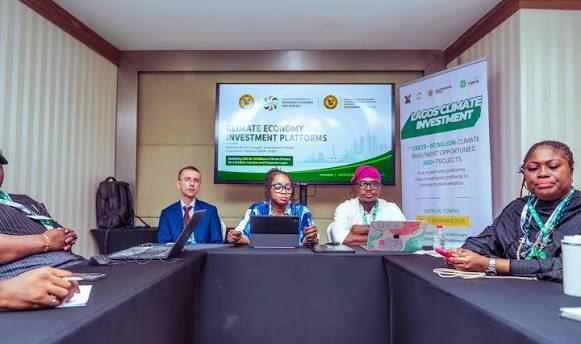
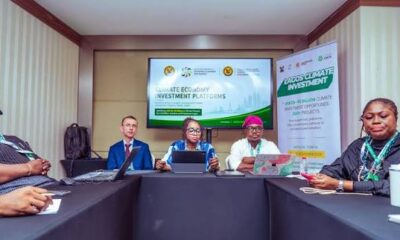
The Lagos State Government says investors have begun expressing interest in partnerships across its climate investment projects, following engagements with financial institutions, energy companies and project developers at the ongoing 31st United Nations Climate Change Conference in Antalya, Türkiye.
The discussions have produced initial partnership opportunities in healthcare, solar energy, women’s empowerment and clean transportation, as the state seeks to turn its previously unveiled $25bn-$50bn investment pipeline into bankable projects.
The engagements followed the presentation of more than 300 potential climate projects by the state, with investors participating in project pitches, exchanging contacts and exploring financing arrangements with government representatives and local businesses.
In a statement issued on Tuesday following a reception at the Lagos Climate Investment Day, which capped a week-long engagement with investors, the Special Adviser to the Governor on Climate Change and Circular Economy, Titilayo Oshodi, said the interactions had strengthened the state’s confidence in its ability to attract private capital for climate investments.
She said, “We’ve brought in the public sector. We’ve brought in the private sector. We’ve brought in young enterprises who are already doing stuff in the green economy. We’ve brought in financial institutions who are ready to show that where we can take the risk, we can begin to fix green finance.
“We have experimented with these things and we have seen that there’s a possibility in them, and it gives us a lot of confidence right now. So, I just want to say thank you to our financial institutions, once again, Sterling Bank, for taking the pain, for taking a shot at us, taking a chance on government.”
Oshodi disclosed that project developers and investors had held discussions after a full day of presentations, with participants asking questions and exploring possible areas of cooperation.
“We had a full day of pitches just a few hours ago. The investors that we brought in asked questions, they were exchanging cards. They were having conversations to discover themselves, and they are beginning to look at what is possible going beyond now,” she said.
She added that the objective was to move beyond announcements and ensure that investment discussions translated into projects, employment and improved living conditions.
“Let’s carry this momentum. Let’s take it along with us. Let’s turn our pledges into projects. Let’s turn our projects into jobs. Let’s turn our jobs into real impact for Lagos State and, by extension, for Nigeria,” she said.
One of the private-sector partners, Tonye Cole, said the initiative provided an opportunity to connect international capital with sustainable development projects and businesses across Africa.
Cole, who said he had spent decades developing and financing sustainable projects, explained that he had worked with his partner, Funke Shobanjo, to establish a platform connecting available global funding with investment opportunities at the grassroots.
He said, “Together, we have developed this platform, and the platform works. What we are now working with Lagos State Government to bring to COP is the opportunity to partner with businesses like ours, with the state government, to develop and work on how sustainable projects and finance can meet the people that need it the most.
“This is an invitation to help you make a difference in a world that needs a difference. Let’s work together to make this happen.”
The Chief Operating Officer of FBNQuest Merchant Bank, Funke Shobanjo, also pledged support for the initiative, saying private investors were prepared to provide financing through a pan-African sustainable finance platform.
She said, “We are extremely excited about what Lagos State is doing, and we are passionate about driving the climate ambition forward for the projects under the umbrella.
“Our commitment is in private individuals coming together to provide capital and financing through a pan-African sustainable finance platform. I want to congratulate Lagos State on this goal and ambition and commit, on behalf of my co-founder and myself, our support to see the projects in the pipeline.”
The early engagements have also produced interest in social-sector projects. A member of the Lagos delegation disclosed that five investors had indicated willingness to partner with projects, including healthcare insurance initiatives aimed at reducing out-of-pocket medical expenses.
The delegate said Sterling Bank had also indicated support for providing between 50 and 100 tricycles for women’s empowerment programmes in Lagos, while Worldwide Energy had promised to solarise a primary healthcare centre.
Climate and carbon asset expert, Dr Adebola Odunsi, described the engagements as an opportunity to unlock economic value through partnerships across states and sectors.
He said the waste generated in one state could serve as raw material for businesses in another, creating opportunities for trade, investment and shared climate benefits.
“The waste that is being generated in one state can become the raw material in another state. So very soon, there are trade opportunities and climate outcome opportunities that we can share, all for the shared climate prosperity of our beautiful country, Nigeria,” Odunsi said.
He added that the investment platform had taken years of work to develop and had attracted considerable interest from international stakeholders.
The engagements come as Lagos seeks to bridge the financing gap between its climate ambitions and actual project delivery. Its previously announced pipeline covers more than 300 potential projects across clean energy, transportation, water management, climate resilience, circular economy, agriculture and green enterprise.
In a related development, the Lagos State Commissioner for Energy and Mineral Resources, Biodun Ogunleye, has identified private capital as a critical factor to addressing the state’s electricity supply deficit and financing its energy transition.
He said Lagos, with an estimated electricity demand of 12,000 megawatts, could not depend solely on government resources to finance the infrastructure required to bridge the gap.
“Our goal as government is to create an enabling environment and not to generate the power ourselves. But reforms alone must not build power plants. Indeed, capital does.
“Government balance sheet alone cannot fund the investment that we know is required,” Ogunleye said.
He disclosed that the state was targeting an additional 2,000 megawatts of electricity capacity and had established regulatory institutions to encourage private investment across generation, distribution and mini-grid development.
Ogunleye urged investors to take advantage of financing mechanisms, including the Global Fund for Infrastructure and Investment Finance, to support project preparation and reduce investment risks.
He said, “Government provides legitimacy, enabling policy and a pipeline, while the private sector provides structuring, capital, credit decisions and asset management.”
He added that the state was ready to share priority projects with financing partners and explore guarantees and other risk-sharing arrangements to make the investments attractive to lenders.
Source: punchng.com
FOLLOW US ON:
FACEBOOK
WHATSAPP CHANNEL
TWITTER
PINTEREST
TIKTOK
YOUTUBE
LINKEDIN
INSTAGRAM