Connect with us

Crime

Soldiers kill 50 ISWAP terrorists, recover arms in Yobe attack

Published

on

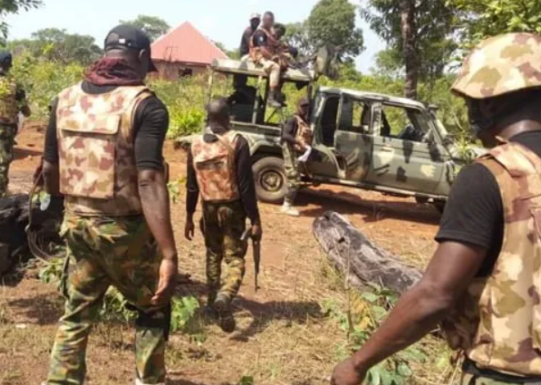
Troops of the Operation HADIN KAI have neutralised at least 50 suspected Islamic State West Africa Province terrorists during a coordinated attack on the Headquarters of 27 Brigade in Buni Gari, Yobe State.

The Nigerian Army disclosed this in a statement issued on Saturday by the Media Information Officer of the Joint Task Force (North East), Operation HADIN KAI, Sani Uba.

According to the statement, the terrorists launched the attack at about 2 am on Thursday from multiple directions targeting the brigade headquarters and the Buni Gari checkpoint.

The army said the attackers first advanced from the western flank before reinforcing through the southern axis along Ganinga Junction and later attempted to encircle the troops from the south-western flank.

“The assault, launched under the cover of darkness by a large number of terrorists from multiple axes, was met with devastating firepower, tactical brilliance and resolute determination by troops who held their ground and inflicted catastrophic losses on the attackers.

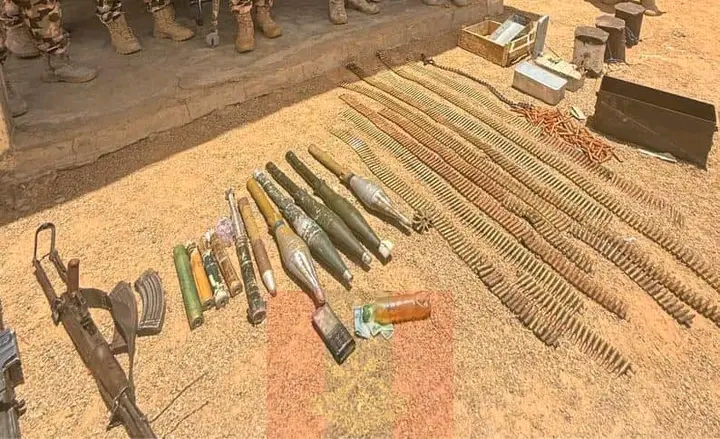
“No fewer than 50 terrorists were neutralised, while a large cache of arms and ammunition was recovered from the fleeing remnants,” the statement read.

The military said troops deployed indirect fire and offensive-defensive tactics to repel the insurgents, forcing them to retreat while evacuating some of their dead and wounded fighters.

It added that no part of the military formation was breached during the attack.

“At no point was any part of the camp breached, as the integrity of the location remained fully intact throughout the engagement.

“Exploitation of the general area confirmed the recovery of 10 terrorist corpses within the immediate vicinity, while human intelligence reports indicate that over 20 additional bodies were scattered across bushes around Gashua, Azare, and Kamuya along the terrorists’ withdrawal routes,” he stated.

See also  Soldiers Intercept Gunrunner, Recover Six Machine Guns, N170K Cash, Others In Taraba

The army also said the Air Component of Operation HADIN KAI provided Intelligence, Surveillance and Reconnaissance support during the operation, enabling precision air strikes on identified terrorist positions and fleeing insurgents.

“In a synchronised air-land operation, precision air interdiction strikes were conducted on confirmed terrorist positions and fleeing elements, accounting for an additional 20 terrorists neutralised as aircraft pursued retreating insurgents along their escape corridors,” he added.

Recovered items included eight AK-47 rifles, two General Purpose Machine Guns, two Rocket-Propelled Grenade tubes, five RPG bombs, three RPG chargers, boxes of 7.62mm ammunition, loaded magazines, bandoliers and three Improvised Explosive Device canisters.

The military disclosed that some Mine-Resistant Ambush Protected vehicles and gun trucks sustained minor damage during the operation, while injured personnel were receiving treatment.

It also confirmed that two soldiers were killed during the encounter.

“Regrettably, two gallant soldiers paid the supreme price in the course of the engagement. Their sacrifice embodies the highest traditions of service, courage, and unwavering commitment to the defence of the nation,” the statement added.

The army said troops and volunteer forces had commenced follow-up operations to track fleeing terrorists and prevent regrouping attempts in the area.

punch.ng

FOLLOW US ON:

FACEBOOK

TWITTER

PINTEREST

TIKTOK

YOUTUBE

LINKEDIN

INSTAGRAM

Continue Reading
Click to comment

Leave a Reply

Your email address will not be published. Required fields are marked *

Crime

Nigerian woman arrested in India with N40.9m cocaine

Published

on

A Nigerian woman has been arrested in Indore, Madhya Pradesh, India, with 57.18 grammes of cocaine valued at more than Rs29 lakh (approximately N40.9m).

According to a report by News18 Hindi on Monday, the woman, identified as Emmanuel Joy, a Lagos resident, was arrested by Chandan Nagar police after she was allegedly found with the drug near IT Park, Sinhasa.

She was reportedly travelling from Mumbai to Indore to supply cocaine.

The report said the arrest occurred during heightened police checks ahead of Rakshabandhan and Janmashtami celebrations, when officers patrolling the IT Park Sinhasa area noticed Joy carrying a black bag.

“A foreign woman carrying a black bag appeared suspicious,” the report quoted the police as saying.

Police reportedly stopped and questioned her, but “her answers were unsatisfactory,” prompting a search in the presence of female police officers.

The search allegedly led to the recovery of 57.18 grammes of cocaine concealed in a transparent bag.

The seized substance was valued at “over 29 lakh rupees,” according to the report.

News18 Hindi reported that “Joy arrived in India from Nigeria on August 14 on a seven-month business visa and was living in Bandra East, Mumbai, where she worked at a hair salon with her sister.”

During interrogation, Joy allegedly told police that she purchased cocaine at a low price and intended to sell it at a higher price in Indore.

However, investigators are independently verifying her account.

A case has been registered against her under Sections 8 and 21 of the Narcotic Drugs and Psychotropic Substances Act.

Police have also examined her passport, visa and immigration records.

See also  Soldiers Intercept Gunrunner, Recover Six Machine Guns, N170K Cash, Others In Taraba

Following her arrest, Joy was produced before a court and remanded in custody as investigations continued.

Police have expanded the investigation to examine her mobile phone and other digital data in an effort to identify other people linked to the alleged drug network.

According to the report, investigators are trying to establish “who purchased the cocaine, who in Indore it was intended to supply, and who else is involved in this network.”

The investigation is expected to determine the extent of the alleged supply chain between Mumbai and Indore and whether other suspects were involved.

Source: punchng.com

FOLLOW US ON:

FACEBOOK

TWITTER

PINTEREST

TIKTOK

YOUTUBE

LINKEDIN

INSTAGRAM

Continue Reading

Crime

NRC, NSCDC foil railway vandalism attempt, recover nine cylinders in Osun

Published

on

The Nigerian Railway Corporation and the Nigeria Security and Civil Defence Corps have foiled an attempt to vandalise railway track materials at the siding serving the Dangote Steel Rolling Mills in Osogbo, Osun State, recovering nine oxygen gas cylinders allegedly brought to the site for the operation.

In a statement signed on Sunday by its Chief Public Relations Officer, Callistus Unyimadu, the NRC said its Principal Track Officer in Osogbo received a report on Friday, August 28, about the ongoing vandalisation of railway track materials and immediately proceeded to the site with security personnel.

The statement said, “On sighting the security operatives, the suspected vandals fled the scene.”

It added, “A search of the area led to the recovery of nine oxygen gas cylinders reportedly brought to the site for the illegal operation.”

The corporation said security personnel, including officers of the NSCDC Railway Command, had since secured the affected railway materials and the vicinity.

Reacting to the incident, the NRC Managing Director and Chief Executive Officer, Kayode Opeifa, described the intervention as “another significant success in the sustained efforts to protect railway infrastructure from vandals and other economic saboteurs.”

Opeifa commended the security personnel for their vigilance and timely response, while urging security formations across the railway network to intensify surveillance and enforcement against the vandalisation and theft of railway assets.

He stressed that “railway infrastructure constitutes critical national assets whose protection is essential to the safety of rail operations, sustainability of services and the economic development of the country.”

See also  Soldiers Intercept Gunrunner, Recover Six Machine Guns, N170K Cash, Others In Taraba

The NRC boss also called on members of the public, particularly communities located along railway corridors, to support the campaign against vandalism by promptly reporting suspicious activities around railway tracks, stations and other railway facilities.

He further directed security operatives to intensify efforts towards identifying, apprehending and prosecuting those responsible for the attempted vandalisation at the Dangote Steel Rolling Mills siding.

Opeifa assured that the corporation would continue to support security agencies in efforts to curb vandalism and other acts capable of undermining railway operations across the country.

Source: punchng.com

FOLLOW US ON:

FACEBOOK

TWITTER

PINTEREST

TIKTOK

YOUTUBE

LINKEDIN

INSTAGRAM

Continue Reading

Crime

Lured online, sold for $5,000: Read how Nigerian youths are trapped in Asia’s cyber-slave camps

Published

on

When Sabiu demanded to leave the compound, his boss gave him an answer that still haunts him: “I had paid $5,000 to buy you.” What began as a promised job in Laos had become captivity. His passport was gone, his savings were stolen and armed guards watched over a workforce forced to scam strangers online. His story is one of several uncovered in this investigation by STEPHEN ANGBULU into the trafficking of Nigerian youths through social media into the brutal cybercrime camps of Southeast Asia

The last wrap of weed Sabiu sold in the Golden Triangle fetched him 20 Yuan, about $2.70. It was enough for a plate of noodles, which was all he ate most days, once, at night.

It was October 2024, and the 26-year-old who hails from Borno State had been surviving this way for months in Bokeo Province, Laos, a mountainous Southeastern nation in Asia bordering China, Vietnam, Myanmar, Thailand, and Cambodia. He was sleeping on bus station benches when he ran out of rent money, eating leftover food from restaurants, charging his phone by sitting in eateries until attendants chased him away, and selling marijuana at a small markup to other displaced Africans who had stumbled out of the same cyber-scam compounds that had held him captive. He had tried to kill himself once already, swallowing poison mixed into pineapple juice. It only gave him diarrhoea, after which he returned to scavenging.

A Laotian shopkeeper, a Buddhist who did not trust Black people, began letting Sabiu take noodles on credit after noticing that he, unlike other foreigners, always removed his shoes before entering the shop.

“He told me my character was different,” Sabiu said. It was the closest thing to kindness he had experienced in months.

“At some point, I was chatting with ChatGPT, asking it the easiest way I could just end it. It would not give me the answer. It just kept recommending agencies that could help me. That was how I found IOM,” Sabiu told our correspondent during a sit-down interview.

Before the weed supply dried up when his Laotian friend was arrested, Sabiu had built a fragile economy of survival. He buys at 30 yuan, sells at 50 and pockets the difference. It was, by his own reckoning, the most dignified phase of the six months he spent outside the cybercrime compound that had swallowed his scholarship, his savings, and nearly his life.

Scholarship that didn’t happen

Sabiu’s journey to that desolate point began in a university classroom. In 2023, he secured a scholarship to Jiangxi University of Science and Technology in China to study engineering. But the scholarship, he discovered upon arrival, covered only one year of Chinese language instruction. The remaining four years of tuition would fall on him. His father told him to return home. But Sabiu, who had “tried everything to leave Nigeria behind,” refused.

“I tried to be responsible. I tried to man up,” he said.

With a good command of Mandarin and English, Sabiu rose to the challenge. He taught English to private students in Xinyi city. He worked as a cargo inspector in Guangzhou’s business district, earning small commissions wrapping goods for export. But his student visa barred him from legal employment, and when Chinese immigration began cracking down, even those meagre earnings dried up.

“Unfortunately, in China, if you have a student visa, you cannot work for part time anywhere. So, your job will be illegal by the books. First, I got a job teaching English to a 17-year-old boy in my city, Xinyu in Jiangxi Province.

“But shortly after I started teaching English there, the family relocated to Guangzhou. This was when I became really broke,” he narrated.

It was during one of his trips to Guangzhou that he met a Chinese businessman who introduced himself as Wang Xu. The man was friendly, spoke English, and invited Sabiu to dinner. Over beer, Sabiu, a Muslim, does not drink, Wang Xu listened to his story and offered him a job, a three-month contract as a telecom representative in Laos during the summer break. The work, as he was told, involved helping tourists subscribe to local phone networks.

See also  I staged my kidnap to extort N25m from family — Delta man

“Everything sounded legit. He told me people in Laos do not speak English, so tourists need help subscribing to their SIM cards. I was like, okay, I am interested,” Sabiyu recalled.

He added, “My desperation took over me. I did not think twice.”

Given his aptitude and skills, Sabiu was by every measure the exact kind of bright and resourceful young Nigerian that traffickers operating Asia’s cybercrime underworld have begun to target.

“They do not just pick anyone anymore,” a senior NAPTIP operative who facilitated our correspondent’s access to Sabiu explained, adding, “They target intelligent youths with computer and IT skills, as well as those with clean health records.”

The operative, who spoke on condition of anonymity because he was not authorised to address the media, said between November 2024 and early 2025, the agency’s Intelligence and International Cooperation Unit intercepted close to 1,000 persons attempting to travel to the Middle East and Asia. But the Southeast Asian route, he said, represented something qualitatively different from the domestic servitude pipelines to Iraq and Saudi Arabia that NAPTIP had been combating for years.

“These are people with degrees, people who can code, people who understand trading platforms. And that is exactly why they are wanted,” the operative said.

Wang Xu bought Sabiu a train ticket to Sichuan Province, a 32-hour journey, arranged a hotel, paid for his Laos visa, and had an associate he identified as Wang Li escort him across the border. At the hotel in Sichuan, the Chinese receptionist gave Sabiu his first warning on this journey.

“He told me, ‘whatever you do, do not go to Myanmar. They kill people there.’ He said Laos is fine, but Myanmar, no. I told him I was going to Laos, not Myanmar. But something started feeling off,” Sabiu recalled.

He crossed into Laos by bus and was driven to Bokeo Province, to a place called the Golden Triangle, alleged to be one of the most notorious criminal enclaves on earth.

Bought for $5,000

The Golden Triangle Special Economic Zone is a sealed-off, Chinese-built enclave in northwestern Laos where the borders of Laos, Myanmar and Thailand converge at the Mekong River. Established in 2007 under a 99-year lease granted to Chinese businessman Zhao Wei, it was ostensibly designed as a trade hub.

In reality, however, it is allegedly a self-governed criminal city. The United States Treasury Department sanctioned Chinese businessman Zhao Wei in 2018 for running a transnational criminal organisation. As of 2024, up to 400 scam call centres operated within the zone. The US-China Economic and Security Review Commission revealed in 2025 that scam centres across Myanmar, Cambodia and Laos produced approximately $43.8bn in revenue in 2023, equivalent to 40 per cent of the GDPs of the three countries combined. The United Nations estimated that 220,000 people were being held as forced labourers in such centres across the region.

Sabiu described the Golden Triangle as mini state where the currency, signage and business language operated in Chinese. He said Laotian police couldn’t enter without permission from the zone’s management. For him, it felt like stepping back into China. Except this time, there was no way out.

On his first day, Sabiu was interviewed, not on his communication skills, but on his knowledge of cryptocurrency. After a 10-day probationary period, he was moved into the main compound. There, he saw persons from various nationalities; Ethiopians, Indians, Pakistanis, Filipinos, Brazilians, Russians, all typing at computer terminals, flanked by Myanmar bodyguards who, he said, “do not even smile at you.”

“They were just typing, and Myanmar bodyguards roaming around. They do not even smile at you. They have no sympathy. The moment you do something wrong, they can kill you. They just need an order.

“That was when I realised the whole thing was about scamming people online. We targeted Americans especially,” he said.

As Sabiu came to understand, the operation was a romance fraud on an industrial scale. Workers were instructed to find attractive female profiles on Instagram, women who looked 35 of age, with at least 500 uploaded photos. These images were used to build fake identities. An AI system processed selfies to enable real-time deepfake video calls via WhatsApp. A team of Russian women handled the calls. Once trust was established, the “girlfriend” would steer the target towards a rigged cryptocurrency platform that showed fabricated profits of 40 to 50 per cent on early investments. When the victim deposited their life savings, the money vanished.

See also  PHOTOS: Angry Protesters Block Lafia-Makurdi Highway After Gunmen K!lled Two Youths And Kidnapped Residents In Nasarawa

After his 10-day probation, Sabiu was handed a contract written in Chinese, which he could speak but not read. The guards pressured him to sign while his supervisor stepped out to smoke. Though he planned to work for three months, the contract he hurriedly signed bound him for two years. His passport was confiscated too under the guise of visa extension.

“That was the biggest mistake I ever made in my life,” Sabiu said, fighting tears.

“They took away my passport saying that they wanted to extend the visa. I had a tourist visa, which was only for two months. They said they wanted to extend it for three months. And that was it,” he added.

According to Sabiu, an Ethiopian detainee pulled him aside and warned, “Bro, if you know what is good for you, do not work in this company like me. That is the advice I can give you. They beat people and all they care about is money.”

It was the second warning, but it arrived too late. When Sabiu protested that his contract was only for three months, the Ethiopian shook his head and replied, “There is no company in Golden Triangle that will give you a contract for three months. Go and check what you signed.”

Sabiu confronted his boss, who told him to call Wang Xu. But the answer came back cold.

“Finally, he told me he had paid $5,000 to buy me,” Sabiu said.

He worked 17-hour per day. Toilet breaks were capped at 15 minutes. Those who fell asleep were tasered. His Indian friend Raju, who was “always smiling, always happy,” was dragged into an office one day after being caught collecting recruitment commissions from multiple companies.

“I heard a gunshot. They never brought him out. I messaged him. Till today he has not responded. This is one of my own wounds I was telling you about,” Sabiu said almost inaudibly, showing our correspondent the small, circular cigarette burn scar on his arm, a parting gift from his supervisor the day he begged to leave.

That night, Myanmar bodyguards escorted him to a car. They demanded his phone. When he refused, the driver punched him in the nose. They tasered him and drained his Binance cryptocurrency wallet of $9,000, his entire life’s savings, which was not enough to carry him through school. They dumped him by the Mekong River with nothing.

“I wanted to just jump in and kill myself,” he said. Instead of killing himself, however, he scavenged. He ate leftovers from restaurants. An Ethiopian man, himself an agent who sold people to the compounds, took pity on him and gave him shelter.

It took six months of homelessness, a recommendation from ChatGPT, and the intervention of the IOM, the Nigerian Embassy in Vietnam, NAPTIP and the National Intelligence Agency before Sabiu made it back home to Nigeria.

He returned to Nigeria in September 2025, broke and in debt, owing over N3m to a friend from a business deal that collapsed while he was trapped in Asia. He now lives with his father, a stroke patient, and uses his younger brother’s phone. He cannot return to Maiduguri where many of his creditors live.

The day before our interview, his mother found him vomiting blood in his room.

“People thought it was food poisoning from Ramadan. It was not,” he said.

‘They said I will earn $1,500 monthly’

Sabiu’s experience is not an outlier. It sits within a rapidly expanding frontier of trafficking that NAPTIP’s Director-General, Binta Bello, flagged as a national emergency. In February 2026, NAPTIP repatriated 23 Nigerian youths from Thailand who had been trafficked for cyber-enabled crimes. Agency data showed 93 convictions in 2025 and over 2,500 interceptions of potential victims.

See also  Panic as five bodies found along Lagos riverbank

The pipeline is industrial in scale and chillingly efficient in design; efficient enough to deliver 28-year-old Offor from a quiet life in Abia State into the dense humid jungles of Myanmar. Offor lost his father in January 2025. In April, while scrolling Facebook, he saw a sponsored advert for an online marketing job with a Chinese company called Tanjin in Thailand, offering $1,500 a month. He tapped the link, joined a WhatsApp group run by an admin called “Oscar,” and was interviewed on video by an Asian woman named “Mary” sitting at a professional-looking desk.

“She could speak English. She was Asian. She asked me my age, if I knew how to use a computer. I told her I could use Microsoft Word, a little of Excel too,” Offor said. He passed the interview. His mother, cautiously optimistic, told him, “Since the company says you are not going to spend any money, maybe you can try it.”

An agent called John, whom Offor would never meet, arranged his visa, NDLEA clearance and flight ticket. On September 5, 2025, Offor boarded an Ethiopian Airlines flight from Abuja to Bangkok. At Suvarnabhumi Airport, an immigration officer walked straight to him, holding up the selfie he had taken on the plane and sent to Oscar minutes before take-off.

“They will tell you to snap a picture of yourself and send at every point in the journey. It was when I reached the airport in Abuja that Oscar sent me my Visa and a token of $500.

“So in Thailand, this female officer showed me my picture. The same picture I took inside the plane. I was wearing this same white native,” he said, flapping the hem of his native wear. His passport was stamped without the standard interview and no questions were asked.

What followed was a 24-hour descent into the underworld. Over the course of 12 hours, Offor said was transferred between seven Toyota Hilux vehicles, each handover at an increasingly remote location, each new driver armed. Then he arrived at a small camp where, for the first time, he met others like him, trafficked from various countries, including a Nigerian couple. At dusk, the vehicles could go no further. The terrain had given way to swampy rice paddies and steep, muddy hills.

“We had to remove our slippers and go barefoot. You had to crawl up the hills. We broke sticks inside the bush to use as climbing hooks. These people, the guides, were doing it so easily. It was clearly their regular job,” Offor said.

They trekked for six hours through dense forest, across two rivers waist-deep, in total darkness, with armed guides who communicated only through hand signals and torch beams that vanished ahead if you fell behind. Several people sustained injuries from falls on the slippery terrain, he said. The Nigerian man he had befriended was exhausted. Offor kept encouraging him in Igbo: “We do not have any choice. If we run, where are we running to? Look at the distance we have driven.”

Offor said they arrived at CK Hills Hotel in Myanmar at 5am, caked in mud. At daybreak, a vehicle conveyed them from the hotel to a fenced compound guarded by soldiers he would later identify as the Democratic Karen Benevolent Army, a Karen ethnic armed group operating in Myanmar’s volatile border regions that the syndicate had contracted to provide military-grade security.

The DKBA soldiers carried rifles and machine guns, he narrated. They are one of several ethnic armed groups born out of Myanmar’s decades-long civil conflict which has splintered into factions, some of which have struck deals with Chinese-run criminal syndicates, providing armed protection in exchange for revenue.

Their presence meant that the facility was not merely a workplace for Offor and his colleagues but a militarised encampment from which escape was practically impossible. Inside, private security personnel wielded tasers and batons. Nearly a thousand people including Chinese, Nigerian, Indian, Pakistani, Ugandan, Kenyan were held there, each assigned a desktop computer, forced to execute fraud targeting wealthy foreigners.

Source: punchng.com

FOLLOW US ON:

FACEBOOK

TWITTER

PINTEREST

TIKTOK

YOUTUBE

LINKEDIN

INSTAGRAM

Continue Reading

Trending