Connect with us

Lifestyle

One year after 272 massacred, fear still rules Yelewata

Published

on

How much has changed since that tragic night of June 13, 2025? Have the survivors of the massacre found healing and security, or are they still trapped by fear, poverty and painful memories? JOHN CHARLES visited Yelewata on Saturday and reports on a community still searching for answers

In Yelewata, memories do not live in photographs alone; they stand in burnt walls, empty compounds and the tears of survivors who still struggle to understand why hundreds of their neighbours never lived to see another sunrise.

The tears came without warning.

Standing before the charred remains of a house in Yelewata, Saaondo, a middle aged man, could no longer hold back the memories. Around him, prayers echoed from a memorial Mass organised to honour victims of the June 13, 2025 massacre. But for him, the tragedy was not history; it was a wound that reopened with every glance at the ruins.

A year ago, fate spared him. He had travelled out of the community just hours before armed attackers stormed Yelewata, killing hundreds and setting homes ablaze. Those he left behind never escaped.

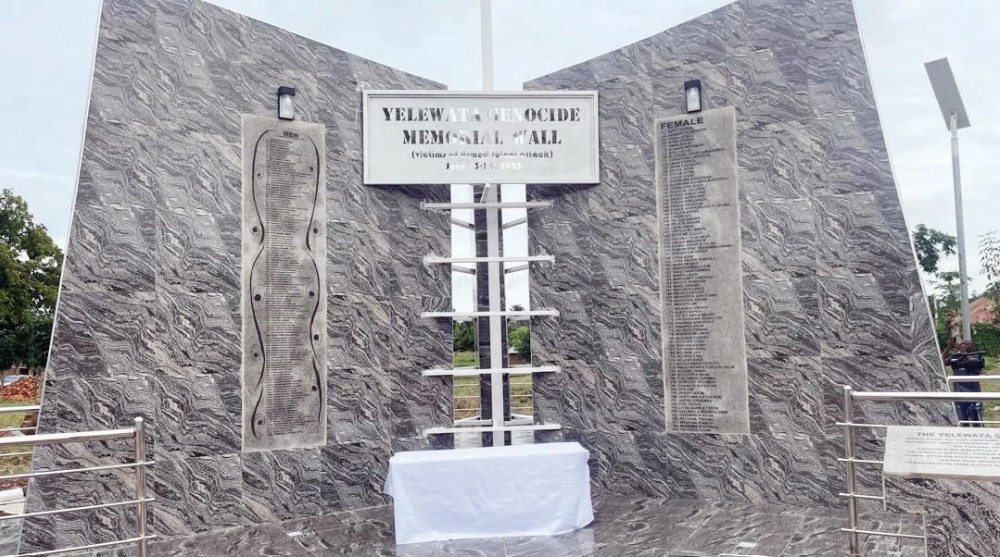
Last Saturday, as the community marked the first anniversary of the attack, the sorrow was unmistakable. Behind the speeches, prayers and unveiling of a monument bearing 272 names was a painful reality: while the dead are being remembered, many survivors say they are yet to rebuild their lives.

One of the leaders of Yelewata community, Matthew Mnyan, noticed Saaondo standing alone and quietly approached him. Concerned, he asked why he had stepped away from the memorial Mass and appeared deeply troubled.

The man’s response was enough to melt even the hardest heart.

‘I would have died too’

Pointing to the burnt remains of a house nearby, Saaondo said, “I left this particular house for Makurdi on the eve of June 13. But all the occupants of the house were killed and burnt when the marauders invaded Yelewata. If I had been around that night, I would have been among those being remembered at this memorial today.”

His grief reflected the mood in Yelewata last Saturday as the once-sleepy community again played host to visitors from different walks of life. They had not come to celebrate a festival or honour a prominent figure. Rather, they had gathered to mark the first anniversary of the deadly attack that left the community devastated.

Yelewata, located along the Lafia-Makurdi Federal Highway in Guma Local Government Area of Benue State, came under a brutal attack on June 13, 2025. The assault, which reportedly lasted about four hours, drew national and international attention. Initial reports put the death toll at about 200.

See also  PHOTOS: The Untold Story of Nigeria’s First Political Plane Hijack

However, with the unveiling of a memorial monument in honour of the victims during the first anniversary commemoration, the number of those killed was officially put at 272, including 67 children.

According to Franc Utoo, a native of the community and Director of Advocacy for the US-based non-profit organisation, Equipping The Persecuted, which funded the Yelewata Genocide Memorial Monument, the project was conceived to ensure that the victims are never forgotten.

“By choosing to erect this monument, the organisation affirms that those slain in Yelewata must never be reduced to a passing headline or anonymous casualty figures. They must be remembered with dignity, permanence and honour,” he said.

He added, “As the first monument of its kind in Benue State, it occupies a historic place in the moral landscape of remembrance. It preserves the names of the 272 members of the Yelewata community who were killed — 67 children, 83 women and 122 men — and places before the world a solemn record of lives violently taken.”

As residents and visitors marked the anniversary, it became evident that Yelewata is still struggling to recover from the tragedy. Twelve months after the attack, the scars remain visible and the pain is far from over.

Memorial service

Delivering his homily at the memorial Mass, the Catholic Bishop of Makurdi Diocese, Most Rev. Wilfred Anagbe, called on government at all levels to adopt a deliberate policy of resettling displaced persons in their ancestral communities rather than keeping them indefinitely in makeshift Internally Displaced Persons camps.

According to the bishop, the continued confinement of displaced persons in camps for fear of further attacks amounts to a defeatist approach and projects the government as powerless in the face of insecurity.

He argued that keeping otherwise productive members of communities in camps where they depend largely on charity is counterproductive to their physical and psychological well-being and ultimately undermines their dignity.

Anagbe also faulted the Benue and Nasarawa State governments for what he described as negligence, accusing them of failing to act on intelligence reports that allegedly warned of the impending attack on Yelewata.

Despite the tragedy, the bishop commended the resilience of the people of Yelewata, noting that they have remained steadfast in the face of immense physical and psychological trauma.

See also  Video - Sunday Igboho Visits Yoruba Traditional Rulers | Powerful Meeting for Unity & Progress

He assured them that the Christian community across the world continues to stand with them in prayer and solidarity.

Moro blasts FG

In his remarks, Senate Minority Leader Abba Moro criticised the Federal Government and Nigeria’s political class for what he described as their failure to fully appreciate the magnitude of the insecurity confronting the nation.

Moro accused the government of avoiding uncomfortable truths and warned that refusing to confront the problem head-on would not make it disappear.

Taking a swipe at the country’s political elite, he asked: “Can we, in all honesty, go around during campaigns and ask the people to vote for us again when the mandate already entrusted to us has not been effectively deployed for their well-being? We need to wake up.”

How are survivors faring?

For many residents, the first anniversary of the attack was not only a time to remember the dead but also an opportunity to draw attention to the plight of the living.

A community leader, Matthew Mnyan, painted a grim picture of life in Yelewata one year after the tragedy, lamenting that many survivors are still struggling to rebuild their lives.

According to him, poverty has deepened in the community, while insecurity remains a major concern.

He said residents still live in fear and cannot venture far from the community or freely access their farms because of persistent security threats.

Mnyan cited the case of a young girl who was allegedly sexually assaulted while fetching firewood in a nearby bush.

“People of Yelewata and neighbouring communities, especially Udei, are still living in fear. They cannot access their farms because of recurring attacks in the area,” he said.

“There is a case involving a young girl that I am still pursuing. She was sent to fetch firewood from a nearby bush and was allegedly molested by four suspected herders. Incidents like this show that our people are still vulnerable.

“The level of poverty has also increased because many people who relied on small-scale businesses and other means of livelihood have not been able to recover from the attack.”

Mnyan also criticised the Technical Committee on Donations for Internally Displaced Persons, headed by the Secretary to the Benue State Government, Deborah Aber, accusing it of not doing enough to alleviate the suffering of survivors.

“While the government may believe it has done a lot, many people in the community feel otherwise,” he said.

The community leader said residents had advised the state government on how best to utilise donations received from individuals and organisations, including the contribution made by the First Lady Oluremi Tinubu, but alleged that the funds had not been effectively deployed for the benefit of victims.

See also  Makoko demolition: When economic interest overrides humanity

In March this year, the Secretary to the State Government announced that the committee had received about N1.25bn in donations from various sources, including N1bn donated by the First Lady following the attack.

Mnyan said the community had proposed that a substantial part of the funds be used to resettle displaced residents and support their economic recovery.

“We suggested that some of the money should be given to affected persons as start-up capital for small businesses, while markets and other facilities that would help restore livelihoods should also be provided,” he said.

He further alleged that some of the beneficiaries selected by the committee were not among the names submitted by the community.

According to him, residents raised concerns that the list used for the distribution of assistance did not accurately reflect those affected by the attack.

Mnyan also questioned the quality of some of the housing projects being executed for displaced persons, alleging that some of the buildings had already begun to develop cracks.

He called on Governor Hyacinth Alia to personally visit the community and assess the situation on the ground.

“I am not sure the governor is fully aware of what is happening. I urge him to come and see things for himself, inspect the projects and hear directly from the people of Yelewata,” he said.

Mnyan further expressed concern that several directives issued by President Bola Tinubu during his condolence visit to Benue State had yet to be implemented.

However, the Benue State Emergency Management Agency presented a different account of the situation.

The agency’s Information Officer, Tena Ager, said some displaced persons from Yelewata had already been resettled, while others remained at the International Market IDP camp.

According to him, more than 1,000 completed housing units have been allocated to displaced persons, while the government has acquired additional land in the community for the development of social infrastructure, including a mosque, church, hospital and market.

“Government has also provided cash assistance and other relief materials to the people of Yelewata,” Ager said.

punch.ng

FOLLOW US ON:

FACEBOOK

TWITTER

PINTEREST

TIKTOK

YOUTUBE

LINKEDIN

INSTAGRAM

Continue Reading
Click to comment

Leave a Reply

Your email address will not be published. Required fields are marked *

Lifestyle

Actor Baba Ijesha welcomes baby boy

Published

on

Actor Olanrewaju Omiyinka, popularly known as Baba Ijesha, has announced the birth of his son.

The actor disclosed this in an Instagram post on Monday, sharing a maternity photoshoot featuring himself and his wife.

Expressing gratitude to God, Baba Ijesha revealed that the couple welcomed a baby boy named King Kagar Omiyinka.

He wrote, “In quiet ways, in unseen ways, God has been writing a story only He could tell. We thank the Almighty for blessing us with a healthy baby boy.

“God gave me more than I prayed for. My ever beautiful wife, strong Jagaban, Abikese de mi owo, @ceolumineeofficial, who became the mother of my son, King Kagar Omiyinka.”

The announcement attracted congratulatory messages from fans and colleagues in the entertainment industry.

Baba Ijesha was released from prison in November 2025 after serving a jail term following his conviction in a child sexual assault case.

See also  Saudi Arabia’s Grand Mufti dies at 82
Continue Reading

Lifestyle

Abdulsalami reveals why he told Obasanjo not to contest 1999 presidency

Published

on

Former Head of State, Gen Abdulsalami Abubakar (retd.), has disclosed that when Gen Olusegun Obasanjo came to see him after his release from prison in 1998, he advised him point-blank to abandon the idea of contesting the presidential election.

He said he told him at the time to go home, thank God he was alive, and forget about becoming President.

Abdulsalami also revealed that at the same meeting, he talked Obasanjo out of filing a lawsuit against the Federal Government over his wrongful imprisonment, warning him that the court process was uncertain and offering instead to explore compensation for the collapse of his business during his years in detention.

The accounts are contained in Chapter 22 of Abdulsalami’s 264-page, 27-chapter autobiography titled ‘Call of Duty,’ obtained by our correspondent at the public presentation of the book at the Aso Rock Villa, Abuja.

The presentation was held to mark the former Head of State’s 84th birthday and was attended by President Bola Tinubu, who was represented by Vice President Kashim Shettima as the special guest of honour.

Describing the encounter, Adulsalami wrote that Obasanjo came to him with two issues after his release: his intention to sue the government and the invitation from the Peoples Democratic Party to contest the presidency.

“I was forthright with him. One, I advised him that he should not take the government to court because it might not augur well.

“For one, he would not know how long it would take the court to give judgment. I told him that, as a government, we would try to see what could be done about his business in the form of compensation.

“The court process was uncertain, I told him. I tried to dissuade him from pursuing the litigation option, and he agreed with me,” he wrote.

Abdulsalami continued, “On the invitation by the PDP that he should run in the presidential race, I advised him to return home and thank God that he was still alive after all he had gone through in four years. I told him point-blank that he should forget about contesting to be President.

“He took a deep sigh and said he was going to think about it and revert. He never got back to me. He can confirm this encounter.”

The former head of state argued that the fact that Obasanjo ultimately contested and won the election should not be taken as evidence that his administration was behind the candidacy.

See also  Makoko demolition: When economic interest overrides humanity

“I tell people till today that my administration had nothing to do with the presidential ambition of General Obasanjo.

“It may be hard to believe, but we did not endorse him, and we did not work for him. It was a conjecture.

“As I have said several times, as a government, we decided to release all political prisoners. We did not pick and choose. We did not single any individual out for favour. General Obasanjo was one of those prisoners who regained freedom,” he stated.

According to him, “Some said because we granted him a pardon, which allowed him to run for office, that meant we were working for him.

“But we released and pardoned scores of political prisoners. It was because General Obasanjo ended up as the President that people overlooked the other prisoners that were pardoned as well.”

Abdulsalami also acknowledged that there were reports of retired Generals working behind the scenes to persuade Obasanjo to run, believing he could unite Nigerians at that critical moment. But he distanced himself and his government from those efforts.

“There were reports that some retired Generals worked behind the scenes to persuade General Obasanjo to run because they believed he was the one who could unite Nigerians at that critical time, given his experience, network and knowledge.

“I read the reports, too. I was also aware of efforts made by some people to ensure that somebody who was nationally acceptable was elected as President.

“Those were private initiatives and had nothing to do with our government or me,” he wrote.

In the chapter, Abdulsalami also gave an account of how he deliberately bent the electoral rules to ensure the Alliance for Democracy, the party formed by NADECO and the Afenifere Yoruba socio-cultural organisation, was registered as a political party, even though it failed to meet the criteria his administration had set.

He said that by the criteria for party registration, which required presence in two-thirds of the 36 states, legal registration, offices in the FCT and state capitals, and a constitution, the Peoples Democratic Party and the All Peoples Party were clearly the top two, while the AD could realistically only win the six south-western states.

He said, “We had to apply some wisdom and flexibility. As projected, the AD eventually didn’t meet the criteria for the registration of political parties. We tinkered with the rules and said any party that came third would be registered. That was how AD scaled through.

“We did not want to create a system in which the South-West would feel marginalised. Whatever decision we took was for the peace and progress of the country. If tinkering with the rule we made ourselves would give respite to Nigerians, why not?

See also  PHOTOS: The Untold Story of Nigeria’s First Political Plane Hijack

“The rules were made by humans and for humans. The idea was to give peace a chance and to ensure that there was equity and justice.”

Abdulsalami also explained why Nigeria’s return to civilian rule came in May 1999 rather than October 1998, the date Abacha had announced before his death.

He said the October date was never feasible, as his administration scrapped Abacha’s entire transition programme as lacking credibility, adding that May 1999 was ultimately determined not by political calculation but by a request from the judiciary.

According to him, “My first suggestion was that we should draw up a six-month transition plan. That would have seen us hand over to a democratically elected President by March 1999.

“However, when I called for a meeting with the military echelon and the judiciary, Justice Muhammadu Uwais, then Chief Justice of Nigeria, said he would need at least sixty days after the elections to ensure that all the judicial matters brought to the courts were dispensed with before inauguration.

“That was how we arrived at May 1999. It was a function of a judicial request and my desire to make the transition process as short as possible. Six months was the fastest we could do to organise elections and give the political parties the time to set up and prepare.”

He disclosed that he faced pressure from multiple directions not to hand over at all, including from some of his own military colleagues, from some West African Heads of State, from segments of the international community, and even from some NADECO members who felt they had been caught flat-footed by the speed of the transition and wanted more time.

“Initially, there was intense pressure from some of my colleagues, some Heads of State in the West African sub-region and some in the international community that it was too soon to transition to democracy.

“Surprisingly, there were pressures from some NADECO members too. Two to three months into my administration, some NADECO members realised that I was sincere about the handover date, and they saw themselves as short-changed because they were not politicking as they should have done.

See also  Video - Sunday Igboho Visits Yoruba Traditional Rulers | Powerful Meeting for Unity & Progress

“They felt they had missed the train and wanted to come on board, which made them request more time to get their act together,” he wrote.

He said when NADECO came to him requesting an extension, he turned the tables on them, demanding that they write a formal letter requesting the extension and call a press conference publicly endorsing the request, which they declined.

“I promised that if they did that, I would grant an extension. But they never did. I knew they wouldn’t. We went ahead with our programme,” Abdulsalami wrote.

He said some of his military colleagues were also hostile to handing over to civilians, but that he was personally unmoved by any temptation to stay.

“For me, I was not in any way tempted to stay longer in office. I had made up my mind. By the time I took over the reins of power, the country was on the edge.

“There was extreme pressure from NADECO, G-34, and other political players for the military to go.

“Nigeria was at a breaking point. The military needed to relinquish power,” he wrote.

On the eve of the May 29, 1999, handover, Abdulsalami said he slept soundly, noting that the only nights he had not slept since taking power were the first few nights.

“I slept well that night. I always slept well, apart from the day I assumed power when I didn’t sleep a wink for days.

“Thereafter, I always slept well, even though I worked round the clock at times. But that was a choice. I had no anxieties whatsoever on the eve of the handover. I had made up my mind to relinquish power within the shortest possible time, and I didn’t have any issues that I was about to leave power.

“Rather, I was happy that as much as possible, we had brought peace to the country and stabilised the military too,” he wrote.

He added that on the morning of May 29, 1999, he took Obasanjo on a familiarisation tour of the Presidential Villa, introduced him to staff, and, after the handover ceremony, drove back to Minna, his personal belongings having already been moved out a week earlier.

“As we drove through towns and villages, people gathered by the roadside to wave to us. It was quite a sight. I was a very happy man,” he wrote.

punch.ng

FOLLOW US ON:

FACEBOOK

TWITTER

PINTEREST

TIKTOK

YOUTUBE

LINKEDIN

INSTAGRAM

Continue Reading

Lifestyle

Dad told us ‘I’m going home’ hours before his death – Late Kola Oyewo ’s son

Published

on

Oluwatobi Oyewo is the youngest of the five sons of legendary actor, scholar and cultural icon, Kola Oyewo, who died on Friday aged 80. In this interview with WALE AKINSELURE, Oluwatobi recounts his father’s final moments and values that defined his life and legacy

Tell us about the final moments before your dad’s death…

He passed on Friday at about 6:30pm. Two days before he died, he had been talking in a way that was mysterious. He was speaking in parables. My immediate elder brother had been in Ife for a while, taking care of him. His family stays in Ife, so he had been with them for some time. In a way, he was talking in parables as if he was ready to go. He kept telling my brother that it was sad that he would be leaving behind such good children. My eldest brother still had a video call with him on Friday morning. They joked and laughed. He was in the hospital. My brother asked Daddy if he was on his way home. He responded that, yes, he was going home. But we later realised that while my brother was talking about going back home to Ife, I think he was referring to transitioning. He was just talking in parables. Our mum is late; we lost her in 2020. There was a point when he kept mentioning her name as if she was in the vicinity. He kept saying, “Aduke, mo ti se tan o” (Aduke, I am now ready).

Your dad once disclosed that he had an enlarged prostate. Was he able to overcome it before his death on Friday?

Just as he disclosed during an interview he granted Kunle Afod, he had an enlarged prostate. He was diagnosed in 2019 and had been managing it since then. He had the first surgery, which was successful and sustained him. He was fine. In fact, he was the one who drove himself around. But we realised that towards the end of last year, his condition started deteriorating. The normal things he could do, like driving himself around, he could no longer do. Because of his age, there was no way we could have told him to undergo another surgery. The doctor even said it was a 50-50 situation, and he wasn’t convinced about having the surgery. You can’t force someone to do what he doesn’t want to do. Moreover, he acknowledged that he had fulfilled his purpose in life. There was nothing else he wanted that he hadn’t achieved. He was also happy to see all of us grow. He had been preparing. In fact, I remember when I came home in May and he couldn’t look me in the eyes. Sometimes, when our eyes met, he would just shake his head and bow it. He felt that he was leaving us and didn’t want us to be stressed. He didn’t like the fact that we had to take him to the hospital repeatedly to bring him back. My dad was a very strong person. Before this ailment and everything that followed, he had never spent a night in a hospital throughout his life. He had never been admitted. He was used to travelling from one location to another. He enjoyed driving a lot. Growing up, I remember that my dad drove almost all over the country. If you asked him how to get anywhere in Nigeria, he would tell you the route because he had travelled almost everywhere in the country. If he wasn’t driving, he was travelling around with his theatre troupe. He was used to being active and constantly on the move. It was really disheartening for him to be in that state, and he kept feeling that he was a burden to us.

See also  Christy Essien-Igbokwe: Nigeria’s Lady of Songs and Humanitarian Icon

You mentioned Kunle Afod’s visit. Were there other thespians that rallied around him while he was on the sick bed?

Yes, there were other people. Some called us the children to ask about how he was faring. Of course, some couldn’t come physically, but Uncle Kunle was the one who took the bold step. I think he was doing something on his channel, visiting veteran actors one after another. He was the one who even made the whole thing public. There were other people too. Toyin Adegbola visited and called. Others always came around, visited, and called us as children to check on him. They were really supportive to the best of their ability. There’s nothing anyone can do when it’s time. I’m happy that we, the children, did our best, and he was really happy about it.

What principles guided your father’s life?

He believed strongly in hard work, responsibility and humility. That’s one thing I can say I personally learnt from him. My dad was a very humble person. He was so humble that in my parish in Ife, before old age slowed him down, he used to play the konga drum in the choir. Since his death, many of his videos have resurfaced online. What gladdens you most about his legacy? I feel proud to be associated with someone who achieved so much and was genuinely loved by people. All the comments I have been reading have been heartwarming and positive. There have been so many positive comments about him. That gladdens my heart. I feel proud to say that he was my father, even though he is no longer with us. Although, I also think about the fact that the shoes he left behind are very big ones to fill.

See also  Makoko demolition: When economic interest overrides humanity

Is there any of his children also involved in the arts?

My eldest brother is a lecturer in Theatre Arts, so he is partly involved in acting. My second brother also acts, mostly in television series and Africa Magic productions rather than regular home videos. Those are the two people I can say are really involved in acting. The other three of us have gone into different professions.

What were his final wishes?

The major thing he preached was humility and unity among his children. He always told us to remain united and to listen to our eldest brother because he would now serve as a father figure to us. That is Dr Wale Oyewo. He also encouraged us to remain prayerful and keep the faith. As a Catholic, he was always passionate about keeping the faith alive. I remember telling him that I had become the Parish Pastoral Council Chairman of my parish. He was really surprised and happy. Things like that thrilled him. He was always glad whenever I came home to worship in our parish and saw that I was receiving Holy Communion. He was happy that I remained part of the fold because he was a very devoted Catholic. He worshipped at St. Mary’s Catholic Church, Igboya, Ife.

How would you like him to be remembered?

I would love him to be remembered as the legend that he was. Even though he was my father and someone I could call at any time, that does not diminish the fact that he was a legend. People saw him as a mentor and someone they could always look up to. I would love him to be remembered for the impact he made, especially in academics and theatre arts.

What posthumous honour would you like Nigeria to bestow on him?

I wouldn’t know exactly. There was a time during his birthday when the President released a congratulatory message. Now, the President has also condoled with the family. I don’t know what specific honours are usually given in situations like this. Maybe the MFR or something similar. It would be really nice if he received an honour like that so that his name would remain in the history books as a great achiever.

Would you say your father lived a fulfilled life?

Yes, definitely. I would say he lived a fulfilled life because there was virtually nothing he wanted to achieve that he didn’t achieve, at least to the best of his ability, considering his humble background. In fact, he had almost no chance of making it out of our village in Osun State. Yet here he is, being celebrated, with news of his passing making headlines across the country. I was really surprised yesterday when I saw so many news organisations reporting it. I was amazed and asked myself, “Is my dad really this legendary?”

See also  PHOTOS: The Untold Story of Nigeria’s First Political Plane Hijack

His command of Yoruba was exceptional. Did he deliberately pass that on to his children?

Yes, he did. That’s why, despite the growing dominance of English, our Yoruba language skills remain deeply ingrained. I usually tell people that I didn’t learn English at home; I learnt it in school. My dad would never speak English to us at home. I knew how to speak Yoruba fluently from a very young age. He only spoke Yoruba to us. I can’t imagine my dad saying things like, “Sit there” or “Don’t do this” in English. If you heard my dad speaking English, it probably meant he was angry because you had done something wrong. You hardly heard him speak English. I’m sure it was the same for all my other four brothers. We are five men in total. We learnt English in school, not at home. It’s different from what we see nowadays, where many parents speak only English to their children from infancy.

But was he tempted to speak English when his grandchildren came around?

Yes, but he still tried to instil Yoruba in them. That’s why all of us have traditional names — what Yoruba people call oríkì names. I’ve never heard him call me by my given name, Tobi, except perhaps when referring to me to someone else. He would always call me by my native name, Akano. Everyone has a native name, including our wives. Once we got married, he gave each of our wives a native name. My wife even said yesterday that she hopes her native name won’t go extinct because he’s the only person who calls her Agbeke. All the grandchildren also have native names, and that’s what he called them.Whenever they were around, he tried to speak Yoruba to them rather than English.

Did he maintain a personal library or archive at home for his many works, probably it could be set aside as a historical room of some sort?

No, he didn’t have a formal library or archive. But I know where his books are. He had a lot of books on the shelves in his room. There were many books, though not what I would describe as a formal archive or library.

punch.ng

FOLLOW US ON:

FACEBOOK

TWITTER

PINTEREST

TIKTOK

YOUTUBE

LINKEDIN

INSTAGRAM

Continue Reading

Trending