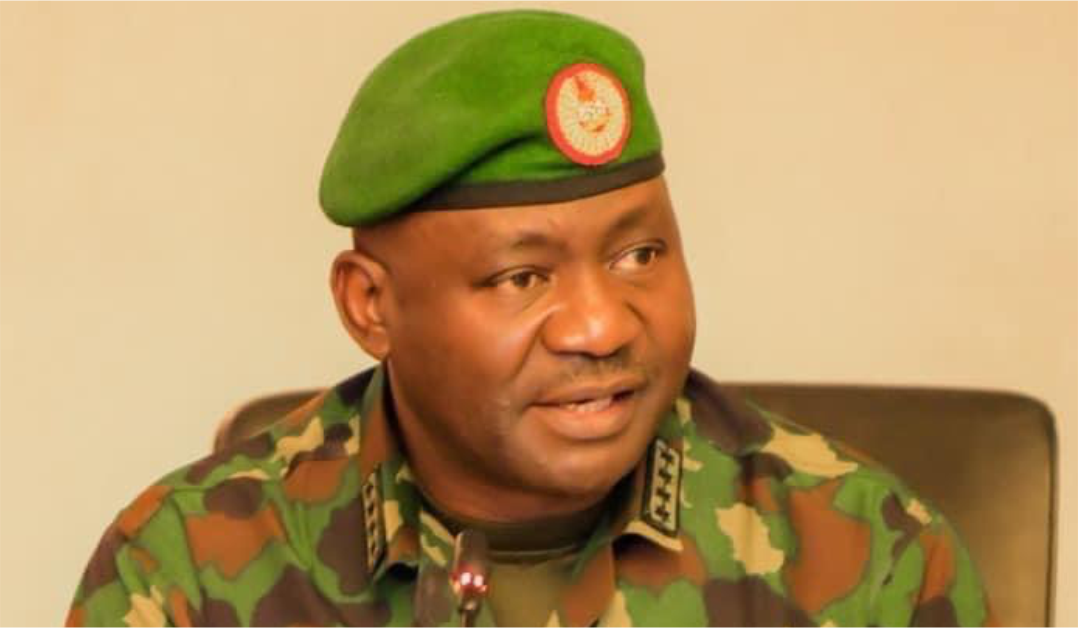
The Chief of Defence Staff, Gen. Christopher Musa, has linked the recent surge in killings across the country to the build-up to the 2027 general election.
The country has in recent times witnessed renewed terror attacks in the North-East and attacks by the bandits in the North-West.
Benue and Plateau states continue to be epicentres of killings.
On Monday, at least 34 worshippers at a mosque in Unguwar Mantau community of Malumfashi Local Government Area of Katsina State were killed.
Speaking on Channels Television’s Politics Today on Thursday evening, Musa said the rising wave of insecurity compared to last year could not be divorced from political activities ahead of the polls.
According to him, some politicians are deliberately fuelling violence to discredit the government’s security record and campaign on the back of chaos.
“Criminals, both bandits and terrorists, work together. They have a common goal to make money and destabilise communities. But there is also a political angle. Some individuals don’t want peace because when there is peace, the government is seen to be doing well. When there is no peace, the government is seen to be failing.
“Last year, we recorded the lowest number of deaths. How come this year, suddenly, everything has spiked? Politics is coming, the election is coming. You cannot rule out the fact that some people are controlling these criminals to ensure there is no peace, and governance is discredited. But the funny thing is, how do you kill the people you want to govern? What do you gain from it?” Musa asked.
The Defence Chief further disclosed that terrorism continues to thrive in Nigeria due to local and foreign funding.
He said the Attorney-General of the Federation, the Nigerian Financial Intelligence Unit, the Department of State Services and the National Intelligence Agency are tracking terror financiers, though legal hurdles have slowed down the process of naming them.
He noted the identification of international collaborations and foreign funding of terrorism, assuring that such links are being tracked.
“The process of naming terrorism financiers is on. Just last week, the AGF and others went to check. It has to do with legal issues and international connections. Some of them get funds from outside. The NFIU has been doing so much; arrests have been made, and prosecutions have started. Those behind the Owo bombing are already facing trial,” he said.
Musa lamented that the country’s legal system frustrates terrorism prosecution, calling for faster trials, stiffer laws and the creation of special courts for terrorism cases.
Musa added, “Also, it has to do with the legal system. Sometimes, legal intercepts, you take it to court, and it is knocked out for one reason or another. Again, we have to review our legal system because some of the punishments and prosecutions are slow and inadequate.
“If we have special courts, we will treat cases as quickly as they should. We also need to review the punishment for offences. But our laws need to be stringent, even for terrorism. Our legal system is frustrating. We need to unbundle it, make it faster and more stringent. Once people know they can get away with anything, impunity sets in, and we cannot prosecute.
“Sometimes you take evidence to court, and it is knocked out for one reason or another. Punishments are slow and inadequate. We need to unbundle our legal system, make it faster and more stringent. Once people know they can get away with anything, impunity sets in. For example, in the South-South, we arrest vessels, they pay peanuts, and the vessels return. That’s why we resorted to bombing them, though environmental concerns arose. But that has brought more peace than allowing the legal bottlenecks to continue,” he added.
The CDS also acknowledged the security risks posed by instability in the Sahel region, pointing to open markets for arms and ammunition in neighbouring countries and Nigeria’s porous 4,000-kilometre border.
He cautioned Nigerians against indiscriminate hospitality towards foreigners, stressing that many infiltrators pose as brothers and sisters but end up as threats.
“Since Libya fell, the Sahel has been open. You can buy any weapon in those markets. Niger, Mali and Burkina Faso are also unstable. Everybody is interested in Nigeria because it is rich and large. Our problem is that Nigerians open their doors too easily. Boko Haram started like that—welcoming strangers who later became monsters. We must never allow foreigners to take an inch of our land,” he warned.
Musa said the military was working with Sahelian counterparts under the Alliance of Sahel States to curb cross-border terrorism, but urged Nigerians to support the Armed Forces by refusing to shield criminals.
“These terrorists thrive because some people still support them with funds, fuel, logistics or shelter. Locals even reroute money daily into their accounts. If we don’t give them space, they won’t thrive. To defeat them, everybody must be on board.
The problem started after Libya fell. And now Sudan is in turmoil, the Sahel is open. They have markets where you can go and buy any kind of weapon or ammunition. And everybody sails through, and the borders are just there. Niger, Mali, and Burkina Faso are also having this issue in the Sahel.
“Everybody is interested in Nigeria because they feel Nigeria is rich and large. They can come in and do a lot of things in Nigeria. One issue we also have is Nigerians opening their doors. We have large hearts. But we have to think of security. Sometimes these guys come in and we say, these are our brothers, sisters coming in, but they don’t mean us good. We allow them to fester until they become monsters and start eating us, then we start complaining.
“We are still working together with the Alliance of Sahel States countries because we know we need them. We need them to be stable. If your neighbour is in trouble, the way it is now, you have to stand strong. We are working with the military there. We know it is important that we must secure ourselves,” the CDS said.
The CDS also lamented that terrorists in the country were taking advantage of the inadequacy of technological equipment to continue to perpetrate their heinous acts.
He disclosed that security had become expensive partially due to the ongoing Russia-Ukraine war, but said the Nigerian Army was doing its best with available resources to ensure the protection of citizens.
He said, “I give an example; the price of a medium range precision weapon for each one is $100,000. At $100,000, how much is it in Naira? How many can you buy? So, you have to be very careful as to where you use it, to make sure that is making the positive impact. Just last two weeks, we had a good strike where we killed over 100 of them on 50 motorcycles, that is a good strike. Because the timing came in, and we were ready for it and the drone was there, and we took them out,” he said.
Musa also stated that the military needed real-time satellites for precision strikes, noting however, that the technology was very expensive, a fact he said was exploited by the bandits and terrorists.
He added, “You see, in terms of what we need, we need real-time satellites. I tell you an example when an operation is ongoing, and you can see, your commanders can direct you, this man is moving here, these ones are deployed here, good. But we don’t have that, and these things are expensive to get, because we don’t have them. And they capitalise on these incapacities.”
He added that some other countries were able to use the technologically-advanced equipment because they produced them by themselves, adding that the administration of President Bola Tinubu had approved the Defence Industrial Bill that would allow production in Nigeria
“Sometimes, even with your money you can’t get that equipment. Now, with the Russian-Ukraine war ongoing, a lot of equipment are difficult to come by. So that’s why I’m happy that Mr President last year approved, after signing the DICON bill, the Defence Industrial Bill, for us to now invite original equipment manufacturers, let’s produce. Because when we produce, then we can get much at money’s worth. If you don’t, it’s going to be extremely difficult and so we’re working on that,” the Defence chief said.
FOLLOW US ON:
FACEBOOK
TWITTER
PINTEREST
TIKTOK
YOUTUBE
LINKEDIN
TUMBLR
INSTAGRAM



















 Politics6 hours ago