Connect with us

Lifestyle

The Statue of Obatalá in Costa do Sauípe: A Living Symbol of Yoruba Heritage in Brazil

Published

on

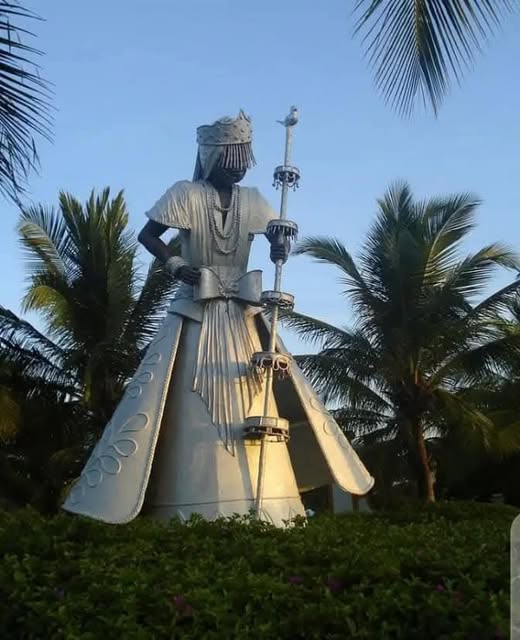
Along the breezy coast of Costa do Sauípe in Bahía, Brazil, a striking modern monument honors Obatalá—known in Brazil as Oxalá—the revered Yoruba deity of creation and purity. More than an eye-catching work of art, this statue stands as a contemporary tribute to centuries of cultural resilience, reflecting the enduring spiritual bridge between West Africa and the African diaspora in the Americas.

Obatalá: The Yoruba Deity of Creation and Purity

In the traditional Yoruba religion of southwestern Nigeria, Obatalá is regarded as the òrìṣà (divine spirit) of creation, wisdom, and spiritual balance.

Yoruba cosmology recounts that Olódùmarè, the Supreme Being, entrusted Obatalá with shaping the first humans from clay. Dressed in white—symbolizing clarity, peace, and justice—Obatalá embodies the ideals of compassion, fairness, and cosmic harmony.

When millions of Africans were forced across the Atlantic during the transatlantic slave trade, devotees of Obatalá carried his worship to the Americas. Despite the brutal realities of enslavement and colonial repression, Yoruba spirituality survived, adapting to new environments and sustaining a powerful cultural memory.

The Brazilian Transformation: Oxalá in Candomblé

In Brazil, Obatalá became widely known by the Portuguese name Oxalá and took a central place in Candomblé, the Afro-Brazilian religion born from the blending of Yoruba traditions and Catholic influences.

In many Candomblé communities, Oxalá is associated with Jesus Christ or the Senhor do Bonfim, illustrating the creative syncretism that allowed enslaved Africans to preserve their faith under colonial scrutiny.

Feast days in honor of Oxalá remain among the most moving religious events in Bahía. Processions of devotees dressed in white—Oxalá’s sacred color—fill the streets of Salvador and surrounding towns, offering a vivid celebration of African heritage.

See also  Ned Never Slept Outside Because I Held Him Well In The Other Room – Regina Daniels

The Modern Monument at Costa do Sauípe

The statue of Oxalá at Costa do Sauípe is a modern homage, not a relic from the slavery era. Typically depicted in flowing white robes and holding the opaxorô (a staff symbolizing authority and spiritual guidance), the sculpture radiates serenity and the creative force of life itself.

White doves—traditional symbols of peace—often surround artistic representations of Oxalá, reinforcing his association with wisdom and tranquility.

Located in a region that is the spiritual heart of Afro-Brazilian culture, the monument functions both as a cultural landmark and a devotional site. For worshippers, scholars, and travelers, it is a visible reminder of the living links between Yoruba spirituality and Brazilian identity.

Legacy and Cultural Significance

The Costa do Sauípe statue speaks to more than religious devotion: it is a symbol of resilience, celebrating how African descendants in Brazil safeguarded their ancestral beliefs despite centuries of oppression.

By honoring Oxalá, Bahía pays tribute to both the Yoruba homeland and the Afro-Brazilian communities that continue to keep this ancient faith alive.

Today, the monument draws pilgrims and researchers alike, offering a powerful encounter with the transatlantic heritage that continues to shape Brazilian culture.

It stands as a spiritual bridge across the Atlantic, linking Nigeria’s sacred traditions with the vibrant Afro-Brazilian practices of the present.

Sources

Verger, Pierre Fatumbi. Orixás: Deuses Iorubás na África e no Novo Mundo. Corrupio, 1981.

Matory, J. Lorand. Black Atlantic Religion: Tradition, Transnationalism, and Matriarchy in the Afro-Brazilian Candomblé. Princeton University Press, 2005.

FOLLOW US ON:

FACEBOOK

TWITTER

PINTEREST

TIKTOK

YOUTUBE

LINKEDIN

TUMBLR

INSTAGRAM

Continue Reading
Click to comment

Leave a Reply

Your email address will not be published. Required fields are marked *

Lifestyle

Nollywood actress Sarah Martins apologises for roadside cooking

Published

on

Nollywood actress Sarah Martins has formally responded to the Lagos State Government’s warning regarding her recent public cooking activity, clarifying that the event was an emotional reconnection with vulnerable children rather than a deliberate breach of environmental laws.

The response comes after the Lagos State Commissioner for the Environment and Water Resources, Tokunbo Wahab, on Saturday, cautioned the actress against cooking on public roads, warning that she risks arrest and prosecution if she continues the practice.

In an open letter posted on her Instagram handle on Sunday, Martins, the founder of the Sarah Martins Golden Heart Foundation, sought to set the record straight, stating that the meal was prepared in a controlled environment.

“I would like to respectfully clarify that I did not cook on the walkway or on the main street.

“The meal was prepared in front of the King’s Palace under the supervision of security personnel, and the activity took place very far from the main road, ensuring that it did not obstruct movement or create any public nuisance,” she wrote.

Explaining the motivation behind the act, the actress described it as a response to the pleas of street children she frequently encounters.

“The visit was simply born out of an emotional moment. I had deeply missed the bond I share with the vulnerable street children in that area,” she explained.

“As I occasionally drive past that axis, the children often plead with me to come back and cook with them like I used to. On this particular day, I decided to spend some time with them and prepare a meal, purely to reconnect and create memories with the kids who have always shown me genuine love,” she added.

The actress offered an apology to the state government for any perceived impropriety, saying, “My brief return to that location was never intended to create any form of public nuisance, but simply to share a heartfelt moment with children who have continued to ask for my presence.

See also  Akinloye Akinyemi: Nigerian Army Major at the Centre of Two Coup Allegations

“However, if my actions were perceived as inappropriate in any way, I sincerely apologide. I hold the laws and environmental standards of Lagos State in the highest regard.

“Going forward, I will ensure that all cooking activities are carried out strictly within the charity kitchen provided for the foundation.”

In her response, Martins also expressed gratitude to Seyi Tinubu, the President’s son, noting that his donation of a charity kitchen was specifically intended to ensure her feeding programs are conducted in a proper and organised environment, which she said her foundation remains committed to using.

PUNCH Online reports that Martins was arrested in October 2025 by KAI officials while she was cooking on a road median in Lekki, seizing her equipment.

The Lagos State Government defended the operation, with Wahab stating that the actress had engaged in unauthorised activities on public infrastructure in contravention of environmental and sanitation regulations.

While she previously claimed to have received ₦20 million from his office, Seyi Tinubu reportedly denied making the donation personally, saying some friends, moved by compassion, had raised funds to help her secure a proper space for her charity work, but stressed that he did not support any act that violated Lagos State laws.

punch.ng

FOLLOW US ON:

FACEBOOK

TWITTER

PINTEREST

TIKTOK

YOUTUBE

LINKEDIN

TUMBLR

INSTAGRAM

Continue Reading

Lifestyle

My father fought well to stay alive – Onigbinde’s son

Published

on

Mr Oyekunle Onigbinde, the last child of the late national coach Festus Onigbinde, has said that although his father was sick, he fought well to stay alive.

Oyekunle made the remarks in an interview with the News Agency of Nigeria in Ibadan on Tuesday.

Describing his father as a generous man who cared for everyone, Oyekunle said his death on Monday came as a huge shock.

“He fought well to stay alive.

“He was sick, but due to old age, his body couldn’t fight the recovery.

“My father was very accommodating; he pulled everyone together.

“He didn’t care who you were; he just wanted everyone happy and united.

“He was the string that knitted many together,” he said.

Meanwhile, renowned sports analyst Tayo Balogun told NAN that his 40-minute phone conversation with Onigbinde in 2025 would forever linger in his memory.

“We went down memory lane, and I thanked him for being who he was: painstaking, foresighted, forthright, forthcoming, and incredibly hardworking.

“I told him I appreciated him and that I was calling to let him know that his contributions to Nigerian football will always be footnoted in history.

“During the call, I noticed his voice had lost some of its vibration. He attributed this to old age, claiming he was as fit as a fiddle.

“He asked after my TV Gang of Feyi Ogunduyile and Modele Sarafa-Yusuf (then known as Oshiinaike),” he said.

Balogun said he praised Onigbinde for his contributions to Shooting Stars Sports Club (3SC).

“He actually changed the name from IICC Shooting Stars.

“I asked him if he remembered that I asked him why he was practising penalty kicks after 3SC had comprehensively beaten Tonnere Kalara Club of Yaounde at the Liberty Stadium, just before the second-leg match.

See also  PHOTOS: Meet Grace Atinuke Oyelude — Nigeria’s First Miss Nigeria, Still Radiant at 93!

“He told me Remi Asuni, the then Oyo State FA Chairman, asked him the same question and that he answered, ‘If we can beat them 4-0 in Ibadan, they may pay us back in Yaounde,’” he said.

The 73-year-old analyst said he also praised Onigbinde for his bravery in selecting players for the 2002 World Cup.

“I told him I understood why he included Mutiu Adepoju, but did not understand why he didn’t play him in any of the matches.

“He said that was the only mistake he made, but that if I noticed, we were quite close in all the matches we played, and if he brought in Mutiu and we lost, it would be blamed on Adepoju,” he said.

Balogun described Onigbinde as the most thorough Nigerian coach he knew.

“Each year, he would draw up a list of requirements for his team.

“With Shooting Stars, he would get 20 per cent, and with the Eagles, he didn’t even get 10 per cent.

“All the same, he got spectacular results with both teams.

“He was the first coach to take a group of rookies like Chibuzor Ehilegbu, Paul Okoku, Femi Olukanmi, and others to Ghana and beat the then-dreaded Black Stars in their country.

“Onigbinde’s memory will remain indelible.

“He was a gentleman, humble, and highly intelligent.

“I am glad I got to know you, sir,” he said.

(NAN)

punch.ng

FOLLOW US ON:

FACEBOOK

TWITTER

PINTEREST

TIKTOK

YOUTUBE

LINKEDIN

TUMBLR

INSTAGRAM

Continue Reading

Lifestyle

The Name Given To Me By My Parents Was A Curse – Phyna

Published

on

Reality TV star, Josephina Otabor, popularly known as Phyna, has opened up about the struggles she faced while growing up and why she does not like the name given to her at birth.

During a recent interview with Ezinne Akudo on the show Beyond With Ezinne, the former Big Brother Naija winner said her parents named her Blessing, but she came to dislike the name because her life did not reflect its meaning.

It was reports that Phyna explained that as she was growing up, many parts of her life were very difficult.

According to her, she often felt like she was always begging for love from people around her, including family members, friends and even in relationships.

She said the situation made her feel as if the name Blessing did not match the experiences she was going through.

The reality star also spoke about the pain she felt after the death of her sister. She said the loss deeply affected her, and at one point, she even wished she could die because of the emotional burden she was carrying at the time.

She said, “The name given to me by my parents is Blessing. My reasons for hating that name was you don’t see sense of blessing in my life. Because you know, it felt like I was always begging for love, family love, friendship, even in relationships. In fact, Dem don use am curse me. All aspects of life for me, growing up was very crazy. Even when you’re a teenager, there are things you could get from parents, from friends, family I didn’t have that, but I knew for one that I was going to be big.

See also  Akinloye Akinyemi: Nigerian Army Major at the Centre of Two Coup Allegations

“Then I always tell my aunts, everybody, even when they beat me or maltreat me, today, the next minute I will see when I go watch me for television, you know, I go get money. People always say negative things about me. Even when I’m trying my best, it affects me. It affects my workload. They are quick to broke shame me. In fact, when my sister died, I wanted to die. A lot was going on with me. It actually makes me feel God is with me because so many things have happened that I suppose don really run mad.”

FOLLOW US ON:

FACEBOOK

TWITTER

PINTEREST

TIKTOK

YOUTUBE

LINKEDIN

TUMBLR

INSTAGRAM

Continue Reading

Trending