Connect with us

Business

National Assembly okays N2.29tn FCT budget, sets 76% for capital projects

Published

on

The National Assembly on Thursday passed the 2026 Statutory Appropriation Bill for the Federal Capital Territory, approving a total expenditure of N2.285tn for the development and administration of the nation’s capital.

The approval followed the presentation and consideration of the harmonised report of the Senate and House of Representatives Committees on the FCT during plenary.

The report was presented by the Vice Chairman of the Senate Committee on the FCT, Austin Akobundu (Abia Central), on behalf of the committee chairman, Ibrahim Bomai (Yobe South).

Presenting the report, Akobundu said the joint committees recommended the sum of N2.285tn as the FCT statutory budget for 2026 from a projected revenue of N2.385tn.

He explained that the budget proposal contained N165.7bn for personnel costs, N378.2bn for overhead costs, while N1.741tn was allocated to capital expenditure.

According to him, the structure of the budget indicated a strong focus on infrastructure development and public service delivery, with 76.19 per cent of the total allocation devoted to capital projects, while recurrent expenditure accounted for 23.8 per cent.

Akobundu said the appropriation process complied with constitutional provisions and emerged after extensive deliberations between the National Assembly committees and officials of the Federal Capital Territory Administration.

He said, “The committees met with the minister and other relevant officials of the FCTA and deliberated extensively on the subject matter.”

Lawmakers who contributed to the debate commended the fiscal framework of the budget, describing it as balanced and development-oriented.

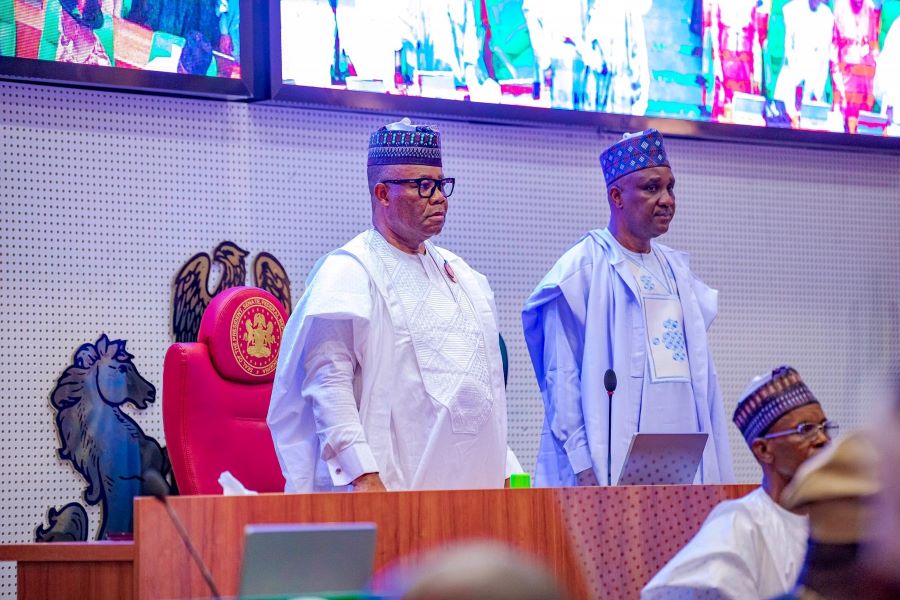
Deputy President of the Senate, Jibrin Barau, praised the spending plan, saying it demonstrated a strong commitment to infrastructural renewal in the FCT.

See also  Import waivers, insecurity end two-year agric trade surplus

He said, “Mr President, the budget is top-notch. You know, I am the only one in the history of the legislature in this country that has had the opportunity to serve as chairman appropriation committee in the House and in the Senate.

“So when I see a good budget, I know it’s a good budget. It is a budget that’s top-notch. We have to commend the FCT minister for doing a very good job.

“A budget that you have a total of N2.2tn, and out of this, N1.7tn is going for capital. It shows his willingness and determination to continue to show FCT to the admiration of all.”

Abdul Ningi (Bauchi Central) described the appropriation as well-structured and responsive to concerns previously raised by lawmakers during oversight engagements with the FCTA.

Ningi said the budget was well-packaged and well-balanced, considering the observations made by the Senate Committee on the FCT last year.

The Senate thereafter passed the bill through third reading, paving the way for its transmission for presidential assent.

At the House of Representatives, the lawmakers also passed the 2026 statutory budget proposals of the FCT.

They also passed N1.75tn respectively for the Niger Delta Development Commission.

The approvals followed the consideration and adoption of reports presented to the House during plenary by the relevant committees.

Presenting the report on the FCT budget, Chairman of the House Committee on the Federal Capital Territory, Muktar Betara, said the N2.29tn proposal was structured to address personnel obligations, overhead costs and critical infrastructure projects across the nation’s capital.

See also  FG to borrow N800bn via February bonds

According to him, “Out of the N2.29tn, the sum of N165.78bn is for personnel costs while N378.23bn is for overhead costs.

“The balance of N1.74tn is for capital projects, for the service of the Federal Capital Territory, Abuja, for the financial year commencing January 1 and ending December 31, 2026.”

A breakdown of the recurrent expenditure showed that the Federal Capital Territory Administration secured N151.44bn for its operations.

In what lawmakers described as part of ongoing efforts to strengthen security architecture in Abuja and surrounding satellite communities, the House approved N6.79bn for the security services department of the FCTA.

The lawmakers also approved N1.51bn and N910.20m for the FCT Muslim Pilgrims Welfare Board and the Christian Pilgrims Welfare Board, respectively.

For capital projects, the education sector received N162bn, while engineering services got the largest allocation of N758.15bn.

The resettlement and compensation department was allocated N143.18bn, public buildings received N2.38bn, while the satellite towns development department secured N212.74bn.

Meanwhile, details of the N1.75tn NDDC appropriation obtained by The PUNCH showed that N47.57bn was earmarked for personnel costs, while overhead expenditure stood at N49.93bn.

The commission also secured N22.36bn for internal capital expenditure, with the bulk of the budget — N1.63tn — dedicated to development projects across the oil-producing Niger Delta region.

The approval followed the consideration of a report presented by the Chairman of the House Committee on NDDC, Erhiatake Ibori-Suenu.

For the NDDC, the passage of the N1.75tn budget is expected to strengthen intervention projects in the oil-rich region, where concerns over underdevelopment, environmental degradation and youth unemployment have persisted for decades despite the area’s contribution to national revenue.


See also  Ikeja Electric reveals why Lagos is experiencing persistent power interruptions

Continue Reading
Click to comment

Leave a Reply

Your email address will not be published. Required fields are marked *

Business

How Moniepoint customers can check eligibility for FG’s ₦50,000 relief support

Published

on

Moniepoint Microfinance Bank says eligible customers can now check their status and access the Federal Government’s ₦50,000 emergency relief support through its Unstructured Supplementary Service Data (USSD) channel.

The bank said in a statement issued on Wednesday that “customers could dial *5573*27# from their registered phone numbers and select the option to check their eligibility for the National Emergency Relief and Stabilisation Intervention (NERSI).”

It said customers confirmed as beneficiaries would be guided through the steps to accept the support and receive the funds into their Moniepoint accounts at no additional cost.

The intervention, led by the Federal Ministry of Humanitarian Affairs and Poverty Reduction, is designed to provide direct financial assistance to vulnerable households to help them meet essential needs amid prevailing economic pressures.

On Tuesday, PUNCH Online reported that that FG had begun payment to eligible Nigerians.

Moniepoint said it was “among the payment providers selected by the Federal Government to facilitate the disbursement of the relief funds.”

It explained that beneficiary selection was based on the government’s eligibility criteria and verification processes, which relied on verified national identity records and the National Social Register.

The bank noted that the programme was being implemented in phases across the country, adding that not all customers would qualify or be selected at the same time.

What moniepoint customers should know?

Babatunde Olofin, Managing Director and Chief Executive Officer of Moniepoint Microfinance Bank, said the “bank was pleased to support eligible customers in receiving assistance under the government initiative.”

See also  PHOTOS & VIDEO: South African Man Laments Businesses Dying After Foreigners Left

Olofin said Moniepoint would deploy its technology and financial infrastructure to make the process accessible, seamless and secure.

He urged “customers to use only the bank’s official USSD channel when checking their eligibility or accessing the funds.”

He added that the process required “no additional payment, documentation or third-party intervention.”

The bank also advised customers with enquiries to contact its customer service team or the NERSI helpdesk.

Moniepoint said its nationwide network of financial services infrastructure, including Point-of-Sale terminals across the country’s 774 local government areas, would support efforts to extend access to the intervention.

Source: punchng.com

FOLLOW US ON:

FACEBOOK

WHATSAPP CHANNEL

TWITTER

PINTEREST

TIKTOK

YOUTUBE

LINKEDIN

INSTAGRAM

Continue Reading

Business

$196m NIN funds unspent, FG seeks extension

Published

on

The Federal Government has requested another 12-month extension of Nigeria’s $430 million digital identity project as approximately $196m of its financing remains undisbursed and National Identification Number (NIN) issuance trails the target by 59 million.

This is contained in a World Bank restructuring paper dated 22 October, 2026, obtained by The PUNCH from the bank’s website on Wednesday.

The proposed extension would move the Nigeria Digital Identification for Development Project’s closing date from 31 December, 2026, to 31 December, 2027.

“The proposed Level 2 restructuring seeks to extend the project closing date by 12 months, as requested by the Government on May 8, 2026,” the report stated.

“This would be the third closing date extension under this project since Board Approval in February 2020, for the cumulative period of 42 months (3.5 years).”

The project was originally scheduled to close in June 2024 before receiving a six-month extension and another two-year extension.

An analysis by The PUNCH showed that approximately $196m, representing 45.6 per cent of the financing, remained undisbursed after total disbursements reached about $234m.

“The overall project disbursement rate inclusive of co-financiers stands at approximately $234m or 54.4 per cent,” the bank stated.

The financing comprises $115m from the World Bank’s International Development Association, $100m equivalent from the French Development Agency and $215m equivalent from the European Investment Bank.

The undisbursed balance therefore covers all three financiers. The report’s financing summary separately puts IDA’s undisbursed balance at $18.83m.

Approved in February 2020 and effective from December 2021, the project seeks to expand access to identification and services through a secure, inclusive national identity system.

See also  Indonesia promises Nigerian investors special incentives

However, about 121 million people had received NINs by September 30, 2026, against the 180 million target, leaving a shortfall of 59 million.

Although this represents an increase of approximately 84 million from the baseline, NIMC must substantially accelerate enrolment to meet the target.

“NIMC reconfirmed the commitment to reach the target of 180 million noting that this would require an increase in monthly enrollment rates from the current average of 1.5 million to 3.9 million,” the report stated.

This implies a 160 per cent increase in monthly enrolment.

The bank also distinguished enrolment records from successfully generated NINs, noting that more than 140 million enrolments had been recorded by September 14, but only 121 million had completed biometric and demographic validation and duplicate checks.

Women and children remained behind their respective targets. As of June, 40.4 million women and girls had NINs against a target of 79 million, while 26.3 million children under 16 had NINs against 60.83 million.

The report identified unpaid enrolment partners as another constraint, stating that the billing system must produce audited payment reports to enable payments to partners “which have not been paid since January 2026.”

Other priorities include deploying 7,000 procured mobile devices by January 2027, training agents, expanding ward-level enrolment nationwide and beginning school enrolment by December 2026.

The ward campaign had generated 10 million NINs since March, according to the report.

A major reason for the extension is the delayed replacement of NIMC’s existing technology with the National Identity Management System 2.0.

The contract was signed on September 15, 2026, following lengthy procurement. Implementation, normally requiring approximately 18 months, was compressed into 15 months, with full deployment and data migration scheduled for December 15, 2027.

See also  Lagos Reopens Ferry Terminal After Clearing Water Hyacinth

The new platform would replace fragmented proprietary systems with an open-source system designed to improve capacity, interoperability and data protection.

Although NINAuth was launched in May 2025, the project’s digital authentication targets remained unmet pending integration into the new platform.

The bank warned that failure to extend its involvement would also halt implementation by the other financiers.

“If the project is not extended by WBG, all other co-financiers will also close,” it stated.

Source: punchng.com

FOLLOW US ON:

FACEBOOK

WHATSAPP CHANNEL

TWITTER

PINTEREST

TIKTOK

YOUTUBE

LINKEDIN

INSTAGRAM

Continue Reading

Business

Read how FG selects beneficiaries for N50,000 relief

Published

on

The Federal Government has explained how it selects beneficiaries for its N50,000 cash relief under the National Emergency Relief and Stabilisation Intervention.

The clarification comes as payments continue and many Nigerians seek to understand how the government identifies recipients and determines their eligibility.

According to information on the Federal Ministry of Humanitarian Affairs and Poverty Reduction’s NERSI website, sighted by PUNCH Online on Wednesday, beneficiaries are selected from verified national identity records and the National Social Register.

“Beneficiaries are selected from verified national identity records and the national social register, then screened to reach poor and vulnerable households,” the website states under its eligibility and selection section.

The National Identification Number (NIN) is issued by the National Identity Management Commission (NIMC) after enrolment.

It is used to verify an individual’s identity and is linked to the mobile wallet through which selected beneficiaries receive the relief.

The National Social Register (NSR), on the other hand, is a database of poor and vulnerable households in Nigeria, coordinated by the National Social Safety-Nets Coordinating Office.

According to NASSCO, the register contains data on more than 70 million individuals.

It said registering vulnerable persons is a multi-process activity that begins with states identifying their poorest local government areas and communities, after which trained teams work with residents and community leaders to identify vulnerable households.

The identified households are then registered digitally and assessed using poverty indicators.

Those ranked within the bottom six deciles may qualify for inclusion in the National Beneficiary Register, which is used for programmes such as cash transfers.

See also  ‘Pilots, Biologists’ — UK Removes Over 100 Occupations From Skilled Worker Visa List (See Full List)

Enrollment in both NIMC and NSR is a prerequisite for being selected for N50,000 cash relief, according to NERSI.

However, the office does not provide further details on the specific screening criteria used to determine relief recipients.

It stresses that Nigerians cannot apply or pay to be included in the beneficiary list.

“You cannot apply or pay to be added,” the website says. “Not everyone is in the first group. Your data is used only for this programme.”

The Humanitarian Assistance Programme is described as the Federal Government’s shock-responsive cash transfer initiative for poor and vulnerable households. It provides financial support through mobile wallets.

“Under NERSI, selected beneficiaries receive support of ₦50,000 into a mobile wallet,” the website explains. “It is a grant from the Federal Government. You do not pay it back.”

According to the office, selection is based on need and covers all six geopolitical zones, regardless of religion, ethnicity or political affiliation. Payments are made in phases, meaning beneficiaries are not contacted at the same time.

PUNCH Online reported that the Minister of Humanitarian Affairs and Poverty Reduction, Dr Bernard Doro, announced the commencement of disbursement in a statement on October 30.

Nigerians can check if they are selected through the approved providers by dialling their USSD codes: ALAT by Wema (*945*23#), MoMo PSB (*671*0#), NairaGram (*726*00#), OPay (*955*20#) and Moniepoint (*5573*27#).

Source: punchng.com

FOLLOW US ON:

FACEBOOK

WHATSAPP CHANNEL

TWITTER

PINTEREST

TIKTOK

YOUTUBE

LINKEDIN

INSTAGRAM

Continue Reading

Trending