Connect with us

Lifestyle

PHOTOS: The Origin of the Name “Nigeria” Flora Shaw’s Proposal in 1897

Published

on

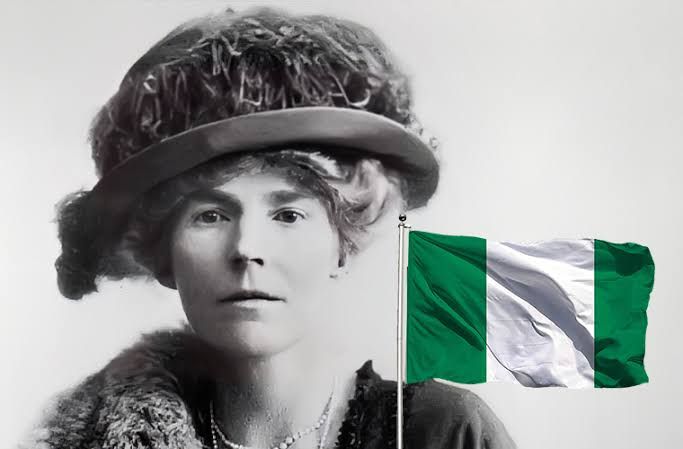
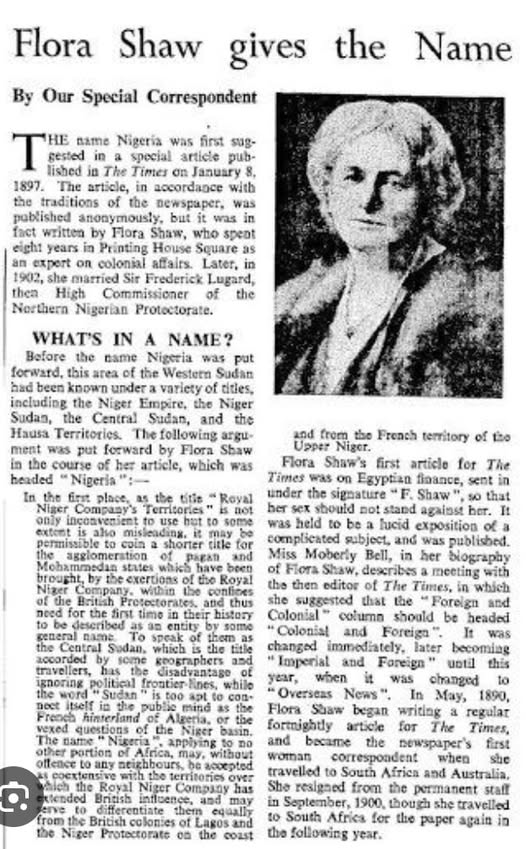
The name “Nigeria” first appeared in print on 8 January 1897 in The Times of London, in an article written and signed by Flora Shaw, the paper’s colonial editor. Shaw—who would later marry Sir Frederick Lugard, the future High Commissioner of the Northern Nigerian Protectorate—suggested the name as a concise and practical alternative to the long descriptive titles Europeans then used for the region.

Her proposal gave a single geographical label to an immense and culturally diverse area under increasing British influence. Shaw argued that a shorter name would simplify both administration and international recognition at a time when Britain was expanding its colonial presence in West Africa.

Derivation from the Niger River

Shaw’s name derived from the River Niger, the great waterway that flows through present-day Guinea, Mali, Niger, Benin, and Nigeria before emptying into the Atlantic.

The origin of the word “Niger” itself remains debated. Some scholars trace it to the Latin “niger,” meaning black, a term used by early European geographers to describe the dark waters or the people along the river. Others suggest it came from a local Tuareg phrase—often cited as egerew n-igerewen—used by peoples along the middle reaches of the river. Because neither explanation can be proven conclusively, historians generally present both as plausible.

Pre-Colonial and Early Colonial Descriptions

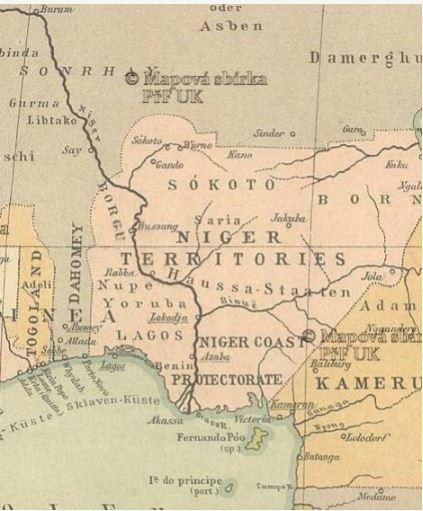
Before 1897, Europeans referred to the area with a variety of names:

“Central Sudan” or “Niger Sudan,” reflecting its location south of the Sahara.

“Hausa Territories,” in reference to the influential Hausa city-states of the north.

“Niger Empire,” used loosely in nineteenth-century travel literature.

See also  Fela Allowed His Wives To Sleep With Other Men – Seun Kuti

These labels highlighted powerful pre-colonial polities such as the Sokoto Caliphate, Oyo Empire, Benin Kingdom, and others, but none captured the entire territory in a single term.

Colonial Context and the 1914 Amalgamation

Shaw’s suggestion came at the height of British colonial expansion in West Africa. By 1900 the British government had proclaimed the Protectorates of Northern and Southern Nigeria, formalising its control over the region.

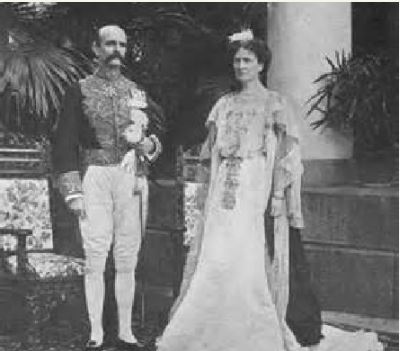
In 1914, Sir Frederick Lugard—by then Shaw’s husband—oversaw the amalgamation of these two protectorates to form the Colony and Protectorate of Nigeria. The name proposed by Flora Shaw seventeen years earlier became the official designation of the new political entity.

This act of naming exemplified a broader colonial pattern: compressing diverse ethnicities and kingdoms into a single administrative unit for imperial convenience. While the name “Nigeria” would later become a source of national pride, it originated as a tool of British governance.

Path to Independence and Enduring Legacy

The name endured through decades of colonial rule and into the era of nationalism. When Nigeria achieved independence on 1 October 1960, the colonial label became the name of the new Federal Republic of Nigeria, symbolising a modern state forged from many peoples and histories.

Over a century later, “Nigeria” remains more than a geographical term. It is a reminder of how colonial encounters shaped modern African identities and of how Nigerians have since infused the name with their own meanings of sovereignty and unity.

Key Timeline

Pre-1897: Region variously described as Central Sudan, Niger Sudan, Hausa Territories, Niger Empire.

8 January 1897: Flora Shaw publishes the article “Nigeria” in The Times of London.

See also  Celebrities who battled body shaming

1900: British government consolidates territories as Northern and Southern Protectorates.

1914: Lugard oversees the amalgamation; the name “Nigeria” becomes official.

1 October 1960: Independence as the Federal Republic of Nigeria.

Sources
Flora Shaw, “Nigeria,” The Times (London), 8 January 1897.

            Lord Lugard and Flora Shaw

FOLLOW US ON:

FACEBOOK

TWITTER

PINTEREST

TIKTOK

YOUTUBE

LINKEDIN

TUMBLR

INSTAGRAM

Continue Reading
Click to comment

Leave a Reply

Your email address will not be published. Required fields are marked *

Lifestyle

Emir of Ilorin greets Muslims on Islamic New Year

Published

on

The Emir of Ilorin and Chairman of the Kwara State Traditional Rulers Council, Alhaji Ibrahim Sulu-Gambari, CFR, has congratulated the Muslim Ummah on the occasion of the Islamic New Year, 1st Muharram, 1448 A.H.

He noted that the migration of Prophet Muhammad (SAW) from Makkah to Madinah established the foundation for justice, brotherhood, and community building, as well as values that are urgently needed for global peace.

Sulu-Gambari stated this in a goodwill message issued on Tuesday by his spokesman, Abdulazeez Arowona, describing the Hijrah as a timeless reminder of sacrifice, perseverance, and faith in Allah’s divine plan.

The monarch noted, “Hijrah teaches us that hard times do not last forever. As we enter 1448 A.H., I urge Muslims to renew their commitment to piety, peaceful coexistence, and service to humanity.”

He appealed to Nigerians to use the new year to pray for peace, unity, and economic prosperity at all levels, while urging religious and political leaders to avoid divisive utterances capable of causing rancour in society and to promote messages that strengthen national cohesion.

The Emir further commended Governor AbdulRahman AbdulRazaq for his administration’s support for religious harmony and urged youths to emulate the discipline and courage of the early Muslims by shunning violence, drug abuse, and other social vices.

Sulu-Gambari also offered special prayers for the repose of the soul of the late Prof. Yusuf Lanre Badmos, whose relentless efforts, scholarship, and devotion to the National Hijrah Organisation, Kwara State Chapter, significantly advanced the commemoration of Hijrah and the propagation of Islamic values during his lifetime.

See also  Liars don’t last in ministry – Oyedepo warns pastors

He prayed that Almighty Allah (SWT) forgive his shortcomings, accept his good deeds, and grant him Al-Jannatul Firdaus.

“May the New Year inspire us to be our brother’s keeper. I pray Almighty Allah (SWT) grants us good health, abundant blessings, and accepts our acts of worship,” the Emir added.

punch.ng

FOLLOW US ON:

FACEBOOK

TWITTER

PINTEREST

TIKTOK

YOUTUBE

LINKEDIN

INSTAGRAM

Continue Reading

Lifestyle

One year after 272 massacred, fear still rules Yelewata

Published

on

How much has changed since that tragic night of June 13, 2025? Have the survivors of the massacre found healing and security, or are they still trapped by fear, poverty and painful memories? JOHN CHARLES visited Yelewata on Saturday and reports on a community still searching for answers

In Yelewata, memories do not live in photographs alone; they stand in burnt walls, empty compounds and the tears of survivors who still struggle to understand why hundreds of their neighbours never lived to see another sunrise.

The tears came without warning.

Standing before the charred remains of a house in Yelewata, Saaondo, a middle aged man, could no longer hold back the memories. Around him, prayers echoed from a memorial Mass organised to honour victims of the June 13, 2025 massacre. But for him, the tragedy was not history; it was a wound that reopened with every glance at the ruins.

A year ago, fate spared him. He had travelled out of the community just hours before armed attackers stormed Yelewata, killing hundreds and setting homes ablaze. Those he left behind never escaped.

Last Saturday, as the community marked the first anniversary of the attack, the sorrow was unmistakable. Behind the speeches, prayers and unveiling of a monument bearing 272 names was a painful reality: while the dead are being remembered, many survivors say they are yet to rebuild their lives.

One of the leaders of Yelewata community, Matthew Mnyan, noticed Saaondo standing alone and quietly approached him. Concerned, he asked why he had stepped away from the memorial Mass and appeared deeply troubled.

The man’s response was enough to melt even the hardest heart.

‘I would have died too’

Pointing to the burnt remains of a house nearby, Saaondo said, “I left this particular house for Makurdi on the eve of June 13. But all the occupants of the house were killed and burnt when the marauders invaded Yelewata. If I had been around that night, I would have been among those being remembered at this memorial today.”

His grief reflected the mood in Yelewata last Saturday as the once-sleepy community again played host to visitors from different walks of life. They had not come to celebrate a festival or honour a prominent figure. Rather, they had gathered to mark the first anniversary of the deadly attack that left the community devastated.

Yelewata, located along the Lafia-Makurdi Federal Highway in Guma Local Government Area of Benue State, came under a brutal attack on June 13, 2025. The assault, which reportedly lasted about four hours, drew national and international attention. Initial reports put the death toll at about 200.

See also  PHOTOS: The Legacy of August Harvey Martin America’s First Black Commercial Airline Pilot

However, with the unveiling of a memorial monument in honour of the victims during the first anniversary commemoration, the number of those killed was officially put at 272, including 67 children.

According to Franc Utoo, a native of the community and Director of Advocacy for the US-based non-profit organisation, Equipping The Persecuted, which funded the Yelewata Genocide Memorial Monument, the project was conceived to ensure that the victims are never forgotten.

“By choosing to erect this monument, the organisation affirms that those slain in Yelewata must never be reduced to a passing headline or anonymous casualty figures. They must be remembered with dignity, permanence and honour,” he said.

He added, “As the first monument of its kind in Benue State, it occupies a historic place in the moral landscape of remembrance. It preserves the names of the 272 members of the Yelewata community who were killed — 67 children, 83 women and 122 men — and places before the world a solemn record of lives violently taken.”

As residents and visitors marked the anniversary, it became evident that Yelewata is still struggling to recover from the tragedy. Twelve months after the attack, the scars remain visible and the pain is far from over.

Memorial service

Delivering his homily at the memorial Mass, the Catholic Bishop of Makurdi Diocese, Most Rev. Wilfred Anagbe, called on government at all levels to adopt a deliberate policy of resettling displaced persons in their ancestral communities rather than keeping them indefinitely in makeshift Internally Displaced Persons camps.

According to the bishop, the continued confinement of displaced persons in camps for fear of further attacks amounts to a defeatist approach and projects the government as powerless in the face of insecurity.

He argued that keeping otherwise productive members of communities in camps where they depend largely on charity is counterproductive to their physical and psychological well-being and ultimately undermines their dignity.

Anagbe also faulted the Benue and Nasarawa State governments for what he described as negligence, accusing them of failing to act on intelligence reports that allegedly warned of the impending attack on Yelewata.

Despite the tragedy, the bishop commended the resilience of the people of Yelewata, noting that they have remained steadfast in the face of immense physical and psychological trauma.

See also  Annie Macaulay reclaims 2baba’s name

He assured them that the Christian community across the world continues to stand with them in prayer and solidarity.

Moro blasts FG

In his remarks, Senate Minority Leader Abba Moro criticised the Federal Government and Nigeria’s political class for what he described as their failure to fully appreciate the magnitude of the insecurity confronting the nation.

Moro accused the government of avoiding uncomfortable truths and warned that refusing to confront the problem head-on would not make it disappear.

Taking a swipe at the country’s political elite, he asked: “Can we, in all honesty, go around during campaigns and ask the people to vote for us again when the mandate already entrusted to us has not been effectively deployed for their well-being? We need to wake up.”

How are survivors faring?

For many residents, the first anniversary of the attack was not only a time to remember the dead but also an opportunity to draw attention to the plight of the living.

A community leader, Matthew Mnyan, painted a grim picture of life in Yelewata one year after the tragedy, lamenting that many survivors are still struggling to rebuild their lives.

According to him, poverty has deepened in the community, while insecurity remains a major concern.

He said residents still live in fear and cannot venture far from the community or freely access their farms because of persistent security threats.

Mnyan cited the case of a young girl who was allegedly sexually assaulted while fetching firewood in a nearby bush.

“People of Yelewata and neighbouring communities, especially Udei, are still living in fear. They cannot access their farms because of recurring attacks in the area,” he said.

“There is a case involving a young girl that I am still pursuing. She was sent to fetch firewood from a nearby bush and was allegedly molested by four suspected herders. Incidents like this show that our people are still vulnerable.

“The level of poverty has also increased because many people who relied on small-scale businesses and other means of livelihood have not been able to recover from the attack.”

Mnyan also criticised the Technical Committee on Donations for Internally Displaced Persons, headed by the Secretary to the Benue State Government, Deborah Aber, accusing it of not doing enough to alleviate the suffering of survivors.

“While the government may believe it has done a lot, many people in the community feel otherwise,” he said.

The community leader said residents had advised the state government on how best to utilise donations received from individuals and organisations, including the contribution made by the First Lady Oluremi Tinubu, but alleged that the funds had not been effectively deployed for the benefit of victims.

See also  Nene Etule: The 1959 Miss Nigeria Who Made History as the Only Non-Nigerian Winner

In March this year, the Secretary to the State Government announced that the committee had received about N1.25bn in donations from various sources, including N1bn donated by the First Lady following the attack.

Mnyan said the community had proposed that a substantial part of the funds be used to resettle displaced residents and support their economic recovery.

“We suggested that some of the money should be given to affected persons as start-up capital for small businesses, while markets and other facilities that would help restore livelihoods should also be provided,” he said.

He further alleged that some of the beneficiaries selected by the committee were not among the names submitted by the community.

According to him, residents raised concerns that the list used for the distribution of assistance did not accurately reflect those affected by the attack.

Mnyan also questioned the quality of some of the housing projects being executed for displaced persons, alleging that some of the buildings had already begun to develop cracks.

He called on Governor Hyacinth Alia to personally visit the community and assess the situation on the ground.

“I am not sure the governor is fully aware of what is happening. I urge him to come and see things for himself, inspect the projects and hear directly from the people of Yelewata,” he said.

Mnyan further expressed concern that several directives issued by President Bola Tinubu during his condolence visit to Benue State had yet to be implemented.

However, the Benue State Emergency Management Agency presented a different account of the situation.

The agency’s Information Officer, Tena Ager, said some displaced persons from Yelewata had already been resettled, while others remained at the International Market IDP camp.

According to him, more than 1,000 completed housing units have been allocated to displaced persons, while the government has acquired additional land in the community for the development of social infrastructure, including a mosque, church, hospital and market.

“Government has also provided cash assistance and other relief materials to the people of Yelewata,” Ager said.

punch.ng

FOLLOW US ON:

FACEBOOK

TWITTER

PINTEREST

TIKTOK

YOUTUBE

LINKEDIN

INSTAGRAM

Continue Reading

Lifestyle

Actor Baba Ijesha welcomes baby boy

Published

on

Actor Olanrewaju Omiyinka, popularly known as Baba Ijesha, has announced the birth of his son.

The actor disclosed this in an Instagram post on Monday, sharing a maternity photoshoot featuring himself and his wife.

Expressing gratitude to God, Baba Ijesha revealed that the couple welcomed a baby boy named King Kagar Omiyinka.

He wrote, “In quiet ways, in unseen ways, God has been writing a story only He could tell. We thank the Almighty for blessing us with a healthy baby boy.

“God gave me more than I prayed for. My ever beautiful wife, strong Jagaban, Abikese de mi owo, @ceolumineeofficial, who became the mother of my son, King Kagar Omiyinka.”

The announcement attracted congratulatory messages from fans and colleagues in the entertainment industry.

Baba Ijesha was released from prison in November 2025 after serving a jail term following his conviction in a child sexual assault case.

See also  The first monarch of Jebba Land, Oba Adebola Adebara (1897-1901).
Continue Reading

Trending