Connect with us

Lifestyle

The History of the Yellow Card: How the International Certificate of Vaccination Came to Be

Published

on

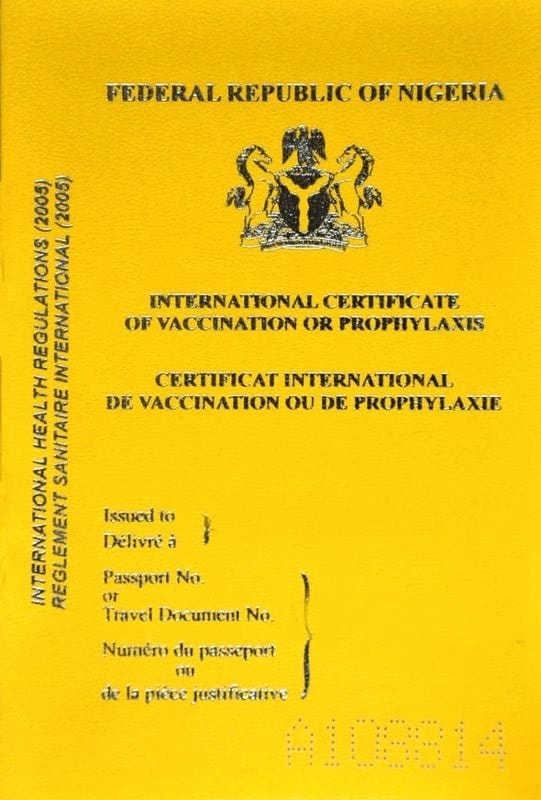
The Yellow Card, officially known as the International Certificate of Vaccination or Prophylaxis (ICVP), is more than just a travel document — it’s a historical symbol of the world’s effort to prevent the international spread of deadly diseases. Its story begins in the early 20th century, when global health authorities realized that infectious diseases could easily cross borders through international travel.

Early Origins: The Fight Against Epidemics

The roots of the Yellow Card can be traced back to the early 1900s, when deadly diseases such as cholera, smallpox, and yellow fever were spreading rapidly across continents through ships and trade routes.

At that time, many countries implemented their own local vaccination or quarantine certificates for travelers and sailors. However, there was noe global standard, which made verification difficult and often led to confusion or fraudulent documents.

This concern led to the creation of the International Sanitary Conferences, where global leaders met to discuss coordinated disease prevention strategies. These conferences laid the foundation for international health cooperation and later evolved into what became the World Health Organization (WHO) in 1948.

Creation of the International Certificate of Vaccination

After the establishment of the WHO, there was a clear need for a standardized, globally recognized vaccination document.

In 1951, the International Health Regulations (IHR) were first adopted. These regulations provided a legal framework for countries to prevent and control the international spread of diseases while minimizing unnecessary interference with global travel and trade.

As part of these regulations, the WHO introduced the International Certificate of Vaccination, popularly known as the Yellow Card because of its distinct yellow color — chosen to make it easily recognizable and hard to counterfeit.

See also  Genevieve Nnaji slams viral tweet urging Igbo men to marry non-Igbo women

Focus on Yellow Fever

While the Yellow Card was designed to record multiple vaccines, it became most closely associated with yellow fever — a viral disease transmitted by mosquitoes that can cause severe illness and death.

Yellow fever had a history of devastating outbreaks in Africa, the Americas, and parts of Europe. In the 20th century, it became one of the first diseases for which international vaccination was required for travel, especially to and from endemic regions.

To protect both travelers and destination countries, the WHO mandated proof of yellow fever vaccination for entry into certain countries. This rule made the Yellow Card an essential document for global travelers.

Evolution and Digitalization

Over the decades, the Yellow Card expanded to include vaccines for other diseases, such as cholera, meningitis, and COVID-19 in recent years.

In Nigeria, the Yellow Card was first introduced under the supervision of the Federal Ministry of Health through Port Health Services, which managed vaccination centers at airports, seaports, and border posts.

In 2019, Nigeria launched the e-Yellow Card, a digitalized version embedded with a QR code to verify authenticity and reduce forgery. Travelers can now register online via yellowcard.health.gov.ng, receive their vaccination, and print a verifiable certificate.

The Yellow Card Today

Today, the Yellow Card remains a vital document under the revised International Health Regulations (IHR 2005). It stands as proof that the holder has received vaccinations required for international travel, especially the yellow fever vaccine, which remains valid for 10 years and is recognized globally.

Beyond its use in travel, the Yellow Card also represents a legacy of global cooperation in health — a reminder of how the world came together to fight infectious diseases across borders.

See also  Ramadan, Lent begin today across the globe

Key Historical Milestones

Year Event

1851 First International Sanitary Conference held to control cholera and plague spread.
1948 World Health Organization (WHO) established.
1951 First International Health Regulations adopted; birth of the Yellow Card.
1969 WHO revised IHR to include yellow fever as a mandatory vaccination.
2019 Nigeria launched the e-Yellow Card system.

The history of the Yellow Card reflects humanity’s shared journey toward health security and international cooperation. What began as a simple health record has evolved into a global passport for disease prevention, ensuring that international travel does not compromise global health.

It stands today not just as a proof of vaccination, but as a testament to the world’s determination to safeguard life through science, regulation, and unity.

Sources

1. World Health Organization (WHO) – International Health Regulations (IHR), 1951–2005

2. Federal Ministry of Health, Nigeria – Port Health Services: Yellow Card Portal (yellowcard.health.gov.ng)

3. Centers for Disease Control and Prevention (CDC) – International Certificate of Vaccination or Prophylaxis

FOLLOW US ON:

FACEBOOK

TWITTER

PINTEREST

TIKTOK

YOUTUBE

LINKEDIN

TUMBLR

INSTAGRAM

Continue Reading
Click to comment

Leave a Reply

Your email address will not be published. Required fields are marked *

Lifestyle

Women Who Love and Listen to Their Pastors More Than Their Husbands Should Be the Pastor’s Second Wife

Published

on

This statement may sound funny, provocative, or even offensive, but it raises an important question about priorities in marriage and religion.

A pastor is a spiritual leader, but he is not supposed to replace a woman’s husband. If a married woman consistently values her pastor’s opinions above her husband’s, obeys her pastor while dismissing her husband, or shows greater loyalty and admiration toward her pastor than toward her spouse, then something may be seriously wrong with the balance in that marriage.

Marriage requires communication, mutual respect, trust, and understanding. A pastor can provide spiritual guidance, but that guidance should not become a reason for a husband and wife to lose respect for each other.

At the same time, husbands should not expect their wives to obey them blindly. Both husband and wife should seek God’s wisdom, communicate openly, and make decisions with love and respect.

So perhaps the real question is not whether such a woman should become the pastor’s “second wife,” but why has the pastor become more important in her marriage than her own husband?

Put God first. Respect your spouse. And never allow a spiritual leader to become a substitute for your marriage partner.

FOLLOW US ON:

FACEBOOK

TWITTER

PINTEREST

TIKTOK

YOUTUBE

LINKEDIN

INSTAGRAM

See also  Maiduguri cleaner explains why she returned N4.8m bank error
Continue Reading

Lifestyle

Why is it only in Africa that we hear so much about “generational curses”?

Published

on

This is a question worth asking—not to insult African traditions or dismiss anyone’s beliefs, but to encourage honest reflection.

Across Africa, it is common to hear people explain repeated family problems as a “generational curse.” When poverty, broken relationships, addiction, failure, sickness, family conflict or misfortune appears to repeat from one generation to another, some people immediately conclude that an ancestor, spiritual force or past wrongdoing is responsible.

But is every repeated family problem truly a curse?

If a child grows up in poverty, has limited access to quality education, receives little financial support and then struggles as an adult, is that necessarily a spiritual curse—or could it be the result of circumstances that have been passed from one generation to another?

If children grow up watching violence, substance abuse, unhealthy relationships or constant conflict, they may unknowingly repeat those patterns. That does not necessarily mean they are cursed. Sometimes behaviour is inherited through environment, not through supernatural forces.

And Africa is certainly not the only place where people believe in supernatural explanations for suffering or misfortune. Different societies around the world have their own concepts of inherited wrongdoing, family misfortune, ancestral consequences, fate and spiritual punishment.

So perhaps the more important question is not:

“Who cursed my family?”

But:

“What pattern has been passed down to me, and what can I do to stop passing it to the next generation?”

We should be careful not to use the idea of a curse to discourage people from taking action. A family facing poverty may need education, opportunity and financial planning. A family experiencing repeated conflict may need healthier communication. A person struggling with addiction may need professional support and a strong recovery environment. Communities facing injustice may need better institutions, accountability and opportunity.

See also  Remi Lagos: The Legacy of a Nigerian Fashion Icon

Faith and spirituality are deeply meaningful to many people, and everyone has the right to hold their beliefs. But faith should not prevent us from examining the practical causes of our problems.

We cannot change the past, but we can change what we pass forward.

Instead of teaching our children that they are victims of an unavoidable family curse, let us also teach them knowledge, discipline, emotional strength, financial responsibility, education, healthy relationships and the courage to break destructive patterns.

Maybe the greatest “curse” is not something mysterious placed upon a family.

Maybe sometimes it is simply a problem that nobody stopped long enough to understand and change.

And the greatest inheritance we can give the next generation is not fear of a curse—but the knowledge and courage to build a better future.

FOLLOW US ON:

FACEBOOK

TWITTER

PINTEREST

TIKTOK

YOUTUBE

LINKEDIN

INSTAGRAM

Continue Reading

Lifestyle

You are very proud to speak big English, but yet you cannot speak your own language?

Published

on

There is nothing wrong with speaking English fluently. In fact, being able to communicate confidently in different languages is a valuable skill. But we should ask ourselves a deeper question: while learning to speak the language of another culture, are we slowly losing the language that connects us to our own roots?

Your mother tongue is more than just words. It carries the stories of your ancestors, the wisdom of your grandparents, the jokes that only your people understand, the traditional greetings, the names, the songs, the history and the identity of your community.

Imagine being able to speak perfect English, but struggling to have a simple conversation with your own grandmother because you do not understand the language she grew up speaking. Imagine your children knowing foreign languages but being unable to understand the language of their own heritage.

That should make us pause.

Speaking English does not make you more intelligent, and speaking your indigenous language does not make you less educated. One is a communication skill; the other can be a connection to your heritage. We should not have to choose between being educated and preserving our identity.

Learn English. Speak it confidently. Learn French, Dutch, Spanish or any other language that opens doors for you.

But don’t let the pursuit of foreign languages close the door to your own.

Teach your children your language. Speak it at home. Ask your parents and grandparents to teach you the words you never learned. If you have forgotten it, it is never too late to start again.

See also  My father’s death turned me to Lagos hawker – Gov. Umo Eno inspiring story

Because when a language disappears from a family, something precious disappears with it.

Be proud of your education. Be proud of your ability to speak English. But also be proud of where you come from.

Your language is not something to be ashamed of. It is a part of your story. Preserve it before the next generation only knows it as something their ancestors once spoke.

FOLLOW US ON:

FACEBOOK

TWITTER

PINTEREST

TIKTOK

YOUTUBE

LINKEDIN

INSTAGRAM

Continue Reading

Trending