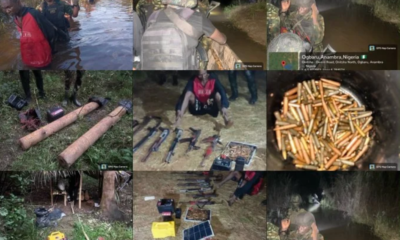
Despite the reported intensified military operation against bandits, the criminals have continued their wave of terror, abducting 20 persons in Kwara and Kano between Monday night and Tuesday morning.
The development comes barely 24 hours after 38 worshippers abducted from the Christ Apostolic Church, Oke-Isegun, Eruku, Ikere, Kwara State, on November 18, were released by their abductors.
The worshippers were freed on Sunday after a non-kinetic operation involving the Department of State Services and the military.
The details of the operation are hazy, but presidential spokesperson, Bayo Onanuga, dismissed speculation that a ransom was paid, stressing that the government simply negotiated with the bandits for the release of the hostages.
There was also relief for parents and the people of Kebbi State as 24 schoolgirls abducted from Government Girls’ Comprehensive Secondary School, Maga, in Danko-Wasagu Local Government Area, regained their freedom on Tuesday.
The students, who were kidnapped from their hostel in the early hours of last Monday, were released a week later, following intensified security operations and high-level intervention from the Federal Government.
Worried, however, by the latest attack in which 10 persons, including a pregnant woman, nursing mothers and children were reportedly seized in Isapa community, a few kilometres from Eruku, Kwara State, President Bola Tinubu ordered a total security cordon over the forests in the state.
Presidential aide, Sunday Dare, disclosed on X.com on Tuesday that the President directed the Nigerian Air Force to expand their surveillance to Kebbi and Niger forests, which are believed to have been occupied by the bandits.
He tweeted, “Tinubu directed the Air Force to expand its air surveillance across the innermost parts of the forest in Kwara State, where it is believed the terrorists are hiding. They are to maintain 24-hour surveillance and link up with the booths on the ground.
“This order equally applies to the Kebbi and Niger states axis, where many are expected to be rescued. Communities are also urged to provide timely information about strange movements and activities to aid the work of the security forces.”
Kwara attacked, again
The Isapa attack occurred around 6.00 p.m. when about 30 bandits stormed the quiet agrarian settlement, with a large herd of cattle, shooting indiscriminately as residents fled for safety.
The Police Public Relations Officer for the Kwara State command, Adetoun Ejire-Adeyemi, affirmed that 10 persons were kidnapped.
Multiple Facebook posts and WhatsApp voice notes reviewed by our correspondent revealed that the attackers fired gunshots indiscriminately into homes as they passed through the community, pockmarking several buildings.
Bullet holes were reportedly found on walls, windows and doors, confirming the intensity of the gunfire. Several spent AK-47 shells also reportedly littered the ground.
A community leader, who spoke to The PUNCH under strict anonymity, however, claimed 11 persons were abducted, including seven family members.
According to him, the kidnapped victims included a pregnant woman, two nursing mothers and several children.
He listed the abductees as Talatu Kabiru, six-year-old Magaji, Kande (5 years), Hadiza (10) and Mariam, who is six.
Others are Saima (5), Habibat (a housewife), Fatima Yusufu, 22, a pregnant woman identified as Sarah Sunday, Lami Fidelis, and Haja Na Allah, a nursing mother.
“This is the worst attack we have seen in recent times. Seven members of the same family were taken. People are terrified. We don’t even know what to expect next.
“People are now living in fear. This is too much. Eleven people just disappeared into the bush. We don’t know what tomorrow holds,” the community leader said.
A highly placed security official confirmed the incident to The PUNCH on Tuesday, saying that operatives had already begun combing the forest linking Isapa, Eruku and other surrounding villages.
“Yes, 11 people were abducted from what we have gathered. Our men are in that area now to ascertain the exact number and identify those responsible,” he said.
He added that despite the presence of federal security reinforcements deployed after the Eruku church kidnapping, the vastness of the forest and the multiple settlements made surveillance difficult.
“Security agencies from Abuja are still around that axis, but you know that forest is vast. There are many villages around there, and it’s hard to be everywhere at the same time. But we are combing the area to rescue the victims.”
A statement on Tuesday by the police spokesman, Ejire-Adeyemi, said the command received distress calls around 6:30 p.m. on Monday and immediately deployed patrol teams and tactical units in the area.
According to the police, “Preliminary investigations showed that the attackers invaded the community around 6:05 p.m., firing repeatedly as they advanced through the settlement.
“A woman who sustained a gunshot wound to her leg had been treated and discharged. Further details from police operatives discovered that 10 persons were later abducted,” the statement read.
In response to the severity of the incident, the Commissioner of Police, Adekimi Ojo, visited Isapa for an on-the-spot assessment.
“During the visit, he met with traditional rulers such as the Onisapa of Isapa land, Oba Gbenga Adeyeye, and the Olokesa of Okesa land, Oba Olu Fagbamila Olusegun, as well as local and youth leaders.
“The CP assured residents that the command had intensified operations to rescue the victims and restore confidence in the area,” the statement further explained.
The command disclosed that joint teams of police tactical units and local vigilantes were currently combing the surrounding bushes in search of the abducted residents.
“A search-and-rescue operation is ongoing, and normalcy has been restored to the village. The situation is under strict monitoring,” the police spokesperson said.
The attack has sparked fresh panic in Isapa, Eruku and neighbouring communities, with many residents expressing fear that the bandits may be attempting to occupy the area.
Local vigilantes have intensified night patrols, while some religious centres have scaled back evening activities.
The Isapa attack is the third major assault on Ekiti LGA communities in less than a month.
Three weeks ago, 18 residents were kidnapped in Eruku, but were later rescued. Last week, 38 worshippers were abducted inside the CAC in Eruku during a thanksgiving service and were later released.
Kano villages ransacked
In the Kano incident, the criminals were said to have taken away 10 persons in the Biresawa and Tsundu communities in the Tsanyawa Local Government Area.
A relative of some of the victims, Kabiru Usman, revealed that the gunmen struck around 10.00 p.m., kidnapping five people from Biresawa village and another five from neighbouring Tsundu village.
“They came on foot, armed with guns. They kidnapped my wife, Umma; my 17-year-old daughter, Fati; my brother’s wife, and two other women,” Usman said.
He further disclosed that community members tried to repel the attack, but were quickly overwhelmed.
“We tried to stop them, but our weapons were no match for them as they were carrying guns,” he said.
He added that residents had alerted the police and military after receiving prior warnings that the bandits were heading toward the villages.
“Before the attack occurred, we got a report that they were heading towards us, and we notified the security agencies, including the police and military, ahead of time because they gave us their numbers and asked us to call if we got any information,” he added.
Kano police spokesman, Abdullahi Kiyawa, promised to verify the report and provide an update.
Nasarawa attack
In the Agboda community of Mararaba Udege Area of Nasarawa State, a church crusade ended abruptly on Monday evening following an alleged attack by suspected bandits.
One person was reportedly hacked with a machete by the attackers.
Speaking with journalists in Lafia, the state capital, over the phone on Tuesday, the crusade organiser, Daniel Ukpo, narrated that the incident occurred between 7:30 p.m. and 8.00 p.m. while the religious programme was in full swing.
He stated that the event came to an abrupt end as people fled on receiving reports of an attack in a nearby community.
He said, “One of the youths in the community was attacked while riding his motorcycle and suffered a machete cut. His motorcycle was also taken. When news of the attack reached us, confusion broke out, and people began to flee.”
Ukpo asked the authorities to deploy security operatives in the area, noting that the people now lived in fear.
He recounted that during a recent visit to the Ochimi community in the area, the residents expressed fear over their safety and the destruction of crops.
“People are being attacked on the roads and on their farms, and many cases are not reported. The worrying part is that residents here feel defenceless. Many have nowhere else to relocate and are living in fear,” he said.
However, the state police spokesman, Ramhan Nansel, said, “The matter was not reported to any police station in the state. We are calling on the organiser of the crusade or the victims to report the matter to us so that we can take it up from there.”
Kwara abduction negotiation
Providing an update on the release of the 38 worshippers seized from the CAC, Ekuru in Kwara State, Tinubu’s Special Adviser on Information and Strategy, Onanuga, argued that the Federal Government opted for negotiation rather than a direct military confrontation, as an assault on the kidnappers’ camp could lead to civilian casualties.
Speaking on Prime Time, an Arise Television programme on Sunday, he revealed that the security agencies opened communication lines with the abductors, a move he said became necessary to prevent loss of innocent lives.
He said the hesitation to storm the kidnappers’ hideout was because the abductors routinely used victims as a buffer during raids.
“What sometimes restrains them from going after the kidnappers is the risk of collateral damage. They go about abducting our people, and they use them as a shield so they will not be attacked.
“So, they don’t just want to be attacking them. They need to be sure that they are not using our people as a kind of shield,” he stated.
Pressed to explain how the captives were freed without force, Onanuga confirmed that the operatives contacted the kidnappers directly.
“Well, after the incident happened, the DSS and the military were involved in the rescue efforts. I think they got in contact with the bandits to release those people unharmed.
“And I think finally, on Sunday, they were able to get them. They do have a way of tracking these people, right? So they know what’s going on at any point in time,” he explained.
He said the government had issued warnings during the talks, adding that the abductors understood the consequences of ignoring the government’s demand.
“They got in contact with them…they know the risk if they keep those people with them.
“And they’re saying, ’release them,’ they know that the next thing we’re going to embark on is the kinetic action and attack their base.
“They just acquiesced because they know the consequence of not acquiescing to the government’s demand that they should be released. They let those people go,” he asserted.
No ransom – Presidency
Onanuga insisted that, contrary to speculation, the government did not pay a ransom.
“You mean they paid them? No. They know the risk if they keep those people with them,” he reiterated.
Kebbi students’ freedom
Confirming the release of Kebbi schoolgirls, Governor Nasir Idris described the development as “a huge relief to the government, parents, and the entire people of Kebbi State.”
He said, “This is a day we have been praying for. We appreciate Mr President for responding swiftly and directing the Minister of State for Defence to take charge of the operation.
“Our security agencies worked tirelessly, and we thank them for their commitment.”
As of press time, authorities had not disclosed whether any arrests were made or if ransom was involved, but security officials said operations were ongoing to dismantle the gang behind the attack.
The governor assured that the state would intensify security around schools, saying, “Our children must be safe. Education cannot thrive where fear prevails.”
The students were expected to undergo medical checks and counselling before reuniting with their families.
The President welcomed the release of the 24 schoolgirls abducted by terrorists.
He applauded the security agents for all the efforts made to secure freedom for all the victims taken away by the terrorists and tasked them to make more efforts to rescue the remaining students still being held captive.
“I am relieved that all the 24 girls have been accounted for. Now, we must put as a matter of urgency more boots on the ground in the vulnerable areas to avert further incidents of kidnapping.
“My government will offer all the assistance needed to achieve this,” Tinubu said.
IG visits Kebbi
The Inspector-General of Police, Kayode Egbetokun, had earlier visited the governor on Tuesday, expressing concern over the abductions and assuring that the rescue operation was progressing.
Describing the school attack as an act of terror aimed at spreading fear and denying children their right to education, Egbetokun said the police had strengthened their operations in the North-West to fast-track the rescue effort.
“The attack in Maga is not just a crime; it is an act of terror designed to break our spirit and stop children from learning,” he said.
“We have responded by expanding our operational platforms and deepening intelligence-sharing with sister security agencies,” he said.
Need for accountability
Some former military and police officers called for accountability while commending the release of the hostages, stressing the need for stronger preventive measures to avoid future incidents.
Retired Brig Gen Peter Aro described the release as a relief, but said it highlighted ongoing security challenges in Nigeria.
Aro emphasised the importance of accountability, stating that rescuing victims without pursuing the perpetrators could encourage further kidnappings.
“The peaceful release of the CAC worshippers in Kwara is a relief, but it also exposes uncomfortable truths about Nigeria’s security reality.
“Yes, we thank God for preserving the victims: no injury, no loss of life, families reunited. But the way the operation ended raises deeper questions.
“Knowing the strategic, quiet, and calculating nature of the DG DSS and understanding the operational instincts of Nigeria’s Armed Forces, it is hard to believe this kind of smooth release happened without something deeper at play. I strongly suspect the security team and the DG have something up their sleeve.
“Their methods are rarely loud; they prefer subtle, intelligence-driven actions that unfold away from the public eye. So, it is reasonable to believe that punitive measures may already be in motion, even if not announced yet.
“But let us also be honest: if nothing happens after this, if the perpetrators simply vanish without consequence, then it will be deeply disappointing. Rescue without accountability is not victory; it is weakness disguised as relief.”
Retired Commissioner of Police, Lawrence Alobi, said negotiating with a terrorist or bandit was unacceptable, adding that the government must have the political will to fight terrorists, devoid of any sentiments.
“Negotiating with bandits is not acceptable at all anywhere in the world. You don’t negotiate with a criminal and pay him compensation. When you pay ransom to bandits or criminals, you embolden them, you empower them. It now becomes a lucrative business, which is not good at all for security.
“The government should go out to deal with criminals. That is the law. The primary purpose of government is the security and welfare of citizens. The government should have the political will, devoid of political or ethnic sentiments, not to negotiate with criminals. I subscribe to what El-Rufai said, ‘the best criminal is one who is dead.’
“Negotiating means the government has now succumbed to terrorism, and it is not supposed to be so. Laws are meant to be obeyed, and laws that cannot be enforced are of no benefit to man and society,” the former FCT CP said.
Alobi also called for better equipment and funding for the police, noting that a better, well-equipped police force could ensure safety and prevent the payment of ransoms by the government.
“So, I think what the government should do is empower the police, fund the police, motivate the police; give them technology. And there should be less political control over the police. What has killed the police is an unethical political control; it is not supposed to be so,” he said.
Similarly, a former Assistant Inspector General of Police, Wilson Inalegwu, noted that negotiating with the terrorists would not change them or produce significant results, adding that the government should rather fight the terrorists to a standstill.
“Terrorists are ideologically motivated, so negotiating with them cannot change them or produce any significant results. However, violent conflicts related to herders and crop farmers in the Middle Belt states, especially Benue State, can be settled with negotiations.
“But for ISWAP and Boko Haram, the government has to fight them to a standstill; indigenous people, whether Muslims or Christians, should report people of questionable beliefs in their areas,” he admonished.
Brig Gen George Emdin (retd.) submitted that the priority in such a situation is securing the safe return of victims, noting that there was no single approach to resolving hostage cases.
“There is no one common solution to every problem. The most important thing is to select your aim, which is to save the victims.
“Whatever it takes to get them back alive, either through negotiations or diplomatic talks, the important thing is that their lives have been saved. Whether they paid bandits or they repented, the most important thing is getting them out in record time,” he said.
Emdin added that the groups involved in banditry were not a single organisation, describing some as “opportunists,” pointing out that this complexity could not be ignored.
Also speaking, Brig Gen Bashir Adewinbi (retd.) said the release of the captives was the priority, even if the approach was not ideal.
“It’s not all that good, but once a situation arises, there is a need to prioritise. The lives of those in captivity are a priority. They must be released, and we thank God they have been released.”
Adewinbi said security agencies had limited options in ensuring the victims’ return, adding that preventing abductions should now be the focus.
He emphasised that avoiding future attacks is a collective responsibility.
“Prevention is better than a cure. What they have done is cure the situation. What we need is to prevent the occurrence of such activities. Security is the responsibility of everybody —military, political, social, and all citizens,” he said.
Opposition slams FG
Notwithstanding the successful release of the hostages in Kwara and Kebbi states, the opposition political parties chided the Tinubu administration for opting to negotiate with the bandits.
In a sharp rebuke, the Peoples Democratic Party, through its National Publicity Secretary, Ini Emomobong, described the government’s action as an admission of official incapacity to tackle the insecurity challenge across the country.
“What the President Bola Tinubu-led government has shown by this act is a demonstration of ineptitude and inefficiency. If the government can now open a direct line of communication with criminals, what else is left?
“The truth is that when a government encourages the payment of ransom to criminal elements, kidnapping and other forms of criminality will remain a lucrative business.
“The government must not stop at this: They should tell us the terms of the negotiation. How much was paid and what was agreed on. They owe Nigerians this explanation, and they should be fast about it,” he said.
In a separate interview, the National Publicity Secretary of the New Nigeria People’s Party, Oladipo Johnson, maintained that in many countries, negotiating with criminal elements was never an option.
“It has long been the position of many governments around the world that you do not negotiate with terrorists. This is because the more you negotiate and give them money, the more weapons they will buy and continue to be a thorn in the flesh of your citizenry,” he said.
He, however, added that for the families of the kidnapped victims, negotiating with criminals may be a good strategy.
“We are not the families of the kidnapped victims. So, we cannot say this principle must be sacrosanct. Those who have their loved ones in captivity would be hoping that the government will negotiate and bring these people home.
“However, what this shows is the failure of the government to protect the lives of its citizens,” he lamented.
The Interim National Publicity Secretary of the Labour Party, Tony Akeni, faulted the idea of negotiating with terrorists despite the mandatory NIN registration meant to help track criminals.
He added, “From the very beginning and even dating back some years into the PDP government, what we have seen in Nigeria is shameful, a crass lack of capacity in national security, domestic security, and everything that has to do with the security of lives and their properties.”
The security situation, he stated, reflected years of incompetence in managing Nigeria’s security architecture.
“It is as good as saying that the government has failed in security as well as on other fronts. They could track a young man who simply posted on his social media an opinion calling for the military, but they cannot track terrorists on TikTok, YouTube ranting about kidnapping governors and the president. They cannot track those who murdered a whole assistant commissioner of police.”
According to him, the situation painted Nigeria as “the headquarters of sorrow” and exposed what he called the hypocrisy of officials defending the government.
The Social Democratic Party also condemned the government, saying the country had become overwhelmed by non-state actors.
Its National Publicity Secretary, Rufus Aiyenigba, said, “It is sad that we are in this situation as a nation, where non-state actors are taking over our national security architecture. Almost everywhere, North-South, South-West, South-East, no part of Nigeria is safe anymore.”
He described the killing of a Brigadier General by terrorists as evidence of the scale of collapse, insisting that the ruling party inherited and worsened a pattern of failure.
He added, “So whatever narrative that is being put out by the government is nothing but an admission of a failure of their capacity… In the days of the Buhari government, we had a sitting governor saying he travelled to Mali or Niger to negotiate with terrorists.”
Similarly, the African Democratic Congress faulted the defence put up by the Presidency, saying the government’s explanations “do not add up.”
ADC National Publicity Secretary, Bolaji Abdullahi, said, “It would seem like the government is pandering to their demands. Who do they think we are? Do they think we are foolish?”
He argued that the government’s approach was encouraging kidnappers rather than deterring them.
“The net consequence of this is that those same people, or other people, have gone to the same local government today and abducted 11 people in the same Kwara State. The government is fuelling the banditry economy with their approach.”
‘Safer Kwara’ inaugurated
Meanwhile, Kwara State Governor, AbdulRahman AbdulRazaq, has inaugurated a high-level security committee chaired by the Deputy Governor, Mr Kayode Alabi, to develop short, medium, and long-term strategies for strengthening public safety.
The panel, tagged the ‘Safer Kwara’ Security Committee, is expected to conduct broad consultations and produce a Kwara-specific security framework tailored to emerging threats across the state’s communities.
A statement issued on Tuesday by the Chief Press Secretary to the Governor, Rafiu Ajakaye, said the committee would “midwife exclusive engagements with different stakeholders, including traditional rulers, to design a security strategy that addresses local realities.”
The committee, according to the statement, brings together senior government officials and security advisers, including: Special Adviser on Security Matters, Brig Gen Saliu Tunde Bello (retd.), Commissioner for Local Government, Chieftaincy Affairs and Community Development, Abdullahi Bata and Senior Special Assistant on Security, Alhaji Muhyideen Aliu.
Others are the Special Assistant on Security, Alhaji Moshood Gobir, three local government chairmen, one from each senatorial district and Mrs Olufunke Shittu, from the Office of the Head of Service, serves as the secretary.
Ajakaye explained that the committee’s work was aimed at further enriching “existing understanding of nationwide security situations from local perspectives,” following recent attacks in parts of the state, especially communities in the Kwara South axis.
“The governor mandated the committee to submit its report within four weeks, after which further government actions are expected.
“The newly constituted committee is part of the government’s broader strategy to enhance surveillance, intelligence coordination, and community-level resilience across the state,” the statement concluded.
Kaduna security sweep
In a related development, the Kaduna State Police Command, in collaboration with the military and other security agencies, has launched a large-scale clearance operation aimed at flushing out bandits, insurgents and criminal gangs across several local government areas of the state.
The joint operation, which began in Makarfi, Hunkuyi and Ikara LGAs, involved personnel of the Nigeria Police Force, the Nigerian Army, the Department of State Services, the Nigeria Security and Civil Defence Corps, the Kaduna Vigilance Service and local hunters.
The command said the move formed part of renewed efforts to dismantle criminal hideouts and illegal camps, as well as restore peace to affected communities.
In a statement on Tuesday, the Police Public Relations Officer, Mansir Hassan, said the operation followed the marching orders issued by the Inspector General of Police, Kayode Egbetokun, directing all state commands to scale up offensives against criminal elements.
“This operation is strategically designed to flush out criminal hideouts, dismantle illegal camps and restore absolute peace and stability within the nooks and crannies of the affected areas,” Hassan said.
According to him, the Commissioner of Police, Rabiu Muhammad, assured residents that the exercise would be sustained and expanded until criminal activities were completely stamped out.
Bishops condemn attacks
Concerned by the deteriorating security situation, the Catholic Bishops Conference of Nigeria has urged the authorities to take urgent steps to protect citizens and address the alleged lapses in security responses.
In a statement signed by the President of CBCN, Archbishop Lucius Ugorji, and the Secretary, Bishop Donatus Aihmiosion, on Tuesday, the bishops condemned the repeated attacks on predominantly Christian communities, particularly in the North and Middle Belt, which they said have led to “heavy casualties and the tragic loss of many Christian lives.”
It said, “The deplorable security situation in our nation and the ongoing discourse heating up the nation’s fragile social and religious climate are truly worrisome,” adding that the continued violence had “destroyed homes and displaced families.”
The clerics cited a series of recent incidents, including the abduction of worshippers in Kwara State, 25 girls in Kebbi State, 13 female farmers in Borno, and 303 students and teachers in Niger State, alongside the killing of over 70 people in Southern Taraba and security personnel.
They warned that “when criminals can strike schools, farms, and communities with impunity, it threatens the very foundations of family life, education, and social stability.”
CBCN called for decisive action, stressing that “those responsible for these heinous crimes must be identified and brought to justice, for without accountability, there can be no lasting peace.”
The CBCN also urged authorities to ensure the safe return of abducted persons and the restoration of displaced citizens to their homes.
Recalling the killing of Deborah Samuel in Sokoto for alleged blasphemy, they said justice must be served to prevent further impunity.