Connect with us

Business

Cooking gas stabilises around N1,000/kg as supply improves

Published

on

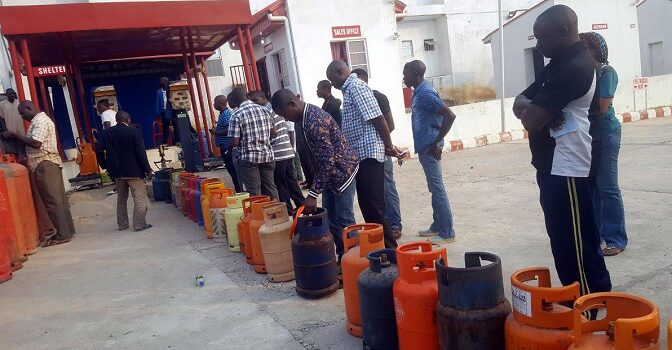
There is cautious optimism among retailers of liquefied petroleum gas (cooking gas) as the product becomes more available, currently selling between N1,000 and N1,400 per kilogram, depending on location and seller.

A market survey by our correspondent showed that cooking gas became more accessible towards the end of 2025, unlike the severe scarcity experienced in September and October last year.

Consumers in Lagos, Ogun, Oyo and other states said they purchased LPG at rates ranging from N1,050 to N1,400.

Our correspondent also learnt that some major marketers sold LPG at N900 directly to consumers.

To some, the current prices are an improvement on the steep rises seen after a rift between the Dangote refinery and the Petroleum and Natural Gas Senior Staff Association of Nigeria led to a shutdown of gas facilities in September and October.

Many consumers, however, remain hopeful that prices will fall below N1,000/kg in the new year, saying this is the only way to encourage clean cooking.

Speaking to our correspondent, the National Chairman of the Liquefied Petroleum Gas Retailers branch of the Nigeria Union of Petroleum and Natural Gas Workers, Ayobami Olarinoye, said the LPG market has been relatively stabilised, with some offtakers now receiving gas supply in Apapa, Lagos.

According to Olarinoye, retail prices currently range between N1,300 and N1,400 depending on neighbourhoods.

He noted that prices could be lower at filling stations and gas plants, adding that location and logistics also influence costs.

“The LPG market is relatively stabilised. Some off-takers have gas now in Apapa.

See also  NNPCL boss links crude oil theft to international syndicates

“The retail price is between N1,300 and N1,400 per kg at retail outlets on the streets. It depends on the area and cost of logistics; it may be cheaper at fuel stations and gas plants. I am speaking for retailers,” he said.

Olarinoye added that retailers purchase from major marketers at between N960 and N1,050/kg, explaining that those selling below N1,000/kg are plant owners who do not sell to distributors.

“As retailers, we currently buy between N960 and N1,050 depending on the individual company.

“Those selling below N1,000/kg may be some of those plants that do not sell to distributors/retailers. They sell directly to end users,” he said.

The prices of cooking gas had risen from an average of N1,000 per kg to about N2,000/kg in some locations in October following the strike by the Petroleum and Natural Gas Senior Staff Association of Nigeria during the rift with the Dangote refinery.

The Dangote refinery has once promised to crash LPG prices by selling directly to consumers.

punch.ng

FOLLOW US ON:

FACEBOOK

TWITTER

PINTEREST

TIKTOK

YOUTUBE

LINKEDIN

TUMBLR

INSTAGRAM

Continue Reading
Click to comment

Leave a Reply

Your email address will not be published. Required fields are marked *

Business

EFCC Begins Probe Of Ex-NMDPRA Boss After Dangote’s Petition

Published

on

The Economic and Financial Crimes Commission (EFCC) has commenced an investigation into a petition filed against the former Managing Director of the Nigerian Midstream and Downstream Petroleum Regulatory Authority (NMDPRA), Farouk Ahmed, by the President of Dangote Group, Aliko Dangote.

It was gathered that Dangote formally submitted the petition to the EFCC earlier this week through his legal representative, following the withdrawal of a similar petition from the Independent Corrupt Practices and Other Related Offences Commission (ICPC).

Dangote had initially approached the ICPC, asking it to investigate Ahmed over allegations that he spent about $5 million on his children’s secondary education in Switzerland, an expense allegedly inconsistent with his known earnings as a public officer.

Although the petition was later withdrawn, the ICPC had said it would continue with its investigation.

Confirming the new development, a senior EFCC officer at the commission’s headquarters in Abuja, who spoke on condition of anonymity because he was not authorised to speak publicly, said the petition had been received and investigations had commenced.

“They have brought the petition to us, and an investigation has commenced on it. Serious work is being done concerning it,” the source said.

In the petition signed by Dangote’s lead counsel, Dr O.J. Onoja (SAN), the businessman urged the EFCC to investigate allegations of abuse of office and corrupt enrichment against Ahmed and to prosecute him if found culpable.

The petition further stated that Dangote was ready to provide documentary and other evidence to support claims of financial misconduct and impunity against the former regulator.

See also  Audit uncovers over N61bn payment breaches in NNPCL

“We make bold to state that the commission is strategically positioned, along with sister agencies, to prosecute financial crimes and corruption-related offences, and upon establishing a prima facie case, the courts do not hesitate to punish offenders,” the petition read, citing recent court decisions.

Onoja also called on the EFCC, under the leadership of its chairman, Olanipekun Olukoyede, to thoroughly investigate the allegations and take appropriate legal action where necessary.

When contacted, the EFCC spokesperson, Dele Oyewale, declined to comment on the matter but promised to respond later. No official reaction had been received as of the time of filing this report.

FOLLOW US ON:

FACEBOOK

TWITTER

PINTEREST

TIKTOK

YOUTUBE

LINKEDIN

TUMBLR

INSTAGRAM

Continue Reading

Business

IMPORTANT NOTICE REGARDING MONEY TRANSFERS IN NIGERIA (2026)

Published

on

Starting from *January 2026*, please ensure that *any money you send* to anyone — including me — comes with a *clear description* or *payment remark*. This is *very important* for tax purposes.

Use descriptions like:

– *Gift*
– *Loan*
– *Loan Repayment*
– *House Rent*
– *School Fees*
– *Feeding*
– *Medical*
– *Support*,
– School fee etc.

*Why this matters:*

In 2026, any money entering your account *without a description* may be treated as *income*, and *IRS (or relevant tax authority)* could tax it — or even worse, ask you to explain the source.

The *first ₦800,000* may be *tax-free*, but after that, any unexplained funds might attract up to *20% tax*, or in extreme cases, lead to legal issues.

So please:

– *Always include a payment remark.*
– *Avoid using USSD or apps that don’t allow descriptions.*
– *Ask the receiver for the correct description BEFORE sending.*

As for me, *do not send me any money* without discussing it with me first.
And no, I don’t want to hear “Sir/Ma, I used USSD” – if you can’t add a description, *hold your money*.

From now on, *I will tell you exactly what to write in the payment remark.*
Let’s all form the habit of *adding payment descriptions now* to avoid problems later.

FOLLOW US ON:

FACEBOOK

TWITTER

PINTEREST

TIKTOK

YOUTUBE

LINKEDIN
TUMBLR

INSTAGRAM

See also  Google pledges N3bn to boost Nigeria’s AI capacity
Continue Reading

Business

FG earmarks N1.7tn in 2026 budget for unpaid contractors

Published

on

The Federal Government has budgeted the sum of N1.7tn in the 2026 Appropriation Bill to settle outstanding debts owed to contractors for capital projects executed in 2024.

A breakdown of the proposed 2026 national budget shows that the amount is captured under the line item titled “Provision for 2024 Outstanding Contractor’s Liabilities,” signalling official recognition of delayed payments to contractors amid recent protests over delayed settlements.

This budgetary provision follows mounting pressure from indigenous contractors and civil society groups who, in 2025, raised alarm over unpaid contractual obligations allegedly exceeding N2tn.

Some groups under the All Indigenous Contractors Association of Nigeria had also staged demonstrations in Abuja, lamenting the severe impact of delayed payments on their operations, with many contractors reportedly unable to service bank loans taken to execute government projects.

Earlier, Minister of Works David Umahi had promised to clear verified arrears owed to federal contractors before the end of 2025. However, only partial payments were made amid revenue constraints, prompting the inclusion of the N1.7tn line item in the 2026 budget as a catch-up mechanism.

In addition to the N1.7tn for 2024 liabilities, the government has also budgeted N100bn for a separate line item labelled “Payment of Local Contractors’ Debts/Other Liabilities”, which may cover legacy debts from previous years, smaller contract claims, or unsettled financial commitments that were not fully verified in the current audit cycle.

The total N1.8tn allocation is part of the broader N23.2tn capital expenditure in the 2026 fiscal plan, which seeks to ramp up infrastructure delivery while cleaning up past obligations.

See also  Tax law: N5tn VAT windfall for states as new formula begins

Nigeria’s contractor debt backlog has been a recurring fiscal issue, worsened by delayed capital releases, partial cash-backing of budgeted projects, and underperformance in revenue targets.

Speaking with journalists at the entrance of the Federal Ministry of Finance in December 2025, the National Secretary of the All Indigenous Contractors Association of Nigeria, Babatunde Seun-Oyeniyi, said the government’s failure to release funds after multiple assurances had forced contractors to resume protests. He said members of the association were owed more than N500bn for projects already completed and commissioned.

He explained that despite recent assurances from the Minister of Finance, Wale Edun, no payment had been made. “After the National Assembly intervened, they told us that they will sit the minister down over this matter.  And we immediately stopped the protest,” he said.

According to him, repeated follow-up meetings with the minister had produced no tangible progress. “They have not responded to our request,” he said. “In fact, more than six times we have come here. Last week, we were here throughout the night before the Minister of Finance came.”

Oyeniyi said that although some payment warrants had been sighted, no funds had been released. “Specifically, when we collate, they are owing more than N500bn for all indigenous contractors. We only see warrants; there is no cash back.”

He accused officials of attempting to push the payments into the next fiscal year. “The problem is that they want to put us into a backlog. They want to shift us to 2026; that 2026, they are going to pay,” he alleged. “They will turn us into debt, and we don’t want that. We won’t leave here until we are paid.”

See also  The Bank of British West Africa: Pioneering Modern Banking in Nigeria

However, The PUNCH observed that earlier in August 2025, the Federal Government claimed that it had cleared over N2tn in outstanding capital budget obligations from the 2024 fiscal year, with a pledge to prioritise the timely release of 2025 capital funds.

The Minister of Finance and Coordinating Minister of the Economy, Wale Edun, disclosed this at a ministerial press briefing in Abuja, where he also declared that Nigeria is “open for business” to global investors on the back of improved economic stability.

“In the last quarter, we did pay contractors over N2tn to settle outstanding capital budget obligations. That is from last year,” Edun said. “At the moment, we have no pending obligations that are not being processed and financed. And the focus will now shift to 2025 capital releases.”

By December 2025, The PUNCH reported that President Bola Tinubu expressed “grave displeasure” over the backlog of unpaid federal contractors and set up a high-level committee to resolve the bottlenecks and fund repayments.

Briefing State House correspondents after the Federal Executive Council meeting in Abuja, Special Adviser on Information and Strategy, Bayo Onanuga, said the President was “upset” after learning that about 2,000 contractors are owed. “He made it very, very clear he is not happy and wants a one-stop solution,” Onanuga told journalists.

Tinubu directed the setting up of a committee to verify all claims from federal contractors. The new budget’s provisions are expected to draw from the outcome of that verification exercise and may be disbursed in tranches based on confirmed and certified claims.

See also  Audit uncovers over N61bn payment breaches in NNPCL

The total proposed 2026 national budget stands at N58.47tn, with N23.2tn earmarked for capital expenditure, N15.9tn for debt servicing, N15.25tn for recurrent spending, and N4.09tn for statutory transfers.

punch.ng

FOLLOW US ON:

FACEBOOK

TWITTER

PINTEREST

TIKTOK

YOUTUBE

LINKEDIN

TUMBLR

INSTAGRAM

Continue Reading

Trending